Switzerland Makes Eight: The Quarter-Final Bracket, by Rest Days
A short tournament note. Switzerland's place is confirmed the only way our feed allows — by appearing in the published fixture — and the calendar hands Belgium a three-day turnaround while Norway get six.
The quarter-final fixture list went up this morning, and it answered the question our results feed couldn’t: Switzerland are the eighth quarter-finalist. Their name in the published Argentina–Switzerland fixture is the confirmation that they, not Colombia, survived Tuesday’s goalless round-of-16 tie on penalties. The bracket is now fully set, and since the matches themselves haven’t been played, this note sticks to what the calendar already knows: who plays whom, and how much rest everyone got.
Sourcing. Housekeeping first: match dates and results come from our bundled dataset — 96 completed matches as of July 8, from ESPN’s public scoreboard and match-summary feeds, served raw at /data/wc2026_results.json; the quarter-final pairings and dates come from the same scoreboard’s published fixture list, retrieved July 9. Nothing about unplayed fixtures is predicted.
The bracket
| Quarter-final | Date (UTC) | How they arrived |
|---|---|---|
| France v Morocco | Jul 9, 20:00 | France 1–0 Paraguay; Morocco 3–0 Canada |
| Spain v Belgium | Jul 10, 19:00 | Spain 1–0 Portugal; Belgium 4–1 United States |
| Norway v England | Jul 11, 21:00 | Norway 2–1 Brazil; England 3–2 Mexico |
| Argentina v Switzerland | Jul 11–12 (00:00–01:00 window) | Argentina 3–2 Egypt; Switzerland 0–0 Colombia, on penalties |
France against Morocco is the tie with history: the same pairing as the 2022 semi-final in Qatar, which France won 2–0 on their way to the final. This time it arrives two rounds earlier, and Morocco come into it off the joint-most emphatic round-of-16 win of the eight (3–0, matched in margin by nobody — the other seven ties were decided by one goal or penalties).
The rest math
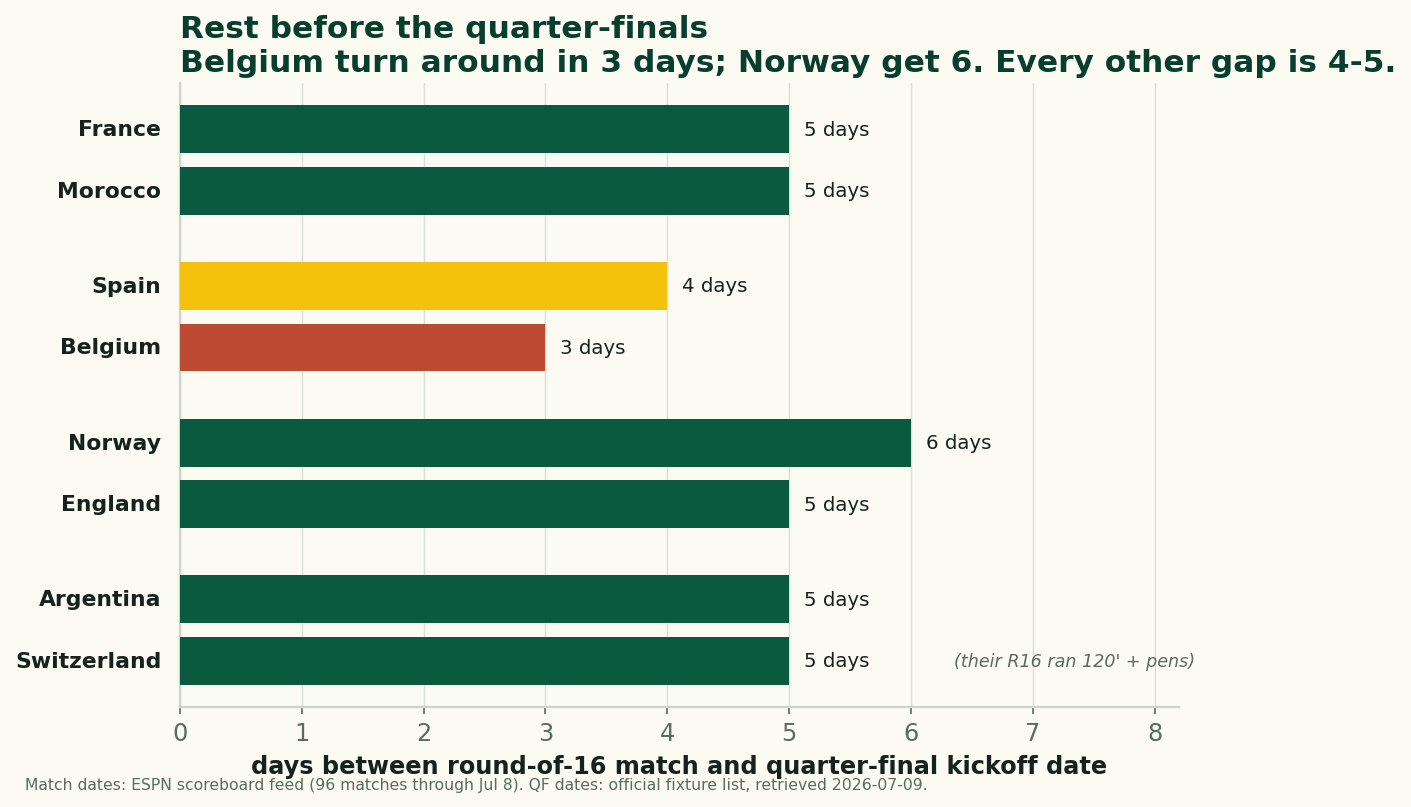
For a knockout calendar squeezed into a 104-match tournament, the committee came out remarkably even-handed. Three of the four ties are level or within a day on rest:
- France (5) v Morocco (5). Both played July 4, both waited five days. No excuses available on either bench.
- Spain (4) v Belgium (3). The one genuine gap. Belgium’s 4–1 over the United States finished late on July 6 (early July 7 in UTC terms), and they turn straight around into a Friday kickoff — the shortest turnaround in the round. Spain, who played Portugal a day earlier, get four. A three-day gap between knockout matches is the kind of margin clubs complain about in domestic cups; at a World Cup quarter-final it’s simply the draw’s bad luck.
- Norway (6) v England (5). Norway’s reward for finishing their business early on July 5 is the longest rest of any quarter-finalist — six full days between beating Brazil and facing England.
- Argentina (5) v Switzerland (5). Level on the calendar — but not on the legs. Both played July 7; Argentina’s 3–2 over Egypt was done in 90 minutes, while Switzerland’s goalless tie with Colombia ran the full 120 plus a shootout. Same five days, roughly half an extra match’s worth of minutes in Swiss legs.
The form lines, side by side
No predictions — but the five-game ledgers each team carries into its tie are already in the dataset, and they frame the matchups honestly. Spain arrive with the tournament’s only unbroken defensive record: 9–0 across five games, five clean sheets — and meet Belgium, who have scored 13 but conceded 5. France’s 14–2 is the best goal difference in the field; their opponents Morocco sit at a tidy 10–4. Norway against England is the highest-event pairing on paper — 23 goals scored and 14 conceded between them — while Argentina’s 14–5 meets a Switzerland side (9–3) that has conceded fewer than anyone left except Spain and France.
| Team | GP | GF | GA |
|---|---|---|---|
| France | 5 | 14 | 2 |
| Morocco | 5 | 10 | 4 |
| Spain | 5 | 9 | 0 |
| Belgium | 5 | 13 | 5 |
| Norway | 5 | 12 | 9 |
| England | 5 | 11 | 5 |
| Argentina | 5 | 14 | 5 |
| Switzerland | 5 | 9 | 3 |
Colombia leave without losing
A record-keeping farewell that deserves its own paragraph: Colombia exit the tournament unbeaten. Five matches: 3–1 over Uzbekistan, 1–0 over Congo DR, 0–0 with Portugal, 1–0 over Ghana, 0–0 with Switzerland — three wins, two draws, no defeats, and exactly one goal conceded in five games. The shootout that ended their tournament isn’t a loss in the match ledger. They also leave as the field’s purest volume-without-payoff attack (5.3% conversion, covered in the quarter-final field piece) — a team that did everything but score, right to the end.
What Switzerland's confirmation settles
In Part Two of the field profiles we carried the eighth chair as two hollow dots — Switzerland’s balanced 12.6-shots, 14.3%-conversion profile against Colombia’s high-volume, no-payoff one. The fixture list fills in the Swiss dot. The quarter-final field’s final shape: five teams converting above the tournament’s 11.8% average (Norway, Argentina, France, Morocco, Switzerland — England sits just above it too at 13.8%), Belgium supplying the volume extreme at 21.4 shots a game, and Spain still the one confirmed quarter-finalist scoring below tournament-average efficiency — with five clean sheets to explain why it hasn’t mattered yet.
A method note, because this keeps happening. Our feed stores final scores, not shootout results, so a 0–0 decided on penalties names no winner. Egypt’s round-of-32 survival only became visible when they appeared on a round-of-16 team sheet; Switzerland’s only became official for us when the quarter-final fixture published. It’s a real limitation, we’d rather flag it each time than quietly guess — and it has now resolved itself for the last time this tournament, because every remaining tie’s participants are known.
The quarter-finals run July 9–12. Wrap notes will follow as results land in the dataset — starting with France–Morocco, kicking off hours after this note publishes.
More from World Cup 2026
The 2026 Dark-Horse Audit: Grading Our June Checklist
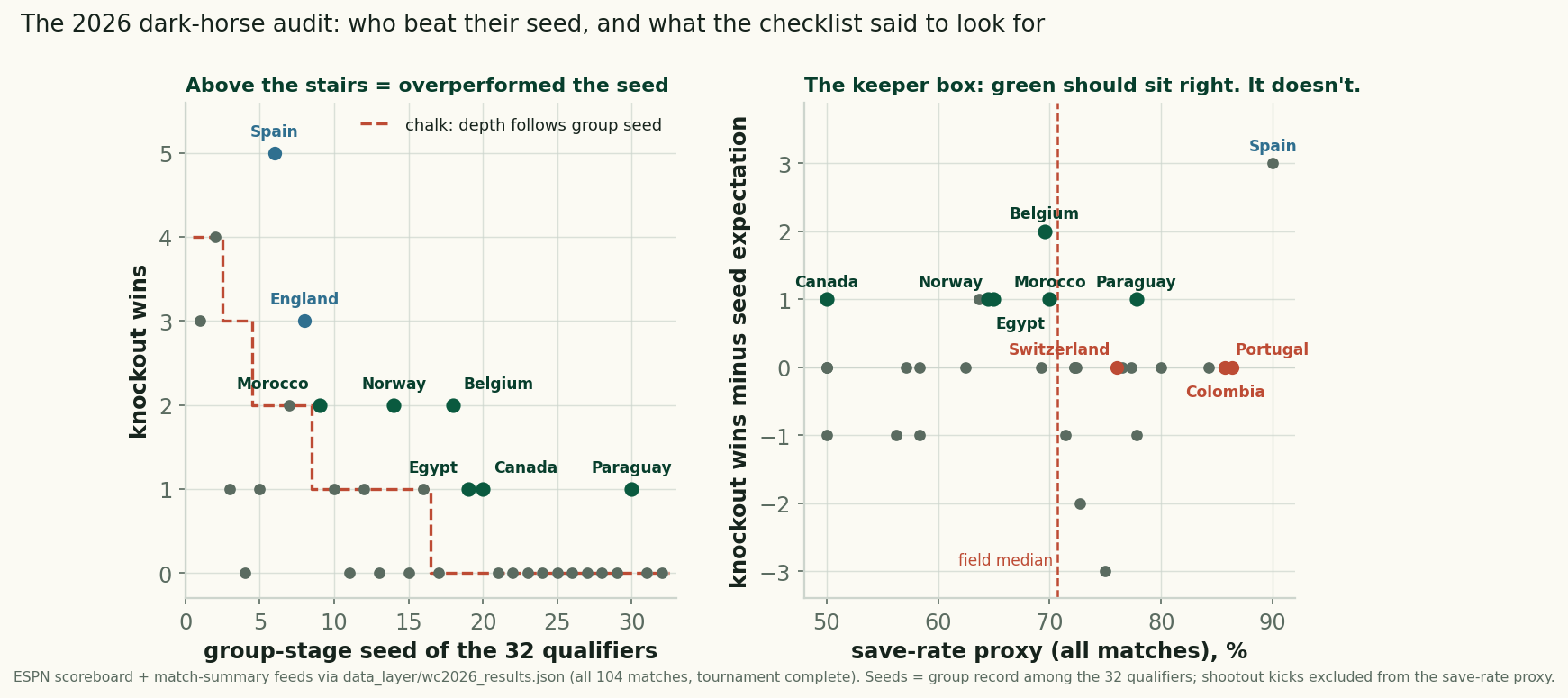
Six teams beat their group seed at the 2026 World Cup, scored against our pre-tournament checklist: the keeper box failed, the kind draw barely helped.
The Shootouts: Rarer, Earlier, and a Reprieve That Never Lasted
Retro #4 closes the series: the shootout rate fell to 12.5% of knockout games from 2022's 31%, all four came early, and survivors went 1-3 next time out.
The Groups Told the Truth: How June Predicted July at the 2026 World Cup
Group-stage points strongly predicted knockout survival: 9-point teams went 3-for-3, 4-point teams 2-for-11, and the last four all ranked top-8.