The 2026 World Cup, By the Numbers: Just Under 3 Goals a Game
The tournament finished higher-scoring than 2022 — just under 3 goals a game. The real data on where the goals came from, and why the early spike settled.
This page spent the tournament as a living snapshot, refreshed as the matches came in. The 2026 World Cup is now complete, so what it holds are the final numbers — the data-only picture across all 104 completed matches (final data refreshed July 19). The 2026 World Cup was a higher-scoring tournament than 2022. The completed games produced 2.96 goals a match, against the 2.69 that the entire 2022 World Cup averaged. That gap is real — and the rate did what a small sample should: it spiked early, then settled. The running average peaked around 3.26 a game (through game 27) and finished at 2.96 — still a clear step above 2022.
A note on sourcing. Every figure here comes from the completed matches only. A refresh script (data_layer/refresh_worldcup.py) re-pulls ESPN's public scoreboard API before each site build — last refreshed July 19, 2026 — and saves the results to a snapshot this site serves at /data/wc2026_results.json, so you can check any score in this piece against the raw file yourself. There are no predictions, no projected standings, and no invented numbers anywhere in this piece. The tournament is over and the dataset is final at 104 matches, so these figures will not move again.
The headline: more goals than 2022
Across the 104 completed games, teams combined for 308 goals — an average of 2.96 per match. The 2022 World Cup, all 64 games, averaged 2.69. So the 2026 rate finished about a quarter of a goal per game higher than its predecessor's full-tournament mark. Here's the distribution of total goals per match, with the 2026 mean and the 2022 average marked for comparison.
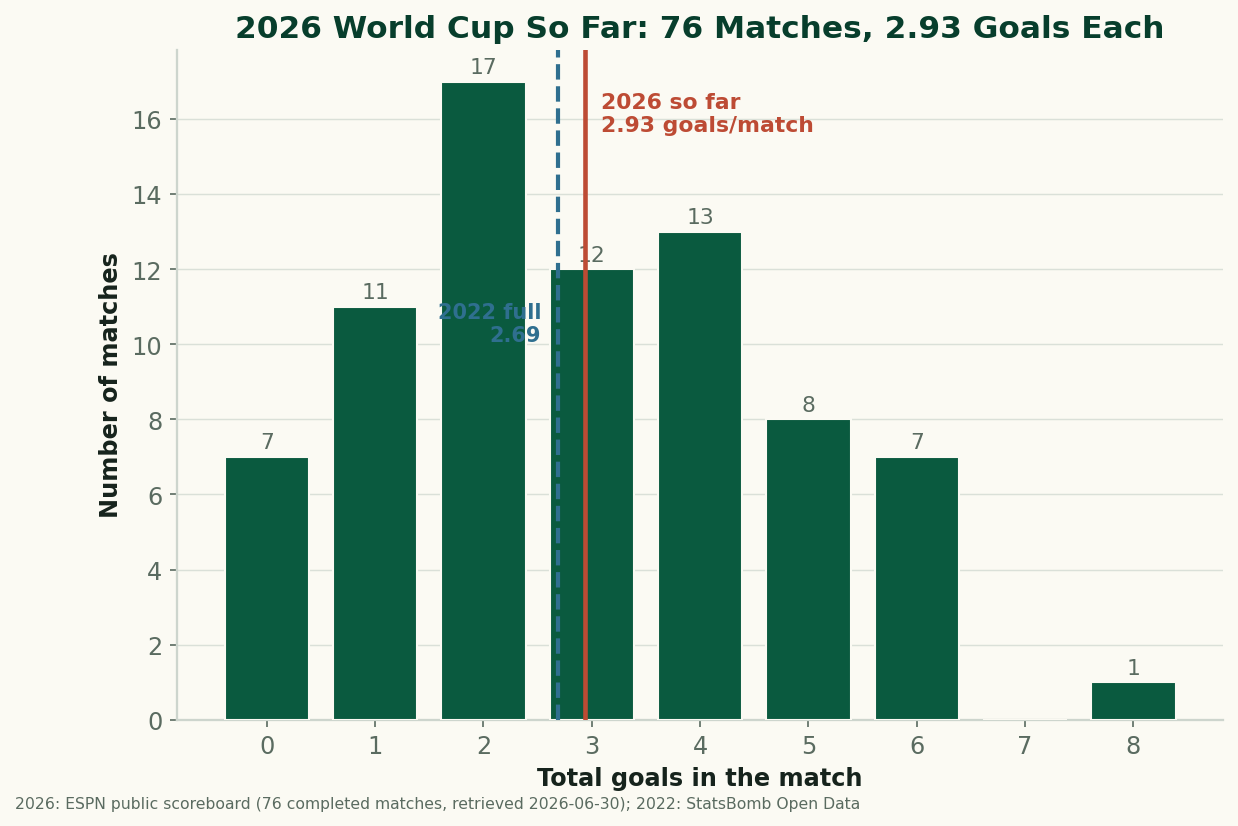
The shape is familiar — most games cluster at two to four goals — but the whole thing is shifted right of 2022, and the tail is fatter. There were five- and six-goal games and the odd blowout, which a 64-match tournament in 2022 produced more sparingly. At the same time, the left side of the chart filled in: 23 of the 104 games finished with one goal or none, so this is a wide distribution, not a uniformly high-scoring one.
What's driving it: blowouts in a bigger field
Before calling 2026 a goal-fest, look at where the goals came from. The biggest scorelines were lopsided ones:
- France 4–6 England
- Germany 7–1 Curaçao
- Sweden 5–1 Tunisia
- England 4–2 Croatia
- Canada 6–0 Qatar
- Netherlands 5–1 Sweden
This is the expanded-format effect showing up in the data. The 2026 World Cup is the first with 48 teams, which means a wider range of quality in the field and, especially in the group games, more mismatches between heavyweights and debutants. Lopsided games are high-scoring games, and a handful of them pull the average up. Strip out the three or four most lopsided results and the average drops to right around 2022 territory. The higher scoring isn't necessarily “better, more open football” — a good chunk of it is simply bigger gaps between teams. (We dig into this polarization — more blowouts and more draws — in a companion piece.)
It hasn't been all blowouts, though
The other side of the ledger: 24 of the 104 matches — 23% — were draws, several of them tight, evenly-matched affairs. So the tournament split into two stories at once: a set of mismatches producing cricket scores, and a set of genuinely competitive games ending level. The 2.96 average sits on top of both. A single mean hides that the distribution is unusually wide — lots of blowouts and lots of draws — which is itself a fingerprint of a 48-team field's uneven quality.
Why the early spike didn't hold
For most of the tournament this section argued the early scoring rate wouldn't survive to the final whistle, for three honest reasons — and all three held up:
- The knockouts did pull it down — gently. The 72 group games averaged 2.99 goals; the 32 knockout games averaged 2.91. Win-or-go-home football trimmed the rate exactly as this section predicted, and the tournament still finished at 2.96 overall — above 2022's 2.69.
- Group openers are the wild ones. Early group-stage matches historically run higher-scoring than what follows, and 2026 was no exception. As the group stage finished and the knockouts began — win-or-go-home games where caution rises and mismatches disappear — scoring eased here too: the early spike (around 3.26 a game) gave part of itself back on the way to the final 2.96.
- The mismatches dried up. The 48-team field's quality gaps are widest in the opening round. Once the weakest teams were eliminated, the surviving games were between better-matched sides, and the biggest blowouts stopped happening. The expanded-format scoring boost was, by design, a group-stage phenomenon.
Put together: the honest read all along was “the 2026 World Cup opened higher-scoring than 2022, largely because a bigger field front-loads mismatches” — and the final ledger bears that out. The early gap narrowed, steadied, and still finished clearly above 2022's full-tournament mark.
The limits of this snapshot
- Completed matches only. The dataset is final at 104 games; nothing here is projected, and nothing will move again.
- One source. The results come from a single public feed (ESPN). Scores are about as verifiable as data gets — they're widely reported and easy to cross-check — but we're not triangulating multiple providers, and finals after extra time are recorded as the post-ET score (penalty-shootout winners aren't separated here).
- Goals are a blunt lens. Total goals say nothing about chance quality. A 1–1 can be a thriller and a 3–0 can be a bore; the underlying expected goals would tell a richer story, but shot-level data for 2026 isn't publicly available, so this piece stays at the scoreline level.
- No projections. Nothing here forecasts results, qualification, or a winner. It's a description of games already played, full stop.
The takeaway
Across all 104 games, the 2026 World Cup outscored 2022 by about a quarter of a goal a match — 2.96 to 2.69 — with the gap powered by the lopsided games a 48-team field produces, even as 23% of the matches ended level. After an early spike the rate settled, trimmed — as this page predicted all tournament — by the arrival of win-or-go-home football, and finished still clearly above 2022. That final 2.96 is the number this page was always waiting for.
The knockout rounds, covered
The elimination bracket got its own coverage as it happened — every piece computed from completed matches, never predicted:
- Spain 1–0 Argentina: the final, in data — how the dataset closes.
- The knockout stage, by the numbers — every knockout result, scoring, margins and shootouts.
- The quarter-finalists, profiled — full-tournament statistical files on each team through.
- The shootout discount — what penalties do under knockout pressure, measured on all 64 of 2022's kicks.
- The World Cup hub collects everything, including the short dated notes published as each round completed.
Reproduce it
The pipeline has two stages, and it helps to be precise about which does what. Stage one, before the build: data_layer/refresh_worldcup.py pulls ESPN's public scoreboard API over the network and writes the completed matches (and only the completed matches) to wc2026_results.json — refreshed 2026-07-19, and served as a public copy at /data/wc2026_results.json. Stage two, the build itself: entirely offline, it re-renders this page and the chart from that snapshot — nothing hand-entered, so the numbers and the chart can never drift apart. Goals per match is just home_score + away_score; the distribution, the 2026 mean, and the 2022 comparison are drawn by charts/chart_wc2026_so_far.py against the same file plus the bundled wc2022_matches.json.
Sources & further reading
- 2026 results: /data/wc2026_results.json (served copy of the bundled
data_layer/wc2026_results.json) — ESPN public scoreboard feed (soccer/fifa.world), 104 completed matches, refreshed 2026-07-19. Charted bycharts/chart_wc2026_so_far.py. - 2022 comparison: bundled
data_layer/wc2022_matches.json— StatsBomb Open Data (free public dataset; attribution required), all 64 matches. - Companion: More draws and more blowouts: 2026 is more polarized than 2022 and what actually wins games.
- Context: Inside the 2022 World Cup: what all 64 results say — the predecessor this is measured against.
More from World Cup 2026
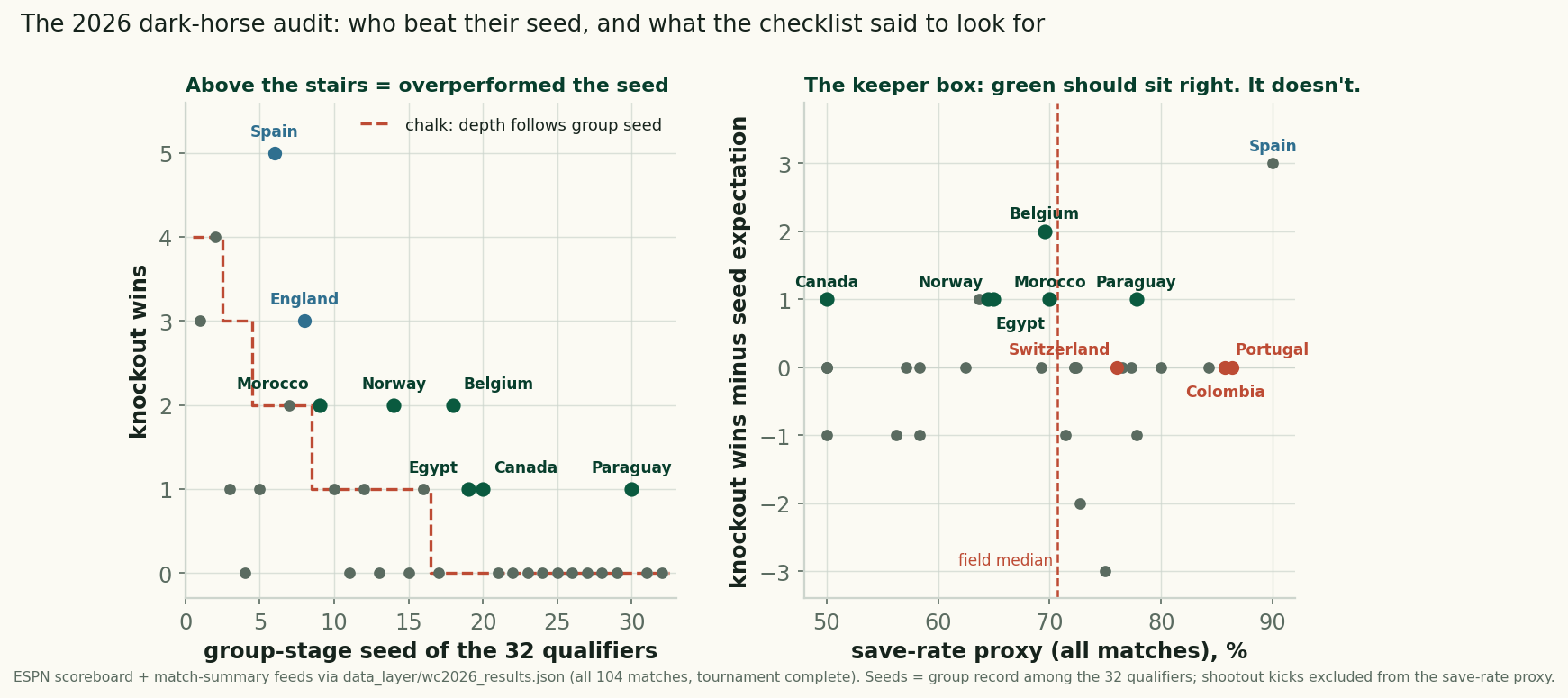
The 2026 Dark-Horse Audit: Grading Our June Checklist
Six teams beat their group seed at the 2026 World Cup, scored against our pre-tournament checklist: the keeper box failed, the kind draw barely helped.
The Shootouts: Rarer, Earlier, and a Reprieve That Never Lasted
Retro #4 closes the series: the shootout rate fell to 12.5% of knockout games from 2022's 31%, all four came early, and survivors went 1-3 next time out.
The Groups Told the Truth: How June Predicted July at the 2026 World Cup
Group-stage points strongly predicted knockout survival: 9-point teams went 3-for-3, 4-point teams 2-for-11, and the last four all ranked top-8.