Football History
Total Football, Quantified: What the Metrics Would Have Captured
Cruyff's Ajax and the 1974 Netherlands played a game decades ahead of the data. What Total Football was — and what modern metrics would have captured.
Category · 4 articles
The game's past, re-examined through data.
Football has a long memory and a short attention span. These articles revisit the moments and eras that defined the modern game and ask what the underlying numbers actually said at the time — about the improbable champions, the tactical revolutions, and the seasons we've decided to remember a certain way.
Historical facts, rule changes and tactical shifts are stated plainly; anything presented as a specific statistic is pulled from real data and dated, so the history holds up.
Writing about football history with data has one recurring hazard, and it shapes everything in this category: the further back you go, the thinner the record gets. Shot locations, pressing actions and expected goals simply do not exist for most of the game's past. What survives is results, scorelines, tables and, for the modern era, an increasingly rich event record. So these pieces are careful about which questions the surviving data can actually answer, and they say so when the honest answer is that a number cannot be recovered.
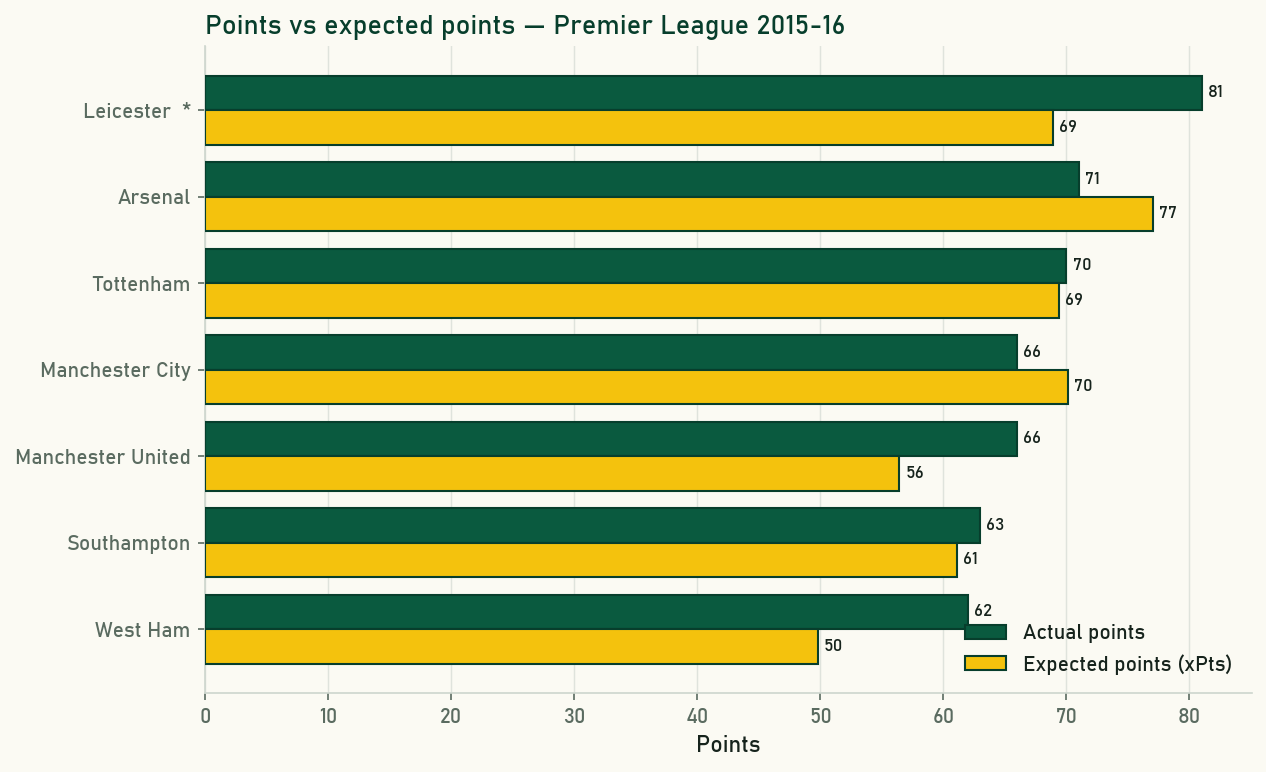
That constraint turns out to be productive. The ten most improbable seasons works from results alone, because results are what every era leaves behind. Leicester 2015-16 revisited falls inside the xG era and can therefore ask a sharper question — whether the underlying numbers ever endorsed the title run. Total Football, quantified goes the other way and is explicit about it: rather than invent measurements for a team from the 1970s, it asks which modern metrics would have captured what that side was doing, and leaves the values unfilled. And the Pep and Klopp rewiring covers the stretch where the data record itself was being built, which is part of the story.
Rule changes, tactical shifts and documented events are stated plainly. Anything presented as a specific statistic is computed from a real dataset and dated, so the history holds up to the same standard as the rest of the site.
Cruyff's Ajax and the 1974 Netherlands played a game decades ahead of the data. What Total Football was — and what modern metrics would have captured.
How positional play, gegenpressing and the analytics revolution reshaped modern football tactics — and the metrics that both drove and tracked the change.
Leicester won the title at 5000-1 on 81 points - but their expected points ranked only fourth. Revisiting 2015-16 through xG shows a more complicated story.
Ten seasons that defied the numbers - from Leicester 5000-1 to unbeaten title runs - and what made each one a genuine outlier rather than just a good story.