The dataset, served raw
Every 2026 World Cup figure on this site is computed from one bundled match file — and that file is public, at this link. Open it, audit it, reuse it.
Open the JSON →Football, told in numbers
Expected goals, pressing intensity, ball progression and projection models — explained in plain language and computed from public data, with every figure traceable to a script you can run yourself.
Every 2026 World Cup figure on this site is computed from one bundled match file — and that file is public, at this link. Open it, audit it, reuse it.
Open the JSON →Monte-Carlo the real 48-team format in your browser: you set the team strengths, it reports advance and title odds. No scraped feeds, no picks.
Run a tournament →Every shot of the 2022 World Cup on an interactive pitch — filter by team, build-up and result, each dot sized by its xG. StatsBomb open data.
Explore the map →Before our prediction model said a word about 2026, we backtested it on 2022 and published the result — including what it could not do.
Read the backtest →The 2026-27 Premier League tracked from completed matches only: goals per game, draws, home advantage and the shots-on-target rule. No predictions — just data.
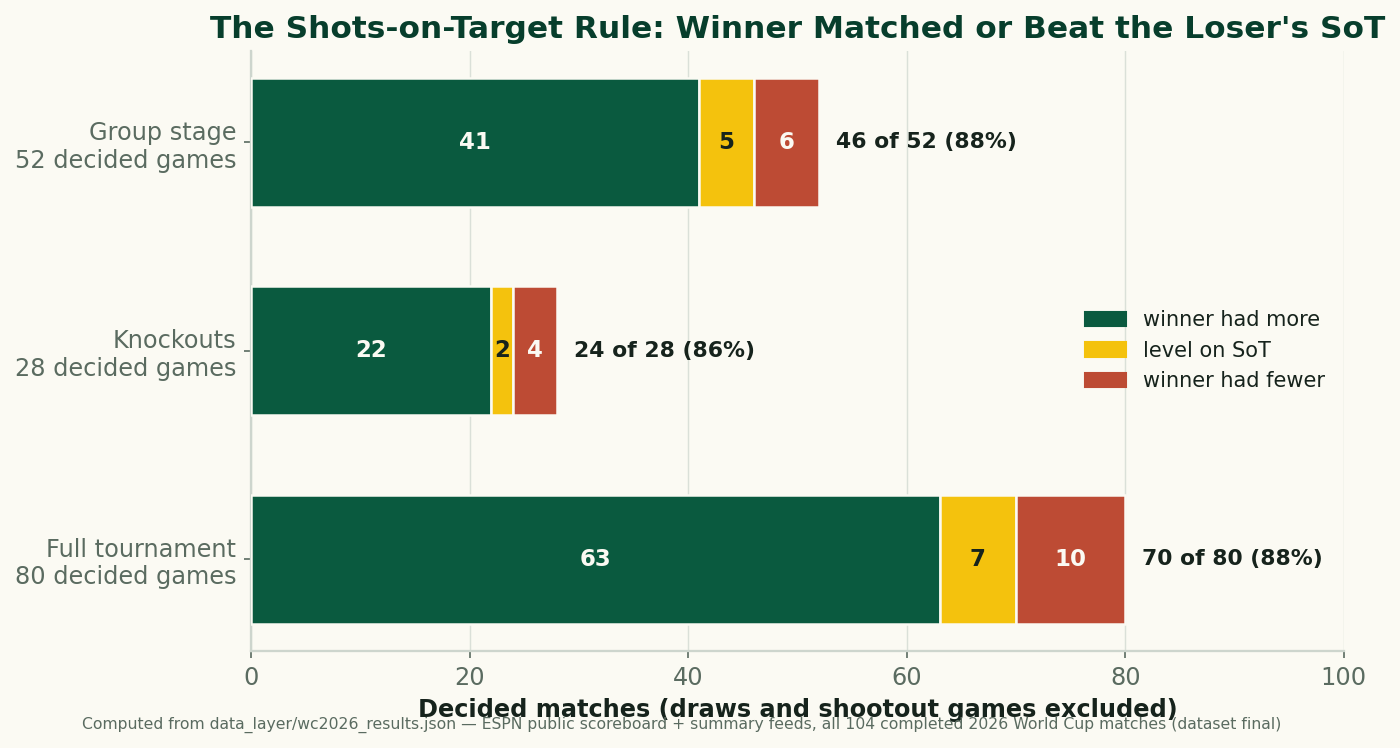
In decided 2026 World Cup games, the team matching or beating its opponent on shots on target won 70 of 80 — 24 of 28 knockouts. The ledger, and the next test.
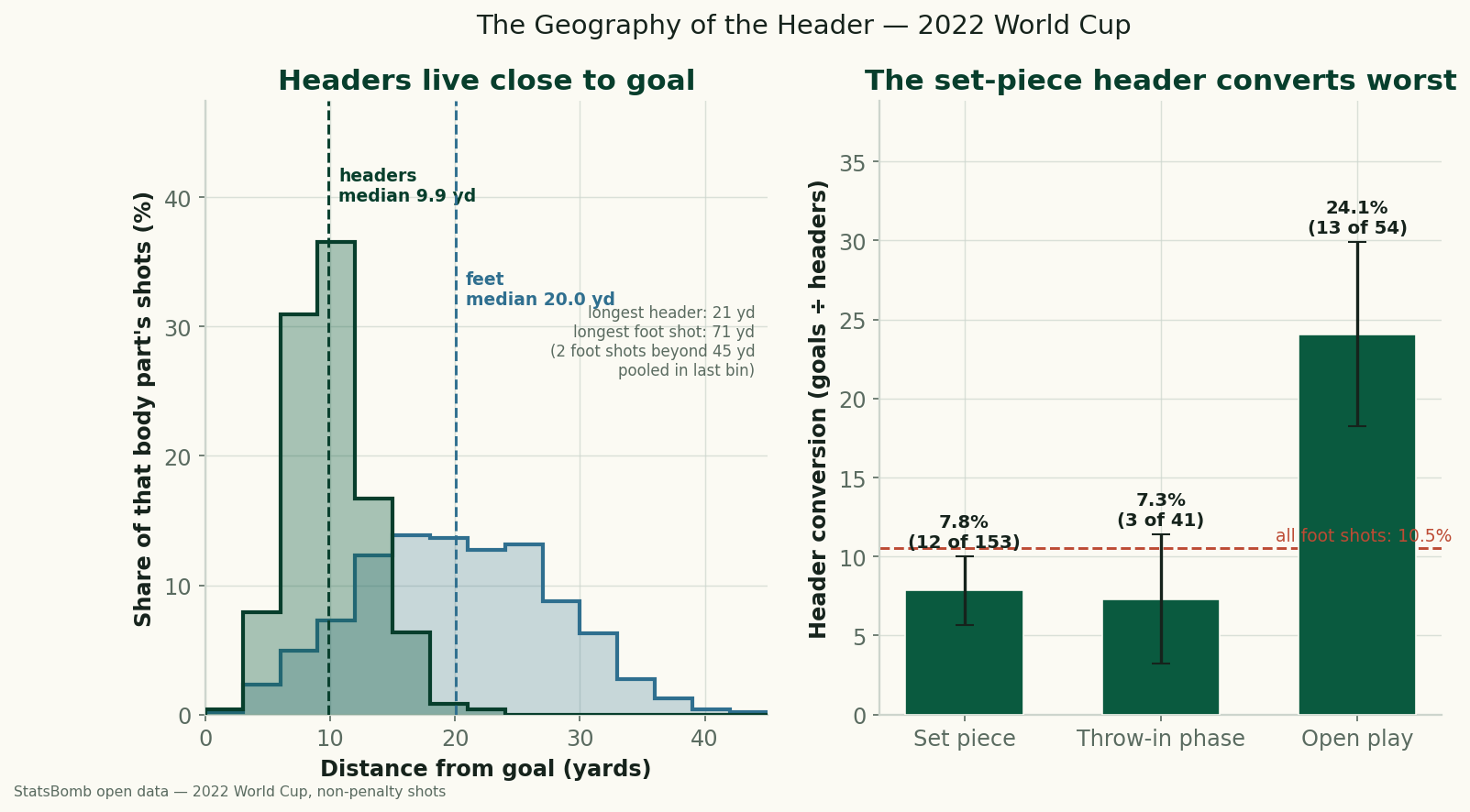
Headers were 18% of 2022 World Cup goals, taken from half a foot shot's distance — and open-play headers converted three times better than set-piece ones.
Retro #4 closes the series: the shootout rate fell to 12.5% of knockout games from 2022's 31%, all four came early, and survivors went 1-3 next time out.
Retrospective #3: group-stage points strongly predicted knockout survival — 9-point teams went 3-for-3, 4-point teams 2-for-11, and the final four all ranked top-8.
Retrospective #2: 2026's groups had triple 2022's blowout rate — and the knockouts were tighter than 2022's, with zero four-goal margins in 32 games.
Retrospective on all 28 decided knockout games: pre-match possession average predicted winners at 82%, nearly matching in-game shots on target. Goals form came last.
The first 48-team World Cup, read through data.
71 articles → 02What the numbers actually measure, in plain language.
22 articles → 03Long-form analysis, built from the raw event data.
28 articles → 04Pull the data and draw the charts yourself.
8 articles → 05Profiles and scouting, by the numbers.
6 articles → 06How forecasts are built — and why they disagree.
4 articles → 07The game's past, re-examined through data.
4 articles →The one metric that reshaped how football is watched — what it measures, where it comes from, and where it breaks.
A transparent Poisson model, backtested on a tournament we already know before it was allowed near the one we don't.
Every 2022 World Cup shot mapped against where the goals actually came from: attempts spray everywhere, goals collapse into a tight central band.
The honest map of where free football data actually lives — what each source covers, and what it doesn't.
The 5,000-to-1 season, re-read through the underlying numbers — how much was skill, and how much was a miracle.
When players actually peak, what fades first, and why sprinting dies before passing does.
SoccerAnalytics.net is an independent publication about the measurable side of football. The aim is simple: take the metrics that now shape how clubs recruit, coaches plan and broadcasters talk — expected goals, expected threat, PPDA, progressive actions, post-shot xG — and explain what they actually measure, where they come from, and where they break.
Nothing here is hand-waved. Every chart and table is built from public data — primarily StatsBomb open data, supplemented by Understat and FBref — and the Python script that produced it ships alongside the article so you can re-run the numbers or learn from the code. When a figure can't be sourced from a real data pull, it doesn't get published.
If you want the metrics explained honestly, the tutorials to compute them yourself, and the occasional argument about what the data does and doesn't prove, you're in the right place. Start with the stat explainers, or learn to pull the data yourself.