World Cup 2026 From the Quarter-Finals to the Final, in Data
The round everyone expected to tighten up instead out-scored the group stage, the shots-on-target rule ran its record to eleven straight, and the four ledgers left standing have won 22 of their 24 matches.
The quarter-finals finished overnight, and they finished loud: England 2–1 Norway, then Argentina 3–1 Switzerland in the small hours. Four games, twelve goals — 3.00 a game, the highest-scoring stage of the tournament, in the round the knockout script says should be the tightest. The semi-finals are set: France v Spain on July 14, England v Argentina on July 15.
Sourcing. A between-rounds ledger, nothing grander. All numbers come from our bundled match dataset — 100 completed matches as of July 12, from ESPN’s public scoreboard and match-summary feeds, served raw at /data/wc2026_results.json; semi-final pairings from the published fixture list. Nothing about unplayed fixtures is predicted.
The two matches
| Norway | England | Argentina | Switzerland | ||
|---|---|---|---|---|---|
| Goals | 1 | 2 | Goals | 3 | 1 |
| Possession | 47.6% | 52.4% | Possession | 59% | 41% |
| Shots | 13 | 14 | Shots | 22 | 11 |
| On target | 4 | 8 | On target | 7 | 5 |
Norway–England was the close one — a single shot separated the attempt counts — but the on-target column wasn’t close at all: 8–4 England, double the accuracy on essentially equal volume. Argentina’s win was more conventional dominance: 59% of the ball and a 22–11 shot edge over a Switzerland side playing its second straight extended assignment. With both results, the tournament’s most durable pattern is now eleven for eleven: every knockout game decided on the pitch has gone to the team that matched or beat its opponent on shots on target. Three rounds, zero exceptions since the round of 32.
The stage table nobody predicted
| Stage | Games | Goals | Per game |
|---|---|---|---|
| Group stage | 72 | 215 | 2.99 |
| Round of 32 | 16 | 42 | 2.62 |
| Round of 16 | 8 | 23 | 2.88 |
| Quarter-finals | 4 | 12 | 3.00 |
The conventional wisdom — scoring falls as stakes rise — held for exactly one round. The round of 32 was the tournament’s defensive trough at 2.62; since then each stage has scored more than the last, and the quarter-finals out-scored the group stage itself. Four games is a small sample and we treat it as one, but the direction is real and it has a plain explanation: the teams still alive are the ones that can score. The four semi-finalists have 57 goals between them.
The semi-final ledgers
| Team | Record | GF–GA | SoT for–against |
|---|---|---|---|
| France | 6W | 16–2 | 47–11 |
| Spain | 5W–1D | 11–1 | 40–7 |
| England | 5W–1D | 13–6 | 40–19 |
| Argentina | 6W | 17–6 | 39–15 |
Combined: 22 wins, 2 draws, no defeats, 57 scored, 15 conceded. July 14 pairs the two locked doors — France’s 16–2 against Spain’s 11–1, the best goal difference in the field against the best defense, as yesterday’s wrap framed it. July 15 pairs the two heaviest attacks: Argentina’s tournament-leading 17 goals against England’s 13, the only semi-finalists who’ve conceded more than twice. By the ledgers, one semi-final is a vault door and the other is a shootout waiting to happen — which is exactly the kind of sentence the results feed exists to embarrass, so we’ll settle for reporting the numbers.
The round’s aggregate line: 109 shots, 43 on target, 12 goals — an 11.0% conversion rate, a shade under the tournament’s season-long 11.8%. So the quarter-finals didn’t out-score the earlier rounds by finishing better; they did it on volume and openness — four games in which somebody always had to chase, and chasing makes games. It was also the first knockout round decided entirely in regulation — no extra time, no shootouts — after the round of 32 produced two shootouts and the round of 16 one more.
The pairings have history
France v Spain is a rematch of the Euro 2024 semi-final, which Spain won 2–1 on the way to the title — and the fixture list’s little joke is that the 2026 bracket hands France the chance to return that exact favor at the same stage. England v Argentina carries heavier World Cup baggage: the 1986 quarter-final in Mexico City (the Maradona game, both of them), the 1998 round-of-16 shootout in Saint-Étienne, the 2002 group game settled by a Beckham penalty. This is the pairing’s first meeting at a World Cup since that 2002 afternoon — twenty-four years of history compressed into one semi-final. We report the archive because it’s good; none of it moves a ball on July 15.
Two farewells
Norway leave as the tournament’s great efficiency experiment, concluded. They arrived at this round converting 22.6% of their shots — the field’s best, nearly double the tournament average — and their full ledger closes 4W–2L, 13–11, with a shots-on-target aggregate of 29–31: the only quarter-finalist out-targeted across the tournament. Conversion carried them past Brazil and to within a game of the semis, and last night it finally met a keeper-and-volume combination it couldn’t out-shoot. The Norway by-the-numbers piece stands as the record of a team that won on almost nothing but aim.
Switzerland exit three days after the fixture list finally named them a quarter-finalist. Their ledger closes 3W–2D–1L, 10–6 — the one loss coming in regulation, at the hands of the field’s heaviest attack, two games after 120-plus-penalties minutes against Colombia. The balanced profile the field piece gave them held to the end: never dominant, never dominated, and gone with the second-best defensive record of any eliminated team.
Semi-final wraps follow as the results land: France–Spain on the 14th, England–Argentina on the 15th, and a final-by-the-numbers piece once the July 19 finalists are known. The dataset is one round from complete.
Before the semi-finals: France-Spain and England-Argentina
This section was first published on 13 July 2026 as a separate article.
Nobody plays today. France v Spain kicks off tomorrow, July 14; England v Argentina follows on July 15. Yesterday’s quarter-final wrap covered the ledgers — four semi-finalists, 22 wins, 2 draws, no defeats — so this note does the between-rounds job instead: full six-game style profiles for each team, how each pairing’s shapes collide, the rest math, and an honest accounting of which of the tournament’s running patterns deserve your trust.
Sourcing. A preview built only on what has already happened: every number comes from our bundled match dataset — 100 completed matches, refreshed July 13, from ESPN’s public scoreboard and match-summary feeds, served raw at /data/wc2026_results.json. The feed carries team box scores only — no player data — and nothing about unplayed fixtures is predicted.
Four teams, six games each
| Team | Poss. | Shots | SoT | Conv. | Corners | Opp. shots | Opp. SoT | Clean sheets |
|---|---|---|---|---|---|---|---|---|
| France | 58.4% | 18.3 | 7.8 | 14.5% | 6.8 | 6.3 | 1.8 | 4 |
| Spain | 66.0% | 18.3 | 6.7 | 10.0% | 7.3 | 5.7 | 1.2 | 5 |
| England | 57.1% | 15.7 | 6.7 | 13.8% | 5.8 | 10.8 | 3.2 | 2 |
| Argentina | 60.1% | 16.2 | 6.5 | 17.5% | 5.2 | 8.3 | 2.5 | 2 |
The table sorts itself into the two pairings almost too neatly. The July 14 teams own the two right-hand columns: opponents get 5.7 shots a game against Spain and 6.3 against France, with 1.2 and 1.8 of them on target — suppression numbers no one else left can touch. The July 15 teams own the scoring columns instead: Argentina’s 17.5% conversion is the best of the four, England’s 13.8% sits third, and both concede real chances doing it — England allow 10.8 shots a game, nearly double France’s figure. Two details the averages hide: Spain’s 66.0% possession is the highest of any of the tournament’s 48 teams, and the heaviest passing volume among the semi-finalists belongs not to Spain but to Argentina — 676 completed-feed passes a game to Spain’s 662, with France at 556 and England at 509.
July 14: two suppression teams, 110 shots each
The dataset’s little joke first: across six games, France and Spain have taken exactly the same number of shots — 110 apiece. Identical volume, different machines. Spain get there with the ball: most possession in the tournament, never out-possessed, never out-shot, and a 36.4% on-target rate. France get there with less of it — 58.4% — but put 42.7% of their attempts on target, which is why their shots-on-target ledger reads 47–11 to Spain’s 40–7. At the other end the two defenses have conceded three goals combined in twelve matches, and Spain’s seven shots on target allowed all tournament is the fewest per game of any team with four or more matches played.
The knockout rounds sharpened both, in opposite places. France’s knockout line is 6–0 across three games with three clean sheets, their shot volume up from 16.0 to 20.7 a game — but their conversion has halved, 20.8% in the groups to 9.7% since. Spain split their 110 shots exactly 55 in the groups and 55 in the knockouts, and the difference is aim: their on-target rate jumped from 29.1% to 43.6%, which is how a team that opened with a 0–0 against Cape Verde has since put three past Austria and beaten Portugal and Belgium. One structural note that costs nothing to state: possession is zero-sum, so on Tuesday one of these teams spends the evening under 50% of the ball. Spain have not been there once in six games; France have, exactly once — 48% in the quarter-final against Morocco, which they won 2–0 anyway.
July 15: the two teams that swapped styles
The full-tournament averages for England and Argentina sit close together; the round-by-round splits run in opposite directions, and that is the real story of this pairing.
| Team — phase | Poss. | Shots | SoT | Conv. |
|---|---|---|---|---|
| England — groups | 65.9% | 19.3 | 6.7 | 10.3% |
| England — knockouts | 48.4% | 12.0 | 6.7 | 19.4% |
| Argentina — groups | 58.2% | 11.3 | 5.0 | 23.5% |
| Argentina — knockouts | 62.1% | 21.0 | 8.0 | 14.3% |
England entered as a control team — two-thirds of the ball, nineteen shots a game — and have won three knockout games as something close to a counterpuncher: possession down seventeen points, shot volume down a third, and yet exactly 20 shots on target in each phase, because their on-target rate climbed from 34.5% to 55.6%. The extreme case was the round of 16 against Mexico: 33.1% possession, 244 passes, six shots — five on target — and a 3–2 win. Argentina ran the same film backwards: a lean, clinical group stage (11.3 shots a game converted at 23.5%) has become a volume attack, twenty-one shots a game in the knockouts with conversion drifting down toward the field average. Each team has already won playing the shape the other now holds — which is what makes the stylistic coin-flip of July 15 genuinely unreadable from the data.
What they share is leakiness. Neither has a knockout clean sheet — the July 14 semi pairs teams with five between them, the July 15 semi pairs teams with none — and both have conceded in every elimination game: England 4 goals in three, Argentina 5. England are also the only semi-finalist to have been out-shot in a match (Mexico again) and the only one carrying a red card, part of a 7-yellow, 1-red ledger that is the heaviest of the four.
The rest math
| Team | Quarter-final played | Semi-final | Days between |
|---|---|---|---|
| France | Jul 9 | Jul 14 | 5 |
| Spain | Jul 10 | Jul 14 | 4 |
| England | Jul 11 | Jul 15 | 4 |
| Argentina | Jul 12 (01:00 UTC) | Jul 15 | 3 |
As with the quarter-final rest math, the calendar is nearly fair — three teams within a day of each other — with one exception: Argentina, whose quarter-final ran into the small hours of July 12, turn around in three days, the shortest gap of the round. The one precedent this tournament offers is Belgium, who carried the quarter-finals’ only three-day turnaround into their tie and lost it 2–1 to Spain. That is a sample of one and we present it as exactly that.
A note on what we checked and didn’t find: neither pairing shares a common opponent anywhere in the 100 completed matches, so there is no through-line comparison to make — no “both played X” table exists for July 14 or July 15. The only common-opponent pairing among the four semi-finalists is the one that hasn’t been scheduled yet: Spain and Argentina have both beaten Austria and both faced Cape Verde. The dataset only offers that comparison if both win this week.
What the patterns say — and where they break
The headline streak is real: eleven straight knockout games decided on the pitch have gone to the team that matched or beat its opponent on shots on target. But the full knockout ledger is 21 of 24, because the round of 32 produced three exceptions before the streak began — worth remembering before treating eleven-for-eleven as a law. The better cautionary tale is the one this series already lived through: at the halfway point of the round of 16, the July 6 note flagged that the busier attack had lost three ties of four — a tidy little “precision beats volume” narrative. The rest of the tournament shredded it. The busier attack won three of the round’s last four decided ties to close the round of 16 at a 4–3 coin flip, then swept the quarter-finals 4–0, and across all 24 decided knockout games the team taking more shots has now won 18. A four-game sample pointed one way; twenty-four games point the other. That is why this preview describes profiles and declines to forecast: the streaks above are summaries of games already played, and the two matches this week are under no obligation to extend any of them.
Wrap notes follow as the results land in the dataset: France–Spain after Tuesday, England–Argentina after Wednesday, and then a final preview once the July 19 pairing is known. Two games from a complete tournament.
Sources
- Match results and team stats: ESPN public scoreboard + match-summary APIs, parsed to
data_layer/wc2026_results.json(100 completed matches, retrieved 2026-07-13); served at /data/wc2026_results.json. All profile numbers computed from that snapshot. - The quarter-finals’ conclusion: the quarter-finals close at three goals a game. The rest-day method: the quarter-final bracket, by rest days.
- The World Cup hub collects the whole series.
France 0-2 Spain
This section was first published on 17 July 2026 as a separate article.
This note is two days late and the first of two published today — the semi-finals played Tuesday and Wednesday, and both results are now in the dataset. First, Tuesday: France 0–2 Spain, and Spain are in the July 19 final. The headline stat is almost a paradox: France matched Spain on shots, edged them on shots on target, split the possession down the middle — and lost by two. In doing so, this match killed the one pattern we said we’d defend with money.
Sourcing. One completed match, one ledger update. The numbers come from our bundled match dataset — 102 completed matches, refreshed July 17, from ESPN’s public scoreboard and match-summary feeds, served raw at /data/wc2026_results.json. The feed carries team box scores only — no player data — and nothing about unplayed fixtures is predicted.
The match: even everywhere except the net
| France | Spain | |
|---|---|---|
| Goals | 0 | 2 |
| Possession | 49.1% | 50.9% |
| Shots | 10 | 10 |
| On target | 3 | 2 |
| Corners | 7 | 1 |
| Passes | 472 | 502 |
| Fouls | 11 | 12 |
Ten shots each, a 50.9–49.1 possession split, thirty passes between them. The preview noted that possession is zero-sum and one of these teams would spend the evening under 50% for effectively the first time; the answer was France, at 49.1% — but the real surprise is what France did to Spain’s half of the equation. Spain arrived averaging 66.0% of the ball, the most of any team in the tournament, and never once out-possessed; they kept the ball Tuesday by 1.8 points, their narrowest share of all seven games and more than fifteen points under their average. France dragged the tournament’s control team into a dead-even fight. Then Spain won the only column that ends arguments: two shots on target, two goals. France put three on target and scored none of them. On a night when every structural number cancelled out, the entire margin lived in the finishing.
The suppression held — on both sides
The preview’s framing for this tie was two suppression machines, and both machines ran. France came in averaging 18.3 shots and 7.8 on target a game; Spain held them to 10 and 3 — France’s lowest shot count of the tournament (their previous floor was 11, in the opener against Senegal) and their first scoreless game in seven. Spain came in averaging 18.3 shots themselves; France held them to 10, their second-lowest of the tournament. Even the corner count — 7–1 France, Spain’s season low — only underlines how little clean territory either side conceded, and how little corners settle (the out-cornering team wins 52% of the time; Tuesday it lost by two). The combined 20 shots made this France’s quietest attacking game of the tournament and Spain’s second-quietest (only the six-shot Uruguay grind sat lower), and the 0–2 scoreline arrived not through volume but through a 20% conversion night — Spain’s most efficient finishing of the tournament, on one of their thinnest volumes.
The shots-on-target streak is dead
Now the bookkeeping we owe. Since the round of 16 began, every knockout tie decided on the pitch had gone to the team that matched or beat its opponent on shots on target — eleven straight when the semi-finals kicked off. France won the shots-on-target battle 3–2 and lost the match. The streak died at eleven. The fuller ledger the preview insisted on quoting alongside it — 21 of 24 decided knockout games, because the round of 32 had already produced three exceptions — now reads 22 of 26 after both semis, and this match joins Norway–Ivory Coast, the United States–Bosnia and Portugal–Croatia as the fourth exception. This is exactly why the preview kept the 21-of-24 framing next to the 11-for-11 one: a pattern that holds 85% of the time is a tendency, and tendencies take nights off. We wrote that the semi-finals were “under no obligation to extend” the streaks. Tuesday, one of them declined.
Spain's ledger: 13–1, and the Belgium goal is still the only one
| Opponent | Result | SoT for–against | Possession |
|---|---|---|---|
| Cape Verde | 0–0 | 7–1 | 74.3% |
| Saudi Arabia | 4–0 | 8–1 | 67.1% |
| Uruguay | 1–0 | 1–1 | 66.9% |
| Austria | 3–0 | 10–0 | 64.4% |
| Portugal | 1–0 | 6–2 | 55.4% |
| Belgium | 2–1 | 8–2 | 67.9% |
| France | 2–0 | 2–3 | 50.9% |
Seven games: 13 scored, 1 conceded, six clean sheets, unbeaten, and Belgium remain the only team to score on them. The aggregates: 120 shots to 44, 42 on target to 10, never out-shot, never out-possessed. Two firsts hide in the France row, though. It was the first time all tournament Spain were out-targeted — through six games no opponent had managed more shots on target than them (Uruguay’s 1–1 was the only even split) — and the first time they won a game they didn’t statistically dominate. That may be the most useful thing the semi-final revealed: the previous six wins all came with the machine humming; this one came with the machine jammed, and they won anyway. One historical note from outside the dataset, stated because it is simple public record: this is Spain’s first World Cup final since the one they won in 2010.
France's farewell: a 6–0 knockout run ends 6–2
France exit with six wins, then one defeat — 16 scored, 4 conceded across seven games. Nobody had scored on them since Norway on June 26 — a shutout run of three full matches — and their knockout aggregate stood at 6–0 when Tuesday kicked off; it closes 6–2. The full-ledger numbers still read like a champion’s: 120 shots taken to 48 conceded, 50 on target to 13, never out-shot in seven games (Tuesday’s 10–10 was the only even split), four clean sheets. And here the dataset’s running joke completes itself: France and Spain entered this match with exactly 110 shots each, took exactly ten each, and leave it with exactly 120 each. Identical volume across seven games, one match apart in outcome — the difference across an entire tournament is the finishing, which is a sample-size sermon we’ll spare you because the box score just delivered it.
One honest word on rest. The preview’s table gave France five days to Spain’s four, and the better-rested team lost — while in the quarter-finals, Belgium’s three-day turnaround preceded a flat performance and defeat. Two uneven-rest results, pointing in opposite directions. That is what a sample of two looks like, and it is why the rest tables in this series carry descriptions rather than conclusions.
The companion note on Wednesday’s semi-final — England 1–2 Argentina, and what the final now looks like — publishes today alongside this one. A full final preview follows once we’ve done the arithmetic justice: Spain v Argentina, July 19, one game left in the dataset’s tournament.
Sources
- Match results and team stats: ESPN public scoreboard + match-summary APIs, parsed to
data_layer/wc2026_results.json(102 completed matches, retrieved 2026-07-17); served at /data/wc2026_results.json. All numbers computed from that snapshot. - The set-up this note pays off: the semi-finals preview, in data. Both teams’ roads here: France’s quarter-final wrap and Spain’s quarter-final wrap.
- The other semi-final: England 1–2 Argentina, wrapped.
- The World Cup hub collects the whole series.
England 1-2 Argentina
This section was first published on 17 July 2026 as a separate article.
The second of today’s two catch-up notes, on Wednesday’s semi-final: England 1–2 Argentina, and the July 19 final is Spain v Argentina. Where Tuesday’s semi was even everywhere except the scoreline, Wednesday’s was lopsided everywhere except the scoreline: Argentina held 64.2% of the ball, tripled England’s shot count, and became the only team at this World Cup to win all seven of its games.
Sourcing. A results note, written the morning after. Every number comes from our bundled match dataset — 102 completed matches, refreshed July 17, from ESPN’s public scoreboard and match-summary feeds, served raw at /data/wc2026_results.json. The feed carries team box scores only — no player data — and nothing about unplayed fixtures is predicted.
The match: one team had the evening
| England | Argentina | |
|---|---|---|
| Goals | 1 | 2 |
| Possession | 35.8% | 64.2% |
| Shots | 5 | 15 |
| On target | 2 | 5 |
| Corners | 2 | 6 |
| Passes | 325 | 588 |
| Fouls | 11 | 15 |
The preview called this pairing a stylistic coin-flip: England had turned from a 65.9%-possession control team into a knockout counterpuncher (48.4% of the ball, 12 shots a game since the round of 32), Argentina from a lean finishing team into a 21-shot volume attack, and each had already won playing the other’s shape. The coin landed flat on both faces: each team played its knockout identity, and Argentina’s was better. Argentina’s 15 shots were below their 21-a-game knockout average but triple England’s 5; their 588 passes fit the tournament-leading passing profile the preview flagged; their 64.2% possession was their second-highest of the tournament. England, meanwhile, went further into the bunker than they had ever gone: 35.8% possession and five shots — both tournament lows for them, under even the Mexico game’s 33.1% and six.
The counterpunch needs the punch
England’s knockout formula was extreme but real: concede the ball, concede the volume, and win anyway on precision — a 55.6% on-target rate across the three knockout wins, 20 shots on target in each phase of the tournament, five-of-six on target in the Mexico escape. Wednesday the precision finally stayed home. Two of five attempts on target — 40%, their worst knockout accuracy — and one goal from them. Against a team taking fifteen at the other end, a counterpuncher converting at that volume needs nearly everything to land; this time it didn’t, and the 3–2 Mexico high-wire act became a 1–2 exit. The shots-on-target rule, freshly broken on Tuesday, reasserted itself here: Argentina won that battle 5–2 and won the game, making the knockout ledger 22 of 26 decided ties to the team matching or beating its opponent on target — 12 of 13 since the round of 16, the France–Spain semi now the lone exception in that stretch.
The three-day turnaround: the precedent failed
The preview’s rest table had one genuine outlier: Argentina, whose quarter-final ran into the small hours of July 12, turned around in three days — the shortest gap of the round — while England had four. The tournament’s only precedent was Belgium, who carried the quarter-finals’ only three-day turnaround into their tie against Spain, produced their season-minimum shot count, and lost. Argentina took the same handicap and delivered 64% possession, a 15–5 shot edge and a win. So the precedent is dead, and honesty requires stating it as exactly that — a failed precedent, not a new law in the other direction. The short-rest team has now lost one and won one. Add Tuesday’s semi, where the better-rested team lost, and the tournament’s three uneven-rest knockout results point in three directions. Rest is a real physiological variable and a useless three-game predictor, and this series will keep tabling it without betting on it.
England's farewell: the ledger of a team that lived dangerously
| Opponent | Result | Possession | Shots for–against | SoT for–against |
|---|---|---|---|---|
| Croatia | 4–2 | 51.7% | 22–10 | 11–5 |
| Ghana | 0–0 | 78.9% | 19–2 | 3–1 |
| Panama | 2–0 | 67.1% | 17–13 | 6–2 |
| Congo DR | 2–1 | 59.7% | 16–7 | 7–2 |
| Mexico | 3–2 | 33.1% | 6–20 | 5–5 |
| Norway | 2–1 | 52.4% | 14–13 | 8–4 |
| Argentina | 1–2 | 35.8% | 5–15 | 2–5 |
England finish five wins, one draw, one defeat: 14 scored, 8 conceded, both clean sheets in the group stage, and a goal conceded in every one of their four elimination games. The traits the preview flagged all held to the end: no knockout clean sheet, the heaviest card ledger of the semi-finalists (8 yellows and the field’s only red), and they remain the only team of the final four to be out-shot in a match — now twice, by Mexico and by Argentina, the two games that between them nearly and then actually ended the run. Their full aggregate, 99 shots to 80 against, is by far the leakiest of the four semi-finalists — England allowed 80 shots all tournament; Spain and France allowed 44 and 48. Living that dangerously bought them a run to the last four and a five-goal thriller for the ages. It just doesn’t survive seven rounds very often.
Argentina: seven for seven
Argentina’s ledger now reads seven wins from seven, 19 scored, 7 conceded — the only perfect record left in the tournament, or anywhere in it. The transformation the preview documented is complete: 11.3 shots a game in the groups, 19.5 in the knockouts, with possession rising rather than falling as the opposition improved. The cost of the volume era shows in the other column — no knockout clean sheet, a goal conceded in all four elimination games, 11–6 on knockout aggregate — but they have out-shot and out-targeted every knockout opponent while doing it. Whatever July 19 brings, the group-stage version of Argentina and the knockout version are two different teams that happen to share a perfect record.
The final is set — and the common-opponent table is finally live
Spain v Argentina, July 19: the last two unbeaten teams standing, a combined 32 scored and 8 conceded. The preview noted that the only common-opponent comparison among the semi-finalists existed “only if both win this week” — Spain and Argentina both beat Austria and both faced Cape Verde. Both won this week, so here is the teaser the full preview note will build on:
| Match | Stage | Result | Poss. | Shots | SoT |
|---|---|---|---|---|---|
| Spain v Austria | R32 | 3–0 | 64.4% | 23–5 | 10–0 |
| Argentina v Austria | Group | 2–0 | 53.6% | 12–6 | 5–1 |
| Spain v Cape Verde | Group | 0–0 | 74.3% | 27–6 | 7–1 |
| Argentina v Cape Verde | R32 | 3–2 | 63.6% | 22–16 | 10–5 |
Read gently — the fixtures came at different stages against different versions of those opponents. Both finalists beat Austria without conceding, Spain the more emphatically; the Cape Verde split is the interesting one, Spain’s 27-shot 0–0 against Argentina’s chaotic 3–2. A team that couldn’t be scored on meets a team that couldn’t stop scoring or being scored on. The full final preview — rest math included: Spain will have five days to Argentina’s four — is now up. Two matches left in the tournament this dataset set out to count: Saturday’s bronze final in Miami, then Sunday.
Sources
- Match results and team stats: ESPN public scoreboard + match-summary APIs, parsed to
data_layer/wc2026_results.json(102 completed matches, retrieved 2026-07-17); served at /data/wc2026_results.json. All numbers computed from that snapshot. - The set-up this note pays off: the semi-finals preview, in data. The round both teams came through: the quarter-finals close at three goals a game.
- The other semi-final: France 0–2 Spain, wrapped.
- The World Cup hub collects the whole series.
Before the final: Spain v Argentina
This section was first published on 18 July 2026 as a separate article.
The 2026 World Cup ends Sunday: Spain v Argentina, July 19, MetLife Stadium, kickoff 19:00 UTC. The dataset describes the pairing more sharply than any billing could. Spain have conceded one goal in seven games. Argentina have scored nineteen, the most in the tournament, and won all seven — the only perfect record in the field. One team has spent a month proving nobody can score on it; the other has spent a month proving it can score on everybody. They are also the last two unbeaten teams standing — standing being the operative word, since Colombia went home unbeaten on a shootout two rounds ago.
Sourcing, as always. Every number below is computed from our bundled match dataset — 102 completed matches through the semi-finals, refreshed July 18, from ESPN’s public scoreboard and match-summary feeds, served raw at /data/wc2026_results.json. Fixture facts for the two remaining games come from the same feed’s published schedule. The feed carries team box scores only, and nothing about the final is predicted. This is the preview Wednesday’s wrap promised: profiles and fault lines, not forecasts.
The tale of the tape
| Spain | Argentina | |
|---|---|---|
| Record | W6 D1 L0 | W7 D0 L0 |
| Goals | 13–1 | 19–7 |
| Clean sheets | 6 | 2 |
| Possession, avg | 63.8% | 60.7% |
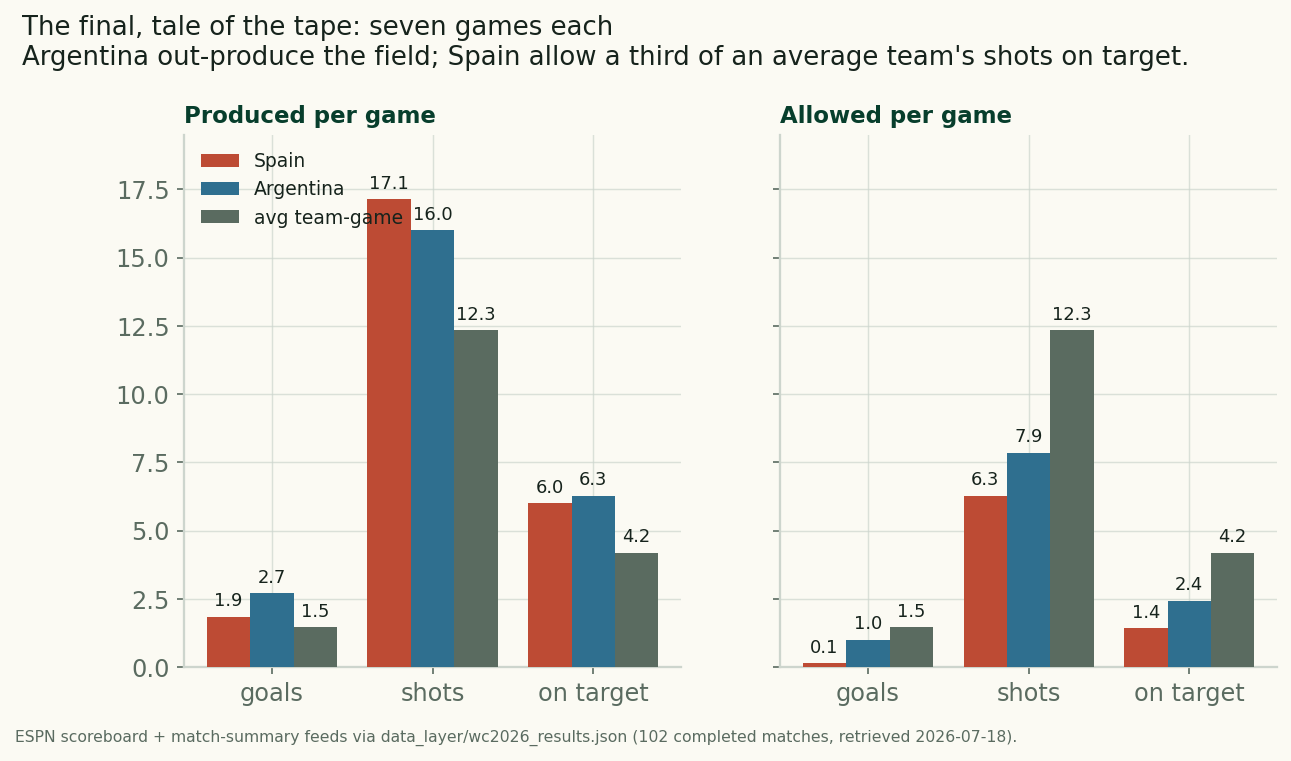
| Shots per game, for–against | 17.1–6.3 | 16.0–7.9 |
| On target per game, for–against | 6.0–1.4 | 6.3–2.4 |
| Passes per game | 639 | 664 |
| Cards | 6 yellow, 0 red | 9 yellow, 0 red |
Spain's case: nobody scores
Spain’s defensive line reads like a typo. One goal conceded in seven games — Belgium’s, in the quarter-final — and six clean sheets, three of them in the knockouts. Forty-four shots allowed all tournament, 6.3 a game; among the 48 teams only Canada, out in the round of 16, allowed fewer per game. Ten shots on target allowed in a month of football: 1.4 a game, exactly a third of what the average team-game concedes. The aggregate shots-on-target ledger is 42–10. And the semi-final answered the one question the profile had left open — what happens when the machine stalls — because France dragged them to even and Spain won anyway, out-targeted for the only time all tournament.
The honest caveat is at the other end. Spain’s 13 goals on 120 shots is a 10.8% conversion rate, a shade under the tournament’s ~12%, and the tail of that distribution is ugly: their heaviest shooting night, 27 attempts against Cape Verde, produced their only scoreless game. This is a control team that manufactures volume and trusts the arithmetic — not a clinical one.
Argentina's case: everything scores
Argentina’s attack is the inverse. Nineteen goals — France’s 16 is the only other total within five — on 112 shots: a 17.0% conversion rate, and 19 of 44 on target finding the net, 43% against the field’s ~35%. They have scored at least twice in every game they have played, and they have won the shots-on-target count in all seven — something not even Spain managed (five wins, a tie, and the semi-final defeat in that column). The transformation the semi-final wrap documented is real: 11.3 shots a game in the groups became 19.5 in the knockouts, with possession rising as the opposition improved.
Their caveat is the mirror of Spain’s. Two clean sheets, a goal conceded in all four knockout games, and an 11–6 knockout aggregate — four elimination wins by a combined five goals, where Spain’s knockout line is 8–1. The volume era bought goals at both ends.
The collision: two teams that want the same ball
The semi-finals were style contrasts — a suppression duel on Tuesday, possession against counterpunch on Wednesday. The final is the opposite: a mirror match. Of the six most ball-dominant teams at this tournament, four are already home; the other two play Sunday. On passes per game Argentina rank second (664) and Spain fourth (639) — the leader on that table, Germany, is long out. Possession is zero-sum, and the streaks are asymmetric: Spain have never been under 50% — their floor is the 50.9% they kept against France — while Argentina have dipped under once, in their opening game. Somebody’s identity bends Sunday, the way France bent Spain’s average without breaking their streak.
The common opponents, built out
Wednesday’s wrap teased the tournament’s only common-opponent table — both finalists beat Austria, both faced Cape Verde — and promised this note would build on it. What those four games actually reveal, read side by side: Austria measured the gap in control (Spain’s 3–0 with 64% of the ball and a 10–0 on-target count against Argentina’s efficient group-stage 2–0), and Cape Verde exposed each team’s one flaw. Spain’s flaw: 27 shots, seven on target, 74% possession — and a 0–0, their only dropped points, the arithmetic refusing to pay out. Argentina’s flaw: a 3–2 where Cape Verde took 16 shots and put five on target — respectively the most and (with Switzerland) the joint-most anyone has managed against them. The islanders, of all teams, wrote the scouting report: park deep and Spain may blank; run at Argentina and you will probably score, and probably still lose.
Rest math and the fault lines
The rest gap the wrap flagged: Spain played Tuesday and get five full days; Argentina played Wednesday and get four. The tournament’s three uneven-rest knockout results point in three directions — short-rest Belgium went flat and lost, short-rest Argentina dominated and won, better-rested France lost a semi-final — so we table the variable and decline, again, to bet on it.
The shots-on-target rule enters the final at 22 of 26 decided knockout games won by the team matching or beating its opponent on target — 12 of 13 since the round of 16. The one exception in that stretch was won by Spain, in the semi-final, which is either a warning about the rule or a warning about Spain, depending on your priors. And if Sunday refuses to be decided at all: four of the 30 knockout games so far have gone to penalties, and the shootout discount — the 2022 census showing conversion falling from 74% in-game to 63% in shootouts — is the piece to reread on the way in.
What the record books add
Outside the dataset, stated as simple public record: Argentina are the defending champions, and a win Sunday would make them the first back-to-back World Cup winner since Brazil in 1958 and 1962 — Italy in the 1930s being the only other. Spain are in their first final since the one they won in 2010, their only title. And this is the first World Cup final ever played between Spain and Argentina — fittingly for a tournament of 104 matches in which the two never once crossed paths.
First, tonight: the bronze
One game remains before the final: France v England, the third-place match, tonight at Hard Rock Stadium in Miami Gardens, kickoff 21:00 UTC. The two teams the finalists beat this week bring their own subplot — France’s 16 goals are the field’s second-most; England have conceded in every knockout game they’ve played. The post-final wrap will fold both results into the tournament’s closing ledger.
Until then, the cleanest sentence this dataset can offer about Sunday: Argentina have scored at least twice in every game; Spain have never conceded twice in any. By Sunday night, one of those sentences will be false. That is as close to a guarantee as 102 matches of bookkeeping can get.
Sources
- Match results and team stats: ESPN public scoreboard + match-summary APIs, parsed to
data_layer/wc2026_results.json(102 completed matches, retrieved 2026-07-18); served at /data/wc2026_results.json. All tournament numbers computed from that snapshot; chart scriptcharts/chart_wc2026_final_preview.py. - Fixture facts (kickoff times, venues) for the third-place match and final: the same ESPN scoreboard feed’s published schedule for July 18–19, retrieved 2026-07-18.
- Historical facts (Argentina 2022 champions, Brazil 1958–62, Italy 1934–38, Spain 2010) are widely documented public record, outside our dataset.
- The road here: France 0–2 Spain and England 1–2 Argentina, plus the semi-finals preview this note inherits its method from.
- Penalty-shootout conversion figures: our census of every 2022 World Cup penalty, built on StatsBomb open data (free public dataset; attribution required).
- The World Cup hub collects the whole series.
The final: Spain 1-0 Argentina
This section was first published on 20 July 2026 as a separate article.
Spain are world champions. Sunday at MetLife Stadium they beat Argentina 1–0, and the scoreline is the least descriptive number on the sheet. Spain took twenty shots and put twelve on target; Argentina took two, and put none on target — the team that had scored at least twice in every game it played, silenced entirely. The preview ended on a guarantee this dataset rarely offers: Argentina had scored 2+ in all seven, Spain had never conceded twice, and by Sunday night one of those sentences had to be false. It was Argentina’s — and not by a goal’s width, but completely.
Sourcing, one last time. The tournament is over, so the dataset is now final: all 104 matches, with team box scores, from ESPN’s public scoreboard and match-summary feeds, refreshed July 20 and served raw at /data/wc2026_results.json. The feed carries no player-level data — so this note, like every note before it, says nothing about who scored, only what the teams did. Historical comparisons are labeled as the public record they are.
The match: one team present
| Spain | Argentina | |
|---|---|---|
| Goals | 1 | 0 |
| Possession | 65.1% | 34.9% |
| Shots | 20 | 2 |
| On target | 12 | 0 |
| Corners | 9 | 4 |
| Passes | 853 | 464 |
| Fouls | 21 | 25 |
| Cards | 0 | 4 yellow, 1 red |
Read the columns in any order and the story is the same. Spain’s 853 passes were their most of the tournament and the second-most by any team in any of the 104 games (only Morocco’s 879 against the Netherlands, in the round of 32, sat higher). Argentina’s two shots are the joint-fewest any team managed in any match all tournament — the other three instances were Qatar, Tunisia and Ghana, group-stage sides parking against elimination, not the defending champions in a final. Add the discipline line — 25 fouls, four yellows and a red against Spain’s zero cards — and the shape of the evening is unmistakable: one team played the final; the other chased it.
The silencing
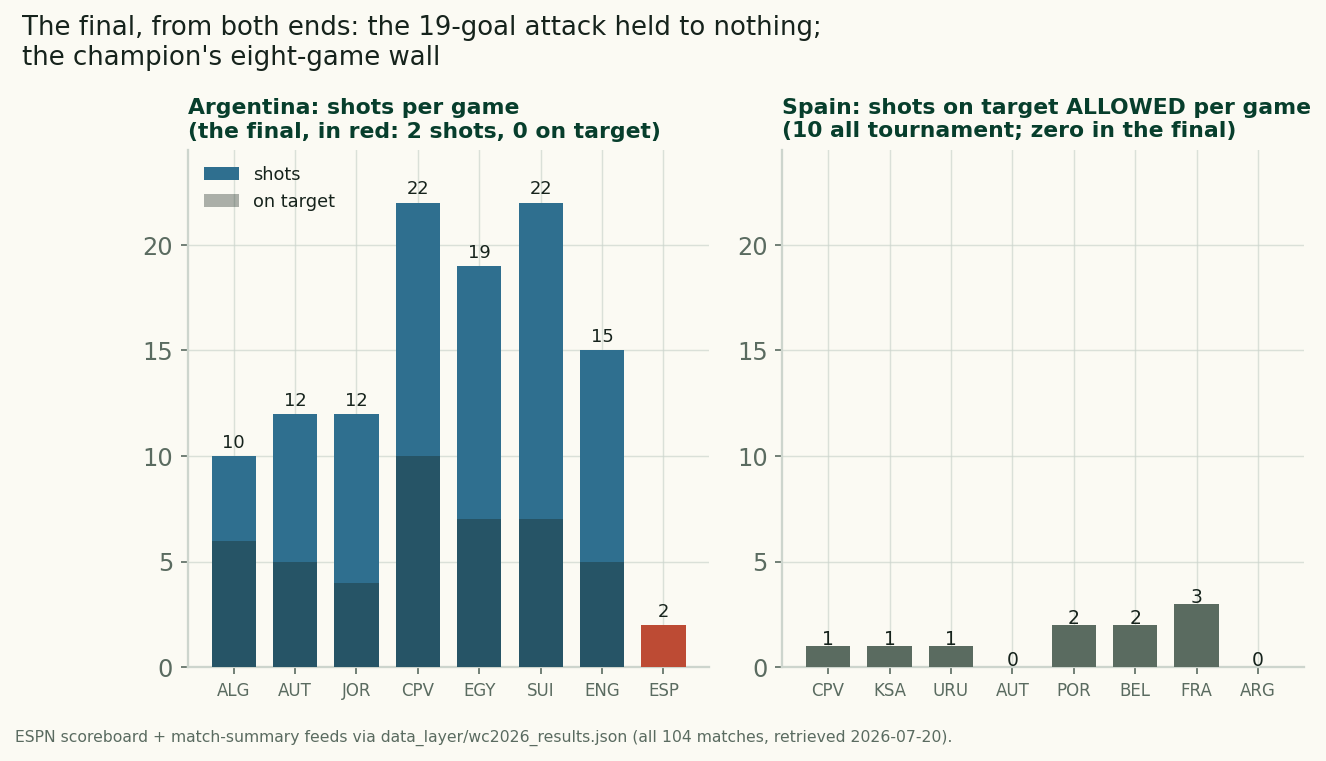
Every knockout streak Argentina carried into the game died in it. Scored two or more in every match: ended at zero. Won the shots-on-target count in all seven: lost it 12–0, the most total loss of that column available. Their 34.9% possession was their tournament low and only the second time all month they were under half the ball — the first was their opener, when the volume era hadn’t started yet. Their 464 passes sat exactly 200 under their tournament average. Wednesday’s wrap called the group-stage Argentina and the knockout Argentina two different teams sharing a perfect record; the final revealed a third, the one Spain permits.
The wall, completed
Spain finish the tournament W7 D1, 14 scored, 1 conceded, seven clean sheets in eight games — unbeaten champions who never once lost the possession battle and never once dipped under 50% of the ball. Belgium’s quarter-final goal remains the only one they allowed in the entire competition. Across eight matches they conceded ten shots on target, total — 1.25 a game, never more than three in any match, and none at all in the final. The aggregate ledger closes at 140 shots for and 46 against, 54 on target for and 10 against.
One line of public record belongs here, because the echo is too clean to leave out: Spain have now won two World Cups, and both finals finished 1–0. The team that built the most suffocating defensive tournament in this dataset’s records won it by the only score its style ever promised.
The bronze: ten goals, no stakes, pure sport
Twenty-four hours earlier, the third-place match delivered the tournament’s photographic negative. France 4–6 England — ten goals, the highest-scoring game of the entire World Cup (nothing else reached beyond eight), on 19 shots apiece, England 11–9 on target, and not a single card between them. England take third place; France finish fourth having scored four in a game and lost. And the closing scorer table is a small satire of the whole knockout month: England and France finish as the tournament’s joint top scorers on 20 goals each. The champion scored 14. Argentina’s 19 sit between them. The teams freed from consequence produced the goals; the team that never conceded any produced the trophy.
The closing ledger: 104 games
| Matches / goals | 104 / 308 — 2.96 per game (groups 2.99, knockouts 2.91) |
| Champion’s record | Spain: W7 D1, 14–1, seven clean sheets |
| Top scorers (teams) | England & France 20 · Argentina 19 · Spain 14 |
| Shots-on-target rule | held in 24 of 28 decided knockout games (86%) |
| Shootouts | 4 of 32 knockout games |
| Red cards | 15, one of them in the final |
The scoring rate deserves its own sentence, stated carefully as public record: at 2.96 goals a game, this was a higher-scoring World Cup than every 32-team edition ever played (none of 1998–2022 cleared 2.69), and you have to go back to 1970 — 95 goals in 32 games, 2.97 — to find a tournament that averaged more. The 2026 World Cup missed the highest per-game rate in 56 years by less than a hundredth of a goal. The 48-team format was supposed to dilute the product; the data says the opposite happened.
And the pattern this series leaned on hardest survived its biggest test: the team matching or beating its opponent on shots on target won 24 of the 28 decided knockout games, the final included — 12–0 being the least suspenseful application of the rule all month. The four exceptions are all named in earlier notes, and one of them, fittingly, was won by Spain.
The bookkeeping, closed out
What the series called correctly: the preview’s one-sentence-must-break framing resolved exactly as constructed, and the possession zero-sum question — somebody’s identity bends — got its answer in Argentina’s 34.9%. What it deliberately refused to call: rest. Spain had five days to Argentina’s four and won, which makes the tournament’s uneven-rest knockout record 2–2 by team — four results pointing four ways, and this series ends as it began, tabling that variable without betting on it. What it never saw coming, because nothing in 102 prior games suggested it: a two-shot final from the most productive attack in the field. The most honest sentence in this note is that one.
The World Cup section of this site now shifts from live coverage to the record: the hub stays, the dataset stays served and final at 104 matches, and the daily notes give way to occasional retrospectives — there are questions in this data (what actually predicted advancement; where the expanded format bent history) that deserve slower answers than a tournament deadline allows. Thanks for following along, match by match. The wall won.
Sources
- Match results and team stats: ESPN public scoreboard + match-summary APIs, parsed to
data_layer/wc2026_results.json(all 104 matches, retrieved 2026-07-20); served at /data/wc2026_results.json. Chart:charts/chart_wc2026_final.py. The feed carries team box scores only — no player data, no goal times — and every claim above respects that boundary. - Historical figures (1970’s 95 goals in 32 games; per-game rates of the 32-team era; Spain’s 2010 final finishing 1–0) are widely documented public record, outside our dataset.
- The road here: the final preview, France 0–2 Spain, and England 1–2 Argentina.
- The World Cup hub collects the complete series, group stage to final.
Published by SoccerAnalytics from public data and the sources named in this piece. How this site is made.