Does Preseason Form Predict Anything? What the Research Says
Friendly results, and how little they tell you.
Every preseason, without fail, some club goes unbeaten through seven friendlies and a wave of confidence washes through the fanbase. Then they lose their opener and we all pretend the friendlies were never that meaningful anyway. That ritual deserves a harder look. Not because preseason form is useless — it does contain a few genuine signals — but because most of what people read into it is noise, and the noise is not randomly distributed: it clusters around the teams and narratives we already care about.
What preseason is actually for
The first thing to get right is the purpose. Preseason exists to restore fitness, embed tactical patterns, assess fringe players and reduce injury risk before the fixtures that count. Results are a secondary concern at best, and most coaching staff are openly comfortable saying so. Players are rotated aggressively — sometimes four full starting lineups in a single week of double-headers. Fitness loads are periodised: the first two weeks are typically high-volume conditioning blocks where performance inevitably dips. A 0–3 loss in week one of preseason is a 0–3 loss against a team that has played three competitive matches already. It is a different sport.
The opposition quality is also all over the place. A Premier League side might beat a Serie B opponent 6–0 on day five of their tour, then fall to a fully-sharpened Bundesliga team three days later. The same number of goals conceded in those two matches tells you almost nothing comparable. No xG model is running these games for public consumption; the underlying quality of chances is unknown. We are back to raw scorelines, which are notoriously flaky even in competitive football.
Why the sample is always too small
Even setting aside rotation and opposition variation, the sample size problem is brutal. A full preseason for an elite club runs to between five and eight matches. That is roughly the same number of games it takes for competitive results to start being marginally predictive of final league position — and that is using competitive data, where both teams are trying to win with their best available players. In friendlies, the effective sample is smaller still, because no two games are really testing the same thing. You are averaging across different lineups, different fitness states, different tactical emphases and wildly varying opponent standards.
The analytics literature on small samples in competitive football is unambiguous: a handful of results tell you surprisingly little. The signal-to-noise ratio in football is low enough that even five to ten competitive matches in a league season can be overridden by regression toward the prior. Preseason magnifies every one of those problems simultaneously.
The psychology of over-reading it
If the evidence is so thin, why do preseason results get such outsized coverage? Two well-documented cognitive tendencies do most of the work.
The first is recency bias. When the season has been over for eight weeks and the new one is three weeks away, the only live football available is preseason. Our attention allocation is not adjusted for information quality. A 4–1 preseason win feels like data because it is the most recent football we have seen, even though a late-May league result has far more predictive content.
The second is narrative capture. Pundits, journalists and fans are in the business of constructing stories about the upcoming season. Preseason provides visible raw material: new signings playing together for the first time, a new formation, a returning captain. The desire to generate early-season narrative is strong enough to press almost any result into service. A win confirms the new striker is settling in. A loss exposes the unresolved defensive fragility. Both framings are available for almost any outcome, which is the classic sign that a variable is not doing much actual explanatory work.
What actually carries signal going into a new season
If preseason form is largely noise, what should you be looking at instead? The analytics consensus points firmly at a cluster of variables that are slower-moving and harder to see in August headlines.
Prior-season underlying numbers. A team's expected-goals differential — how much they outperformed or underperformed their xG — is a better starting prior than any preseason result. A side that finished ninth but had underlying numbers consistent with a top-six quality is more likely to improve than a preseason performance-table leader. Regression to underlying numbers is one of the most reliable effects in league football over the long run.
Squad changes and their magnitude. Not whether a club bought someone, but how much of their expected output they replaced, upgraded or downgraded. Losing a starting goalkeeper and replacing him with a cheaper alternative is a measurable quality change. Losing a striker who was heavily over-performing xG and replacing him with a similar-quality finisher is less alarming than it looks. Preseason tells you how fast a new signing has found his feet in training; it does not tell you whether the underlying squad quality improved.
Returning injuries and availability. A club that ended the prior season with five first-team players injured has a structural tailwind going into preseason that has nothing to do with how the friendlies go. Conversely, a fresh injury to a key player in week two of preseason is more meaningful than a 3–0 defeat: it affects the competitive-season squad rather than just the preseason sample.
Coaching tenure and system stability. Teams in the second or third season under the same manager — with a settled system, stable set-piece routines and understood pressing triggers — tend to outperform early-season expectation relative to squads with a new head coach. That effect is well-attested in the public research and first-principles reasoning supports it: tactical cohesion compounds over time. None of that information is visible in preseason, but all of it was available before the first friendly kicked off.
Where preseason form is not entirely useless
Fairness demands acknowledging what preseason genuinely does tell you, even if it is less than the coverage suggests.
Fitness markers have real value — for the coaching staff rather than for external observers. If a club is publishing training loads or medical updates (rarely, but sometimes), the degree to which players came back in poor condition is a leading indicator of early-season injury rates. Chronic underfitness in preseason does predict first-month muscle problems.
New player integration has a weak but genuine signal. If a high-profile new signing is appearing in every preseason fixture, training well and creating combinations with the existing attackers, that is slightly more informative than noise. Not because the result of those matches tells you anything, but because the qualitative information about whether a player looks comfortable in the system is marginally real. The caveat is obvious: preseason opponents are not pressing at full intensity, and a skill player will always look comfortable against opposition that is not yet match-sharp.
Fitness of key returners matters too. A striker who missed the last three months of the prior season returning to preseason and completing ninety minutes without incident is slightly positive information. His first competitive-match performance remains uncertain, but at least the baseline has been re-established.
The pattern here is consistent: the signal in preseason is physical and logistical, not competitive. It answers questions about whether players are fit and roughly comfortable, not whether the team will win.
How to use this when the season starts
The practical implication is simple: when August arrives and the takes about preseason table-toppers start flowing, resist anchoring on them. A team that has gone unbeaten in six friendlies has exactly the same underlying quality it had in May. The useful update is not the results but the injury list, the squad depth and whether the prior-season underlying numbers suggested upward or downward revision was due.
The inverse is also worth holding onto. A rough preseason — heavy defeat, poor shape, early-season scepticism — is not meaningfully more predictive of a bad league campaign than a good one. The clubs that win leagues in May look exactly like the clubs that won preseasons in July about half the time, which is to say: barely correlated at all.
Preseason is an important period for clubs. It is just almost entirely unimportant for anyone trying to forecast what happens next.
Where these numbers come from
- StatsBomb — research on shot models, league prediction, and signal vs noise in football data.
- FBref — prior-season xG differentials, squad data, and injury histories across major leagues.
- Understat — season-long expected-goals tables for the top European leagues.
- American Soccer Analysis — public-facing analytics research including work on sample sizes and prediction in football.
- DatoFútbol — independent football analytics research and preseason-related writing.
More from Projections & Methodology
Soccer Power Ratings: Elo, SPI, and Why They Disagree
How Elo, SPI and other power ratings are built and why they diverge, and why two reputable league projection models can forecast the same season differently.
How Football Win-Probability and Match-Forecast Models Work
What is behind the win-probability number on your screen — pre-match goal models, team ratings and live in-game updates — explained with the actual maths.
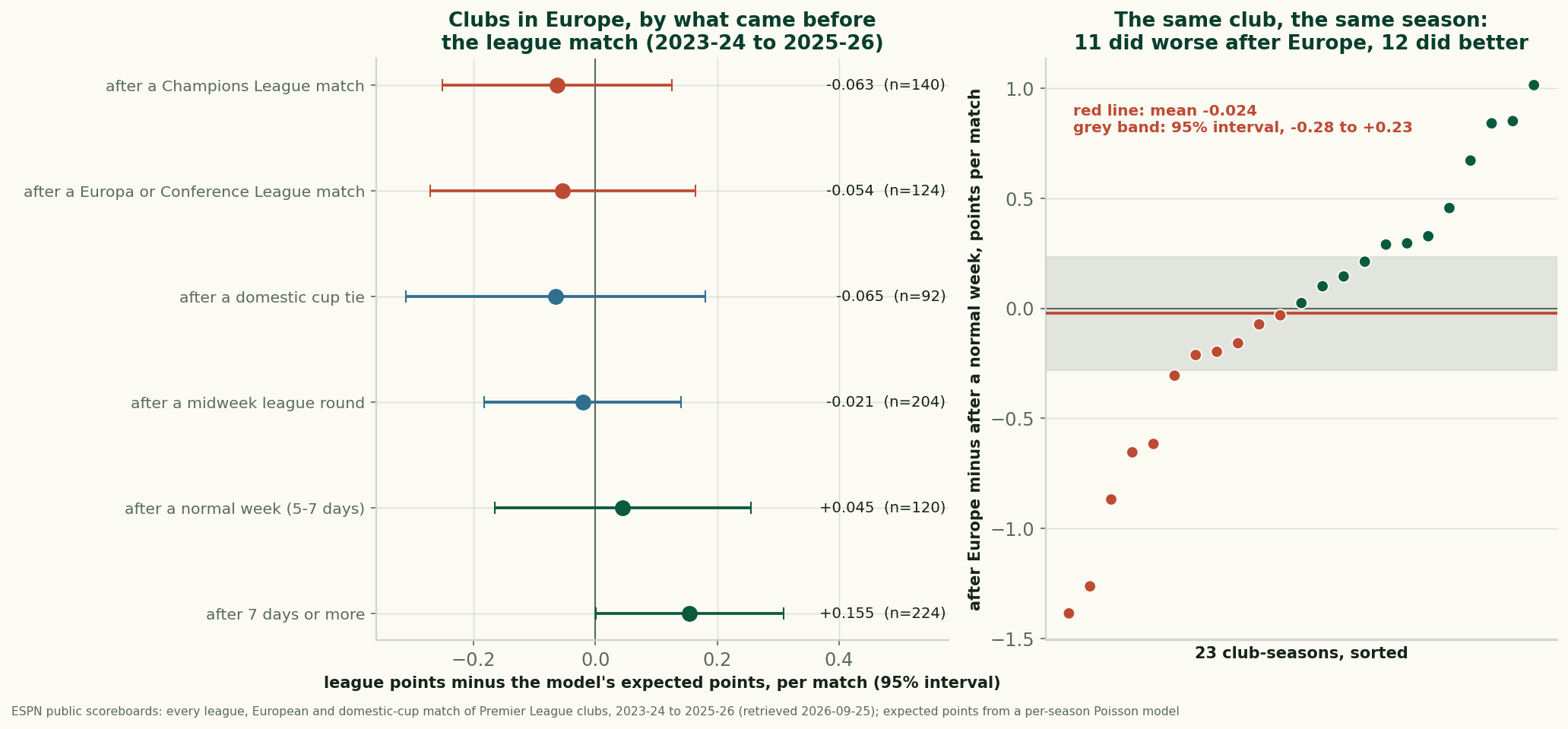
Does Europe Cost English Clubs at the Weekend? Three Seasons Can't Find It
After a European night, English clubs took 1.56 league points a match against 1.62 expected. Within the same club and season the gap is -0.024: not measurable.