The 10 Most Statistically Improbable Seasons in Modern Football
Ten title runs and collapses the numbers said could not happen.
What we're interested in here is not a good run of form — it is the seasons where the surprise was so large and so sustained that they constitute genuine statistical outliers rather than just good stories. Picking up a trophy at 5000-1 qualifies. Going an entire 38-game season unbeaten qualifies. A seven-point lead dissolving in three games qualifies, in the other direction. Here are ten of the most extraordinary seasons modern football has produced, explained through probability and variance rather than romance.
Why seasons look improbable — a quick framework
Before we get to the list, it is worth being precise about what "statistically improbable" actually means. Bookmakers' pre-season odds are the most accessible proxy for prior probability: a 5000-1 implied probability is roughly 0.02%, two chances in ten thousand. But odds bake in bookmaker margin and public sentiment, so we treat them as illustrative rather than exact. The better analytical lens is regression to the mean — over enough games, teams tend to approach their underlying quality. Seasons that break that rule, where a team wildly outperforms or underperforms its apparent quality across an entire campaign, are the genuinely odd ones. Three structural factors make them possible: football's low-scoring nature amplifies variance per game; 38 games is a sample size that can sustain a lucky run longer than intuition suggests; and genuine step-changes in performance — tactical surprise, squad cohesion, the right manager at the right moment — can look like luck from the outside long after the trophy has been lifted.
| Season / Club | Competition | What happened | Why it was improbable |
|---|---|---|---|
| Arsenal 2003–04 | Premier League | 38 games unbeaten, champions | No top-flight English side had gone unbeaten for a full season since Preston in 1888–89 |
| Leicester City 2015–16 | Premier League | Title won; pre-season odds 5000-1 | Longest-odds title winner in English football history by a vast margin |
| Nottingham Forest 1977–78 | First Division / European Cup | Promoted one year, champions the next, then won the European Cup | Only club ever to win the European Cup the season after their first top-flight title |
| Greece at Euro 2004 | UEFA European Championship | Tournament winners as 150-1 outsiders | Beaten every major host or seeded favourite on the way to the trophy |
| Ipswich Town 1961–62 | First Division | Won the league in only their second top-flight season | Newly promoted side beating established giants with minimal resources |
| AC Milan 1991–92 | Serie A | 34-game unbeaten Serie A season; centrepiece of a 58-game Serie A unbeaten run | Longest unbeaten run in Italian football history; entire season without a league defeat |
| Kaiserslautern 1997–98 | Bundesliga | Won the Bundesliga in their first season back in the top flight | Only promoted side ever to win the Bundesliga |
| Liverpool 2013–14 | Premier League | 84 points; title lost on final day after leading by seven points in April | Largest late-season lead squandered in modern Premier League history |
| Celtic 2016–17 | Scottish Premiership | Invincible domestic season: 38 games, 0 losses | First unbeaten domestic season by a Scottish top-flight club in the modern era |
| Deportivo La Coruña 1999–2000 | La Liga | Won La Liga ahead of Real Madrid and Barcelona | A club with a fraction of the financial resources of either giant took the title by a single point |
10. Deportivo La Coruña, La Liga 1999–2000
Galicia is not where La Liga titles go. In the modern era, the trophy shuttles reliably between Madrid and Barcelona, with occasional interruption from Atlético or Valencia. Deportivo's 2000 title was one of those interruptions, and the most unexpected of them. They finished with 69 points, one ahead of Barcelona, in a league whose financial structure already made the gap between Galician clubs and Castilian or Catalan ones essentially unbridgeable. Manager Javier Irureta built on defensive solidity and the clinical forward play of Roy Makaay. The probability of a club outside the recognised elite winning La Liga is, in the modern era, vanishingly small. In 2000 it happened.
9. Kaiserslautern, Bundesliga 1997–98
Kaiserslautern were relegated in 1996. One season later they were back. One season after that they were Bundesliga champions. No promoted side has won the Bundesliga before or since. The mechanism by which this should be impossible is straightforward: newly promoted teams spend the first third of a campaign adapting to a higher tempo, and their squads are not built for a title race. Kaiserslautern under Otto Rehhagel ignored all of that. The base rate for a newly promoted side winning any major European league is essentially zero. The one data point we have is this one.
8. Greece, Euro 2004
Tournaments occasionally produce giant-killings. They rarely produce a team that enters at 150-1, beats the host nation in both the opening game and the final, dismantles France and the Czech Republic in between, and lifts the trophy without a recognisable superstar. Greece under Otto Rehhagel — who had apparently developed a speciality in the improbable — did exactly that. Their approach was not built to win tournaments; it was built to not lose. A 150-1 implied probability translates to roughly 0.67%. Seven matches, zero losses. The numbers are still uncomfortable to look at.
7. Celtic, Scottish Premiership 2016–17
Celtic achieved an unbeaten domestic season in 2016–17 under Brendan Rodgers — 38 games, zero defeats, a treble. The caveat that the Scottish Premiership does not carry the competitive weight of the Premier League is fair; the statistical feat of running an entire campaign without a loss is not diminished by it. Over any 38-game sample, sustaining concentration to avoid a single result going wrong — an injury-time equaliser, a goalkeeper error, a 35-yard fluke — is genuinely difficult. Celtic navigated all of it. No Scottish top-flight club had managed an unbeaten domestic season in the modern era, and the addition of a Champions League group stage qualification that same year only underlines the quality behind the numbers.
6. Liverpool, Premier League 2013–14
This entry is not about winning something improbable but losing something that appeared to be won. With three games remaining, Liverpool led by seven points. Every simulation model produces a title probability north of 95% from that position. Manchester City won the title. Liverpool took four points from a possible nine over those three games, a collapse that included the Steven Gerrard slip against Chelsea and a 3–3 draw at Crystal Palace that turned the goal difference arithmetic fatally against them. The underlying story is variance expressing itself in the exact worst sequence at the exact worst moment. For Liverpool supporters, statistically improbable is cold comfort.
5. Ipswich Town, First Division 1961–62
Alf Ramsey's Ipswich were promoted in 1961. In their second top-flight season, they won the title. Even in the era before television money created an unbridgeable financial gap, this was not probable. Ramsey's tactical innovation — rotating his wingers into central positions in a proto-4-4-2 that opponents had no answer for — is the analytical explanation. The base-rate explanation is simpler: recently promoted provincial clubs do not beat Tottenham, Burnley, and Everton to a championship. That they did it in Ramsey's last season before leaving to manage England makes it feel even more like a single, unrepeatable alignment of circumstance.
4. Nottingham Forest, 1977–79
Two seasons compressed into one because the improbability cannot be separated. Brian Clough's Forest won their first ever First Division title in 1977–78, having been promoted from the Second Division the year before. Then they won the European Cup in 1978–79. They remain the only club to win the European Cup in the season immediately following their first top-flight championship. Second Division in 1977, First Division champions in 1978, European champions in 1979. The speed of that arc has no parallel in European football. There was no model into which you could have fed Clough's squad and obtained a European Cup as the output.
3. AC Milan, 1991–92
Fabio Capello's Milan went the entire 1991–92 Serie A season — 34 games — without losing once: 22 wins, 12 draws, a single point dropped. That campaign was the centrepiece of a 58-match unbeaten Serie A run stretching from May 1991 to March 1993, the longest in Italian football history. Built around Gullit, Rijkaard, and van Basten and a defence that treated conceding as a personal failure, they were nicknamed "Gli Invincibili." An entire top-flight season without defeat was, by every historical base rate, not supposed to be achievable. Milan did it.
2. Arsenal, Premier League 2003–04
The Invincibles: 38 games, 26 wins, 12 draws, 0 defeats, 90 points. No top-flight English club had gone unbeaten for a full season since Preston North End's 22-game campaign in 1888–89 — a different sport in all but name. The base rate argument is simple: over 38 games, injuries, hostile environments, and fixture congestion guarantee that something, somewhere, goes wrong. For every club that has led a major European league heading into the final weeks, none had navigated a whole modern season without a defeat. Arsenal did. The improbability is not rhetorical. It is structural.
1. Leicester City, Premier League 2015–16
The number is 5000-1. That is what several bookmakers quoted Leicester to win the Premier League before 2015–16 kicked off. For context, 500-1 is roughly what you could get on a named politician becoming the next Pope. Leicester at 5000-1 was not a serious price — it was a novelty. Then they won it, with 81 points, seven clear of Arsenal in second. They did not scrape it; they led the table for most of the second half of the season. Claudio Ranieri, dismissed by Greece in November 2014 after a home defeat to the Faroe Islands, built his system on N'Golo Kanté's pressing geometry and Jamie Vardy's counter-attacking pace.
The story gets told as romance. The statistical framing is harsher and more interesting: Leicester were not just lucky. Finishing seven points clear requires sustained quality, not only variance. The question analysts have debated since is how much was genuine step-change performance and how much was a once-in-a-generation variance event. The honest answer is both — which is exactly what makes it irreducibly extraordinary. No other team in any major sport has won a championship at remotely comparable pre-season odds in the professional era. The 5000-1 is not hyperbole. It is the number.
What these seasons have in common
A few patterns recur. Defensive compactness features in almost every positive outlier — Arsenal, Leicester, Greece, and Deportivo all built from a foundation harder to break down than their resources suggested. Goals conceded is a lower-variance stat than goals scored, which means that sides who restrict chances can sustain improbable run lengths longer than sides relying on outscoring opponents. The Liverpool entry illustrates the brutal symmetry: variance does not only run upward. And first-time management configurations appear with striking frequency — Clough at Forest, Ramsey at Ipswich, Ranieri at Leicester, Irureta at Deportivo. The hypothesis that a fresh tactical approach creates an informational advantage that wears off over subsequent seasons is worth more than a casual glance.
None of this is to say the clubs were not good. Arsenal in 2004 were genuinely exceptional. Leicester in 2016 were organised, motivated, and tactically coherent. Good is just not sufficient to explain what happened in these seasons. These are the campaigns that remind you why watching a full season, rather than reading a preview, is still the only reliable way to find out what happens.
Sources & data
- FBref — historical league tables, points totals, and season-level records used throughout.
- Understat — season-level expected goals and shot data for major European leagues.
- StatsBomb — methodology for underlying performance metrics cited in analytical commentary.
- Premier League official site — historical season records and final standings.
- Transfermarkt — squad values and club financial context for historical comparisons.
More from Football History
Total Football, Quantified: What the Metrics Would Have Captured
Cruyff's Ajax and the 1974 Netherlands played a game decades ahead of the data. What Total Football was — and what modern metrics would have captured.
How Pep, Klopp, and the Data Era Rewired Tactics: A Statistical History
How positional play, gegenpressing and the analytics revolution reshaped modern football tactics — and the metrics that both drove and tracked the change.
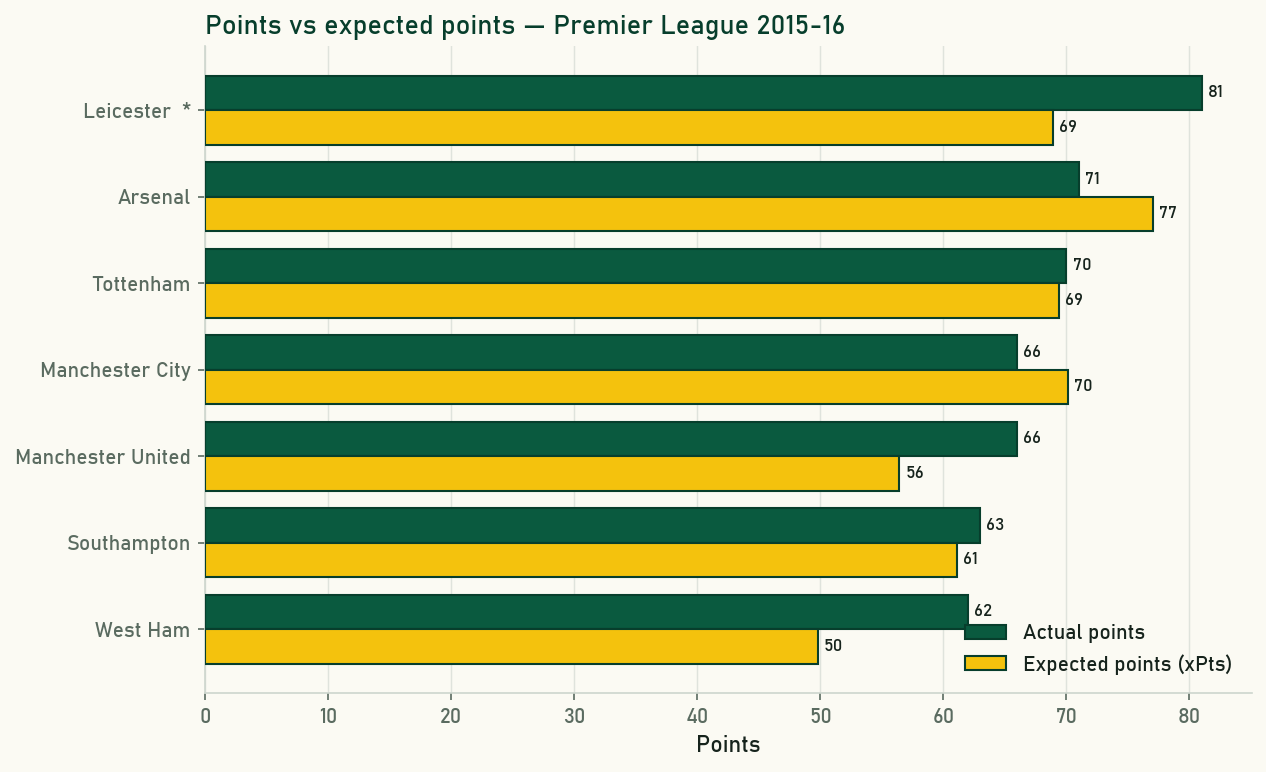
Leicester 2015-16 Revisited: What the Underlying Numbers Really Said
Leicester won the title at 5000-1 on 81 points - but their expected points ranked only fourth. Revisiting 2015-16 through xG shows a more complicated story.