Did 48 Teams Dilute the World Cup? The Goals Moved, the Final Rounds Tightened
The second post-tournament deep dive. Everyone predicted the 48-team format would water the tournament down. Comparing all 104 matches against all 64 from 2022, the prediction was half right — and the half it got wrong is the half that matters.
The case against expanding the World Cup was always the same sentence: more teams means worse teams, worse teams mean blowouts, and blowouts kill the thing people watch for. Now both tournaments are complete datasets, so the sentence can be tested. The answer splits cleanly in two. The group stage: yes — 2026’s groups produced three-goal-plus margins at two and a half times 2022’s rate. The knockouts: the opposite — 2026’s elimination rounds were tighter than 2022’s, with more one-goal games, fewer routs, and not a single four-goal margin in thirty-two matches. The expansion didn’t dilute the World Cup. It sorted it.
Sourcing. Both tournaments are bundled in full: 2026 from our final 104-match ESPN dataset, 2022 from StatsBomb’s open data (all 64 matches; free public dataset, attribution required). Knockout scores in both are post-extra-time with shootout games recorded as draws, so every margin comparison below is like-for-like. Chart script: charts/chart_wc_expansion_margins.py.
The two tournaments, side by side
| 2022 (32 teams) | 2026 (48 teams) | |
|---|---|---|
| Matches / goals | 64 / 172 | 104 / 308 |
| Goals per game | 2.69 | 2.96 |
| Group stage, goals per game | 2.50 | 2.99 |
| Knockouts, goals per game | 3.25 | 2.91 |
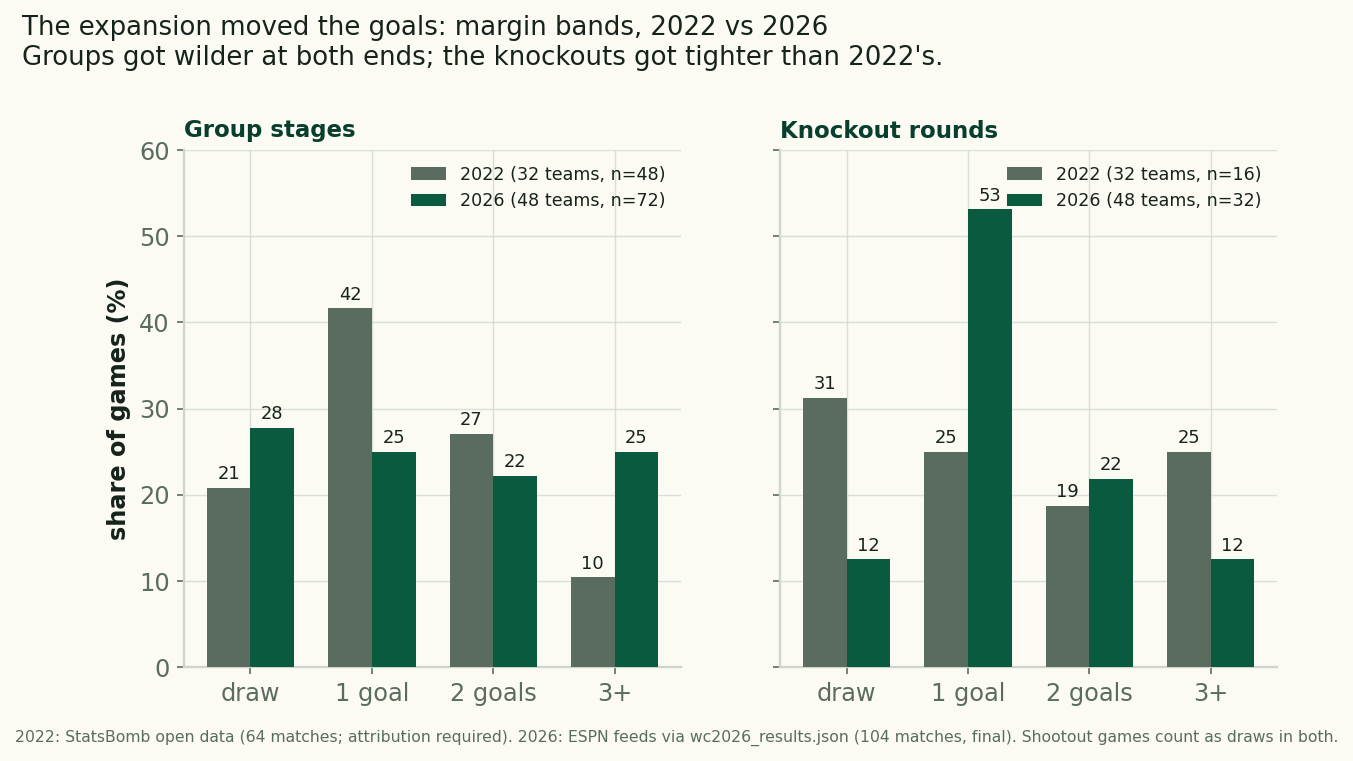
| Group games decided by 3+ | 10% | 25% |
| Knockout games decided by 1 (of decided) | 25% | 53% |
| Knockout margins of 4+ | 1 (6%) | 0 (0%) |
The group stage: the critics were right, and it barely mattered
Concede the point honestly, with its full size: 2026’s 72 group games produced 18 margins of three or more (25%) against 2022’s 5 in 48 (10%); margins of four-plus ran 12% against 4%; and the roll call of group-stage teams who conceded seven or more across their three games ran to eleven of the 48 (Tunisia and Iraq with 12 each, Uzbekistan 11, Qatar 10, New Zealand 10…) where 2022 had six of 32. Germany 7–1 Curaçao and Canada 6–0 Qatar are exactly the fixtures the skeptics predicted. The sixteen extra teams were, on average, what everyone said they’d be.
But look at what else happened in those groups: draws rose too — 28% against 2022’s 21% — and one-goal games collapsed from 42% to 25%. The group stage didn’t uniformly decay; it polarized. Mismatches got settled emphatically, while the games between comparable sides got cagier — plausibly because with a round of 32 waiting, second place (and even a good third) kept teams alive, and nobody chased risk they didn’t need. Wilder at both ends, hollow in the middle: that’s not dilution, that’s sorting.
The knockouts: the prediction inverted
Here is the finding that should reframe the expansion debate. Once the sorting finished, the tournament’s business end was tighter than 2022’s on every measure we can compute. Decided knockout games finishing one goal apart: 53% in 2026 versus 25% in 2022. Routs of three-plus: 12% versus 25%. Margins of four or more: 2022’s knockouts had one (Portugal 6–1 Switzerland in the round of 16); 2026’s had none — zero in thirty-two elimination games. Even the goals-per-game gap (3.25 vs 2.91) reads differently in this light: 2022’s knockout scoring average was inflated by its own lopsided semis, while 2026’s knockouts packed their goals into coin-flip games — the France–England bronze final’s ten goals arrived at a one-goal-game cadence, 4–6.
The mechanism is mundane once you see it: a round of 32 inserts one extra sorting pass between the groups and the quarter-finals. By the time 2026 reached the rounds people actually schedule their lives around, the field had been sieved twice, and the teams that survived the sieve were the ones whose identity travelled. The 16-team knockout of 2022 admitted more passengers — and passengers get routed.
The worked example: same fixture class, different eras
Take the widest games in each dataset. 2022’s was Spain 7–0 Costa Rica — a group game between two teams who had both qualified through continental gauntlets, in the smaller, allegedly purer format. 2026’s was Germany 7–1 Curaçao — a group game the expansion critics can fairly claim. But follow both tournaments forward: 2022’s knockouts still produced a 3–0 semi-final; 2026’s produced nothing wider than England 1–2 Argentina and a final decided by one goal on twenty shots to two. The embarrassments moved to June, where group games have always been allowed to be lopsided, and vacated July, where the tournament lives.
Caveats, at full volume
This is one tournament per format — n=1 against n=1 — and 2022 was itself an outlier (the lowest-scoring World Cup since 1954 through its group stage, played mid-season in November). Formats weren’t the only difference: hosts, continents, calendars, and squads all moved between editions, and none of that separates cleanly. The 2026 knockout tightness could partly be a one-off — 24 of 28 decided games going to the shots-on-target leader suggests a tournament where the better team kept winning by enough, and a bouncier edition would smear these numbers. The claim this piece can actually defend is narrow: in the one head-to-head we have, expansion made the early rounds more lopsided and the late rounds less so — and every argument about the format should now have to carry both halves.
Next in the retrospective series: did the group stage actually tell us who would survive the bracket — or was the round of 32 a reset button? The hub collects the whole line.
Sources
- 2026: ESPN public scoreboard + match-summary APIs, parsed to
data_layer/wc2026_results.json(all 104 matches, final); served at /data/wc2026_results.json. - 2022: StatsBomb open data, all 64 match results (
data_layer/wc2022_matches.json) — free public dataset; attribution required. Knockout scores post-extra-time in both datasets; shootout games recorded as draws. - Every table figure computed by
charts/chart_wc_expansion_margins.pyand its companion audit run; the historical note on 2022’s low-scoring group stage is public record. - Related: what predicted the knockouts, the final, by the numbers, and the group-stage-era running ledger.
More from World Cup 2026
The Knockout Autopsy: Identity Beat Form at the 2026 World Cup
Retrospective on all 28 decided knockout games: pre-match possession average predicted winners at 82%, nearly matching in-game shots on target. Goals form came last.
Spain 1-0 Argentina: The Wall Wins the World Cup
Spain win the 2026 World Cup 1-0. Argentina held to two shots and none on target, the 10-goal bronze final, and the closing ledger of all 104 matches.
The 2026 World Cup So Far, By the Numbers: Just Under 3 Goals a Game
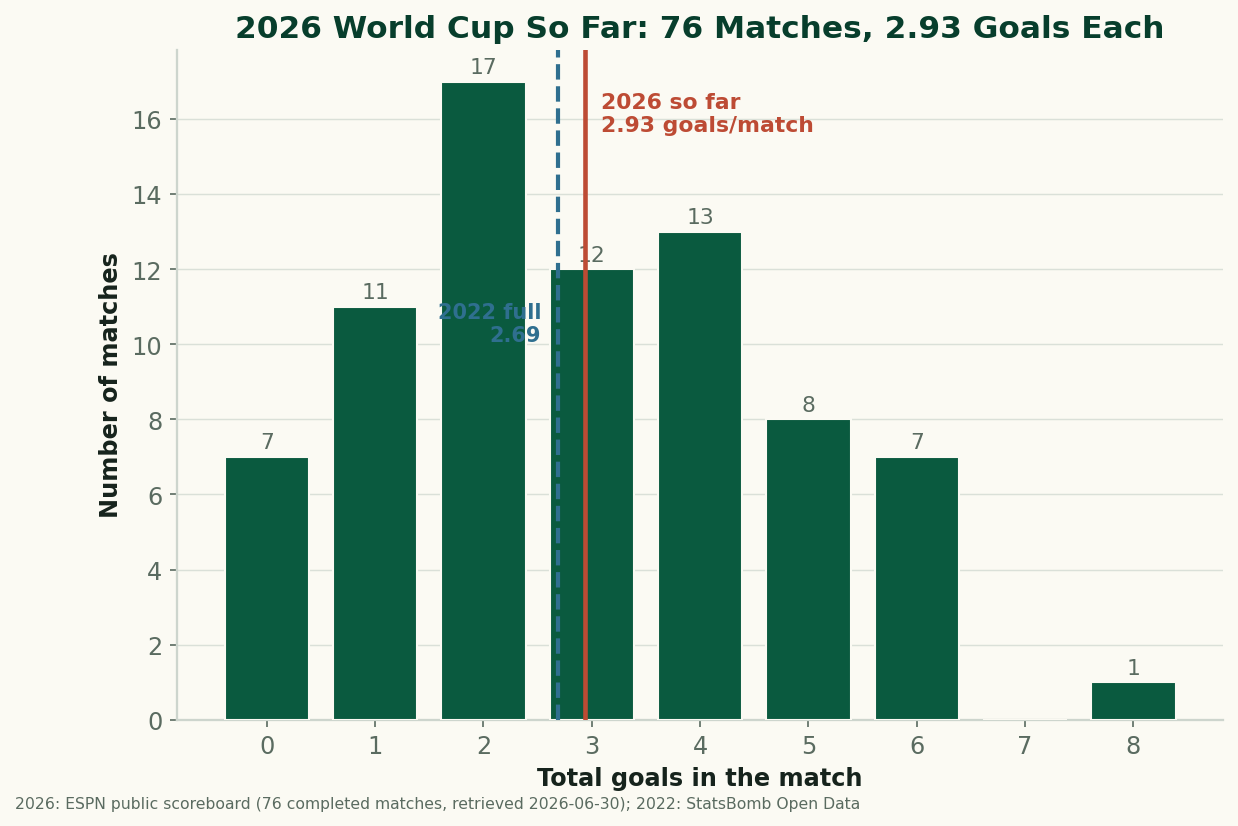
The 2026 World Cup, by the numbers from completed matches only: goals per game vs 2022, draws, and blowouts. A living snapshot, refreshed as games are played.