Spain 1-0 Argentina: The Wall Wins the World Cup
The piece this series has been building toward since match one. Spain are champions, and the box score is among the most lopsided this tournament produced — the 19-goal attack finished with two shots and none on target. The bronze final went the other way entirely. The dataset is complete; here is how it closes.
Spain are world champions. Sunday at MetLife Stadium they beat Argentina 1–0, and the scoreline is the least descriptive number on the sheet. Spain took twenty shots and put twelve on target; Argentina took two, and put none on target — the team that had scored at least twice in every game it played, silenced entirely. The preview ended on a guarantee this dataset rarely offers: Argentina had scored 2+ in all seven, Spain had never conceded twice, and by Sunday night one of those sentences had to be false. It was Argentina’s — and not by a goal’s width, but completely.
Sourcing, one last time. The tournament is over, so the dataset is now final: all 104 matches, with team box scores, from ESPN’s public scoreboard and match-summary feeds, refreshed July 20 and served raw at /data/wc2026_results.json. The feed carries no player-level data — so this note, like every note before it, says nothing about who scored, only what the teams did. Historical comparisons are labeled as the public record they are.
The match: one team present
| Spain | Argentina | |
|---|---|---|
| Goals | 1 | 0 |
| Possession | 65.1% | 34.9% |
| Shots | 20 | 2 |
| On target | 12 | 0 |
| Corners | 9 | 4 |
| Passes | 853 | 464 |
| Fouls | 21 | 25 |
| Cards | 0 | 4 yellow, 1 red |
Read the columns in any order and the story is the same. Spain’s 853 passes were their most of the tournament and the second-most by any team in any of the 104 games (only Morocco’s 879 against the Netherlands, in the round of 32, sat higher). Argentina’s two shots are the joint-fewest any team managed in any match all tournament — the other three instances were Qatar, Tunisia and Ghana, group-stage sides parking against elimination, not the defending champions in a final. Add the discipline line — 25 fouls, four yellows and a red against Spain’s zero cards — and the shape of the evening is unmistakable: one team played the final; the other chased it.
The silencing
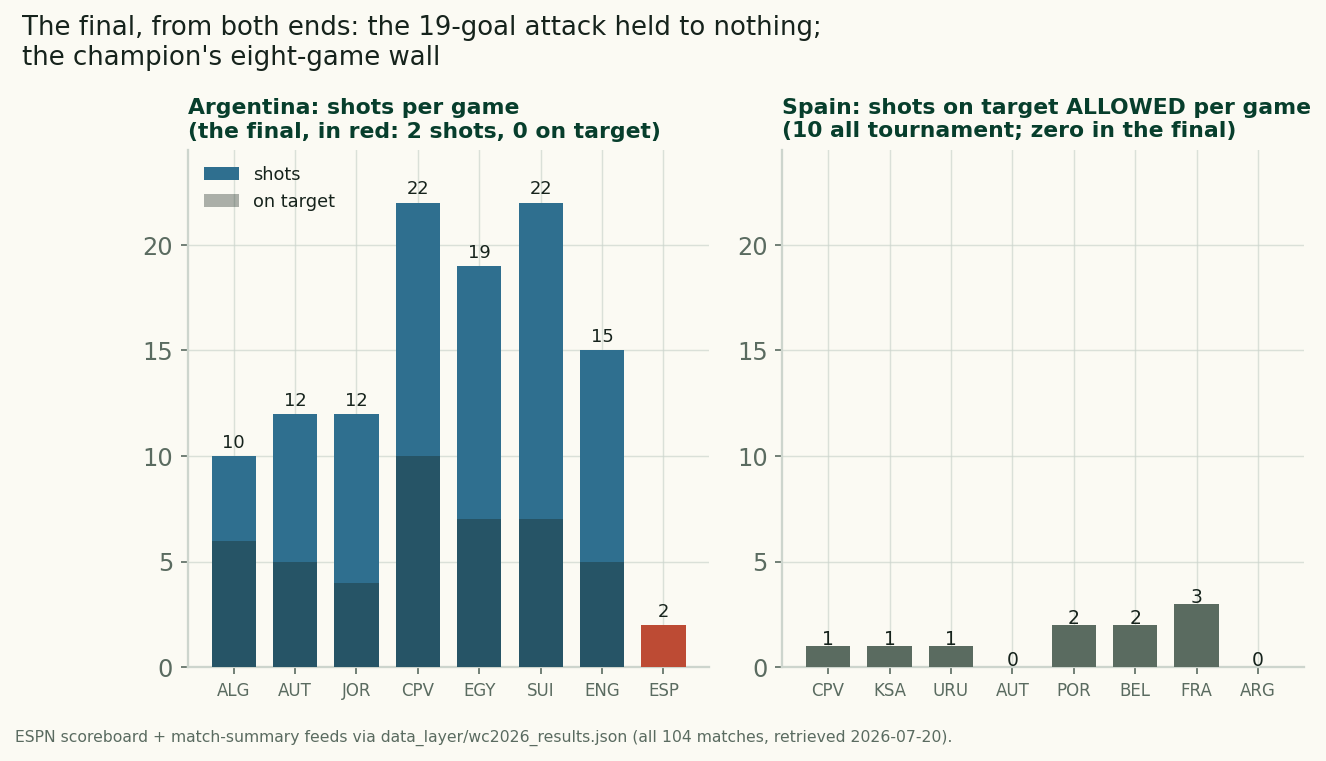
Every knockout streak Argentina carried into the game died in it. Scored two or more in every match: ended at zero. Won the shots-on-target count in all seven: lost it 12–0, the most total loss of that column available. Their 34.9% possession was their tournament low and only the second time all month they were under half the ball — the first was their opener, when the volume era hadn’t started yet. Their 464 passes sat exactly 200 under their tournament average. Wednesday’s wrap called the group-stage Argentina and the knockout Argentina two different teams sharing a perfect record; the final revealed a third, the one Spain permits.
The wall, completed
Spain finish the tournament W7 D1, 14 scored, 1 conceded, seven clean sheets in eight games — unbeaten champions who never once lost the possession battle and never once dipped under 50% of the ball. Belgium’s quarter-final goal remains the only one they allowed in the entire competition. Across eight matches they conceded ten shots on target, total — 1.25 a game, never more than three in any match, and none at all in the final. The aggregate ledger closes at 140 shots for and 46 against, 54 on target for and 10 against.
One line of public record belongs here, because the echo is too clean to leave out: Spain have now won two World Cups, and both finals finished 1–0. The team that built the most suffocating defensive tournament in this dataset’s records won it by the only score its style ever promised.
The bronze: ten goals, no stakes, pure sport
Twenty-four hours earlier, the third-place match delivered the tournament’s photographic negative. France 4–6 England — ten goals, the highest-scoring game of the entire World Cup (nothing else reached beyond eight), on 19 shots apiece, England 11–9 on target, and not a single card between them. England take third place; France finish fourth having scored four in a game and lost. And the closing scorer table is a small satire of the whole knockout month: England and France finish as the tournament’s joint top scorers on 20 goals each. The champion scored 14. Argentina’s 19 sit between them. The teams freed from consequence produced the goals; the team that never conceded any produced the trophy.
The closing ledger: 104 games
| Matches / goals | 104 / 308 — 2.96 per game (groups 2.99, knockouts 2.91) |
| Champion’s record | Spain: W7 D1, 14–1, seven clean sheets |
| Top scorers (teams) | England & France 20 · Argentina 19 · Spain 14 |
| Shots-on-target rule | held in 24 of 28 decided knockout games (86%) |
| Shootouts | 4 of 32 knockout games |
| Red cards | 15, one of them in the final |
The scoring rate deserves its own sentence, stated carefully as public record: at 2.96 goals a game, this was a higher-scoring World Cup than every 32-team edition ever played (none of 1998–2022 cleared 2.69), and you have to go back to 1970 — 95 goals in 32 games, 2.97 — to find a tournament that averaged more. The 2026 World Cup missed the highest per-game rate in 56 years by less than a hundredth of a goal. The 48-team format was supposed to dilute the product; the data says the opposite happened.
And the pattern this series leaned on hardest survived its biggest test: the team matching or beating its opponent on shots on target won 24 of the 28 decided knockout games, the final included — 12–0 being the least suspenseful application of the rule all month. The four exceptions are all named in earlier notes, and one of them, fittingly, was won by Spain.
The bookkeeping, closed out
What the series called correctly: the preview’s one-sentence-must-break framing resolved exactly as constructed, and the possession zero-sum question — somebody’s identity bends — got its answer in Argentina’s 34.9%. What it deliberately refused to call: rest. Spain had five days to Argentina’s four and won, which makes the tournament’s uneven-rest knockout record 2–2 by team — four results pointing four ways, and this series ends as it began, tabling that variable without betting on it. What it never saw coming, because nothing in 102 prior games suggested it: a two-shot final from the most productive attack in the field. The most honest sentence in this note is that one.
The World Cup section of this site now shifts from live coverage to the record: the hub stays, the dataset stays served and final at 104 matches, and the daily notes give way to occasional retrospectives — there are questions in this data (what actually predicted advancement; where the expanded format bent history) that deserve slower answers than a tournament deadline allows. Thanks for following along, match by match. The wall won.
Sources
- Match results and team stats: ESPN public scoreboard + match-summary APIs, parsed to
data_layer/wc2026_results.json(all 104 matches, retrieved 2026-07-20); served at /data/wc2026_results.json. Chart:charts/chart_wc2026_final.py. The feed carries team box scores only — no player data, no goal times — and every claim above respects that boundary. - Historical figures (1970’s 95 goals in 32 games; per-game rates of the 32-team era; Spain’s 2010 final finishing 1–0) are widely documented public record, outside our dataset.
- The road here: the final preview, France 0–2 Spain, and England 1–2 Argentina.
- The World Cup hub collects the complete series, group stage to final.
More from World Cup 2026
The 2026 Dark-Horse Audit: Grading Our June Checklist
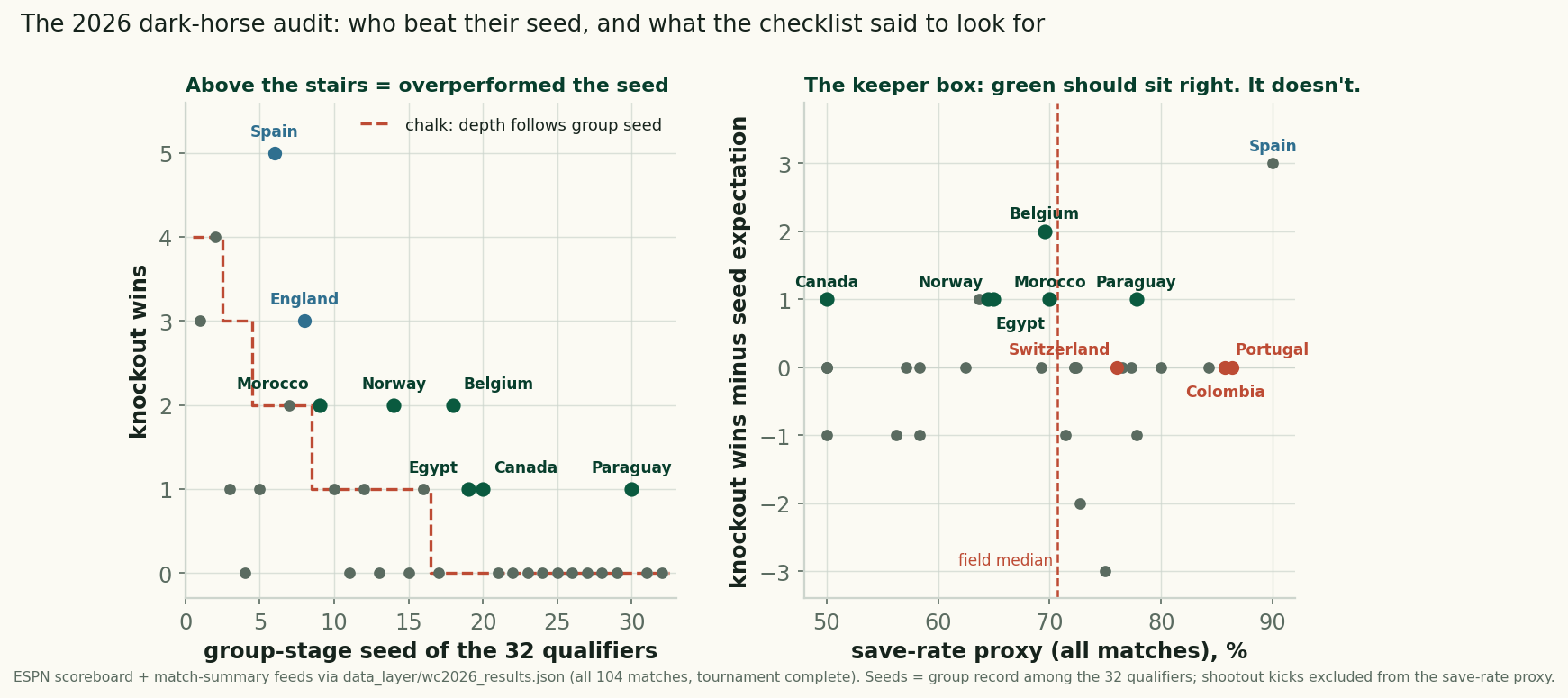
Six teams beat their group seed at the 2026 World Cup. Scored against our pre-tournament dark-horse checklist: the keeper box failed, the kind draw barely helped.
The Shootouts: Rarer, Earlier, and a Reprieve That Never Lasted
Retro #4 closes the series: the shootout rate fell to 12.5% of knockout games from 2022's 31%, all four came early, and survivors went 1-3 next time out.
The Groups Told the Truth: How June Predicted July at the 2026 World Cup
Retrospective #3: group-stage points strongly predicted knockout survival — 9-point teams went 3-for-3, 4-point teams 2-for-11, and the final four all ranked top-8.