France–Spain and England–Argentina: The Semi-Finals in Data
A short tournament note for the between-rounds day. No predictions — just what six games apiece say about how each pairing's styles collide, who got the rest, and why the tournament's streaks describe the past rather than call the future.
Nobody plays today. France v Spain kicks off tomorrow, July 14; England v Argentina follows on July 15. Yesterday’s quarter-final wrap covered the ledgers — four semi-finalists, 22 wins, 2 draws, no defeats — so this note does the between-rounds job instead: full six-game style profiles for each team, how each pairing’s shapes collide, the rest math, and an honest accounting of which of the tournament’s running patterns deserve your trust.
Sourcing. A preview built only on what has already happened: every number comes from our bundled match dataset — 100 completed matches, refreshed July 13, from ESPN’s public scoreboard and match-summary feeds, served raw at /data/wc2026_results.json. The feed carries team box scores only — no player data — and nothing about unplayed fixtures is predicted.
Four teams, six games each
| Team | Poss. | Shots | SoT | Conv. | Corners | Opp. shots | Opp. SoT | Clean sheets |
|---|---|---|---|---|---|---|---|---|
| France | 58.4% | 18.3 | 7.8 | 14.5% | 6.8 | 6.3 | 1.8 | 4 |
| Spain | 66.0% | 18.3 | 6.7 | 10.0% | 7.3 | 5.7 | 1.2 | 5 |
| England | 57.1% | 15.7 | 6.7 | 13.8% | 5.8 | 10.8 | 3.2 | 2 |
| Argentina | 60.1% | 16.2 | 6.5 | 17.5% | 5.2 | 8.3 | 2.5 | 2 |
The table sorts itself into the two pairings almost too neatly. The July 14 teams own the two right-hand columns: opponents get 5.7 shots a game against Spain and 6.3 against France, with 1.2 and 1.8 of them on target — suppression numbers no one else left can touch. The July 15 teams own the scoring columns instead: Argentina’s 17.5% conversion is the best of the four, England’s 13.8% sits third, and both concede real chances doing it — England allow 10.8 shots a game, nearly double France’s figure. Two details the averages hide: Spain’s 66.0% possession is the highest of any of the tournament’s 48 teams, and the heaviest passing volume among the semi-finalists belongs not to Spain but to Argentina — 676 completed-feed passes a game to Spain’s 662, with France at 556 and England at 509.
July 14: two suppression teams, 110 shots each
The dataset’s little joke first: across six games, France and Spain have taken exactly the same number of shots — 110 apiece. Identical volume, different machines. Spain get there with the ball: most possession in the tournament, never out-possessed, never out-shot, and a 36.4% on-target rate. France get there with less of it — 58.4% — but put 42.7% of their attempts on target, which is why their shots-on-target ledger reads 47–11 to Spain’s 40–7. At the other end the two defenses have conceded three goals combined in twelve matches, and Spain’s seven shots on target allowed all tournament is the fewest per game of any team with four or more matches played.
The knockout rounds sharpened both, in opposite places. France’s knockout line is 6–0 across three games with three clean sheets, their shot volume up from 16.0 to 20.7 a game — but their conversion has halved, 20.8% in the groups to 9.7% since. Spain split their 110 shots exactly 55 in the groups and 55 in the knockouts, and the difference is aim: their on-target rate jumped from 29.1% to 43.6%, which is how a team that opened with a 0–0 against Cape Verde has since put three past Austria and beaten Portugal and Belgium. One structural note that costs nothing to state: possession is zero-sum, so on Tuesday one of these teams spends the evening under 50% of the ball. Spain have not been there once in six games; France have, exactly once — 48% in the quarter-final against Morocco, which they won 2–0 anyway.
July 15: the two teams that swapped styles
The full-tournament averages for England and Argentina sit close together; the round-by-round splits run in opposite directions, and that is the real story of this pairing.
| Team — phase | Poss. | Shots | SoT | Conv. |
|---|---|---|---|---|
| England — groups | 65.9% | 19.3 | 6.7 | 10.3% |
| England — knockouts | 48.4% | 12.0 | 6.7 | 19.4% |
| Argentina — groups | 58.2% | 11.3 | 5.0 | 23.5% |
| Argentina — knockouts | 62.1% | 21.0 | 8.0 | 14.3% |
England entered as a control team — two-thirds of the ball, nineteen shots a game — and have won three knockout games as something close to a counterpuncher: possession down seventeen points, shot volume down a third, and yet exactly 20 shots on target in each phase, because their on-target rate climbed from 34.5% to 55.6%. The extreme case was the round of 16 against Mexico: 33.1% possession, 244 passes, six shots — five on target — and a 3–2 win. Argentina ran the same film backwards: a lean, clinical group stage (11.3 shots a game converted at 23.5%) has become a volume attack, twenty-one shots a game in the knockouts with conversion drifting down toward the field average. Each team has already won playing the shape the other now holds — which is what makes the stylistic coin-flip of July 15 genuinely unreadable from the data.
What they share is leakiness. Neither has a knockout clean sheet — the July 14 semi pairs teams with five between them, the July 15 semi pairs teams with none — and both have conceded in every elimination game: England 4 goals in three, Argentina 5. England are also the only semi-finalist to have been out-shot in a match (Mexico again) and the only one carrying a red card, part of a 7-yellow, 1-red ledger that is the heaviest of the four.
The rest math
| Team | Quarter-final played | Semi-final | Days between |
|---|---|---|---|
| France | Jul 9 | Jul 14 | 5 |
| Spain | Jul 10 | Jul 14 | 4 |
| England | Jul 11 | Jul 15 | 4 |
| Argentina | Jul 12 (01:00 UTC) | Jul 15 | 3 |
As with the quarter-final rest math, the calendar is nearly fair — three teams within a day of each other — with one exception: Argentina, whose quarter-final ran into the small hours of July 12, turn around in three days, the shortest gap of the round. The one precedent this tournament offers is Belgium, who carried the quarter-finals’ only three-day turnaround into their tie and lost it 2–1 to Spain. That is a sample of one and we present it as exactly that.
A note on what we checked and didn’t find: neither pairing shares a common opponent anywhere in the 100 completed matches, so there is no through-line comparison to make — no “both played X” table exists for July 14 or July 15. The only common-opponent pairing among the four semi-finalists is the one that hasn’t been scheduled yet: Spain and Argentina have both beaten Austria and both faced Cape Verde. The dataset only offers that comparison if both win this week.
What the patterns say — and where they break
The headline streak is real: eleven straight knockout games decided on the pitch have gone to the team that matched or beat its opponent on shots on target. But the full knockout ledger is 21 of 24, because the round of 32 produced three exceptions before the streak began — worth remembering before treating eleven-for-eleven as a law. The better cautionary tale is the one this series already lived through: at the halfway point of the round of 16, the July 6 note flagged that the busier attack had lost three ties of four — a tidy little “precision beats volume” narrative. The rest of the tournament shredded it. The busier attack won three of the round’s last four decided ties to close the round of 16 at a 4–3 coin flip, then swept the quarter-finals 4–0, and across all 24 decided knockout games the team taking more shots has now won 18. A four-game sample pointed one way; twenty-four games point the other. That is why this preview describes profiles and declines to forecast: the streaks above are summaries of games already played, and the two matches this week are under no obligation to extend any of them.
Wrap notes follow as the results land in the dataset: France–Spain after Tuesday, England–Argentina after Wednesday, and then a final preview once the July 19 pairing is known. Two games from a complete tournament.
Sources
- Match results and team stats: ESPN public scoreboard + match-summary APIs, parsed to
data_layer/wc2026_results.json(100 completed matches, retrieved 2026-07-13); served at /data/wc2026_results.json. All profile numbers computed from that snapshot. - The quarter-finals’ conclusion: the quarter-finals close at three goals a game. The rest-day method: the quarter-final bracket, by rest days.
- The World Cup hub collects the whole series.
More from World Cup 2026
The 2026 Dark-Horse Audit: Grading Our June Checklist
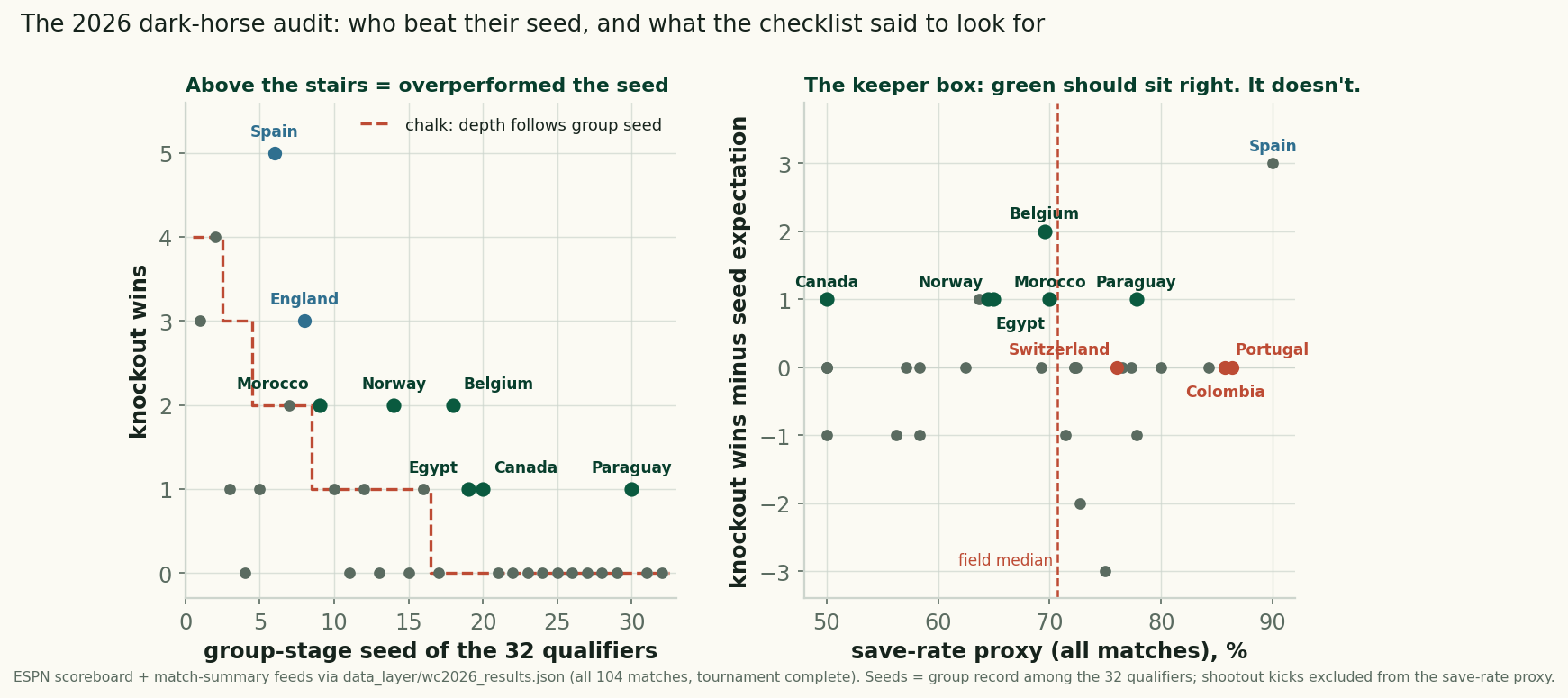
Six teams beat their group seed at the 2026 World Cup. Scored against our pre-tournament dark-horse checklist: the keeper box failed, the kind draw barely helped.
The Shootouts: Rarer, Earlier, and a Reprieve That Never Lasted
Retro #4 closes the series: the shootout rate fell to 12.5% of knockout games from 2022's 31%, all four came early, and survivors went 1-3 next time out.
The Groups Told the Truth: How June Predicted July at the 2026 World Cup
Retrospective #3: group-stage points strongly predicted knockout survival — 9-point teams went 3-for-3, 4-point teams 2-for-11, and the final four all ranked top-8.