England 1-2 Argentina: Seven Wins From Seven, and the Final Is Set
A short tournament note, catching up on Wednesday's second semi-final. The style question the preview called unreadable got a clear answer — both teams played their knockout shapes, and this time the counterpuncher's precision didn't come. Argentina won on the round's shortest rest, and the final pairs the last two unbeaten teams standing.
The second of today’s two catch-up notes, on Wednesday’s semi-final: England 1–2 Argentina, and the July 19 final is Spain v Argentina. Where Tuesday’s semi was even everywhere except the scoreline, Wednesday’s was lopsided everywhere except the scoreline: Argentina held 64.2% of the ball, tripled England’s shot count, and became the only team at this World Cup to win all seven of its games.
Sourcing. A results note, written the morning after. Every number comes from our bundled match dataset — 102 completed matches, refreshed July 17, from ESPN’s public scoreboard and match-summary feeds, served raw at /data/wc2026_results.json. The feed carries team box scores only — no player data — and nothing about unplayed fixtures is predicted.
The match: one team had the evening
| England | Argentina | |
|---|---|---|
| Goals | 1 | 2 |
| Possession | 35.8% | 64.2% |
| Shots | 5 | 15 |
| On target | 2 | 5 |
| Corners | 2 | 6 |
| Passes | 325 | 588 |
| Fouls | 11 | 15 |
The preview called this pairing a stylistic coin-flip: England had turned from a 65.9%-possession control team into a knockout counterpuncher (48.4% of the ball, 12 shots a game since the round of 32), Argentina from a lean finishing team into a 21-shot volume attack, and each had already won playing the other’s shape. The coin landed flat on both faces: each team played its knockout identity, and Argentina’s was better. Argentina’s 15 shots were below their 21-a-game knockout average but triple England’s 5; their 588 passes fit the tournament-leading passing profile the preview flagged; their 64.2% possession was their second-highest of the tournament. England, meanwhile, went further into the bunker than they had ever gone: 35.8% possession and five shots — both tournament lows for them, under even the Mexico game’s 33.1% and six.
The counterpunch needs the punch
England’s knockout formula was extreme but real: concede the ball, concede the volume, and win anyway on precision — a 55.6% on-target rate across the three knockout wins, 20 shots on target in each phase of the tournament, five-of-six on target in the Mexico escape. Wednesday the precision finally stayed home. Two of five attempts on target — 40%, their worst knockout accuracy — and one goal from them. Against a team taking fifteen at the other end, a counterpuncher converting at that volume needs nearly everything to land; this time it didn’t, and the 3–2 Mexico high-wire act became a 1–2 exit. The shots-on-target rule, freshly broken on Tuesday, reasserted itself here: Argentina won that battle 5–2 and won the game, making the knockout ledger 22 of 26 decided ties to the team matching or beating its opponent on target — 12 of 13 since the round of 16, the France–Spain semi now the lone exception in that stretch.
The three-day turnaround: the precedent failed
The preview’s rest table had one genuine outlier: Argentina, whose quarter-final ran into the small hours of July 12, turned around in three days — the shortest gap of the round — while England had four. The tournament’s only precedent was Belgium, who carried the quarter-finals’ only three-day turnaround into their tie against Spain, produced their season-minimum shot count, and lost. Argentina took the same handicap and delivered 64% possession, a 15–5 shot edge and a win. So the precedent is dead, and honesty requires stating it as exactly that — a failed precedent, not a new law in the other direction. The short-rest team has now lost one and won one. Add Tuesday’s semi, where the better-rested team lost, and the tournament’s three uneven-rest knockout results point in three directions. Rest is a real physiological variable and a useless three-game predictor, and this series will keep tabling it without betting on it.
England's farewell: the ledger of a team that lived dangerously
| Opponent | Result | Possession | Shots for–against | SoT for–against |
|---|---|---|---|---|
| Croatia | 4–2 | 51.7% | 22–10 | 11–5 |
| Ghana | 0–0 | 78.9% | 19–2 | 3–1 |
| Panama | 2–0 | 67.1% | 17–13 | 6–2 |
| Congo DR | 2–1 | 59.7% | 16–7 | 7–2 |
| Mexico | 3–2 | 33.1% | 6–20 | 5–5 |
| Norway | 2–1 | 52.4% | 14–13 | 8–4 |
| Argentina | 1–2 | 35.8% | 5–15 | 2–5 |
England finish five wins, one draw, one defeat: 14 scored, 8 conceded, both clean sheets in the group stage, and a goal conceded in every one of their four elimination games. The traits the preview flagged all held to the end: no knockout clean sheet, the heaviest card ledger of the semi-finalists (8 yellows and the field’s only red), and they remain the only team of the final four to be out-shot in a match — now twice, by Mexico and by Argentina, the two games that between them nearly and then actually ended the run. Their full aggregate, 99 shots to 80 against, is by far the leakiest of the four semi-finalists — England allowed 80 shots all tournament; Spain and France allowed 44 and 48. Living that dangerously bought them a run to the last four and a five-goal thriller for the ages. It just doesn’t survive seven rounds very often.
Argentina: seven for seven
Argentina’s ledger now reads seven wins from seven, 19 scored, 7 conceded — the only perfect record left in the tournament, or anywhere in it. The transformation the preview documented is complete: 11.3 shots a game in the groups, 19.5 in the knockouts, with possession rising rather than falling as the opposition improved. The cost of the volume era shows in the other column — no knockout clean sheet, a goal conceded in all four elimination games, 11–6 on knockout aggregate — but they have out-shot and out-targeted every knockout opponent while doing it. Whatever July 19 brings, the group-stage version of Argentina and the knockout version are two different teams that happen to share a perfect record.
The final is set — and the common-opponent table is finally live
Spain v Argentina, July 19: the last two unbeaten teams standing, a combined 32 scored and 8 conceded. The preview noted that the only common-opponent comparison among the semi-finalists existed “only if both win this week” — Spain and Argentina both beat Austria and both faced Cape Verde. Both won this week, so here is the teaser the full preview note will build on:
| Match | Stage | Result | Poss. | Shots | SoT |
|---|---|---|---|---|---|
| Spain v Austria | R32 | 3–0 | 64.4% | 23–5 | 10–0 |
| Argentina v Austria | Group | 2–0 | 53.6% | 12–6 | 5–1 |
| Spain v Cape Verde | Group | 0–0 | 74.3% | 27–6 | 7–1 |
| Argentina v Cape Verde | R32 | 3–2 | 63.6% | 22–16 | 10–5 |
Read gently — the fixtures came at different stages against different versions of those opponents. Both finalists beat Austria without conceding, Spain the more emphatically; the Cape Verde split is the interesting one, Spain’s 27-shot 0–0 against Argentina’s chaotic 3–2. A team that couldn’t be scored on meets a team that couldn’t stop scoring or being scored on. The full final preview — rest math included: Spain will have five days to Argentina’s four — is now up. Two matches left in the tournament this dataset set out to count: Saturday’s bronze final in Miami, then Sunday.
Sources
- Match results and team stats: ESPN public scoreboard + match-summary APIs, parsed to
data_layer/wc2026_results.json(102 completed matches, retrieved 2026-07-17); served at /data/wc2026_results.json. All numbers computed from that snapshot. - The set-up this note pays off: the semi-finals preview, in data. The round both teams came through: the quarter-finals close at three goals a game.
- The other semi-final: France 0–2 Spain, wrapped.
- The World Cup hub collects the whole series.
More from World Cup 2026
The 2026 Dark-Horse Audit: Grading Our June Checklist
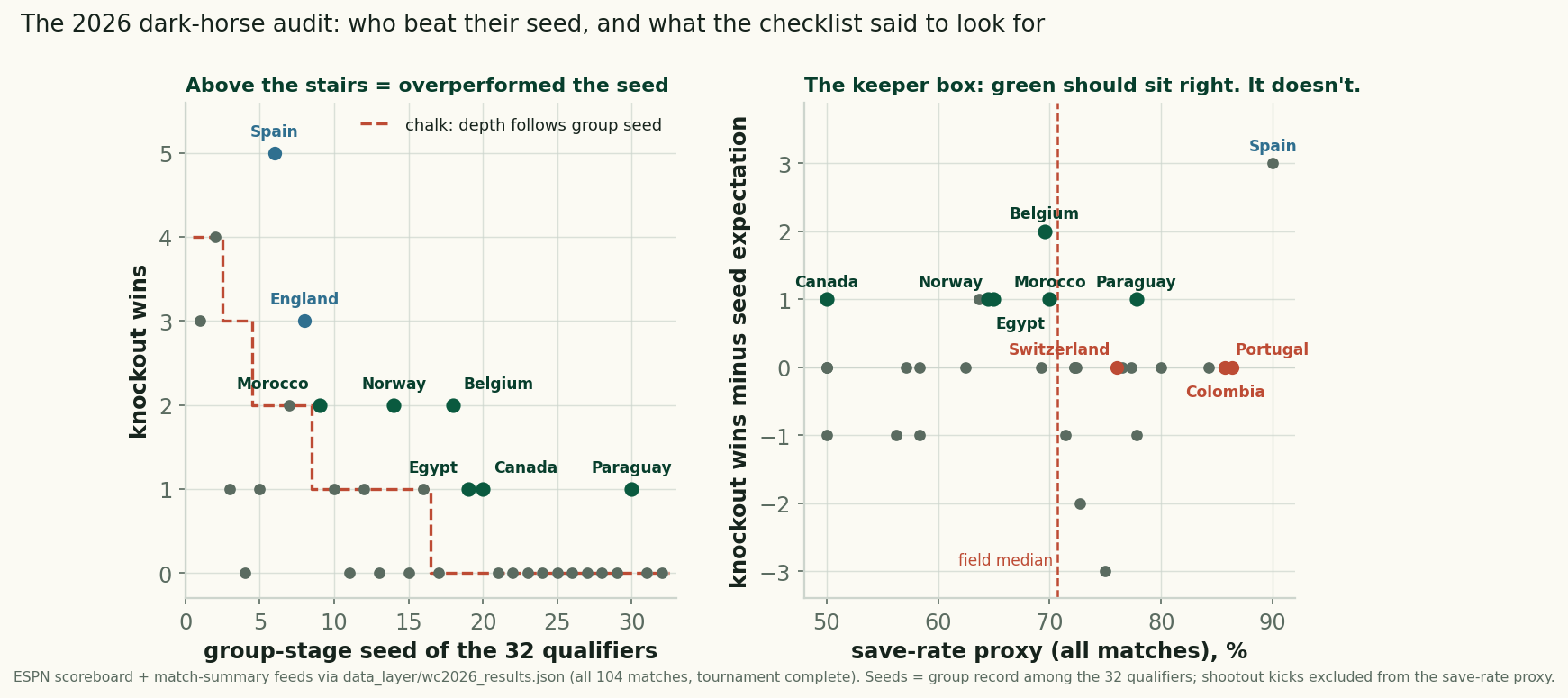
Six teams beat their group seed at the 2026 World Cup. Scored against our pre-tournament dark-horse checklist: the keeper box failed, the kind draw barely helped.
The Shootouts: Rarer, Earlier, and a Reprieve That Never Lasted
Retro #4 closes the series: the shootout rate fell to 12.5% of knockout games from 2022's 31%, all four came early, and survivors went 1-3 next time out.
The Groups Told the Truth: How June Predicted July at the 2026 World Cup
Retrospective #3: group-stage points strongly predicted knockout survival — 9-point teams went 3-for-3, 4-point teams 2-for-11, and the final four all ranked top-8.