Spain v Argentina: One Goal Conceded Meets Nineteen Scored
The full preview the semi-final wrap promised, one day out. The last two unbeaten teams standing meet Sunday at MetLife — the tournament's stingiest defence against its only perfect record. Profiles, rest math and fault lines from 102 completed matches; forecasts, as ever, not included.
The 2026 World Cup ends Sunday: Spain v Argentina, July 19, MetLife Stadium, kickoff 19:00 UTC. The dataset describes the pairing more sharply than any billing could. Spain have conceded one goal in seven games. Argentina have scored nineteen, the most in the tournament, and won all seven — the only perfect record in the field. One team has spent a month proving nobody can score on it; the other has spent a month proving it can score on everybody. They are also the last two unbeaten teams standing — standing being the operative word, since Colombia went home unbeaten on a shootout two rounds ago.
Sourcing, as always. Every number below is computed from our bundled match dataset — 102 completed matches through the semi-finals, refreshed July 18, from ESPN’s public scoreboard and match-summary feeds, served raw at /data/wc2026_results.json. Fixture facts for the two remaining games come from the same feed’s published schedule. The feed carries team box scores only, and nothing about the final is predicted. This is the preview Wednesday’s wrap promised: profiles and fault lines, not forecasts.
The tale of the tape
| Spain | Argentina | |
|---|---|---|
| Record | W6 D1 L0 | W7 D0 L0 |
| Goals | 13–1 | 19–7 |
| Clean sheets | 6 | 2 |
| Possession, avg | 63.8% | 60.7% |
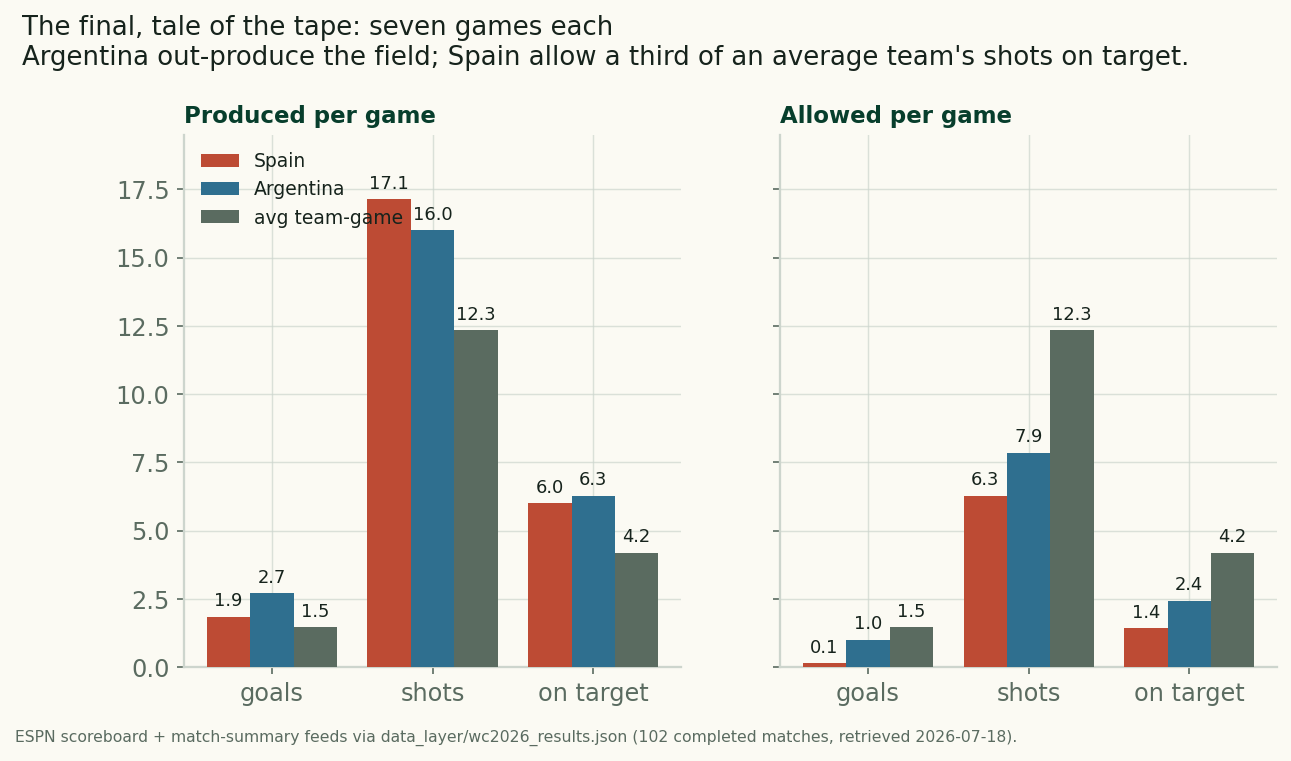
| Shots per game, for–against | 17.1–6.3 | 16.0–7.9 |
| On target per game, for–against | 6.0–1.4 | 6.3–2.4 |
| Passes per game | 639 | 664 |
| Cards | 6 yellow, 0 red | 9 yellow, 0 red |
Spain's case: nobody scores
Spain’s defensive line reads like a typo. One goal conceded in seven games — Belgium’s, in the quarter-final — and six clean sheets, three of them in the knockouts. Forty-four shots allowed all tournament, 6.3 a game; among the 48 teams only Canada, out in the round of 16, allowed fewer per game. Ten shots on target allowed in a month of football: 1.4 a game, exactly a third of what the average team-game concedes. The aggregate shots-on-target ledger is 42–10. And the semi-final answered the one question the profile had left open — what happens when the machine stalls — because France dragged them to even and Spain won anyway, out-targeted for the only time all tournament.
The honest caveat is at the other end. Spain’s 13 goals on 120 shots is a 10.8% conversion rate, a shade under the tournament’s ~12%, and the tail of that distribution is ugly: their heaviest shooting night, 27 attempts against Cape Verde, produced their only scoreless game. This is a control team that manufactures volume and trusts the arithmetic — not a clinical one.
Argentina's case: everything scores
Argentina’s attack is the inverse. Nineteen goals — France’s 16 is the only other total within five — on 112 shots: a 17.0% conversion rate, and 19 of 44 on target finding the net, 43% against the field’s ~35%. They have scored at least twice in every game they have played, and they have won the shots-on-target count in all seven — something not even Spain managed (five wins, a tie, and the semi-final defeat in that column). The transformation the semi-final wrap documented is real: 11.3 shots a game in the groups became 19.5 in the knockouts, with possession rising as the opposition improved.
Their caveat is the mirror of Spain’s. Two clean sheets, a goal conceded in all four knockout games, and an 11–6 knockout aggregate — four elimination wins by a combined five goals, where Spain’s knockout line is 8–1. The volume era bought goals at both ends.
The collision: two teams that want the same ball
The semi-finals were style contrasts — a suppression duel on Tuesday, possession against counterpunch on Wednesday. The final is the opposite: a mirror match. Of the six most ball-dominant teams at this tournament, four are already home; the other two play Sunday. On passes per game Argentina rank second (664) and Spain fourth (639) — the leader on that table, Germany, is long out. Possession is zero-sum, and the streaks are asymmetric: Spain have never been under 50% — their floor is the 50.9% they kept against France — while Argentina have dipped under once, in their opening game. Somebody’s identity bends Sunday, the way France bent Spain’s average without breaking their streak.
The common opponents, built out
Wednesday’s wrap teased the tournament’s only common-opponent table — both finalists beat Austria, both faced Cape Verde — and promised this note would build on it. What those four games actually reveal, read side by side: Austria measured the gap in control (Spain’s 3–0 with 64% of the ball and a 10–0 on-target count against Argentina’s efficient group-stage 2–0), and Cape Verde exposed each team’s one flaw. Spain’s flaw: 27 shots, seven on target, 74% possession — and a 0–0, their only dropped points, the arithmetic refusing to pay out. Argentina’s flaw: a 3–2 where Cape Verde took 16 shots and put five on target — respectively the most and (with Switzerland) the joint-most anyone has managed against them. The islanders, of all teams, wrote the scouting report: park deep and Spain may blank; run at Argentina and you will probably score, and probably still lose.
Rest math and the fault lines
The rest gap the wrap flagged: Spain played Tuesday and get five full days; Argentina played Wednesday and get four. The tournament’s three uneven-rest knockout results point in three directions — short-rest Belgium went flat and lost, short-rest Argentina dominated and won, better-rested France lost a semi-final — so we table the variable and decline, again, to bet on it.
The shots-on-target rule enters the final at 22 of 26 decided knockout games won by the team matching or beating its opponent on target — 12 of 13 since the round of 16. The one exception in that stretch was won by Spain, in the semi-final, which is either a warning about the rule or a warning about Spain, depending on your priors. And if Sunday refuses to be decided at all: four of the 30 knockout games so far have gone to penalties, and the shootout discount — the 2022 census showing conversion falling from 74% in-game to 63% in shootouts — is the piece to reread on the way in.
What the record books add
Outside the dataset, stated as simple public record: Argentina are the defending champions, and a win Sunday would make them the first back-to-back World Cup winner since Brazil in 1958 and 1962 — Italy in the 1930s being the only other. Spain are in their first final since the one they won in 2010, their only title. And this is the first World Cup final ever played between Spain and Argentina — fittingly for a tournament of 104 matches in which the two never once crossed paths.
First, tonight: the bronze
One game remains before the final: France v England, the third-place match, tonight at Hard Rock Stadium in Miami Gardens, kickoff 21:00 UTC. The two teams the finalists beat this week bring their own subplot — France’s 16 goals are the field’s second-most; England have conceded in every knockout game they’ve played. The post-final wrap will fold both results into the tournament’s closing ledger.
Until then, the cleanest sentence this dataset can offer about Sunday: Argentina have scored at least twice in every game; Spain have never conceded twice in any. By Sunday night, one of those sentences will be false. That is as close to a guarantee as 102 matches of bookkeeping can get.
Sources
- Match results and team stats: ESPN public scoreboard + match-summary APIs, parsed to
data_layer/wc2026_results.json(102 completed matches, retrieved 2026-07-18); served at /data/wc2026_results.json. All tournament numbers computed from that snapshot; chart scriptcharts/chart_wc2026_final_preview.py. - Fixture facts (kickoff times, venues) for the third-place match and final: the same ESPN scoreboard feed’s published schedule for July 18–19, retrieved 2026-07-18.
- Historical facts (Argentina 2022 champions, Brazil 1958–62, Italy 1934–38, Spain 2010) are widely documented public record, outside our dataset.
- The road here: France 0–2 Spain and England 1–2 Argentina, plus the semi-finals preview this note inherits its method from.
- Penalty-shootout conversion figures: our census of every 2022 World Cup penalty, built on StatsBomb open data (free public dataset; attribution required).
- The World Cup hub collects the whole series.
More from World Cup 2026
The 2026 Dark-Horse Audit: Grading Our June Checklist
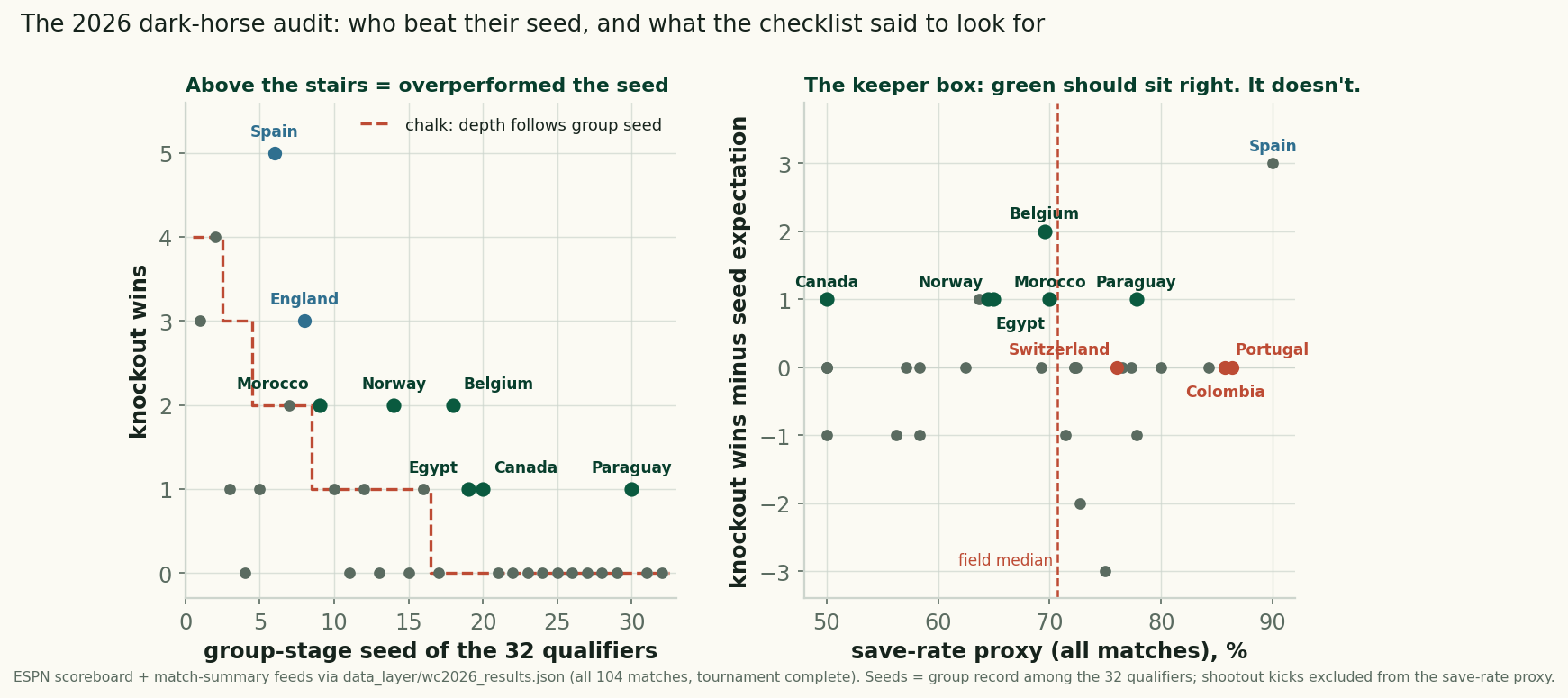
Six teams beat their group seed at the 2026 World Cup. Scored against our pre-tournament dark-horse checklist: the keeper box failed, the kind draw barely helped.
The Shootouts: Rarer, Earlier, and a Reprieve That Never Lasted
Retro #4 closes the series: the shootout rate fell to 12.5% of knockout games from 2022's 31%, all four came early, and survivors went 1-3 next time out.
The Groups Told the Truth: How June Predicted July at the 2026 World Cup
Retrospective #3: group-stage points strongly predicted knockout survival — 9-point teams went 3-for-3, 4-point teams 2-for-11, and the final four all ranked top-8.