The Five-Substitutions Era: How a Quiet Rule Change Reshaped the Closing Minutes
From three subs to five, and who the change quietly favours.
For most of its modern history, football let a manager change three players a match, and an entire grammar of the game grew up around that number. You held a substitution back for the last twenty minutes. You gambled your final change on chasing a goal. A tiring star stayed on because the bench was a scarce resource. Then, almost without anyone treating it as a landmark, the number changed. Five substitutes, not three. The closing stages of a football match have not looked the same since.
What actually changed, and when
The shift began as an emergency measure. When football restarted in 2020 after its COVID-19 shutdown, fixtures were compressed into punishing schedules, and the game’s lawmakers approved a temporary option allowing teams to make up to five substitutions rather than three, to protect players from injury in the congestion. It was explicitly framed as provisional — a response to an unusual situation, not a permanent rewrite of the Laws of the Game.
It did not stay provisional. Competition by competition, the option was extended, and it was subsequently written permanently into the Laws of the Game as a standing allowance rather than a temporary exception. The five-substitute rule is now simply how football works at the top level, and a generation of players will grow up never having known the three-sub world their predecessors managed within.
The detail that matters: windows, not just numbers
The rule is not simply "five changes instead of three." To stop teams from chopping the game into fragments with constant stoppages, the additional substitutions come with a constraint: a team may make its five changes across only three substitution windows during normal time (the half-time interval does not count as one of them). Send on two players at once and you have used a window but only one of your three opportunities to stop play.
That detail shapes the tactics as much as the raw number does. A manager now thinks not only about which five players to introduce but about how to cluster them — making a double or triple change in a single window to preserve a future stoppage, or spending a window early to fix a problem and accepting fewer interventions later. The arithmetic of in-game management got richer overnight.
How it changed the game on the pitch
The first and most obvious effect is simply fresher legs in the final stretch. With five changes available, a manager can refresh an entire spine — a midfielder, a winger, a striker — in the last half-hour without exhausting his options, and can do so while still holding a change in reserve for an injury or a tactical surprise. Players who once had to be nursed through ninety minutes can be used in shorter, higher-intensity bursts, both those coming off and those coming on.
The second effect is tactical flexibility. Two extra substitutions are two extra chances to change the shape of the team in response to the state of the game. A side defending a lead can swap attackers for defenders and genuinely reconfigure rather than make a single token change. A side chasing a goal can throw on multiple fresh attackers at once. The substitutions article of the Laws became, in effect, a wider set of levers, and the managers who pull them well gained an edge over those who do not.
The third effect is the one with the longest reach: squad depth became more valuable. When you can only change three players, the quality of your fourth-to-sixth options matters, but is capped. When you can change five, the gap between your starters and your best reserves is exposed for a larger share of the match. A deep squad can now keep its intensity high for ninety-plus minutes by rotating fresh quality onto the pitch; a thin one cannot, and the difference shows most clearly when legs tire.
The competitive-balance debate
This is where the rule stops being a neutral tweak and becomes contested. The objection, raised by a number of managers at clubs without enormous resources, is straightforward: the teams best placed to exploit five substitutions are the ones with the deepest, most expensive benches. If your reserves are internationals and your opponent’s are academy graduates, then doubling the number of players you can introduce widens the quality gap precisely in the part of the game — the closing minutes — where tired legs already favour the stronger side.
Read directionally, the logic is hard to dismiss: a rule that increases the impact of bench quality should, all else equal, tilt the closing stages toward squads with more of it. The counter-argument is that fresher players reduce injuries and raise the overall standard of the spectacle, and that depth has always been an advantage of richer clubs in one form or another. We should be careful not to overstate the size of the effect — matches are decided by many things, and a deep bench is no guarantee — but the direction of the incentive is clear, and it points toward the clubs that were already favoured.
What is actually measurable
The honest position is that the rule’s effects are easier to reason about than to pin to a precise number, and you should be wary of anyone quoting one confidently. But several things are, in principle, measurable from public data, and worth looking at rather than asserting.
- Late-game goal timing. If fresh legs late in matches change the rhythm, the distribution of when goals are scored across the ninety minutes is the place it would show up. Comparing the shape of that distribution before and after the change is a clean, checkable question.
- Substitute usage and impact. How early changes are made, how often managers cluster them into one window, and how often substitutes are directly involved in late goals are all countable. The "impact sub" — a player brought on specifically to change a game — is now a more deliberate tactical category than it was.
- Minutes distribution across squads. Whether playing time has spread across larger groups of players, reducing the share carried by a small core of starters, is straightforward to track season over season.
Each of those is a study someone can run against league data rather than a figure to quote from memory, and that is the right spirit in which to treat the change.
Why it matters beyond the substitutions themselves
The deeper point is that the five-substitute rule quietly raised the value of game management as a tactical discipline. The closing minutes have always been where matches are decided, and the rule put more tools in the manager’s hands for exactly that phase — which is also the phase where transitions and counterattacks are most lethal, as tiring defences lose their shape and fresh attackers exploit the gaps. A side that can introduce a fresh, athletic fullback for the final half-hour can keep attacking down the flanks with intensity long after a thinner squad has run out of legs in the wide areas, precisely when those areas open up.
None of this is visible in the way a new offside law or a points deduction is visible. There was no single dramatic match that announced the five-substitute era. But the grammar of the closing minutes — who controls them, which clubs they favour, how a manager spends his levers — was rewritten by a rule that arrived as a temporary measure and quietly stayed. That is often how the biggest changes in football actually happen.
Sources & further reading
- The IFAB — the body that writes the Laws of the Game, including the substitutions law and its amendments.
- FBref — match data including substitution timing and minutes played, for studying late-game effects.
- StatsBomb — event data for analysing how substitutions change late-match intensity.
- StatsBomb open data — free match events usable to study goal timing and substitute involvement.
More from Data Deep-Dives
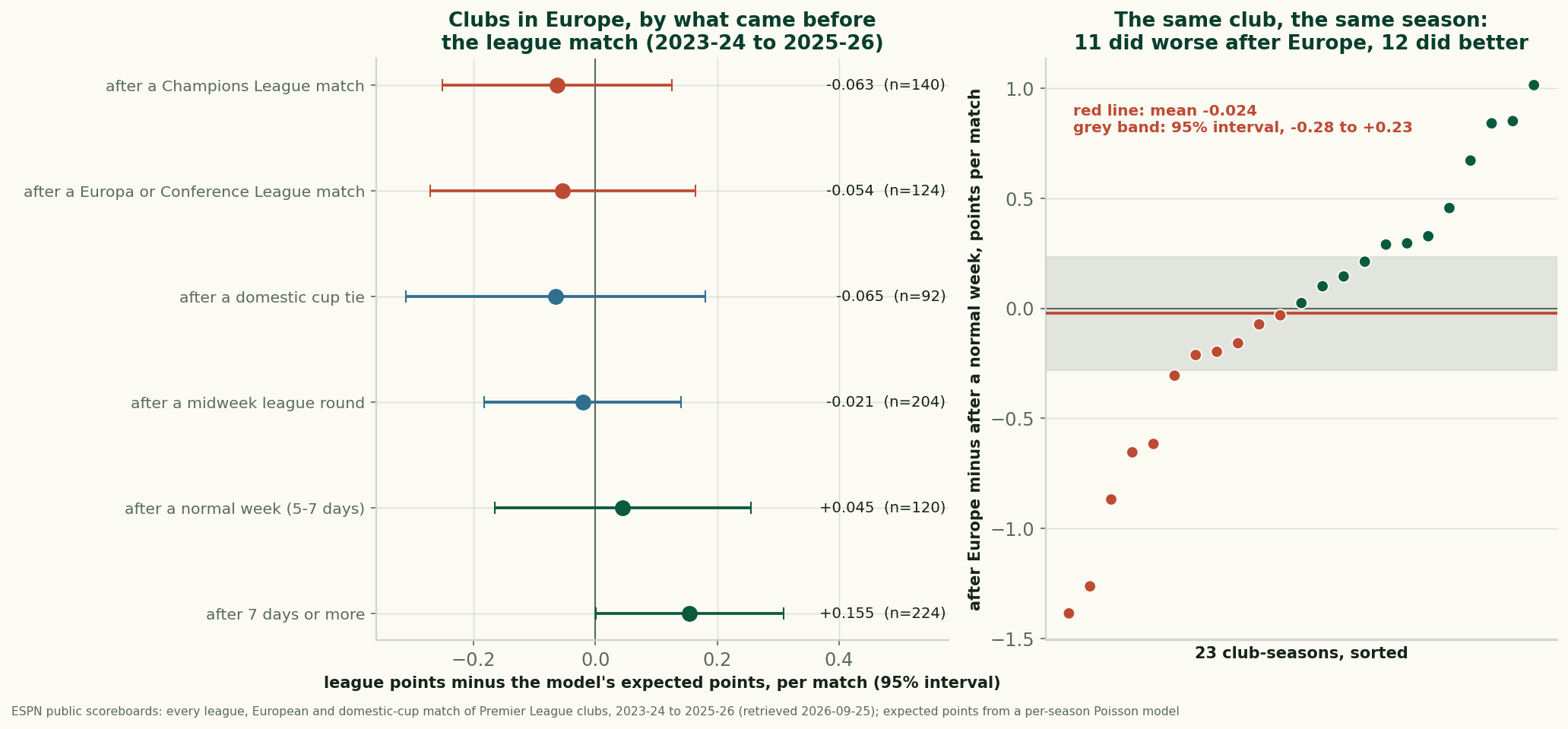
Does Europe Cost English Clubs at the Weekend? Three Seasons Can't Find It
After a European night, English clubs took 1.56 league points a match against 1.62 expected. Within the same club and season the gap is -0.024: not measurable.
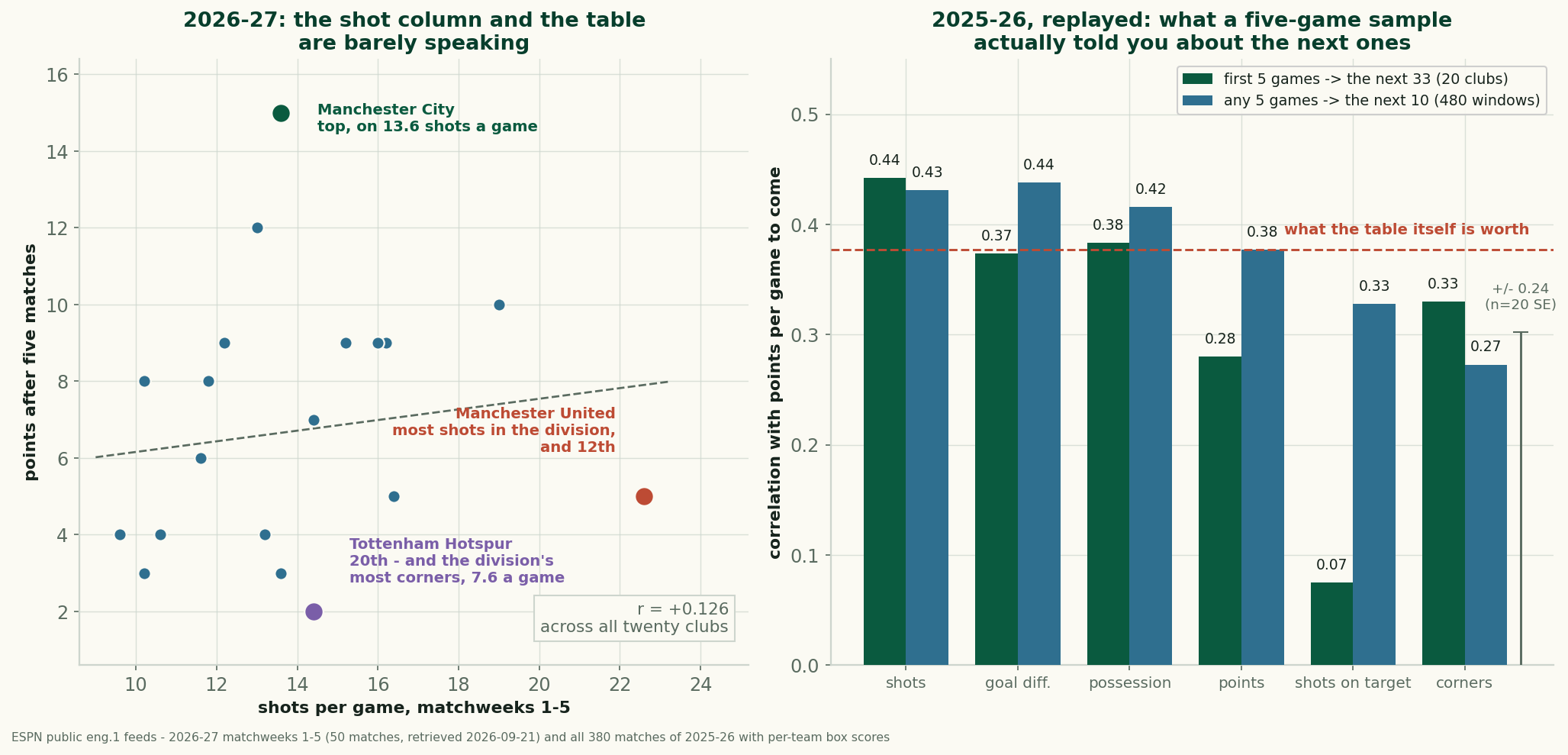
Manchester United Lead the League in Shots and Sit Twelfth
United take 22.6 shots a game and have 5 points. Across 2025-26, a club's five-game shot count predicted its next results better than its points did.
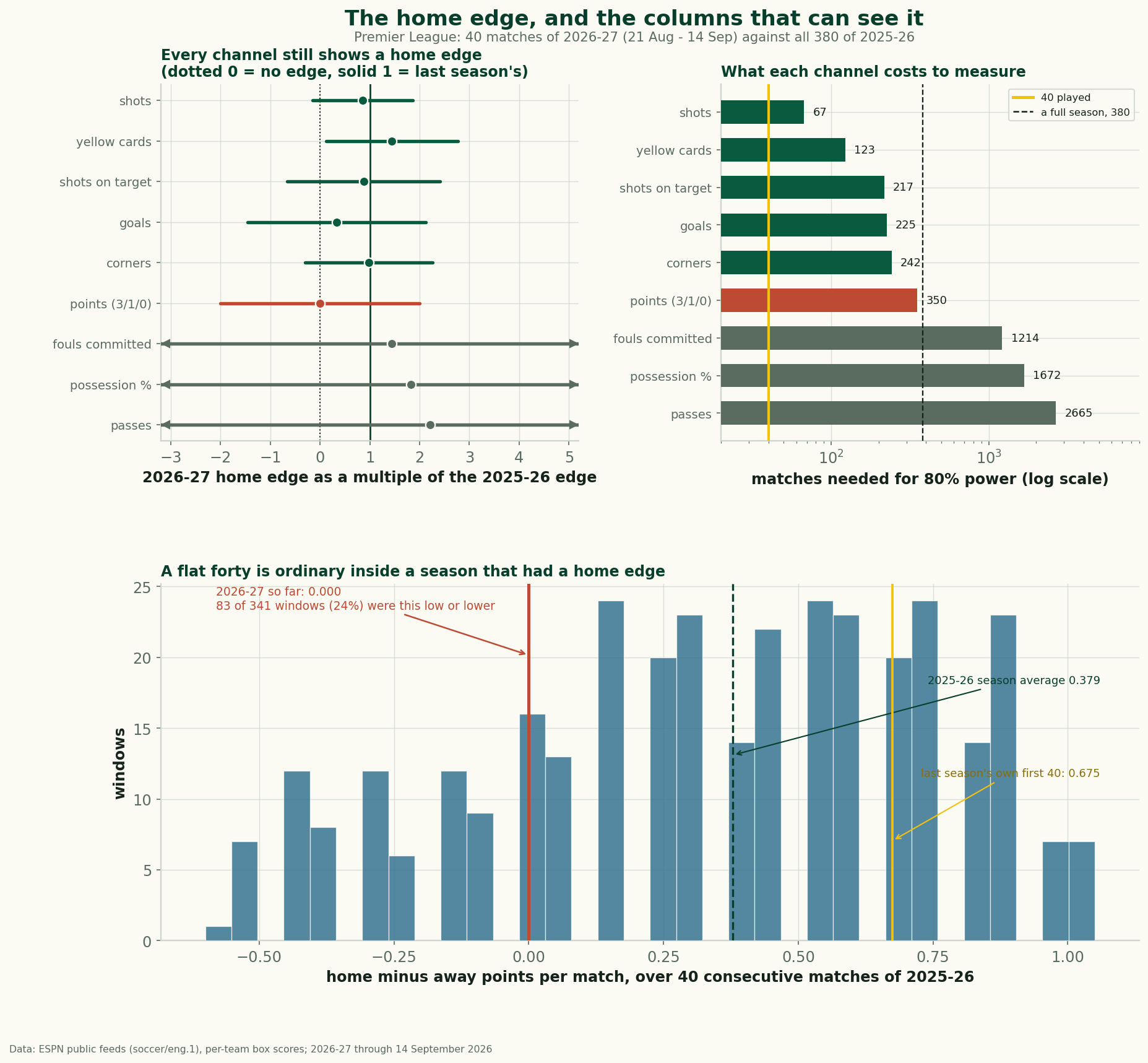
Home Advantage Didn't Die. The Results Column Can't See It
Home and away split the first 40 matches of 2026-27 evenly, yet the shot, corner and card columns keep the home edge. Plus a decade of home-advantage data.