The Cutback: Why the Pull-Back From the Byline Is Football's Most Dangerous Assist
A pass rolled backwards toward your own goal that creates a near-certain chance.
There is one passing pattern that makes analysts sit up every time it appears in the data, and at first glance it looks like a mistake. A player reaches the byline, right next to the opposition goal-line, and instead of crossing toward goal he passes the ball backwards, away from the goal, square across the edge of the six-yard box to a teammate arriving from deep. That backward pass — the cutback — is one of the most valuable actions in football. Understanding why is a short lesson in the geometry of goalscoring.
What a cutback is
A cutback is a pass pulled back from a position close to or on the goal-line, played to a teammate arriving centrally, usually around the penalty spot or the edge of the box. The ball-carrier has driven to the byline — often after beating a full-back on the outside — and rather than trying to find a head in a crowded six-yard area, he rolls the ball back into the space the defence has had to vacate. A runner meets it and shoots, frequently first time, frequently with the goal gaping.
Technically a cutback is a kind of cross, but it has almost nothing in common with the hopeful high ball that gives crossing its poor analytical reputation. The ordinary cross asks a teammate to win an aerial duel and then beat a set goalkeeper with a header — two hard things in sequence. The cutback asks a teammate to side-foot a rolling ball into a net the keeper has been dragged away from — one relatively easy thing. That is why, when we argued that the average cross is overrated, we singled out the cutback as the exception that actually works. (See the overrated cross for that case.)
The geometry of why it works
The cutback's power is geometric, and it comes down to three things happening at once: where the defenders are looking, where the goalkeeper is, and what angle the shooter gets.
The defence is facing the wrong way. When an attacker reaches the byline, the entire defensive line and the goalkeeper have turned to track the ball toward their own goal. Defenders are now ball-watching, side-on or with their backs to the runners arriving behind them. A defender cannot mark a man he cannot see and track a ball at the byline at the same time. The cutback exploits exactly that split of attention: it is played into the blind side the defenders created by collapsing toward the ball.
The goalkeeper is pinned to the near post. As the ball travels to the byline, the keeper shuffles across to guard the near post and the threat of a ball squared in front of goal. That movement drags him out of the centre of his goal. When the ball is pulled back to the penalty spot, the runner is shooting at a goal whose keeper is several yards out of position and moving the wrong way. The keeper has to reset, and there usually is not time.
The shooter is square to goal. This is the heart of it. A header from a high cross arrives across the body, at pace, from an awkward angle. A ball met from a cutback arrives flat along the ground to a player running onto it, facing the goal, able to use his feet. The shooter is central, square, and unhurried by aerial contest. Plug that situation into an expected-goals model — which weighs distance, angle, body part, and the defenders and keeper around the shot — and a central, footed, first-time shot from around the penalty spot with the keeper displaced carries far more xG than a contested header from the same distance.
An illustrative contrast makes the gap concrete. The figures below are round and hypothetical, chosen to show the mechanism rather than to describe any real match.
| Final action | Shooter facing goal? | Keeper set? | Illustrative xG |
|---|---|---|---|
| High cross to a contested header | no | yes | ~0.05 |
| Cutback to a central runner | yes | no | ~0.15 |
Three times the value from the same starting position, repeated across a season, is the whole reason coaches drill the run to the byline and the pull-back rather than the early cross.
Spotting cutback-heavy attacks in the data
If the cutback is so valuable, the practical question is how to find the teams and players who generate it. Raw event data does not usually hand you a "cutback" label, so you reconstruct the pattern from the coordinates. A few signals do most of the work.
- Pass origin and direction. Look for completed passes that start very close to the byline — deep in the final third, near the touchline, almost on the goal-line — and travel backwards relative to goal into the central zone around the penalty spot. A pass that moves away from the opponent's goal-line while staying in the box is the geometric signature of a cutback.
- The shot that follows. Cutbacks show up as assists and key passes that lead to central, footed shots taken from around the penalty spot — not headers, and not shots from tight angles. A team whose chances cluster centrally on the shot map, with a low share of headers, is often a cutback team.
- High xG per chance from wide entries. A side that reaches the byline a lot and converts those entries into high-xG central shots is generating cutbacks. The tell is the combination: lots of penetration to the byline, but chances that look central and high-value rather than the low-value headers a crossing team produces.
- Shot-creating actions from the wide channels. Pairing shot-creation data with location helps separate teams that get to the byline and cut the ball back from teams that get there and float it in. Two sides can have identical "touches in the final third near the line" and produce wildly different chance quality depending on what they do next.
The discipline is the same one that runs through all good chance-creation analysis: never read delivery volume on its own. A team can cross a great deal and create almost nothing, or reach the byline a similar number of times and manufacture a string of high-value central chances by pulling the ball back instead of lofting it in. The xG per chance, and the shape of where those chances sit on the pitch, is what separates them.
Why it is hard to defend
The reason the cutback persists as a weapon — and why coaching against it is so prominent — is that the defensive options are all bad. Step out to block the cutback and you leave the back post; drop to cover the runners and you concede the byline; commit the keeper and you open the near post. The cutback forces the defence to choose what to give up, and a well-timed run from deep attacks whichever choice they made. The best defences guard against it by stopping the move before the byline — preventing the wide entry in the first place — because once an attacker is square on the goal-line with a runner arriving, the geometry has already turned against them.
That is the deeper lesson the data keeps teaching: in football, the position of the ball matters less than the position and orientation of the bodies around it. The cutback wins not because the pass is hard, but because it arrives at the one moment when the defence is looking the wrong way, the keeper is out of his goal, and a teammate is facing an open net. A table of cutback-driven chances would need shot-level event data our tournament feed doesn't carry; for everything the completed 2026 matches do support, see the site's full World Cup coverage.
The data behind this piece
- StatsBomb — research on cut-backs, crossing, and the value of different delivery types.
- The Analyst — explainers on shot quality and chance creation from wide areas.
- FBref — shot-creating actions and passing data by location across competitions.
- Understat — shot-level xG you can use to weigh the quality of cutback chances.
More from Data Deep-Dives
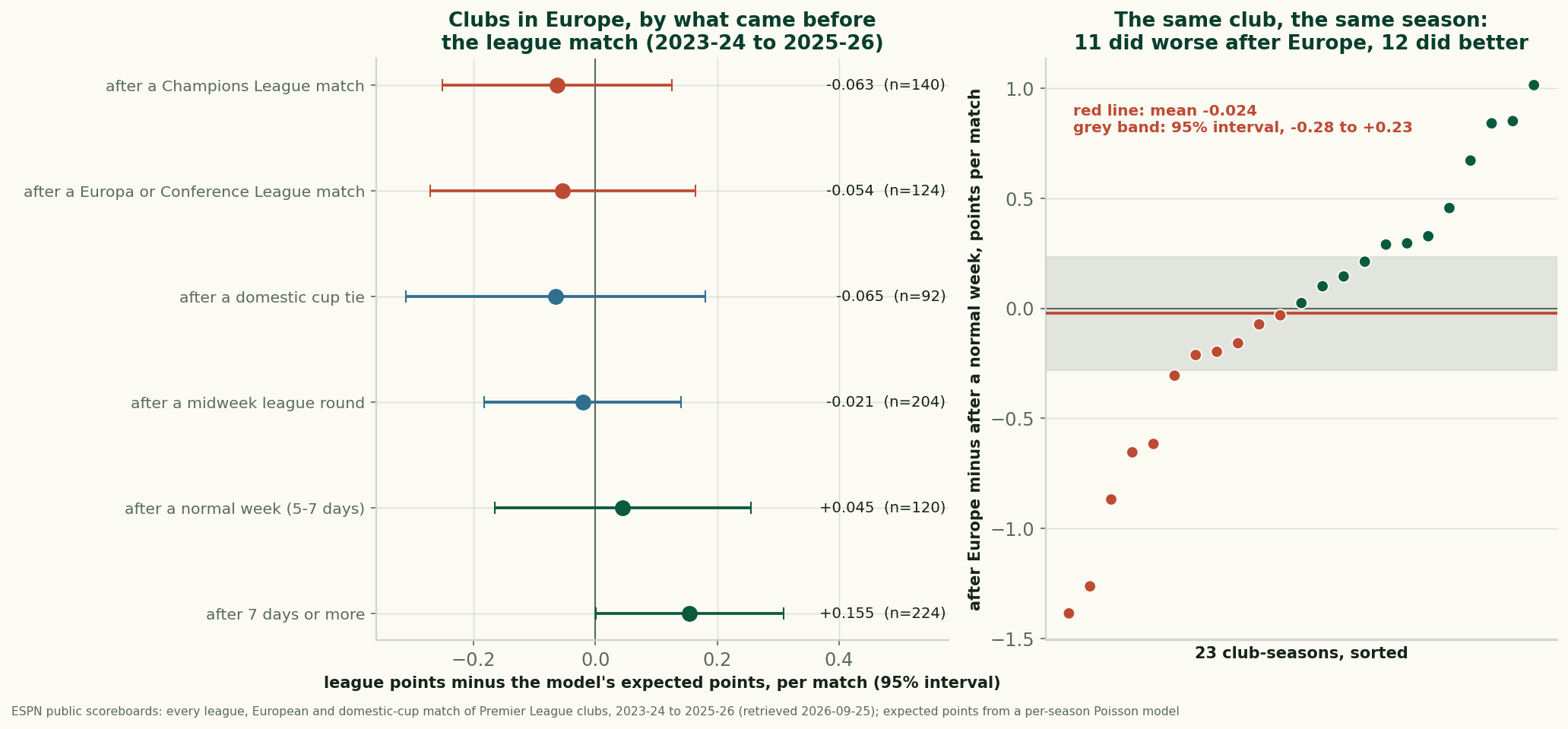
Does Europe Cost English Clubs at the Weekend? Three Seasons Can't Find It
After a European night, English clubs took 1.56 league points a match against 1.62 expected. Within the same club and season the gap is -0.024: not measurable.
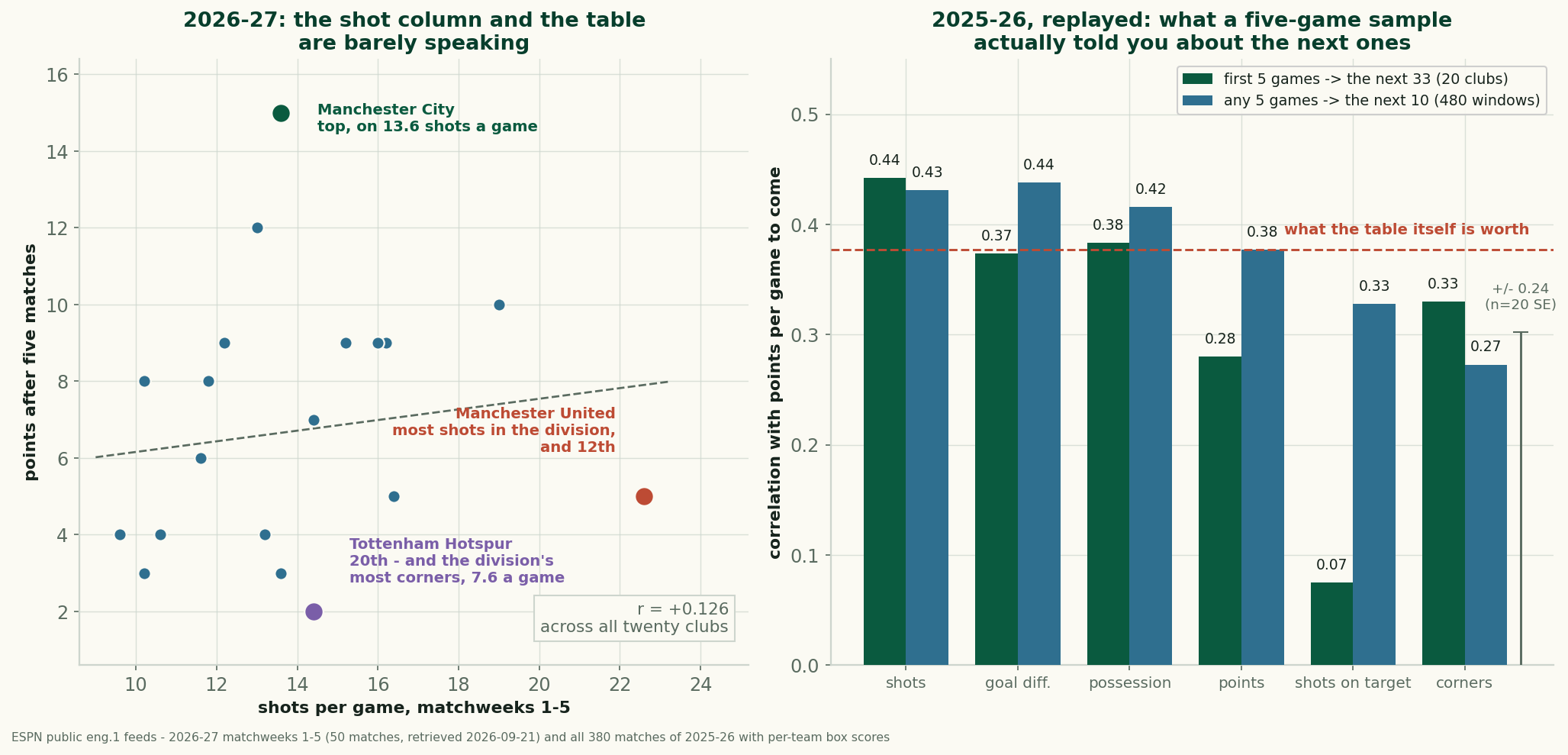
Manchester United Lead the League in Shots and Sit Twelfth
United take 22.6 shots a game and have 5 points. Across 2025-26, a club's five-game shot count predicted its next results better than its points did.
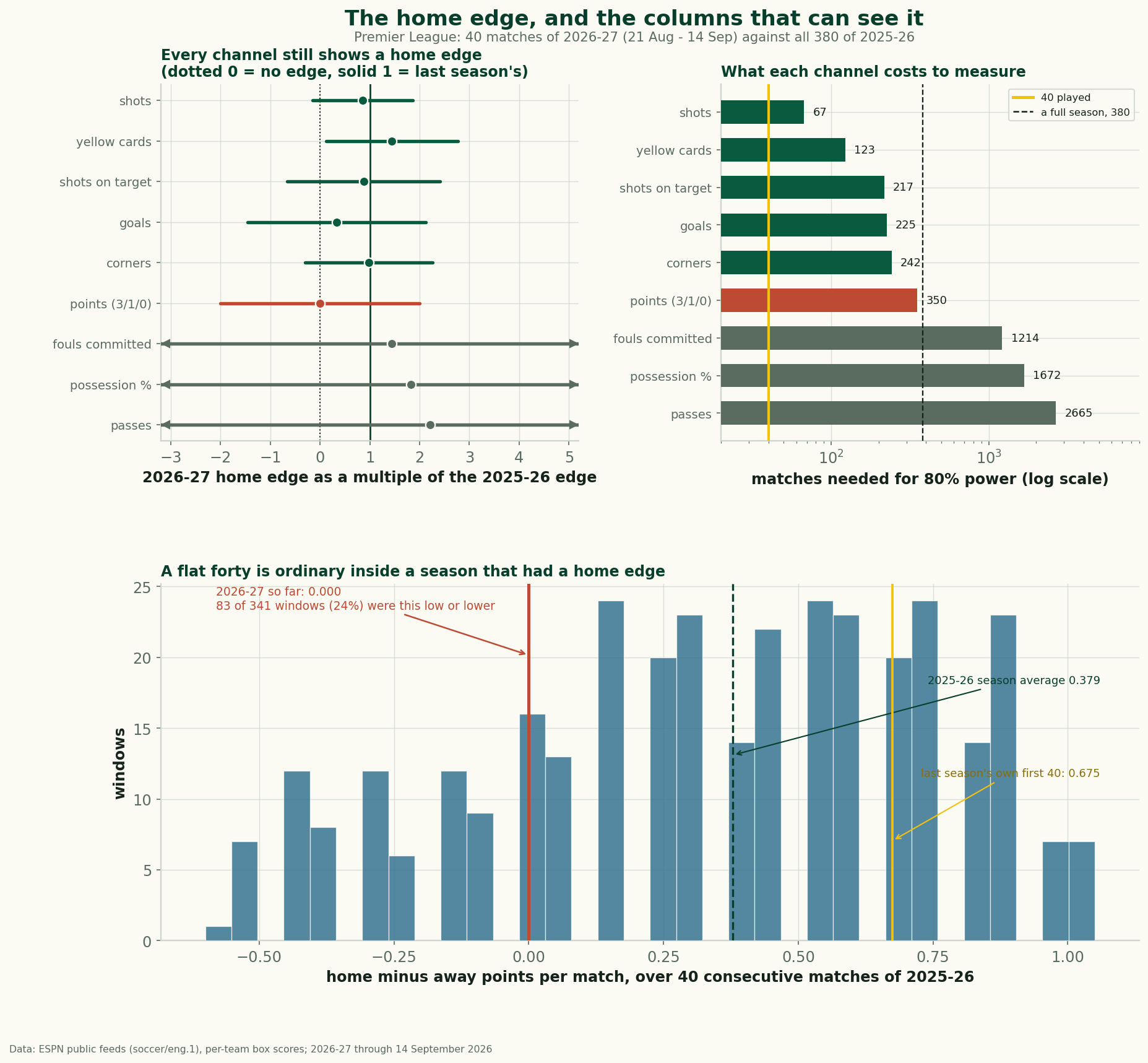
Home Advantage Didn't Die. The Results Column Can't See It
Home and away split the first 40 matches of 2026-27 evenly, yet the shot, corner and card columns keep the home edge. Plus a decade of home-advantage data.