Transition and Counterattacks: Why Turnovers Are Football's Most Dangerous Moments
The seconds after a turnover are when goals are made.
Watch where goals actually come from and a pattern emerges that no amount of slow, patient build-up can match: an enormous share of the best chances in football are created in the few seconds immediately after a turnover. The ball changes hands, one team is suddenly out of shape, and before the defence can reset, the ball is in a dangerous area against fewer bodies than should be there. These transition moments are the closest thing the sport has to free goals, and understanding why is one of the most useful things the data can teach you.
What a transition moment is
A transition is the brief, unstable window that opens the instant possession changes. For the team that has just won the ball, it is a counterattacking opportunity; for the team that has just lost it, it is a defensive emergency. The defining feature is that the defending side is not set. Players who were committed to attacking are now the wrong side of the ball, the defensive line has not had time to compress, and the spaces that are normally closed are briefly, gloriously open.
That window is short — a handful of seconds before shape is restored — which is exactly why elite counterattacking teams play with such urgency the moment they win possession. The value is decaying by the touch. Every pass played slowly, every moment of hesitation, lets a defender recover a position and shrinks the advantage. The whole art of the counter is converting a turnover into a shot before the door closes.
Why counter shots carry higher xG
The reason transition moments matter so much, analytically, is that the chances they produce are systematically better than chances created against a set defence. This is one of the more robust directional findings in public football analytics: shots taken on fast breaks and counterattacks carry, on average, a higher expected-goals value than shots taken in settled possession. The exact size of the gap varies by competition, by how "counter" is defined, and by which model is doing the measuring — so treat any single figure with caution — but the direction of the effect is consistent and intuitive.
The mechanism is space and bodies. Expected goals is driven heavily by where a shot is taken from, how central it is, and crucially how many defenders sit between the ball and the goal. (For what the metric does and does not claim, see expected goals explained.) A shot in settled possession is usually taken against a fully formed defensive block: the keeper is set, defenders are goal-side, lanes are blocked. A shot on a counter is taken into the gaps that block has not yet closed — more central, less obstructed, often with a numerical advantage. Same distance from goal, very different chance quality, because the defensive context is so much friendlier.
Consider two illustrative shots from the same spot — the penalty spot, dead centre, twelve yards out. The numbers here are hypothetical, chosen only to make the contrast concrete, not measured from real matches.
| Context | Defenders between ball and goal | Illustrative xG |
|---|---|---|
| Settled possession, set block | 5 | 0.18 |
| Fast counterattack, 3-v-2 break | 1 | 0.41 |
The location is identical; only the context differs. The settled shot must beat a packed box and a set goalkeeper; the counter shot arrives with one recovering defender and acres of space. A good xG model reads that difference through the geometry of bodies on the pitch, and the transition chance comes out worth more than double. Multiply that edge across a season of turnovers and you see why some teams build an entire identity around it.
The style trade-off
If transition chances are so valuable, why does any team bother dominating the ball? Because the two approaches are a genuine trade-off, not a free lunch. A possession-dominant side accepts lower-value chances in exchange for volume and control: it keeps the ball, suppresses the opponent's attacks by denying them possession at all, and grinds out enough territory to manufacture chances against set defences. A transition-oriented side accepts that it will see less of the ball and create fewer total chances, betting that the ones it does create — struck against unbalanced defences — will be worth far more apiece.
Neither is correct in the abstract; they are different routes to the same destination of out-scoring the opponent. A team can even blend them, dominating possession for long spells and then springing a counter the moment the ball is won high. The defining tactical story of the modern era is in part the discovery that these styles are not opposites to be chosen between but tools to be combined — a theme we trace through how Pep, Klopp and data rewired tactics, where possession dominance and ferocious transition play were welded into the same teams.
Pressing high to win the ball near goal
The most direct way to manufacture dangerous transitions is to win the ball as close to the opponent's goal as possible. A turnover forced high up the pitch hands you a counterattack that starts already in a threatening position, against a defence with the least time of all to recover — because it has just lost the ball while committed to building an attack of its own. This is the logic of the high press, and it is why pressing and transition are really two halves of one idea.
Metrics like PPDA exist to quantify exactly this hunting behaviour — how quickly and how high a team intervenes to win the ball back — and we unpack the construction in PPDA explained. The link to transition value is direct: a team that presses high is, in effect, a machine for generating turnovers in the very zone where the resulting counter is most lethal. The press is not only about regaining possession; it is about regaining it where the ball is worth the most.
Game state and the invitation to counter
Transition dynamics also bend sharply with the scoreline. A team protecting a lead deliberately cedes the ball and drops into a deeper block — which is, from the trailing team's point of view, an invitation to attack into space the leaders have voluntarily vacated. But it is a double-edged invitation: the leading team, sitting deep and compact with players behind the ball, is perfectly arranged to spring its own counters when it wins possession, breaking into the space the chasing side has left behind by committing bodies forward.
This is why so many late goals by a leading side come on the break: the trailing team pushes everyone up to equalise, loses the ball, and is punished into the space it abandoned. The whole effect is a function of game state rather than raw ability, and reading it correctly means knowing the scoreline each chance was created under — the habit we argue for at length in game state and score effects. A counterattacking threat is not a fixed property of a team; it waxes and wanes with the score on the board.
Reading transition in the data
For the analyst, the practical takeaway is to separate a team's chances by how they were created before judging its attack. A side with a modest total xG that comes disproportionately from transitions may be more dangerous than its volume suggests, because its chances are higher-quality per shot and it does not need many of them. A possession side with a large total xG built from low-value efforts against set blocks may be flattering itself. The same season-total number can describe two very different, and very differently dangerous, teams.
Whenever you can, ask not just how much xG a team generated but where it came from in the rhythm of the game. Settled or in transition, against a set block or a scrambling one, won low or won high — these distinctions are where the real information lives. Goals, more often than the highlight reel admits, are not built patiently. They are stolen in the seconds after the ball changes hands.
Sources, notes & further reading
- StatsBomb — analysis and methodology on shot context, fast breaks, and what drives chance quality.
- StatsBomb open data — event data with possession and play-pattern tags, for separating counters from settled play.
- Understat — shot-level xG data for the major European leagues.
- FBref — shot-creation and goal-type breakdowns useful for studying transition attacks.
More from Data Deep-Dives
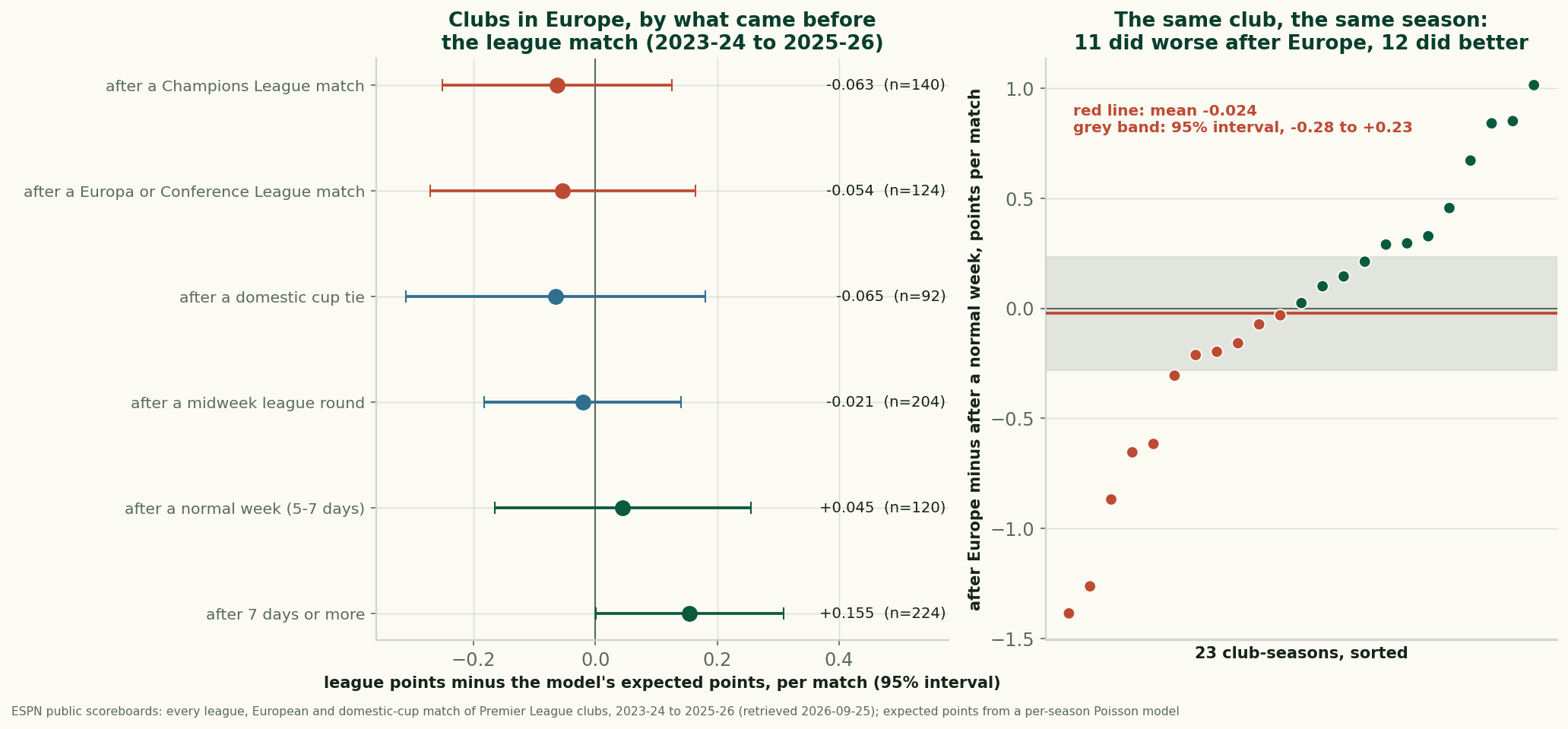
Does Europe Cost English Clubs at the Weekend? Three Seasons Can't Find It
After a European night, English clubs took 1.56 league points a match against 1.62 expected. Within the same club and season the gap is -0.024: not measurable.
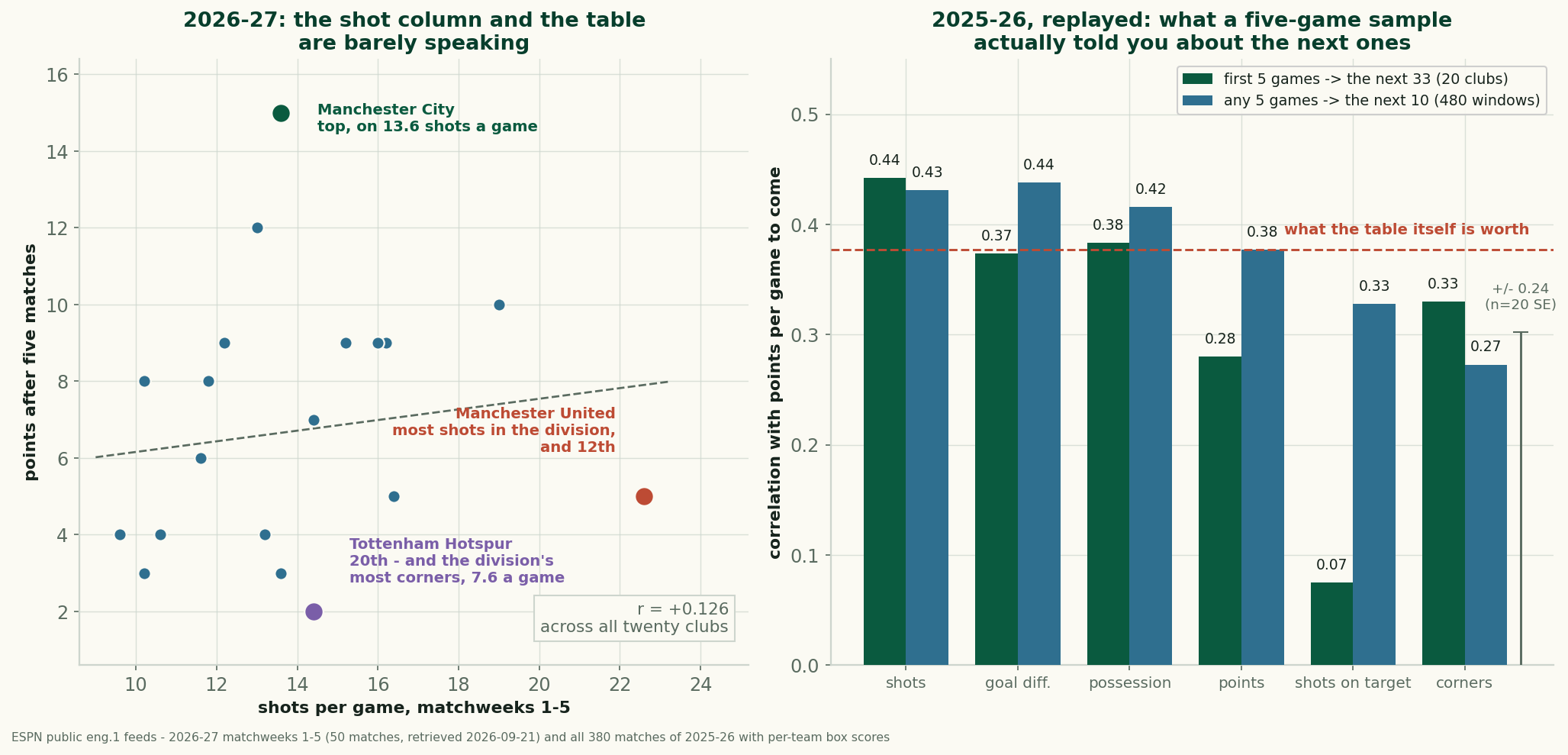
Manchester United Lead the League in Shots and Sit Twelfth
United take 22.6 shots a game and have 5 points. Across 2025-26, a club's five-game shot count predicted its next results better than its points did.
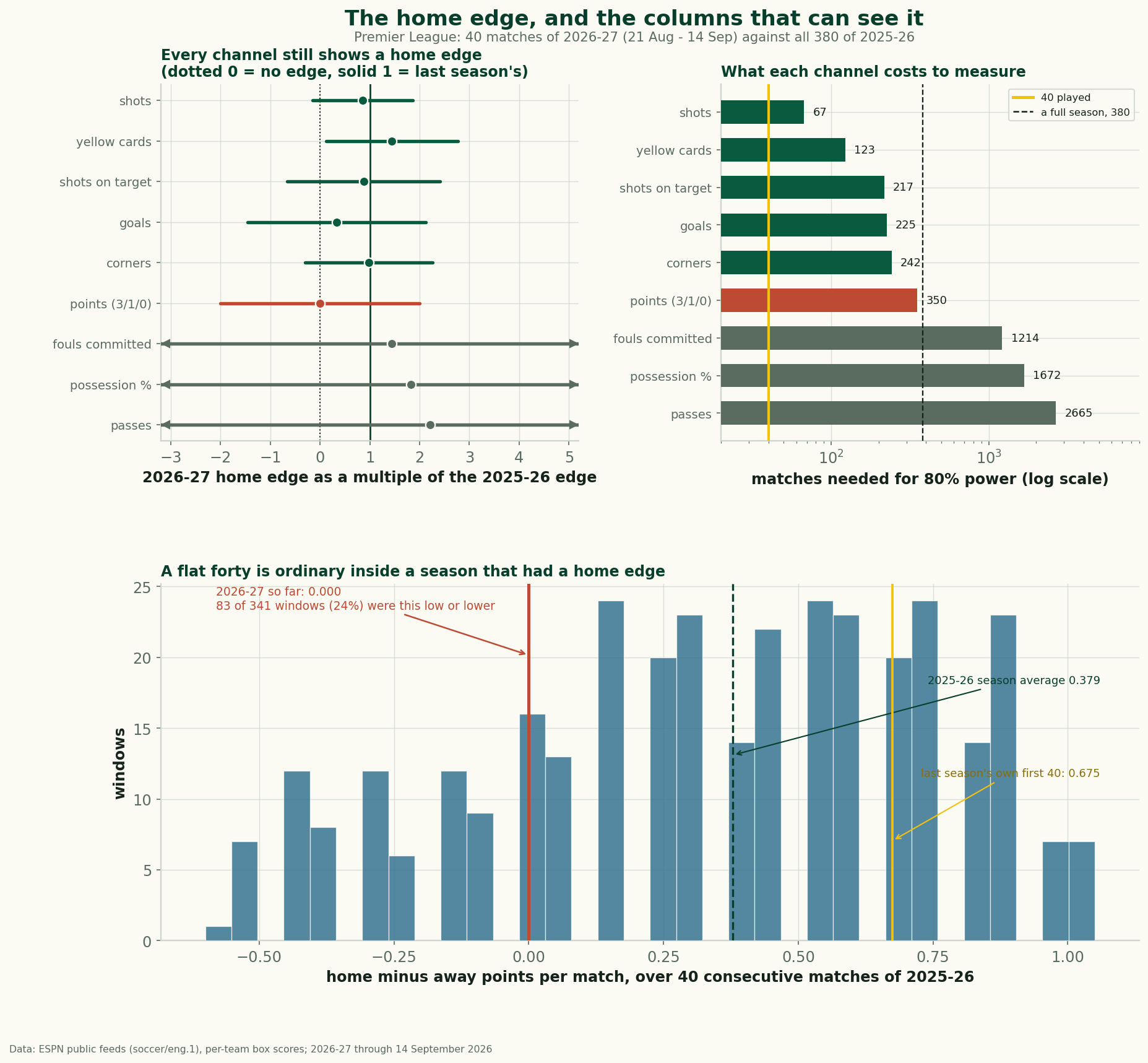
Home Advantage Didn't Die. The Results Column Can't See It
Home and away split the first 40 matches of 2026-27 evenly, yet the shot, corner and card columns keep the home edge. Plus a decade of home-advantage data.