Progressive Passes and Carries: The Stats Behind Ball Progression
Who really moves the ball forward - and how we count it.
Completion percentage tells you nothing about where the ball went. A goalkeeper can spray 98% of his passes sideways all season and top the chart. Progressive passes and progressive carries are the fix: they count only the actions that actually moved the ball toward the opponent's goal. The result is a ranking that looks nothing like the usual suspects — and tells you something the raw numbers never could.
What counts as progressive
Both stats start from the same question: did this action carry the ball meaningfully forward? The operational definitions used in the StatsBomb data are precise and worth quoting exactly:
- Progressive pass: a completed open-play pass that moves the ball at least 10 yards closer to the opponent's goal.
- Progressive carry: a ball carry (a player running with the ball) that advances the ball at least 5 yards closer to the opponent's goal.
Two details matter. "Closer to goal" is measured in straight-line distance to the centre of the goal, not horizontal yardage up the pitch. A diagonal ball that moves the ball sideways but also cuts five yards off the distance to goal counts. A perfect square pass doesn't. The other detail: set-piece restarts are excluded from progressive passes. A corner-kick drilled to the far post is a 30-yard ball moved 30 yards closer to goal on paper; it would pollute the ranking badly, so it's filtered out.
FBref and Opta use a similar family of definitions but not identical ones. FBref's progressive pass requires the ball to travel at least one-third of the way toward the opponent's goal, and their progressive carry requires 10 yards of linear advance. Neither is more "correct" — they're measuring the same underlying concept with slightly different dials turned. When you compare numbers across sources, check the methodology page first.
Why centre-backs and deep midfielders win this ranking
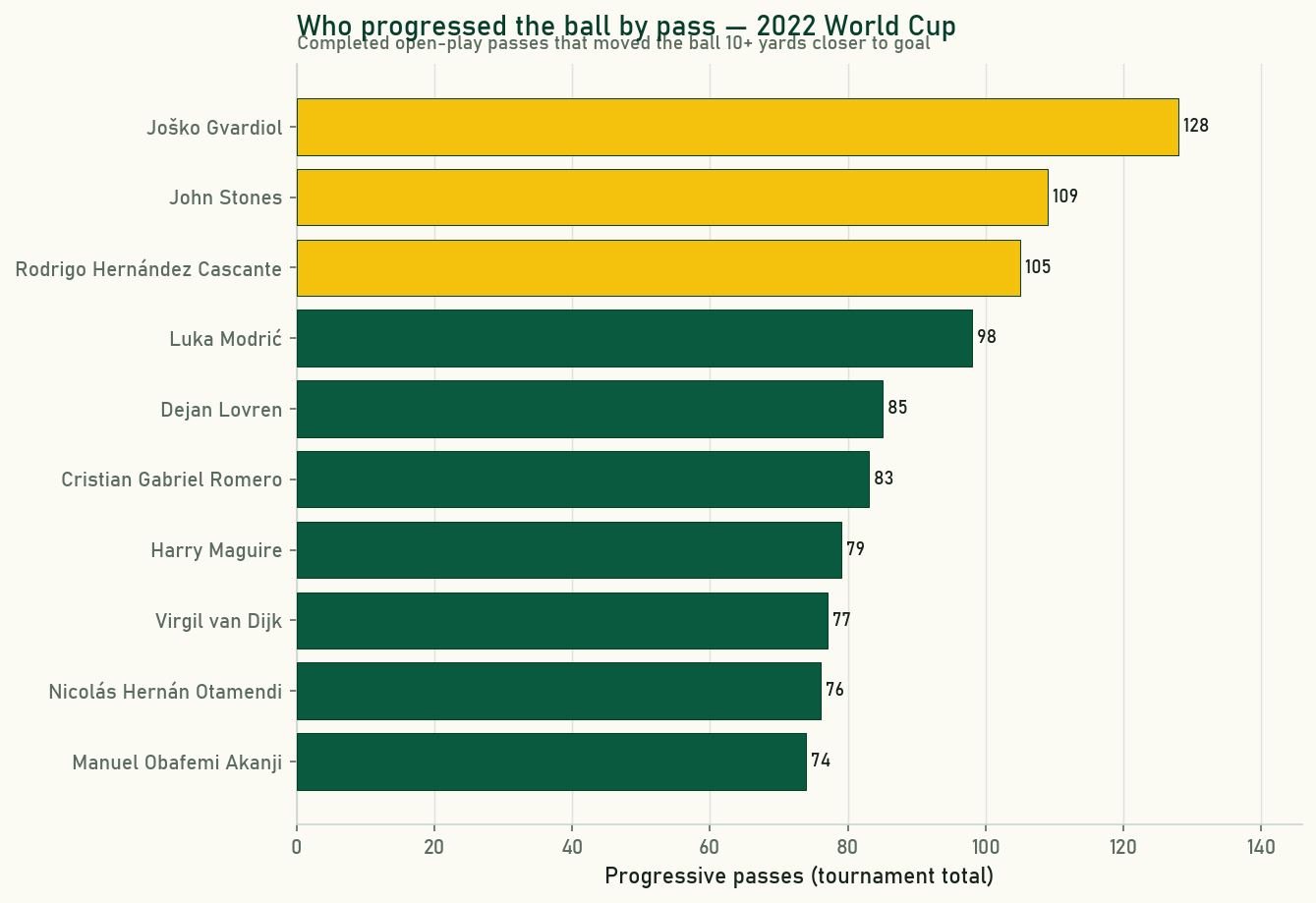
On first instinct most people expect progressive passes to be won by attacking midfielders delivering balls into the box. The data gives a very different answer.
| # | Player | Progressive Passes |
|---|---|---|
| 1 | Joško Gvardiol | 128 |
| 2 | John Stones | 109 |
| 3 | Rodrigo Hernández Cascante | 105 |
| 4 | Luka Modrić | 98 |
| 5 | Dejan Lovren | 85 |
| 6 | Cristian Gabriel Romero | 83 |
| 7 | Harry Maguire | 79 |
| 8 | Virgil van Dijk | 77 |
| 9 | Nicolás Hernán Otamendi | 76 |
| 10 | Manuel Obafemi Akanji | 74 |
Joško Gvardiol led the entire tournament at the World Cup with 128 progressive passes. Below him: John Stones, Luka Modrić, Dejan Lovren, Cristian Romero, Harry Maguire, Virgil van Dijk, Nicolás Otamendi, Manuel Akanji. Eight of the ten are centre-backs or deep-lying midfielders. There is a structural reason for this that has nothing to do with individual talent.
A centre-back in possession stands 30–40 yards from the opponent's goal. Almost any competent forward pass — a 15-yard diagonal into midfield, a line-breaking ball over the press, a switch across the pitch — qualifies as progressive because it covers the required 10 yards toward goal from that starting position. An attacking midfielder or wide forward standing 20 yards out has already moved the ball most of the way; the passes available to them are often shorter and more lateral. The threshold that is very easy to clear from deep is often impossible to clear when you are already in the final third. Volume, therefore, accumulates at the back.
It also accumulates with possession. Croatia's centre-backs completed so many progressive passes partly because Croatia kept the ball well enough to recirculate it through their defensive line repeatedly. A centre-back in a low-block side will see the ball far less, and the comparison becomes unfair without accounting for it.
Carries tell a different story — almost
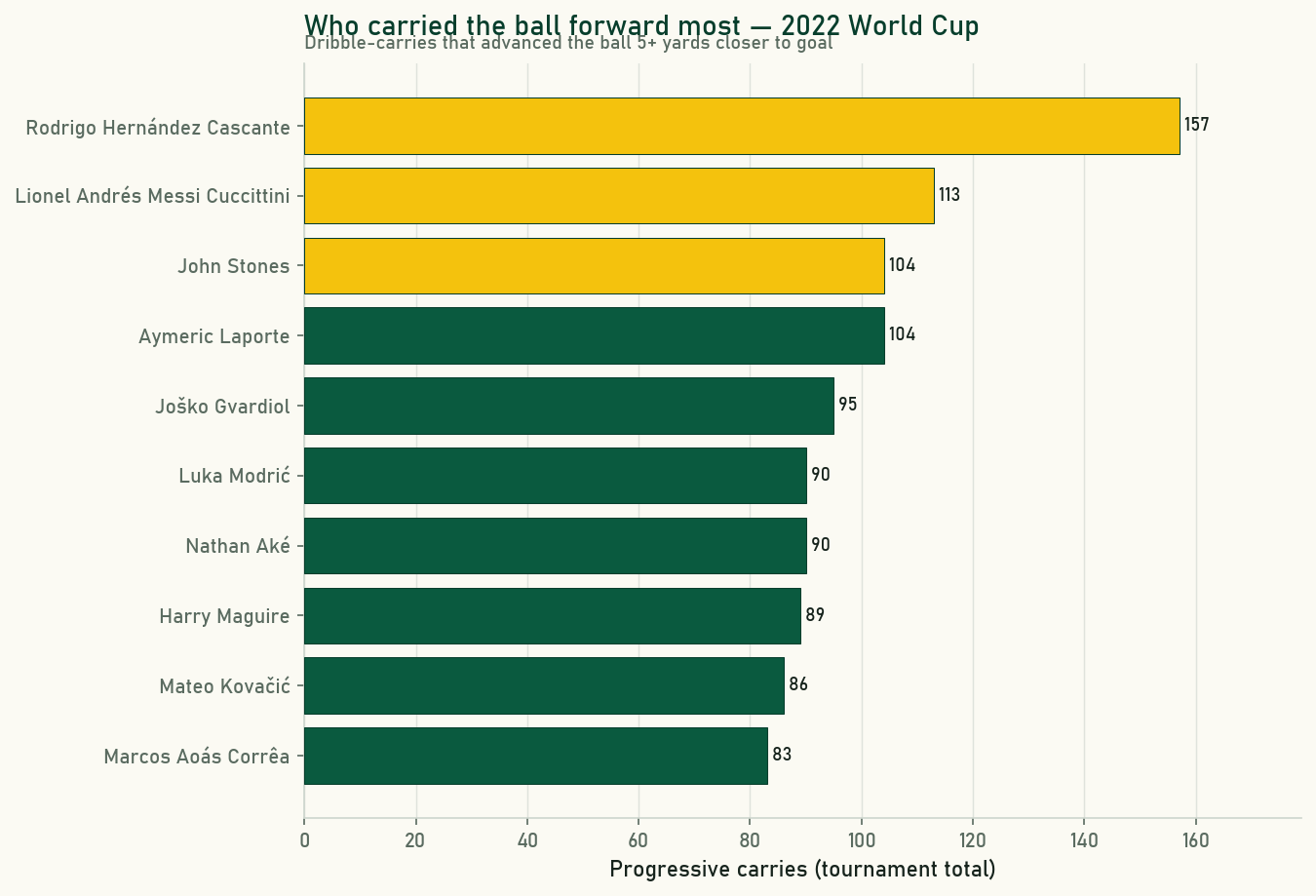
Progressive carries have a lower threshold: just 5 yards closer to goal. Running with the ball is naturally a shorter action than a pass, so the bar is set lower. The carry rankings at the 2022 World Cup show an interesting overlap — and one significant departure.
| # | Player | Progressive Carries |
|---|---|---|
| 1 | Rodrigo Hernández Cascante | 157 |
| 2 | Lionel Andrés Messi Cuccittini | 113 |
| 3 | John Stones | 104 |
| 4 | Aymeric Laporte | 104 |
| 5 | Joško Gvardiol | 95 |
| 6 | Luka Modrić | 90 |
| 7 | Nathan Aké | 90 |
| 8 | Harry Maguire | 89 |
| 9 | Mateo Kovačić | 86 |
| 10 | Marcos Aoás Corrêa | 83 |
Rodrigo Hernández — Rodri — led the tournament with 157 progressive carries. Most of the same centre-backs appear: Stones, Laporte, Gvardiol, Maguire, Aké, Marcos Aoás Corrêa. The structural advantage of playing deep holds for carries too: a centre-back stepping forward with the ball covers those 5 yards easily from their starting position. But the departure is Messi in second place with 113. Elite forwards with the license to receive deep and drive forward show up in carry rankings in a way they rarely do in progressive-pass rankings, because their value in carries comes from what they do with the ball rather than where they receive it.
How to actually use these numbers
Progressive stats are most useful in three ways.
Identifying ball-playing centre-backs. This is arguably where they earn their place most cleanly. A high progressive-pass count from a centre-back, sustained over a tournament or season, is a reliable signal that they are comfortable initiating play under pressure. Gvardiol's 128 at this World Cup is not a fluke of one good game; it is the accumulated result of Croatia's structure asking him to carry the ball out of deep areas, and him executing it. The stat aligns with the eye test in a way that raw completion percentage never could.
Understanding how teams build out. If a team's top progressive passers are its centre-backs and nobody in midfield ranks highly, the team probably builds direct with the midfield largely bypassed. If the midfielders rank highest, the team likely progresses through lines. The distribution of progressive actions across a roster is a structural fingerprint.
Evaluating press resistance. Teams that face frequent high presses need their ball-carriers to beat that press regularly. Progressive carries, in particular, measure whether players can physically advance the ball against pressure rather than just passing away from it. Rodri's 157 carries for a Spanish team that dominated possession tells you something about how Spain escaped pressure situations.
What these numbers cannot tell you: how easy the progressive actions were, whether the ball ended up in dangerous areas after the progression, or what happened to it next. A 10-yard progressive pass into a cul-de-sac on the touchline and a 10-yard line-breaking pass into a striker's feet count identically. Progressive stats are a starting point for analysis, not a verdict.
Sources, notes & further reading
- StatsBomb open data — match and event data for the 2022 World Cup used throughout this article.
- StatsBomb — documentation on their event definitions, including passes and carries.
- FBref — progressive pass and carry data for club football, with their own definitional notes.
- Stats Perform / Opta — source of the definitions used in most broadcast and club data pipelines.
More from Stat Explainers
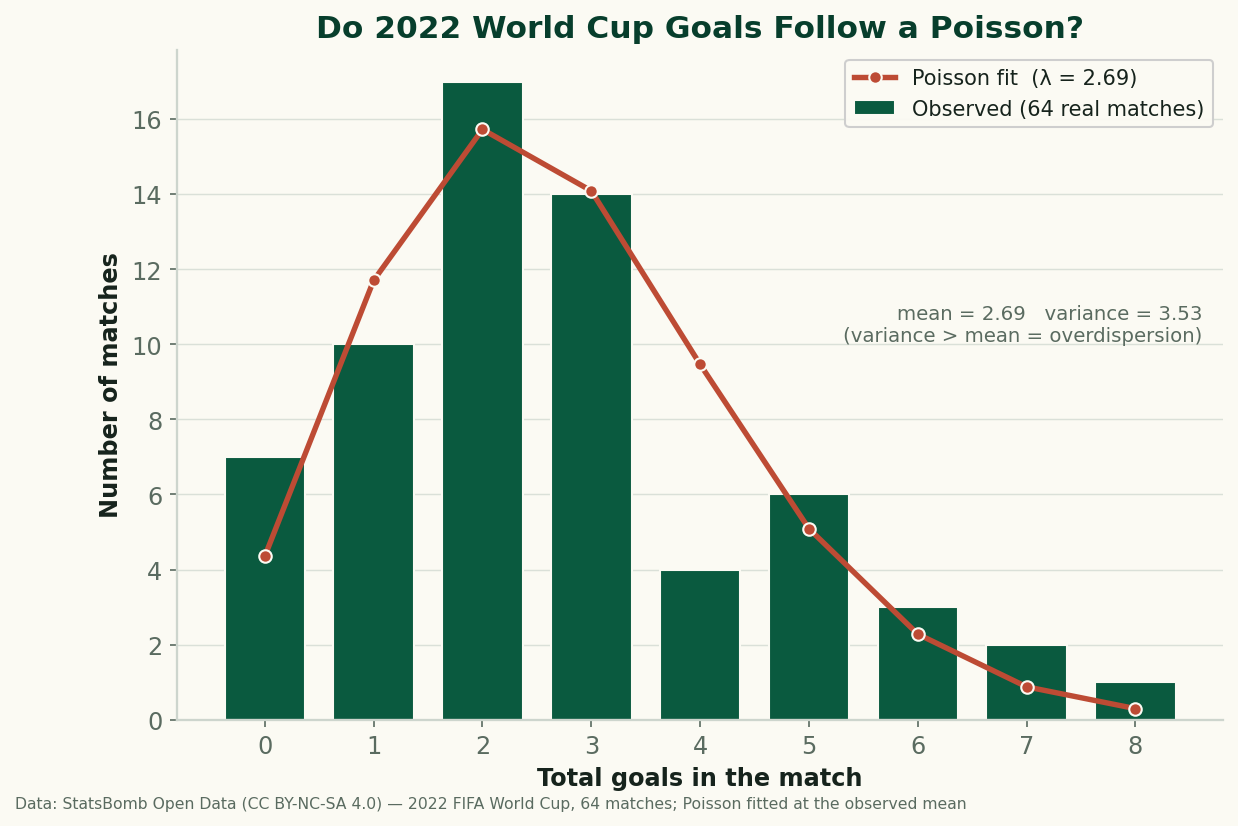
Do Football Goals Follow a Poisson? Testing the Standard Model on All 64 Games of 2022
Every scoreline prediction in football rests on the Poisson. We fit it to all 64 games of 2022 — it gets the shape right, but real goals are overdispersed.
Aerial Duels and Heading Data: Reading Win Rate Without Getting Fooled by Volume
Aerial-duel win percentage, why raw counts mislead, and where aerial dominance actually matters — set pieces, target men, and defending crosses.
Expected Points (xPts): Turning Shot-Level xG Into a Fairer Table
Expected points (xPts) simulates a match from its shot-level xG to get win, draw and loss odds — points that reward chances created, not goals that went in.