Aerial Duels and Heading Data: Reading Win Rate Without Getting Fooled by Volume
The player who wins the most headers and the player who wins them best are rarely the same player.
"He won the most headers" is the kind of sentence worth distrusting. It sounds like a verdict and it's usually just a head count. A player can win fifteen of twenty-five and look commanding on the box score while a quieter team-mate wins eight of ten and is, in fact, the far better aerial presence — the rate says so even when the raw total shouts the opposite. That gap is the whole problem with heading data: the count answers a question (how often was this player in the air?) that is almost never the one you actually meant to ask.
So before trusting any aerial number, ask two things the headline figure hides: how many duels stand behind it, and what the player was being asked to do in the first place. Get those straight and the data becomes one of the more readable stats in the sport. Skip them and it will fool you every time.
What an aerial duel is, and what win % measures
An aerial duel is logged when two opposing players jump to contest the same ball in the air and one of them wins it — gets a head or other legal touch that directs the ball or denies the opponent. The event is recorded for both players, one as a win and one as a loss, so aerial duels come in matched pairs. From those events come two numbers that are constantly confused: the count of duels won, and the win percentage.
The count tells you how many a player won; the rate tells you how good they were at winning the ones they contested. They are different questions with different answers.
The win percentage is the quality measure. A win rate above roughly 60% marks a genuinely dominant aerial player; the very best target men and commanding centre-backs push higher still, while wingers and full-backs who rarely win the ones they contest can sit well below half. But the rate alone is incomplete, which is the heart of the problem.
Why raw counts mislead: the volume trap
Raw aerial counts are driven as much by a player's role and his team's style as by his ability. Consider the ways the count deceives.
Volume is a function of role, not skill. A target striker in a side that plays direct will contest twenty aerials a match; a deep-lying playmaker in a possession team might contest one. The striker can win more headers in absolute terms while being a worse aerial player by rate, simply because he is thrown into far more contests. Ranking players by headers won is therefore largely a ranking of how often their team puts the ball in the air near them — which is to say, not much of a ranking of aerial ability at all.
Team style inflates and deflates the denominator. Play against a team that launches long balls all game and your centre-backs rack up aerial duels by the dozen; play a patient short-passing side and the same defenders barely jump. The opponent, not the player, sets much of the volume.
Rate without volume is fragile. The opposite error is just as easy. A player who contests three aerials and wins all three posts a glittering 100% win rate built on almost nothing. A rate is only as trustworthy as the number of duels behind it — a handful of contests is noise, not a measured skill.
Where aerial dominance actually matters
Aerial ability is not uniformly valuable across the pitch — it concentrates in a few situations where heading the ball is the decisive act, and those are the places to weight it.
Set pieces, both ends. Corners and attacking free-kicks are the purest test of attacking aerial ability: a player who reliably wins his header in the box converts dead-ball volume into chances, and the same player at the other end heads them clear. Set-piece aerial duels are higher-leverage than open-play ones because each contest is closer to a shot. (For the broader value of dead-ball situations, see long throw-ins as a set-piece weapon.)
Target men and the direct outlet. A striker who holds up long balls lets a team bypass midfield pressure and play forward under duress. His aerial win rate against the opposing centre-backs is the engine of that outlet — not for the goals he heads, but for the possessions he wins or retains by getting a touch.
Defending crosses. The defensive value is enormous and easy to undercount. A centre-back who wins his aerials when crosses come in is suppressing chances before they become shots — work that never shows up as a tackle or an interception but shapes how much danger an opponent's wide play produces. Defending the cross is where aerial dominance quietly prevents goals.
Reading the data well
Put the cautions together and a sensible workflow emerges. Start with win percentage, but only trust it once the volume behind it is large enough to mean something — a season of duels, not an afternoon. Compare players within the same position and role, because a striker's aerial profile and a holding midfielder's are not on the same scale. Split by phase where the data allows: a player's set-piece aerial rate and his open-play rate can differ sharply, and the set-piece number is often the one that matters. Read defensive aerials as chance suppression, not as a counting stat, and resist the box-score reflex that rewards the player who jumped the most rather than the one who won what he jumped for.
One more refinement, and it's the one that matters most: aerial win rate says nothing about what happened to the ball after the header. Winning a flick that loops straight to an opponent is logged identically to winning a header that sets up a team-mate. The richest aerial analysis pairs the duel win with the outcome of the second ball — whose team kept possession after the header — which is closer to the thing that actually matters than the duel result on its own.
The bottom line
Aerial-duel data is a small case study in the difference between counting and measuring. The count — headers won — is mostly a record of opportunity, set by a player's role and his opponents' style. The rate — win percentage — is the quality signal, but only once enough duels stand behind it and only once you compare like with like. Weight it where it pays: dead balls at both ends, the direct outlet up front, the cross coming into your own box. Read the two numbers together, attach the outcome of the second ball when you can, and the player who merely spends a lot of time in the air stops being mistaken for the player who actually owns it.
Sources & data
- FBref — aerial duels won, lost, and win % across competitions (via Opta).
- StatsBomb — event definitions for aerial duels and set-piece data.
- StatsBomb open data — event-level data for computing aerial rates yourself.
- Defensive actions: tackles and interceptions — the same volume-vs-rate lessons for other defensive stats.
More from Stat Explainers
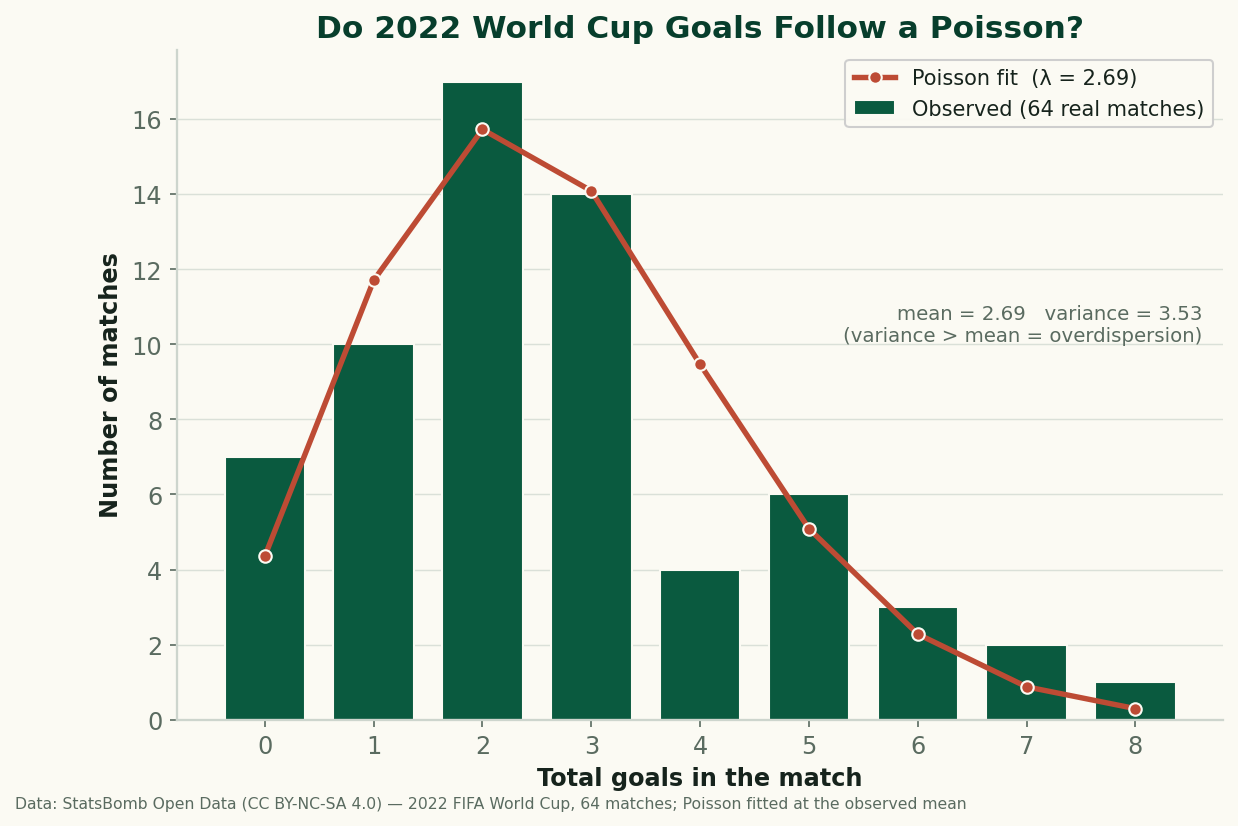
Do Football Goals Follow a Poisson? Testing the Standard Model on All 64 Games of 2022
Every scoreline prediction in football rests on the Poisson. We fit it to all 64 games of 2022 — it gets the shape right, but real goals are overdispersed.
Expected Points (xPts): Turning Shot-Level xG Into a Fairer Table
Expected points (xPts) simulates a match from its shot-level xG to get win, draw and loss odds — points that reward chances created, not goals that went in.
Goalkeeper Distribution and Playing Out From the Back: Reading the Numbers Behind Buildup
Short versus long goalkeeper distribution, launch %, pass completion under pressure, and how a keeper's distribution choices shape a team's buildup.