The Shootout Discount: Every 2022 World Cup Penalty, Measured
The same twelve yards, the same ball, an 11-point gap. StatsBomb's complete 2022 event data lets us measure what a shootout does to the most standardized shot in football — just as 2026's knockout bracket starts manufacturing shootouts of its own.
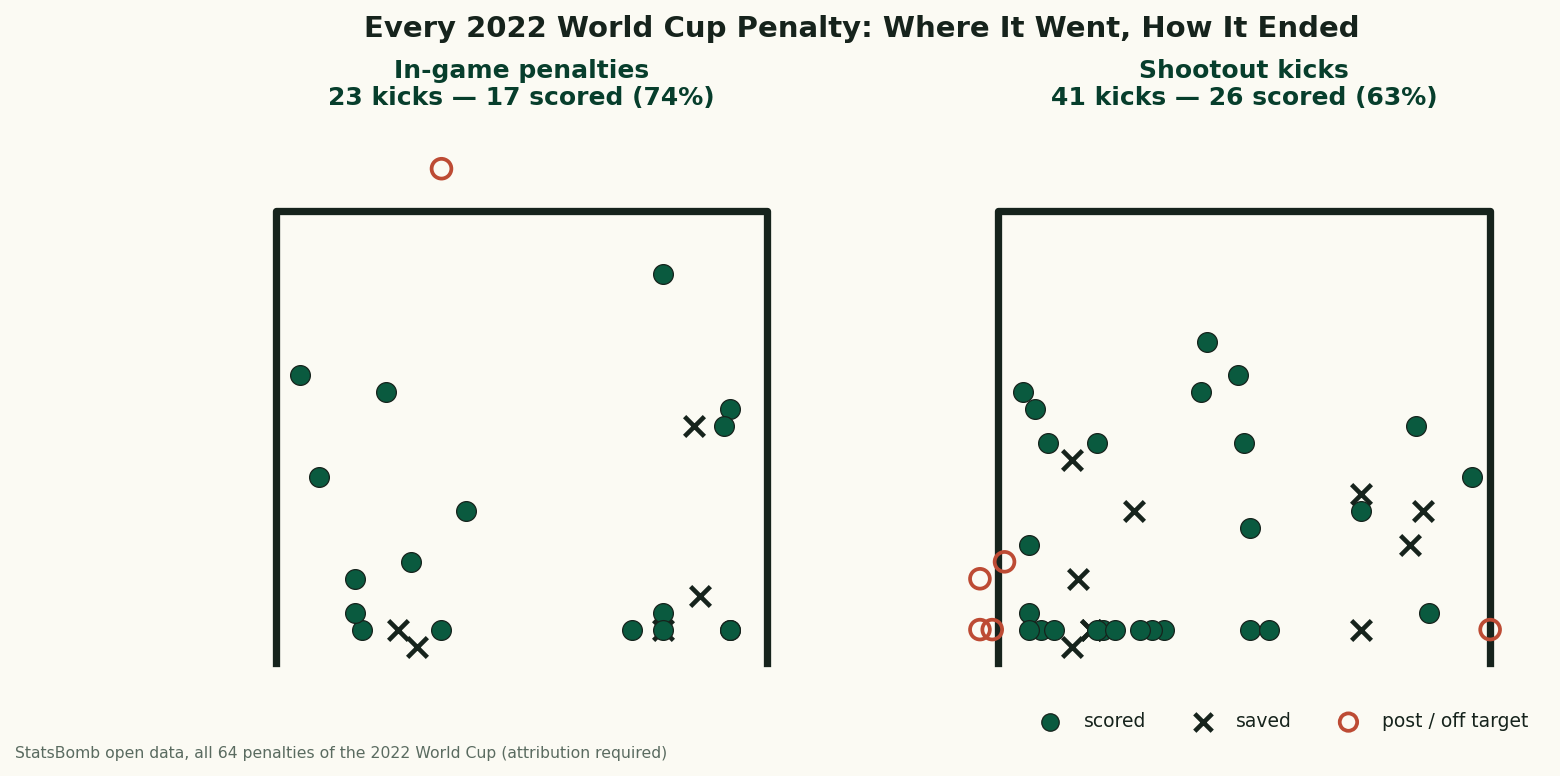
A penalty is football’s most standardized event: same spot, same distance, one kicker, one keeper. The models treat it that way — StatsBomb prices every penalty at 0.78 xG, in any minute of any game. Reality at the 2022 World Cup priced it differently depending on the scoreboard clock. Kicks taken during games went in at 74% (17 of 23). Kicks taken in shootouts went in at 63% (26 of 41). Same twelve yards, an eleven-point discount — and with three shootouts already banked in 2026’s knockout rounds, the discount is back in season.
Sourcing. Shot-level data: StatsBomb’s free open event data for the 2022 World Cup (attribution required), bundled as data_layer/wc2022_shots.json — all 1,494 shots of the tournament, of which 64 are penalties: 23 in normal or extra time, 41 across the five shootouts (StatsBomb records shootout kicks as period 5). 2026 shootout counts come from our live results dataset. Every number below is computed from those files; the chart script is in the repo.
The census
| Context | Kicks | Scored | Conversion | Saved | Post / off target |
|---|---|---|---|---|---|
| In-game (periods 1–4) | 23 | 17 | 74% | 5 | 1 |
| Shootout (period 5) | 41 | 26 | 63% | 10 | 5 |
| All penalties | 64 | 43 | 67% | 15 | 6 |
Reading the gap honestly
Sixty-four kicks is the complete 2022 record, not a sample from it — but it is still a small census, so treat the eleven-point gap as measured history, not a law. The gap does, at least, point the direction every larger study points: penalty conversion in shootouts runs meaningfully below in-game conversion, with tournament pressure, fatigue after 120 minutes, and the parade of designated fifth kickers all plausible mechanisms our event data can’t separate. What the data can separate is how the misses die: in-game, five of six failures were saves; in shootouts, a third of the failures (5 of 15) never tested the keeper at all — three off the woodwork, two wide or over. Kicks that miss the frame entirely are the classic signature of the pressure account, and 2022’s only in-game example was struck, famously, by Harry Kane in a quarter-final. The group-stage save list, meanwhile, reads like a Ballon d’Or shortlist: Messi, Lewandowski, Alphonso Davies, André Ayew and Al Dawsari all had in-game penalties saved in 2022. Even at 74%, nobody is safe.
Where kickers aim, and what it costs
Low kicks dominate both contexts — most of the 64 crossed the line under 1.2 meters, consistent with the placement pattern of open-play goals. The one placement difference our coordinates show: in-game kicks split evenly between the kicker’s left and right (12 vs 11), while shootout kicks leaned heavily to the kicker’s left — 25 of 41, with 7 more down the middle. With 41 kicks that lean is suggestive, not proof; we note it and stop there. What the middle-of-goal cluster does show is the game theory in action: seven shootout kickers trusted the keeper to dive, and the keeper-stays-home counter is exactly the equilibrium logic laid out in our penalty-geometry explainer and formalized in Palacios-Huerta’s work on penalties as a mixed-strategy game.
2026 is manufacturing shootouts again
The 2022 tournament needed five shootouts across sixteen knockout games — two in the round of 16, two in the quarter-finals, and the final itself, 41 kicks in all. The 2026 edition, with its extra knockout round, finished with four shootouts in its 32 knockout matches: Morocco past the Netherlands, Paraguay past Germany, Egypt past Australia (the feed stores the 1–1 final score but not the shootout — the advancer surfaced in the round-of-16 team sheets), and Switzerland past Colombia after the tournament’s only goalless knockout game. That is a lower shootout rate than 2022’s knockouts — four in 32 against five in 16, as our knockout-stage read tracks — and none came later than the round of 16. Kick-level data for 2026’s shootouts isn’t public, so the 74/63 split above remains the best base rate on record.
Try the arithmetic yourself
A shootout is five-plus rounds of roughly-63% events stacked against each other, which is why “lottery” is the wrong word and “coin-flip-ish” is only half right — small edges in conversion compound sharply over five kicks. The simulator below runs the binomial math live; drag the conversion rates apart and watch how quickly a few points of edge move the win probability. The math behind it is in our shootout history piece, and the practical side — what teams can actually control — in shootout preparation.
Honest limitations
- One tournament. 64 kicks is 2022’s complete record and still a small n. The in-game/shootout gap matches the direction of multi-competition studies, but our number is a World Cup census, not a universal rate.
- StatsBomb’s 0.78 penalty xG is a convention, not a claim about shootouts — their model prices in-game penalties. We use it only as the reference line both contexts undershoot.
- Placement coordinates record where the ball ended, including saved kicks — a save at the post says where the kick went, not where the keeper was. Left/right is from the kicker’s perspective.
- No 2026 kick data. Our feed records that shootouts happened and who advanced (where a later team sheet proves it) — nothing about the kicks themselves. Nothing here projects any specific 2026 shootout.
Sources
- Shot-level 2022 data: StatsBomb open data (free public dataset; attribution required), bundled as
data_layer/wc2022_shots.json; all 64 Penalty-type shots, shootout kicks identified by period 5. Chart:charts/chart_wc2022_penalties.py. - 2026 shootout count and advancers: ESPN results via
data_layer/wc2026_results.json(92 matches, retrieved 2026-07-06), served at /data/wc2026_results.json. - I. Palacios-Huerta, Beautiful Game Theory — penalties as a mixed-strategy equilibrium.
- Related: the penalty conversion rate, World Cup shootout history, and preparing for penalties.
More from Data Deep-Dives
Does Europe Cost English Clubs at the Weekend? Three Seasons Can't Find It
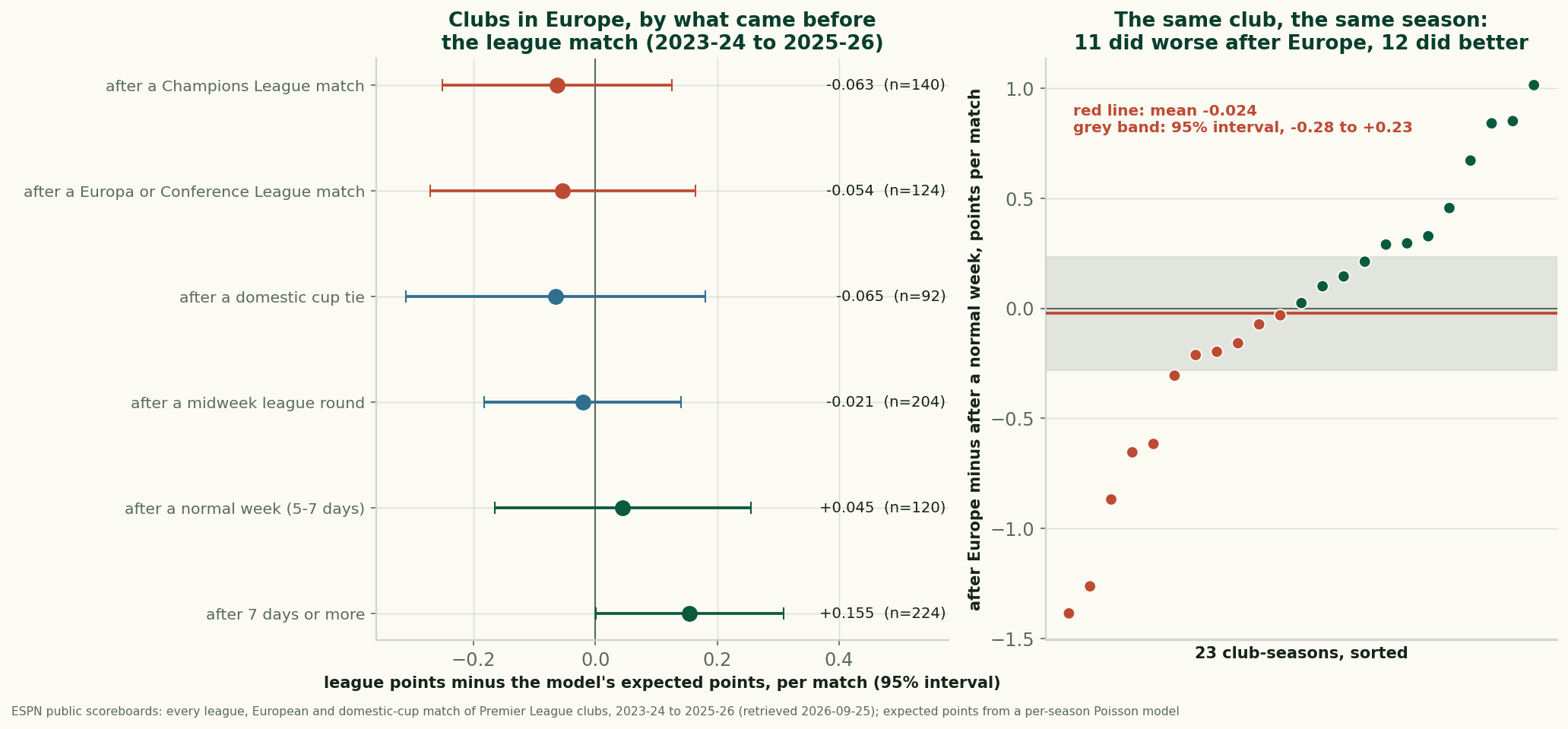
After a European night, English clubs took 1.56 league points a match against 1.62 expected. Within the same club and season the gap is -0.024: not measurable.
Manchester United Lead the League in Shots and Sit Twelfth
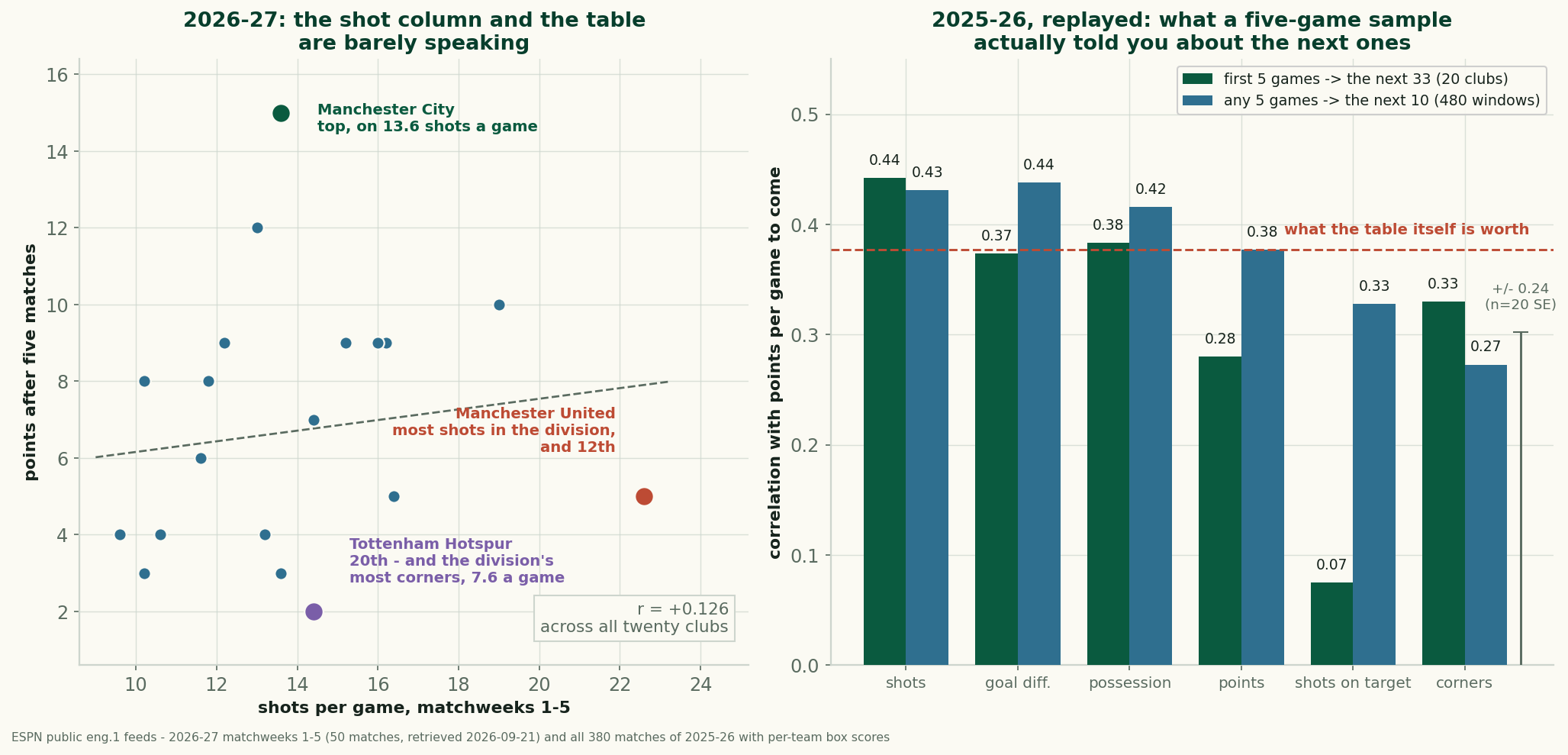
United take 22.6 shots a game and have 5 points. Across 2025-26, a club's five-game shot count predicted its next results better than its points did.
Home Advantage Didn't Die. The Results Column Can't See It
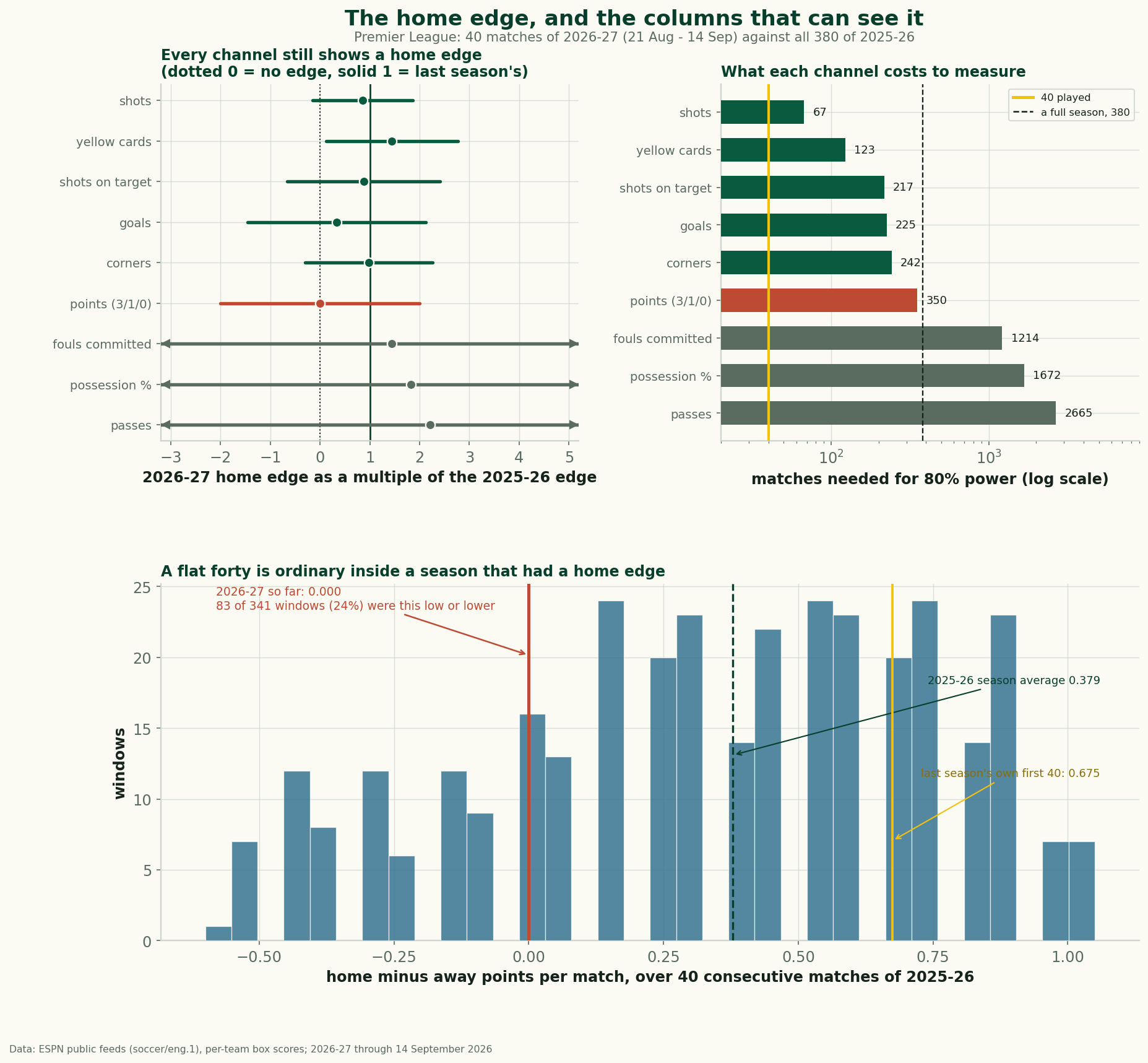
Home and away split the first 40 matches of 2026-27 evenly, yet the shot, corner and card columns keep the home edge. Plus a decade of home-advantage data.