The Best Third-Place Math: How Eight Extra Teams Reach the Knockouts
Why finishing third can still take you through — and how the cut is made.
A 48-team World Cup needs to send thirty-two teams into the knockout rounds, and that creates a problem the old format never had. Twelve groups, with the top two of each advancing, supply only twenty-four. The remaining eight places have to come from somewhere, and the answer is the most awkward piece of arithmetic in the whole tournament: the eight best third-placed teams, ranked against one another across twelve different groups they never played in. It works, it has precedent, and it makes the final round of group matches genuinely strange to watch.
The hole the format leaves
The knockout bracket for 2026 holds thirty-two teams — the maths of why is laid out in why 104 matches. The group stage fills most of it automatically. Twelve groups, two qualifiers each, is twenty-four teams who advance by right: win your group or finish runner-up and you are through, no comparison with anyone else required.
But twenty-four is eight short of thirty-two. If only the top two went through, the bracket would not fill, and a thirty-two-team single-elimination tree is exactly what the format is built around. So FIFA reopened a door that a straight top-two cut would have closed: the eight best teams who finished third in their groups also qualify. Twenty-four plus eight is thirty-two, and the bracket is full.
Ranking teams who never met
Here is where it gets uncomfortable. Inside a group, ranking teams is straightforward: they have all played each other, so points and the usual tiebreakers settle the order. But the third-placed teams come from twelve separate groups. The side that finished third in one group never faced the side that finished third in another, and yet they are competing for the same eight tickets. You cannot use head-to-head, because there is no head-to-head. You have to compare their group records directly.
The comparison runs down a familiar ladder, applied to each third-placed team’s three group matches: points first, then goal difference, then goals scored, with disciplinary record and ultimately a drawing of lots available if teams remain genuinely inseparable. (The full in-group tiebreaker order, some of which carries over here, is set out in World Cup group tiebreakers explained; treat the precise fine print of the cross-group ranking as the kind of detail worth confirming against the official regulations rather than assuming.) The twelve third-placed teams are sorted by that ladder, the top eight go through, and the bottom four go home.
| Rank | From group | Pts | GD | GF |
|---|---|---|---|---|
| 1 | Group of A–L | 4 | +2 | 4 |
| … | … | … | … | … |
| 8 (last to qualify) | some group | 3 | 0 | 3 |
| 9 (first out) | another group | 3 | −1 | 2 |
| … | … | … | … | … |
The illustrative point of that table is the line between eighth and ninth. Two teams can finish third with the same points — here, three apiece — and be separated only by a single goal of difference, or a single goal scored, against opponents the other team never faced. That is a real possibility of the format, not a flaw exactly, but a feature that makes a goal in a dead-looking match matter far more than it appears to.
The precedent: it has been done before
This is not an untested idea. The European Championship has run a 24-team finals with six groups of four since Euro 2016, and faced the identical problem: six groups send through twelve teams as group winners and runners-up, but the knockout bracket needs sixteen. Euro 2016 and Euro 2024 both solved it the same way the World Cup now does — by advancing the four best third-placed teams, ranked across the six groups on points, then goal difference, then goals.
So the mechanism has a decade of precedent at major-tournament level. The World Cup is scaling it up: twelve groups instead of six, eight qualifying thirds instead of four. The arithmetic is the same shape, just larger, and the awkwardness scales with it. Twelve groups produce twelve third-placed teams competing for eight places, which means a third of the way down the standings, the cut is tighter and the cross-group comparisons more numerous than anything the Euros required.
Why the final round goes strange
The real consequence shows up in the last round of group matches, and it is genuinely odd. With both runner-up spots and a possible best-third place in play, a team that is, say, third in its group cannot fully know whether its current points and goal difference will be enough — because the bar is being set by other teams playing simultaneously in other groups. A side might be safe, eliminated, or on the bubble depending on a goal scored hundreds of miles away in a match it has no influence over.
That introduces a coordination and information problem. Ideally the final group games kick off simultaneously so no team knows the exact target it must clear, but with twelve groups and a continent-sized schedule, perfect simultaneity across all of them is hard, and any staggering hands later teams a clearer picture of the number they need. It also changes in-game incentives: chasing a fourth goal in a match already won can be the difference between qualifying as a best third and going out, so the margin of victory, not just the result, carries weight. For how rest and a sprawling map complicate even the scheduling of these decisive games, see rest, travel and time zones.
None of this is necessarily bad theatre — a goal difference race across twelve groups can be gripping. But it is a long way from the clean “win your group or finish second” logic the World Cup ran on for decades, and it is the direct price of needing eight more teams than the groups naturally supply.
The data behind this piece
More from World Cup 2026
The 2026 Dark-Horse Audit: Grading Our June Checklist
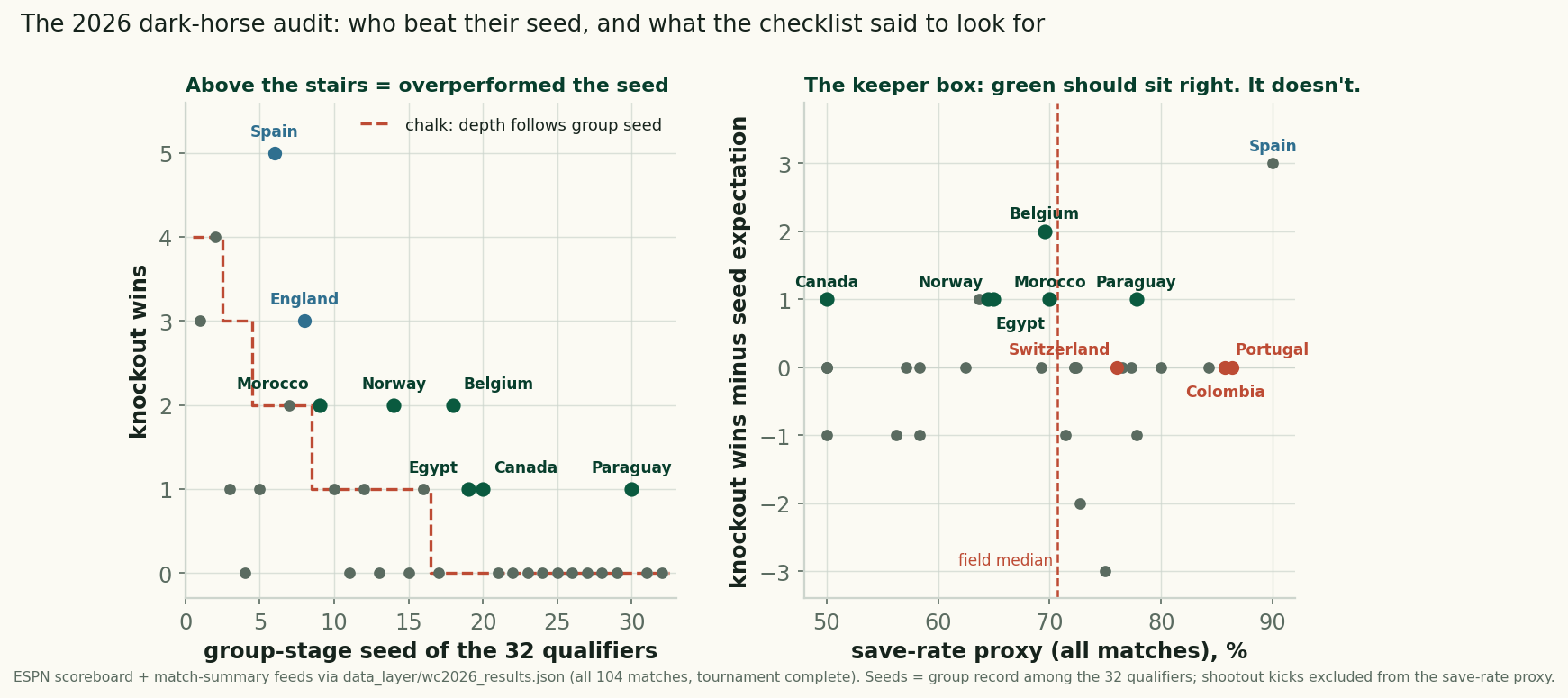
Six teams beat their group seed at the 2026 World Cup, scored against our pre-tournament checklist: the keeper box failed, the kind draw barely helped.
The Shootouts: Rarer, Earlier, and a Reprieve That Never Lasted
Retro #4 closes the series: the shootout rate fell to 12.5% of knockout games from 2022's 31%, all four came early, and survivors went 1-3 next time out.
The Groups Told the Truth: How June Predicted July at the 2026 World Cup
Group-stage points strongly predicted knockout survival: 9-point teams went 3-for-3, 4-point teams 2-for-11, and the last four all ranked top-8.