World Cup Group Tiebreakers, Explained
The ladder that decides who advances when points aren’t enough.
A team can play its way out of a World Cup without losing its final group game, beaten to a knockout place by a rival it never faced, on a tiebreaker half the stadium could not name. That is the strange thing about group qualification: when points run level, the team that advances is chosen by a fixed ladder of criteria applied in a strict order, and the rung that decides it is often one nobody was watching. Everyone knows the top of that ladder. Almost nobody knows what happens when goal difference and goals scored come out level too — and that is exactly where the format’s cruelest edge cases live. Here is the order, top to bottom, and why each rung is shaped the way it is.
The first three rungs: the ones everyone half-knows
Group standings are decided first on points: three for a win, one for a draw, none for a defeat. That is the primary ranking, and most groups are settled by it alone. When two or more teams finish level on points, the tournament does not stop there — it drops to the next criterion, and keeps dropping until the tie breaks.
The well-established order of the next two rungs is goal difference across all group matches, then goals scored across all group matches. So a team level on points is separated first by how its goals scored and conceded net out over its three games, and if that is still level, by how many it scored outright. These three — points, then goal difference, then goals scored — resolve the overwhelming majority of ties, and they are the ones worth committing to memory.
Why goal difference, and why it rewards margin
Goal difference sits second for a reason, and it has a behavioural effect worth understanding. Because the tie drops to goal difference before anything else, the margin of a result matters, not just the result. A 3–0 win and a 1–0 win are identical on points but two goals apart on difference, and in a tight group that gap can be the entire season.
This is what makes a team chase a fourth goal in a match it has already won, or keep attacking at 3–0 when the points are long since secure. It also means a heavy defeat is doubly costly: you lose the points and you carry the negative difference into the standings. In the 48-team format this matters even more than usual, because goal difference is also the lever that separates third-placed teams across groups for the final knockout places — the cross-group ranking covered in the best third-place math. A single goal of difference can decide who advances as a best third, so the second rung of this ladder reaches well beyond any one group.
| Criterion | Team A | Team B | Splits them? |
|---|---|---|---|
| Points | 6 | 6 | No — drop down |
| Goal difference | +3 | +3 | No — drop down |
| Goals scored | 5 | 4 | Yes — A ahead |
The rungs fans forget
If points, goal difference and goals scored are all identical, the ladder keeps going, and this is the territory most people never reach in conversation. The next stage typically narrows the comparison to the matches played between the tied teams only — a head-to-head mini-table of points, then goal difference, then goals scored among just those sides. The logic is that if two teams cannot be separated across their whole group, perhaps the games they played against each other can decide it.
Beyond head-to-head, the criteria become ones almost no one cites: a disciplinary or fair-play score, which tallies yellow and red cards (fewer cards is better), and finally, if every other measure is exhausted, a drawing of lots. Lots are the genuine last resort — the modern equivalent of the coin toss — reached only when two teams are identical on every sporting measure the tournament can find. It is vanishingly rare, but the rung exists so that there is always a defined answer.
One honest caveat: the exact ordering and wording of the lower rungs — whether head-to-head is applied before or after certain all-group measures, how precisely the fair-play points are calculated — is the sort of fine print that lives in the official competition regulations and can be adjusted edition to edition. The top of the ladder (points, goal difference, goals scored) is stable and well-documented; treat the precise sequence below head-to-head as something to confirm against FIFA’s published rules rather than to assert from memory.
Why the ladder is built this way
The design has a clear philosophy: reward the teams that won, then the teams that won well, then the teams that did well against the specific rivals they were tied with, and only at the very end fall back to something arbitrary. Each rung is more granular and more “earned” than the next, which is why the arbitrary tiebreaker (lots) sits at the bottom rather than, say, alphabetical order being used early.
It also explains why the World Cup leans on goal difference so heavily rather than head-to-head first, as some leagues do. In a three-game group, head-to-head between two teams is a single match — an extremely small sample, and one that can hinge on a deflection. Goal difference across all three games is a slightly broader signal, so the format prefers it as the first separator. That is a deliberate trade-off, and reasonable competitions make it differently; domestic leagues that prioritise head-to-head are choosing a different value, not a wrong one.
What it means for watching the group stage
The practical upshot is that the scoreboard in a World Cup group game is never telling the whole story, even when the points are decided. A team 2–0 up and coasting may still be pushing because a third goal improves its goal difference and, in the 48-team format, possibly its standing among third-placed teams elsewhere. The simultaneous final-round kick-offs that try to keep teams honest about the numbers they need are part of the same machinery — the scheduling pressures of which a continent-sized host map adds to, as discussed in rest, travel and time zones.
So when a group ends level and one team advances on goals scored, it is not luck and it is not a technicality — it is the ladder doing exactly what it was designed to do, rung by rung, until two teams that could not be separated by winning were separated by how, and how much, they won. For the wider format context these ties sit inside, see World Cup 2026 by the numbers.
Sources & data
More from World Cup 2026
The 2026 Dark-Horse Audit: Grading Our June Checklist
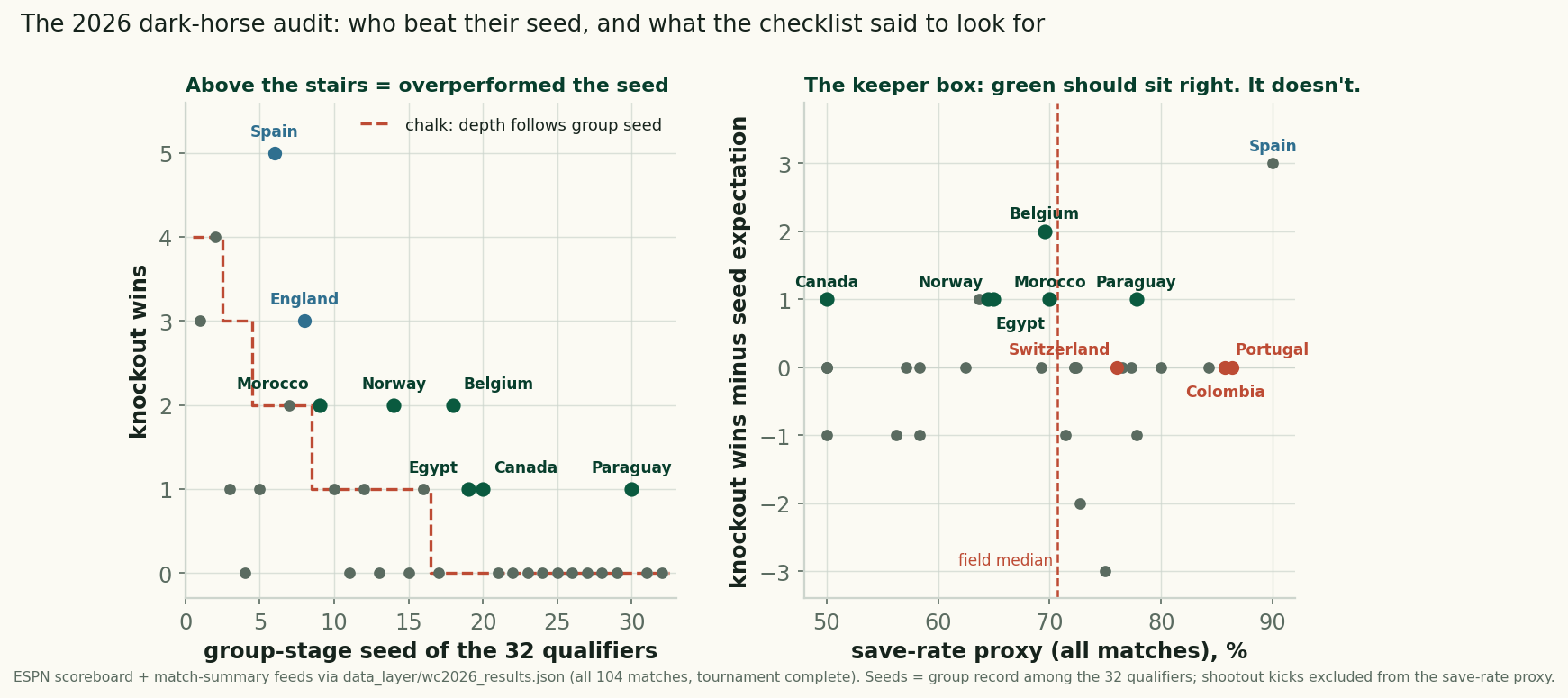
Six teams beat their group seed at the 2026 World Cup, scored against our pre-tournament checklist: the keeper box failed, the kind draw barely helped.
The Shootouts: Rarer, Earlier, and a Reprieve That Never Lasted
Retro #4 closes the series: the shootout rate fell to 12.5% of knockout games from 2022's 31%, all four came early, and survivors went 1-3 next time out.
The Groups Told the Truth: How June Predicted July at the 2026 World Cup
Group-stage points strongly predicted knockout survival: 9-point teams went 3-for-3, 4-point teams 2-for-11, and the last four all ranked top-8.