Why 104 Matches? The Arithmetic of the 48-Team World Cup
Sixteen more teams, forty more matches — the maths behind the jump.
The headline number for the 2026 World Cup is forty-eight teams, but the number that actually reorganises the tournament is one hundred and four. The previous World Cup ran sixty-four matches. Adding sixteen teams — a 50% increase in the field — produced a 62.5% increase in matches. Those two percentages do not match, and the gap between them is the whole story of how the new format is built. More teams does not mean proportionally more games; it means a longer bracket bolted onto a wider group stage, and the arithmetic is worth walking through slowly.
Where the group games come from
Start with the group stage, because that is where most of the new volume lives. The 48-team format splits the field into twelve groups of four. Every team in a four-team group plays the other three, which is three matches each, and a group of four produces six matches in total — the same group size, and the same six games per group, as the old 32-team event used.
So the group-stage maths is simply twelve groups × six matches, which is seventy-two group games. Under the old 32-team structure there were eight groups of four, or eight × six, which is forty-eight group games. The expansion adds four groups, and four extra groups at six games apiece is twenty-four additional group matches before a single knockout tie is played. That is already more than a third of the total increase, and it comes purely from widening the group stage rather than lengthening it.
The knockout stage doubles its entry
The second source of extra games is the knockout bracket, and this is the part that genuinely changes the shape of the tournament. Under the 32-team format, sixteen teams advanced to the knockout rounds: a round of 16, then quarter-finals, semi-finals and a final. In 2026, the top two of each of the twelve groups qualify automatically — that is twenty-four teams — and the eight best third-placed teams across the groups join them, taking the knockout field to thirty-two. (The mechanics of that third-placed cut have their own awkward arithmetic, covered in the best third-place qualification math.)
A thirty-two-team single-elimination bracket has a clean structure. Thirty-two teams play sixteen matches to become sixteen; sixteen play eight to become eight; eight play four to become four; four play two to become two; two play one to crown a champion. Add those up — 16 + 8 + 4 + 2 + 1 — and you get thirty-one knockout matches. The World Cup also stages a third-place play-off between the two losing semi-finalists, so the knockout total is thirty-one plus one, or thirty-two.
| Round | Teams | Matches |
|---|---|---|
| Round of 32 | 32 | 16 |
| Round of 16 | 16 | 8 |
| Quarter-finals | 8 | 4 |
| Semi-finals | 4 | 2 |
| Third-place play-off | 2 | 1 |
| Final | 2 | 1 |
| Total | — | 32 |
Seventy-two group games plus thirty-two knockout games is one hundred and four. There is no rounding and no hidden fixture; the total falls straight out of the structure. The old format produced forty-eight group games plus a sixteen-team bracket. A sixteen-team single-elimination tree is 8 + 4 + 2 + 1, which is fifteen matches, and with the third-place play-off that is sixteen knockout games. Forty-eight plus sixteen is sixty-four, the familiar old number.
Why “more teams” isn’t proportional
The reason the percentages diverge is that the group stage and the knockout stage scale differently. Group games scale with the number of groups, which scales linearly with the field: half again as many teams, half again as many groups, half again as many group matches (48 to 72 is exactly a 50% rise). The knockout stage, by contrast, scales with the number of teams admitted to it, and that number doubled — from sixteen to thirty-two — which adds a whole extra round at the front of the bracket.
That extra round is the round of 32, sixteen matches that simply did not exist before. It is the single biggest chunk of new football in the tournament, larger than the four extra groups. So the jump from 64 to 104 is really three components stacked together: twenty-four more group games, sixteen brand-new round-of-32 games, and the rest of the bracket left essentially unchanged from the quarter-finals onward. The longer bracket is explored on its own in the longest knockout bracket.
What the arithmetic costs
The format was not chosen for the elegance of its sums, and the trade-offs behind it — revenue, access, the risk of more mismatches — are taken up in why the World Cup expanded to 48. But two consequences fall directly out of the numbers. The first is calendar load: forty extra matches have to be played in roughly the same midsummer window, which tightens the schedule and raises questions of rest and travel that an event spread across a continent has to take seriously. The second is the texture of the group stage. Each team still plays only three group games, exactly as before, so the wider field does not give any individual side more data about itself before the knockouts begin — it just adds more sides, and more matches between mismatched ones.
That is the quiet point hidden in the arithmetic. One hundred and four is a big number, and it will produce the largest single-edition dataset football has ever generated. But it is built from the same three-game group every team has always played, plus a longer elimination tree at the end. The tournament got wider and the bracket got taller; the group, for any one team, stayed exactly the size it was. For the broader statistical primer on what all that volume means, see World Cup 2026 by the numbers.
See the format run: the tournament simulator
The cleanest way to feel how this structure behaves is to play it out. Our World Cup 2026 simulator runs the exact 48-team / 12-group format described here — top two of each group plus the eight best third-placed teams into a 32-team knockout — thousands of times from strength ratings you set, and reports advance and title odds with a sample bracket. It is a transparent model from your inputs: it shows no real 2026 results, scores or standings. Run it to see how thoroughly a five-round bracket, bolted onto the back of those seventy-two group games, dilutes even a top-rated side: with a closely-packed field the best team's title share sits in low single figures, and even at the widest spread the inputs allow it climbs only to around 7%.
Open the World Cup 2026 simulator →
The data behind this piece
More from World Cup 2026
The 2026 Dark-Horse Audit: Grading Our June Checklist
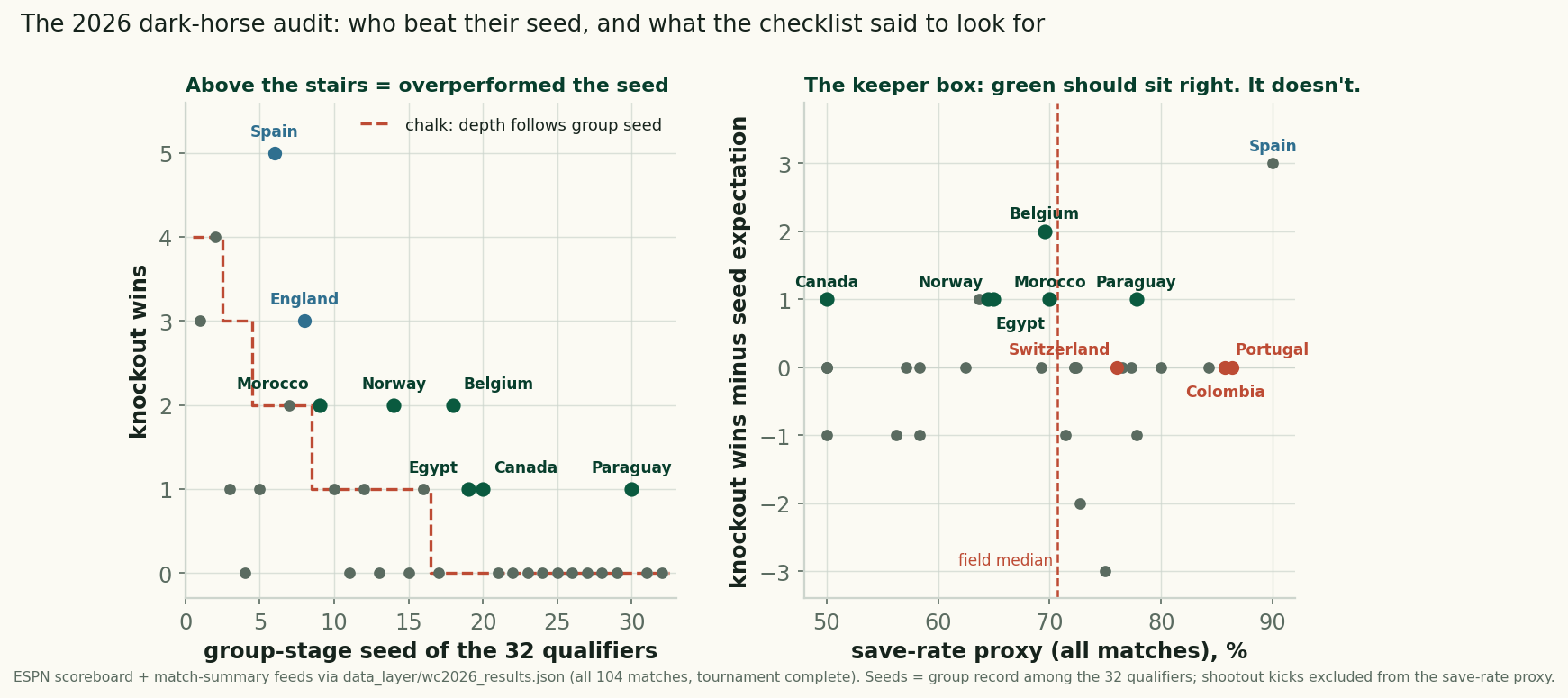
Six teams beat their group seed at the 2026 World Cup, scored against our pre-tournament checklist: the keeper box failed, the kind draw barely helped.
The Shootouts: Rarer, Earlier, and a Reprieve That Never Lasted
Retro #4 closes the series: the shootout rate fell to 12.5% of knockout games from 2022's 31%, all four came early, and survivors went 1-3 next time out.
The Groups Told the Truth: How June Predicted July at the 2026 World Cup
Group-stage points strongly predicted knockout survival: 9-point teams went 3-for-3, 4-point teams 2-for-11, and the last four all ranked top-8.