The Shootouts: Rarer, Earlier, and a Reprieve That Never Lasted
The last entry in the World Cup retrospective series. Penalties decided four games in 2026 — fewer, earlier, and with less consequence than the format's critics feared. What the four shootouts had in common, what became of their survivors, and why the lottery lived exactly where the table ran out of resolution.
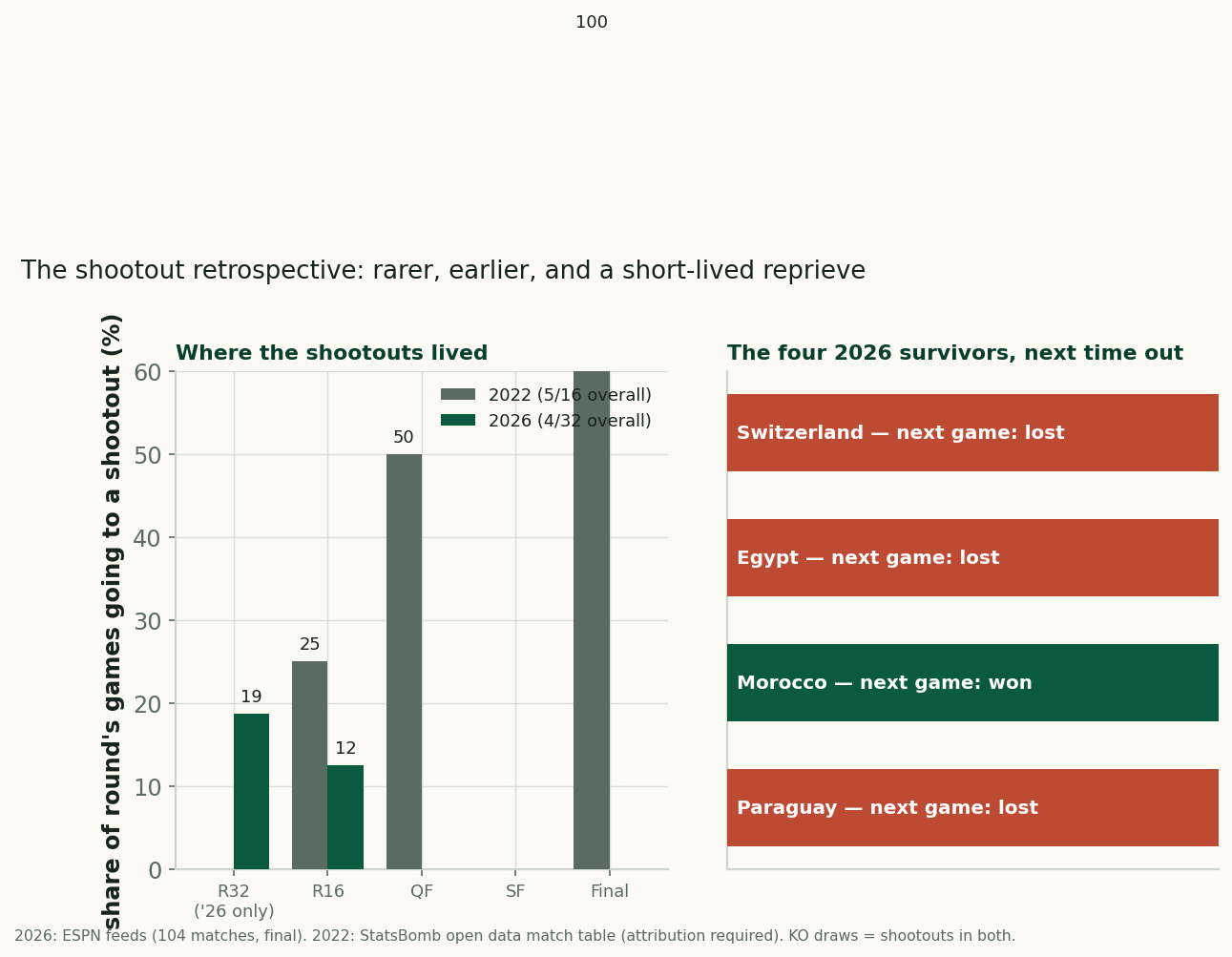
The shootout is the World Cup’s designated tragedy machine, and 2022 fed it generously: five shootouts in sixteen knockout games, including two quarter-finals and the final itself. The expanded 2026 tournament, the one that was supposed to multiply randomness, did the opposite: four shootouts in thirty-two knockout games — 12.5%, down from 31% — all four in the first two rounds, none within a week of the trophy. And the reprieve they bought was short: the four survivors went 1–3 in their next games, and none reached the semi-finals. This closes the retrospective series, on the tournament’s purest lottery behaving less like a lottery than anyone expected.
Sourcing. 2026 from our final 104-match dataset (ESPN feeds, served raw at /data/wc2026_results.json); 2022 from the StatsBomb open-data match table bundled with our penalty census (attribution required). In both files a knockout draw is a shootout — scores are post-extra-time — and 2026 advancement is inferred from each team’s later appearances, all four unambiguous. One honest limit up front: the 2026 feed carries no per-kick data, so this piece counts shootouts and their consequences; the kick-by-kick psychology remains the 2022 census’s territory. Chart script: charts/chart_wc2026_shootouts.py.
The four, and where they lived
| Round | Game | Group pts | Survivor | Next game |
|---|---|---|---|---|
| R32 | Germany 1–1 Paraguay | 6 v 4 | Paraguay | L 0–1 France |
| R32 | Netherlands 1–1 Morocco | 7 v 7 | Morocco | W 3–0 Canada |
| R32 | Australia 1–1 Egypt | 4 v 5 | Egypt | L 2–3 Argentina |
| R16 | Switzerland 0–0 Colombia | 7 v 7 | Switzerland | L 1–3 Argentina |
Why the lottery shrank
Three retrospectives supplied the pieces; this one just assembles them. The groups sorted the field so well that most knockout pairings had a genuine favorite — and look at the group-points column above: the shootouts happened almost exclusively where the table couldn’t separate the teams. Two of the four were dead level on points (7v7 twice); no pairing was more than two points apart. Penalties in 2026 weren’t randomness invading the bracket — they were the bracket’s honest admission that, for those four pairings only, ninety-plus minutes and the group table agreed there was nothing to choose. Meanwhile the expansion piece showed 2026’s knockouts produced more one-goal games but fewer draws (12% vs 31%) — tighter football that still found winners inside 120 minutes. The format didn’t multiply coin flips. It rationed them.
The reprieve that never lasted
Surviving a shootout felt like destiny four times this summer, and the fixture list disagreed within days. Paraguay — the tournament’s great overachiever, having knocked out Germany — lost 0–1 to France four days later. Egypt drew Argentina and exited 2–3 in the tournament’s best round-of-16 game. Switzerland, the only team to win a shootout beyond the first knockout round, ran into Argentina next and lost 1–3 — carrying, as the rest-day ledger noted at the time, legs that had played 120-plus minutes while their opponent’s hadn’t. Only Morocco converted survival into another win, and even they fell in the quarter-finals. The pattern isn’t mystical: a shootout is evidence you were in a coin-flip pairing, and coin-flip teams tend to meet better ones next round — usually on shorter recovery. The 2022 census called the shootout a discount on skill; 2026 adds the sequel: it’s also a loan against the next game’s legs.
Colombia, the asterisk the format owes an apology
One team deserves a closing paragraph. Colombia went home without losing a football match: three wins, two draws, one goal conceded in five games, eliminated 0–0 on penalties by Switzerland. Every tournament with shootouts produces an unbeaten casualty eventually, but Colombia’s file — documented in the bracket piece’s farewell note — is the strongest of 2026’s, and it’s why the final wrap was careful to call Spain and Argentina the last unbeaten teams standing rather than the only ones. The shootout’s whole bargain is that somebody blameless goes home; in 2026 the bill went to Bogotá.
Caveats, and the series closes
Four shootouts against five is a comparison of small numbers — one more bounce either summer moves every rate in this piece, and nothing here should be read as the 48-team format guaranteeing fewer shootouts; it produced fewer this once, for reasons the sorting story explains but doesn’t promise to repeat. The per-kick claims this piece deliberately doesn’t make — who converted, who choked, keeper tendencies — live in the 2022 census, which remains our only kick-level dataset.
And that’s the retrospective series: what predicted the matches, what the format changed, what June knew about July, and now what the lottery actually cost. The 104-match dataset stays served and final; the hub becomes the permanent record; and this site returns to its regular beat until the qualifiers start asking questions worth computing. It was a good tournament to count. The wall won, the table told the truth, and the coin flips — for once — knew their place.
Sources
- 2026: ESPN public feeds, all 104 matches, at
data_layer/wc2026_results.json(served at /data/wc2026_results.json); knockout draws are shootouts (scores post-extra-time); advancement inferred from later appearances (all four unambiguous). Chart + printed audit:charts/chart_wc2026_shootouts.py. - 2022: StatsBomb open data match table (
data_layer/wc2022_shots.json) — free public dataset; attribution required. - Kick-level 2022 analysis referenced, not recomputed: the shootout discount.
- The World Cup hub collects the complete series, group stage to retrospectives.
More from World Cup 2026
The 2026 Dark-Horse Audit: Grading Our June Checklist
Six teams beat their group seed at the 2026 World Cup, scored against our pre-tournament checklist: the keeper box failed, the kind draw barely helped.
The Groups Told the Truth: How June Predicted July at the 2026 World Cup
Group-stage points strongly predicted knockout survival: 9-point teams went 3-for-3, 4-point teams 2-for-11, and the last four all ranked top-8.
The 2026 World Cup, By the Numbers: Just Under 3 Goals a Game
The 2026 World Cup, by the numbers from completed matches only: goals per game vs 2022, draws, and blowouts. The final numbers, across all completed matches.