Rest, Travel and Time Zones: The Hidden Variables of 2026
A continent-sized tournament makes geography a tactical variable.
The previous World Cup was the most geographically compact in the tournament’s history. Qatar 2022 was staged in and around a single metropolitan area; the eight stadiums sat close enough together that teams could base themselves in one place and bus to every match, and fans could in principle attend two games in a day. The 2026 World Cup is the opposite proposition in almost every respect. It is hosted across three nations and spreads from one side of a continent to the other, through several time zones. None of that decides who wins. But travel, rest and the body clock are real variables, they have measurable effects, and 2026 turns up the dial on all three.
The geography problem in plain terms
The 2026 tournament is co-hosted by the United States, Canada and Mexico — that much is well established — and that footprint is enormous. A country-spanning host map means some matchups can involve flights of several hours and a shift across multiple time zones, where Qatar 2022 involved a short coach ride and no time change at all. It is the difference between a tournament that fits inside one city and one that fits inside a continent.
A careful caveat is in order: the exact host cities, the assignment of teams to regional bases, and the published match schedule are details that determine how much any given team actually travels, and the specifics are the kind of thing to read off the official schedule rather than assume. What can be said confidently is structural — three host nations across a continental span guarantees that travel and time-zone change will be a live factor for at least some teams, in a way they simply were not last time. The point here is the factor, not any specific itinerary.
What the research actually says about travel
Travel and circadian disruption are among the better-studied variables in sports science, and the broad findings are consistent even if their match-level size is modest. Crossing time zones desynchronises the body clock from the local schedule, and the effect is generally worse travelling eastward than westward, because advancing the body clock is harder than delaying it. Athletes can experience disrupted sleep, slower reaction time and reduced peak power in the day or two after a long flight across several zones — exactly the window in which a World Cup team might be playing.
The honest framing is that these effects are real but second-order. They do not flip a mismatch; a stronger team tired and jet-lagged still beats a weaker fresh one most of the time. But at the margins — two evenly matched sides, a knockout coin-flip, the back end of a congested schedule — a rested team with a stable body clock and a settled base has a small, genuine edge over an opponent that flew across the continent two days earlier. Across a 104-match tournament, small edges accumulate into outcomes.
Rest days and scheduling asymmetry
Travel is only half of it; the other half is recovery time, and the two interact. The number of rest days between matches matters on its own — a team with three days to recover has measurably fresher legs than one with two — and when unequal rest is combined with unequal travel, the gap widens. A side that plays, flies across the continent, and turns around on short rest is in a meaningfully worse position than one that stayed regional and had an extra day, even if both are nominally in the same round.
The 48-team format raises the stakes here because the schedule is denser. One hundred and four matches have to be fitted into roughly the same midsummer window — the arithmetic of that volume is in why 104 matches — and a longer knockout bracket, detailed in the longest knockout bracket, asks the deepest-running teams to play an eighth match. More games in the same window, across a bigger map, means rest and travel are harder to equalise across teams than in a compact single-city event.
| Factor | Team in a settled base | Team criss-crossing the map |
|---|---|---|
| Rest days | 3 | 2 |
| Travel before match | Short / none | Long flight, time-zone change |
| Likely freshness | Higher | Lower |
Heat, altitude and the rest of the map
A continental host map introduces more than distance and clocks; it introduces wildly different playing conditions. A midsummer tournament across this much territory can mean searing heat and humidity in some venues, cooler conditions in others, and meaningful altitude in places where the air is thinner and the ball behaves differently. A team might play one match in oppressive heat and the next in a temperate evening, conditions that affect tempo, pressing intensity and how much running is sustainable.
Altitude in particular has well-documented effects on endurance for players not acclimatised to it, and heat reshapes the game toward conservation — lower pressing, more measured possession, more rotation. These are not new phenomena, but the breadth of a three-nation host map makes it more likely that teams face a wider range of them, and face them with less time to adapt between very different environments. Again the responsible claim is general: the conditions will vary substantially across the tournament; precisely which venue brings which challenge is a matter for the published venue list.
How to weigh it as a viewer
The right mental model is to treat rest, travel and conditions as a quiet thumb on the scale rather than a headline cause. When two well-matched teams meet and one has had the easier logistical run-in, nudge your expectation a touch in its favour — the way you might already nudge it for home advantage, another real-but-modest effect that the data sizes at a few tenths of a goal. Power ratings and projection models can in principle fold a travel or rest adjustment into their forecasts, and the better ones try to.
What you should not do is reach for jet lag as the explanation every time a favourite underperforms; most results are decided by quality, finishing and the irreducible variance of a low-scoring sport. Travel and time zones are a factor in 2026 in a way they emphatically were not in 2022 — worth tracking, occasionally decisive at the margins, but a supporting actor in the story rather than its lead. For the broader statistical lens on the tournament, see World Cup 2026 by the numbers.
Sources & further reading
More from World Cup 2026
The 2026 Dark-Horse Audit: Grading Our June Checklist
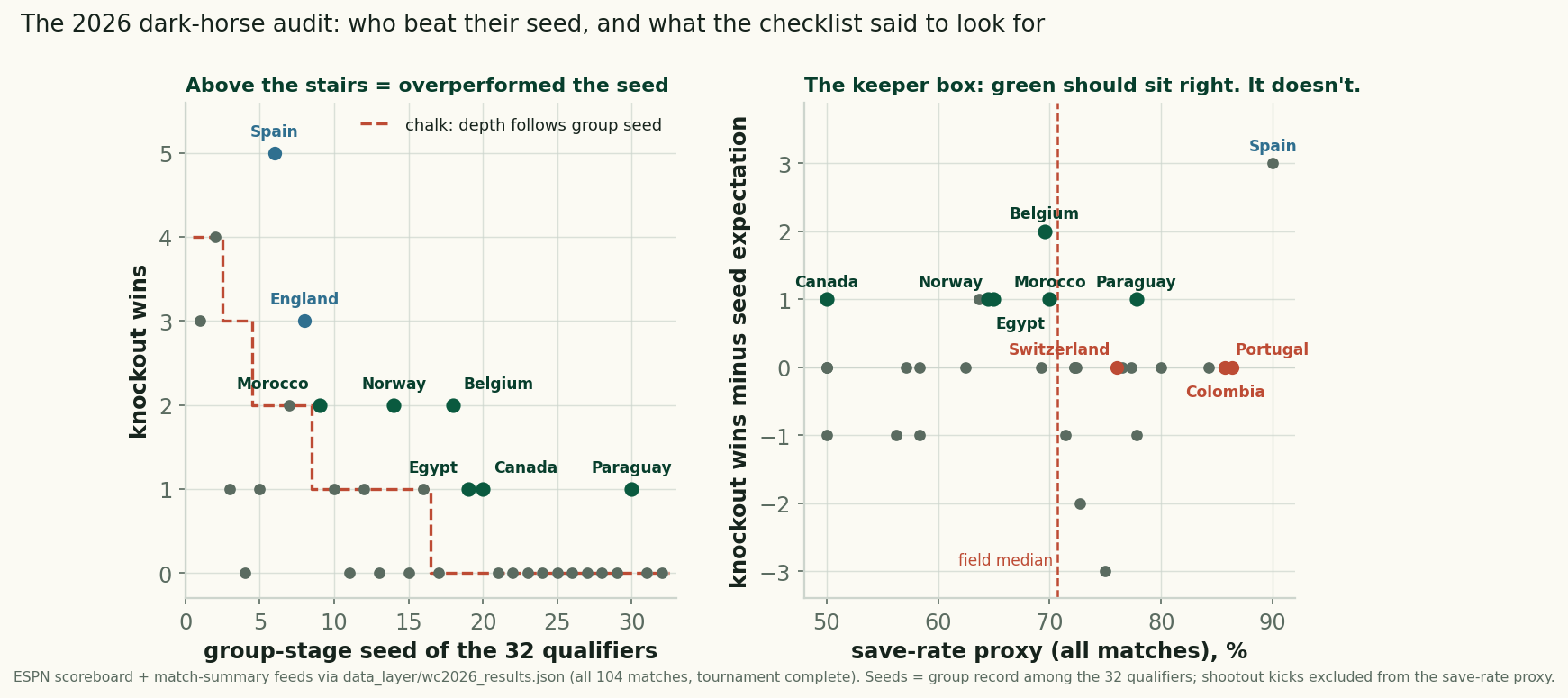
Six teams beat their group seed at the 2026 World Cup, scored against our pre-tournament checklist: the keeper box failed, the kind draw barely helped.
The Shootouts: Rarer, Earlier, and a Reprieve That Never Lasted
Retro #4 closes the series: the shootout rate fell to 12.5% of knockout games from 2022's 31%, all four came early, and survivors went 1-3 next time out.
The Groups Told the Truth: How June Predicted July at the 2026 World Cup
Group-stage points strongly predicted knockout survival: 9-point teams went 3-for-3, 4-point teams 2-for-11, and the last four all ranked top-8.