Group-Stage Narratives vs Numbers: Which Stories Survive the Knockouts
The group-stage stories to distrust, and the numbers that actually carry forward.
By the end of the World Cup group stage, every team has a story attached to it. One is "peaking at the right time". Another "always starts slowly". A third "can't handle the pressure". These narratives arrive on schedule, they sound authoritative, and most of them are built on three matches — a sample far too small to support the weight placed on it. Here are the group-stage narratives worth distrusting, and the underlying numbers that actually carry into the knockouts.
The momentum trap: "peaking at the right time"
The most seductive group-stage narrative is momentum: a team wins its final group game convincingly and is anointed as "peaking", "finding form", "timing its run". The story is irresistible because it fits how we like sport to work — a team gathering itself for a charge. The problem is that the evidence for it is almost always one good result, and one result is not a trend.
Momentum in football is famously hard to find in the data. The idea that a team carries form from one match into the next — beyond what their underlying quality already predicts — does not show up reliably when people look for it. A team that wins its last group game 3–0 might genuinely be excellent, or might have faced a side already eliminated and fielding reserves. The scoreline looks like momentum; it might just be a favourable matchup. Before believing a team is "peaking", ask who they beat and how they actually created the chances, not just what the scoreboard said.
The mirror-image trap is "they always start slowly". A pre-tournament favourite that opens with a draw gets written off as sluggish, when a single tight result against a well-organised opponent is exactly what you'd expect to happen sometimes, even to the best teams. One result in either direction is a weak basis for a story. The discipline of not overreacting to a single match is the whole subject of don't overfit the knockouts, and it applies double to momentum narratives.
The rotation trap: reading too much into team selection
Once a team secures qualification, often with a game to spare, managers rotate — resting key players, blooding squad members, managing yellow-card suspensions. This produces a tangle of narratives that mostly misread what rotation means.
A rotated team that loses its dead-rubber final group game gets called "fragile" or "lacking depth", when the result tells you almost nothing — the first-choice eleven wasn't on the pitch. Conversely, a fringe player who scores in that game gets talked up as a tournament bolter, on the strength of one appearance against opposition that may also have been rotating. Team selection is information, but it is information about the manager's intentions, not about the team's true level. When you see a surprising group-stage result, the first question is always: who actually played, and did the result involve a full-strength side?
The dead-rubber trap: matches that don't mean what they show
The 2026 format makes dead rubbers and half-dead rubbers more common, not less. With the top two from each group plus the eight best third-placed teams advancing to the round of 32, the arithmetic of qualification gets tangled: a team can be already through, already out, or chasing a specific scoreline to secure a best-third spot. Many final-round group games are therefore played at less than full intensity, or with one side managing a result rather than chasing a win.
This wrecks the data for those specific matches. A contender that draws its final group game 1–1 while comfortably qualified is not necessarily stuttering — it may simply be seeing the game out, conserving legs for the knockouts, and keeping players out of suspension trouble. Treating that scoreline as evidence of a problem confuses a deliberate cruise for a genuine wobble. The honest move is to weight dead-rubber matches lightly and lean on the games that were actually contested at full tilt. The complicated best-third math behind which teams have something to play for is its own subject; the broader format is laid out in World Cup 2026 by the numbers.
The numbers that actually carry forward
So if momentum is mostly a mirage, rotation muddies selection, and dead rubbers distort scorelines, what from the group stage actually predicts knockout performance? The honest answer is: underlying chance quality, read carefully and weighted by context. A few signals carry forward better than the narratives do.
Expected goals created against real opposition. A team that consistently manufactured high-quality chances — not just shots, but good shots, measured through xG — across its contested group games is demonstrating something repeatable. Chance creation is a skill that travels into the knockouts better than a couple of flattering scorelines. The key qualifier is "against real opposition": xG piled up against an eliminated, rotated side is worth less than xG earned against a team playing for its life.
Expected goals conceded, which is the most durable signal of all. Defensive structure is harder to fake across multiple matches than finishing is to sustain, and it tends to hold up under knockout pressure. A team posting consistently low xGA through the group stage is showing the kind of organisation that survives a tight elimination tie. This is the number to trust most, and it is why defensively sound sides so often outrun their pre-tournament billing.
The gap between results and underlying performance. A team winning while losing the xG battle is living on borrowed time; a team losing or drawing while dominating the chances is better than its points suggest. Reading that gap — deserved versus actual — is the single most useful habit for the group stage, and the guide to watching with xG covers exactly how to read it match by match.
What does not carry forward: the order in which results arrived (momentum), the scorelines of dead rubbers, the performance of rotated sides, and any narrative built on a single match. Strip those away and the genuinely predictive picture is smaller and quieter than the group-stage chatter — but it is real.
A narrative filter for the group stage
Pulling it together, here is a filter to run every group-stage story through before you believe it:
Count the matches. If the narrative rests on one game, treat it as a hypothesis, not a conclusion. Patterns need more than a single result.
Check the opposition and the team sheet. A result against an eliminated or rotated side, or produced by a rotated side, tells you far less than one from a full-strength, fully contested match.
Go to the underlying numbers. Ask whether the story shows up in xG and xGA, or only in the scoreline. If it lives only on the scoreboard, it is probably noise dressed as insight.
Weight defence over momentum. Of everything the group stage offers, sustained defensive quality is the most reliable predictor of how far a team goes. Momentum is the least.
The group stage is loud, and the loudness is mostly stories — momentum, slow starters, surprise packages, dead-rubber wobbles. Underneath the noise sits a quieter, smaller set of numbers that actually predicts something. Learning to ignore the first and read the second is what separates following the tournament from understanding it. For why three games is such a thin basis for any conclusion in the first place, don't overfit the knockouts makes the statistical case in full.
Where these numbers come from
- Don't Overfit the Knockouts — why three group games is too small a sample to support most narratives.
- How to Watch the World Cup with xG — reading deserved versus actual results, match by match.
- World Cup 2026 by the Numbers — the format and qualification math behind the dead-rubber problem.
- FBref — group-stage xG and xGA to test narratives against the underlying numbers.
- StatsBomb — methodology on the underlying metrics that predict better than scorelines.
More from World Cup 2026
The 2026 Dark-Horse Audit: Grading Our June Checklist
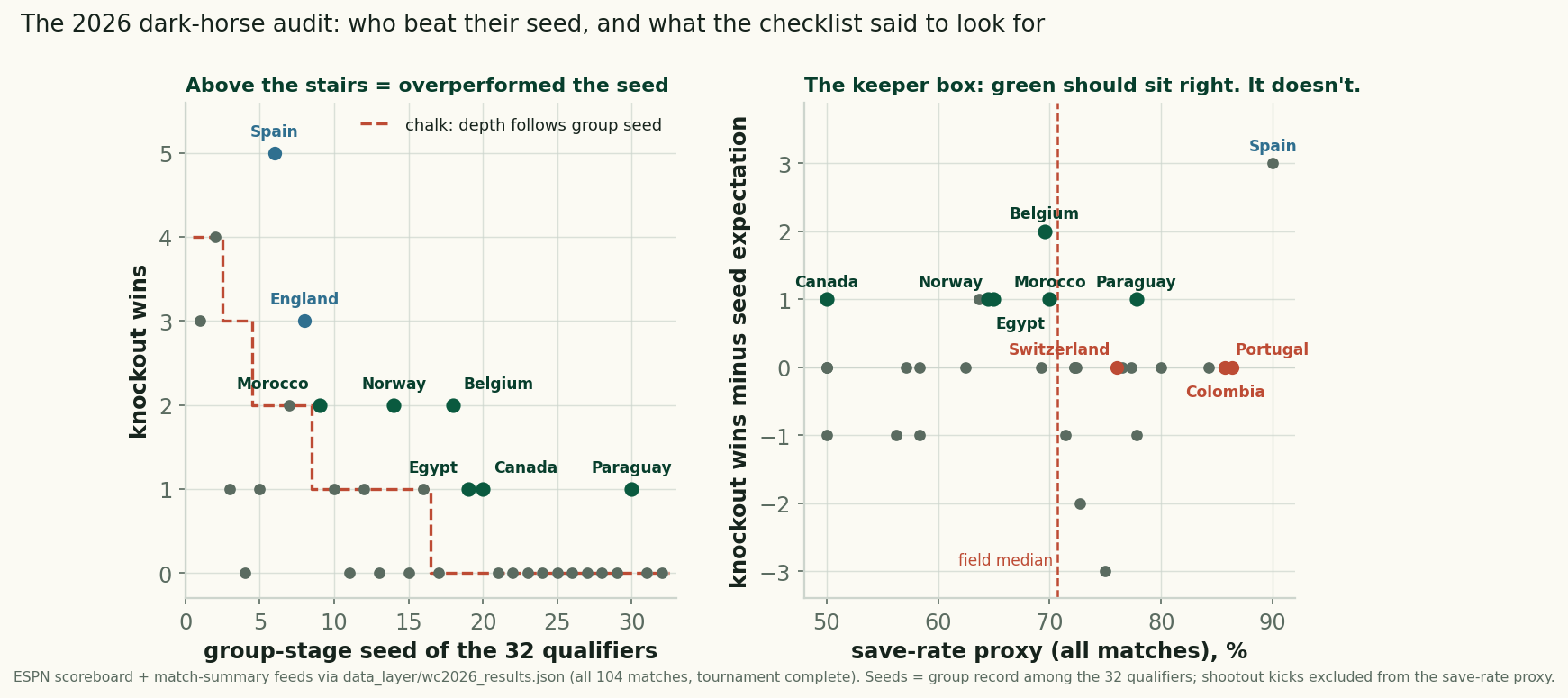
Six teams beat their group seed at the 2026 World Cup, scored against our pre-tournament checklist: the keeper box failed, the kind draw barely helped.
The Shootouts: Rarer, Earlier, and a Reprieve That Never Lasted
Retro #4 closes the series: the shootout rate fell to 12.5% of knockout games from 2022's 31%, all four came early, and survivors went 1-3 next time out.
The Groups Told the Truth: How June Predicted July at the 2026 World Cup
Group-stage points strongly predicted knockout survival: 9-point teams went 3-for-3, 4-point teams 2-for-11, and the last four all ranked top-8.