How to Watch the World Cup with xG: The Story Under the Scoreline
The scoreline is the headline. The xG is the story underneath.
A World Cup result is the loudest number in football. A nation wins, a nation goes home, and a single goal decides which. But the scoreline is a headline, not the story — and at a tournament where 104 matches are squeezed into a month and a single deflection can end a campaign, the story underneath the headline matters more than usual. Expected goals is how you read it. Here is how to watch a World Cup match through xG without mistaking one afternoon for a verdict.
What the scoreline hides
Start with the most common scoreline in knockout football: 1–0. It is the result that decides more World Cup matches than any other, and it is also the least informative. A 1–0 can mean a side dominated for ninety minutes and finally broke through. It can equally mean a side was pinned in its own half, survived, and nicked a winner on its only real chance. The scoreboard reads identically. The two performances are nothing alike.
Expected goals separates them. xG attaches a probability to every shot — the chance that an average finisher would have scored from that position, in that situation — and adds them up. A team that wins 1–0 having created 2.1 xG to its opponent's 0.3 was, on the balance of chances, the better side by a distance. A team that wins 1–0 having created 0.4 xG against 1.6 got away with one. Same three points, opposite stories. If you only read the scoreline, you would file both as convincing — and you would be wrong about one of them.
This is the single most useful habit you can build for 2026: when the final whistle blows, don't ask only who won. Ask who created the better chances, and by how much. The gap between those two answers is where the real information lives. For the underlying mechanics of the metric, the expected goals explainer walks through exactly what a shot's xG value is built from.
Reading xG live, during the match
Broadcasters now flash an xG figure on screen during games, and the running total updates with every shot. Watched carefully, that number is a live readout of who is actually threatening — but it has to be read carefully, because two traps catch people constantly.
The first trap is the single big chance. xG is cumulative, so one penalty (worth roughly 0.79 in most public models) or one point-blank header can swing a team's total from 0.4 to 1.2 in a single moment. A side can spend an hour creating nothing, win a soft penalty, and suddenly "lead" the xG. The running total is real, but it is lumpy: always ask whether a team's xG is built from many decent chances or one outlier. The shape of the number matters as much as the number.
The second trap is game state. A team that goes 2–0 up after twenty minutes will often sit deep and concede territory for the rest of the match. Its opponent then piles up shots, builds xG, and "wins" the second half on chances — not because it is better, but because the leading side chose to defend a lead. Late xG against a parked bus is cheaper than early xG against an open game. When you read a live total, read the scoreline and the clock alongside it.
Deserved versus actual
The phrase analysts reach for is "deserved result", and xG is what makes it concrete rather than a matter of opinion. The deserved result is the scoreline the chances created point toward; the actual result is what the finishing and the goalkeeping produced on the day. Over a long season those two converge, because finishing variance washes out across hundreds of shots. Over a single World Cup match, they routinely diverge — and the divergence is the point, not a flaw.
The 2022 final is the textbook case. Argentina beat France on penalties after a 3–3 draw, and the underlying numbers — Argentina around 2.8 xG to France's roughly 2.3 — were less of a coin-flip than the chaotic scoreline implied, though still genuinely close. The shootout was a true lottery; the ninety minutes leaned, modestly, one way. Both things were true at once. That is the lens to carry into 2026: the actual result is what goes in the record book, but the deserved result is what tells you which teams are actually playing well.
A word of caution in the other direction. "Deserved" is not destiny. A team can deserve to win on chances and lose anyway, and that loss still counts — the tournament is decided by goals, not by xG. The value of the deserved-result lens is not that it overturns scorelines; it is that it tells you whether a result is likely to repeat. A side winning ugly while losing the xG battle is living on borrowed time. A side losing narrowly while dominating the chances is closer to a breakthrough than the table suggests.
The underlying-quality lens for a short tournament
Here is the hard part. Everything above works beautifully across a season of thirty-eight games. A World Cup gives each team three group matches and then sudden death. Three games is a tiny sample, and one-match knockouts are pure high-variance sport. So how much should a single match's xG actually move your opinion?
Less than you want it to, early on, and more than you fear, later. After one group game, a team's xG is a whisper — directionally useful, nowhere near a verdict. After three group games plus a round-of-32 tie, it is a quiet but real signal. By the time a side reaches the quarter-finals it has played five or six matches, and the cumulative xG picture starts to describe something repeatable rather than something lucky. The trick is to let the evidence accumulate without overreacting to any single data point. Reading a short tournament without overfitting is a discipline in itself, and the companion piece on not overfitting the knockouts goes deeper on exactly how to weight three games' worth of evidence.
The metric that stabilises fastest, and the one worth tracking most closely, is expected goals conceded. Sustained chance creation can dry up against elite defences; defensive structure is harder to fake across multiple rounds. A team posting consistently low xGA while advancing is doing something real and repeatable, the kind of underlying quality that tends to survive contact with the knockout rounds. Morocco's run to the 2022 semi-finals was built precisely on that — a defence that held its shape across six matches, not a hot goalkeeper for one night.
A practical match-watching checklist
Pulling it together, here is how to watch a 2026 match through xG without losing the thread:
Before kickoff, note what you already believe about both teams from qualifying and recent form. That prior is your starting point; one match will adjust it, not erase it.
During the match, watch the running xG total, but read it against the score and the clock. Ask whether a team's xG is one big chance or many; ask whether late shots are coming against a side defending a lead.
At full time, write the score and the final xG together. Decide which kind of result it was: deserved, smash-and-grab, or genuinely even. That one-line summary is worth more than the highlights.
Across the tournament, keep a running tally of each contender's cumulative xG for and against. Trust it more with every round. By the semi-finals it is telling you who has actually been the best team — which is not always who is still standing, but is always worth knowing.
The scoreline will always be the headline; it decides the trophy and nothing here changes that. xG is the story underneath — whether the headline was earned, and which teams are quietly playing the kind of football that lasts. For the bigger statistical picture of the whole event, the World Cup 2026 by the numbers primer sets the baseline this lens reads against.
Where these numbers come from
- Expected Goals (xG) Explained — what a single shot's xG value is built from, and how to read it without getting fooled.
- Don't Overfit the Knockouts — how much a single short-tournament match should actually move your opinion.
- World Cup 2026 by the Numbers — the format and the goals baseline this match-watching lens reads against.
- FBref — match-level xG and xGA for international fixtures, powered by Opta.
- StatsBomb — methodology documentation on how expected goals models are built and validated.
More from World Cup 2026
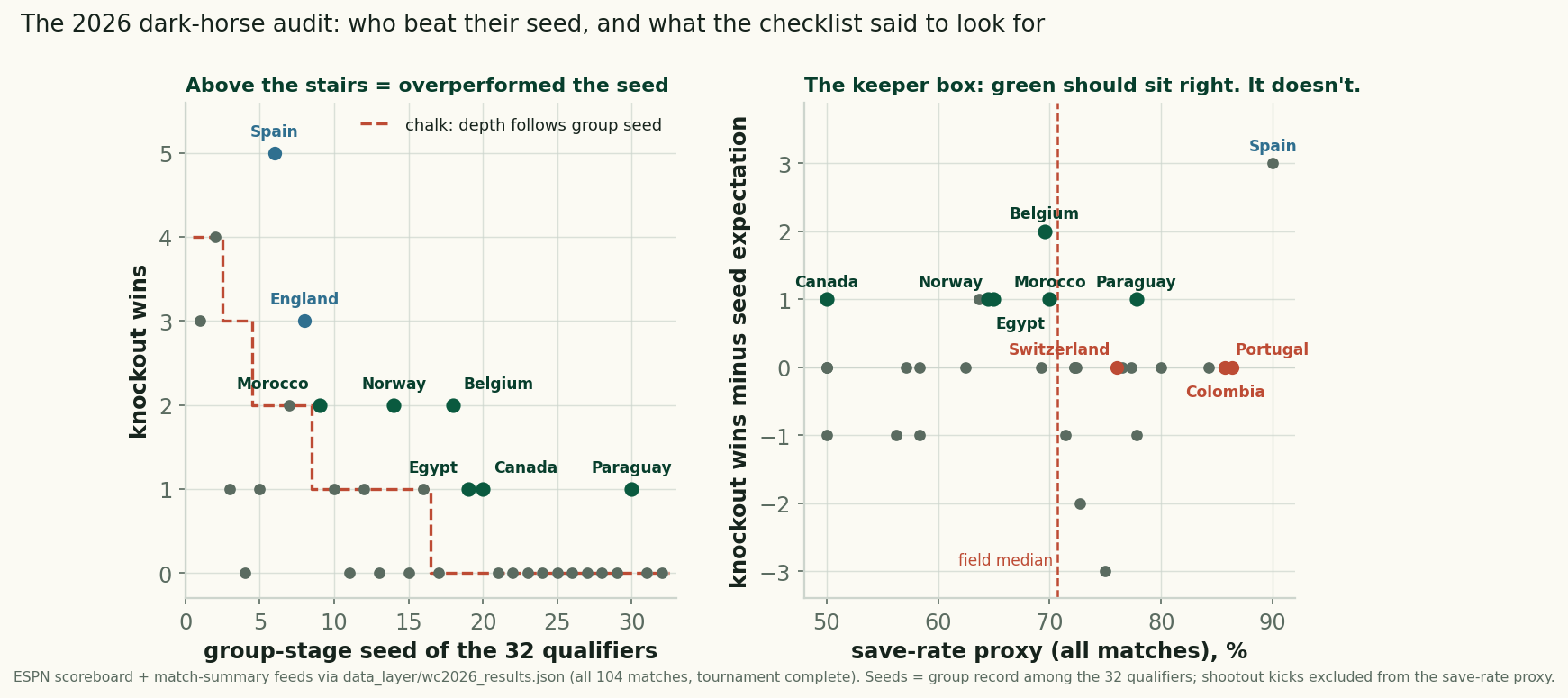
The 2026 Dark-Horse Audit: Grading Our June Checklist
Six teams beat their group seed at the 2026 World Cup, scored against our pre-tournament checklist: the keeper box failed, the kind draw barely helped.
The Shootouts: Rarer, Earlier, and a Reprieve That Never Lasted
Retro #4 closes the series: the shootout rate fell to 12.5% of knockout games from 2022's 31%, all four came early, and survivors went 1-3 next time out.
The Groups Told the Truth: How June Predicted July at the 2026 World Cup
Group-stage points strongly predicted knockout survival: 9-point teams went 3-for-3, 4-point teams 2-for-11, and the last four all ranked top-8.