Don't Overfit the Knockouts: Reading a Short Tournament Without Fooling Yourself
Three group games and a coin-flip knockout aren't much to judge a team on.
A World Cup hands you almost no data and asks you to draw enormous conclusions from it. A team plays three group matches — and at the 2026 edition, the top two from each of the twelve groups plus the eight best third-placed sides advance to a round of 32 — and then the whole thing becomes sudden death. Three games, then a coin flip, repeated until one nation lifts the trophy. That is a tiny, brutal sample, and the single biggest analytical mistake you can make is to treat it like a large one. Here is how to read a short tournament without overfitting to noise.
Why three games is almost nothing
Football is a low-scoring, high-variance sport, which is precisely why three matches tells you so little. In a sport where games routinely end 1–0 and the better side loses often enough to keep everyone watching, a sample of three is dominated by luck. One deflected shot, one offside call that goes the wrong way, one penalty awarded or waved away — any of these can flip a result, and across three games there are only so many results to flip.
Consider what a single group looks like. Four teams, three games each, and the difference between topping the group and going home can be one goal in one match. A side can play well three times and finish third; a side can ride two pieces of fortune and top the group. The final standings are real — they decide who advances — but they are a noisy measurement of how good the teams actually are. The table is the outcome, not the truth.
This is the same problem that makes league forecasting hard, except compressed. League models disagree partly because a season is still short enough for luck to matter; the companion piece on why league projection models disagree shows how much uncertainty survives even across thirty-eight games. A World Cup gives a team three.
The one-game knockout is a coin flip — by design
The group stage at least gives you three data points. The knockouts give you one match, winner advances, and that is where variance peaks. A single elimination game is the highest-variance format in sport: there is no second leg to correct an unlucky afternoon, no aggregate to smooth the result. The better team is favoured, but "favoured" in a one-off football match is a long way from "certain".
Penalty shootouts make this explicit. When a knockout tie goes to penalties, it is close to a literal coin flip — a contest of fine margins that the preceding 120 minutes barely predict. A team can dominate a quarter-final on chances, fail to convert, and lose on penalties to a side that defended for two hours. That happened repeatedly at recent tournaments, and it will happen in 2026. The crucial point: the team that lost on penalties is not therefore worse than the team that won. The shootout did not measure quality. It resolved a tie that quality could not.
Narratives built from three games
The shortness of the sample does not stop the stories. It feeds them. Three games is exactly enough to spin a compelling narrative and far too few to support one. By the end of the group stage, every team has a story: this one is "peaking", that one is "fragile at the back", another "can't score against deep blocks". Each story is built on a sample so small that it would not survive a fourth match.
The trap is that the narrative always sounds more certain than the evidence. A team that conceded a late goal in two of three group games gets labelled mentally weak; in reality, two events is not a pattern, it is a coincidence waiting to be called one. A striker who missed a couple of good chances gets called wasteful; two misses is well within the normal scatter of finishing. Narratives compress noise into a story, and stories feel like knowledge. They mostly are not. The group-stage edition of this problem — momentum, rotation, dead rubbers — gets its own treatment in group-stage narratives versus numbers.
None of this means the eye test is worthless. Watching the games tells you things a results table cannot — whether a defence is organised, whether a midfield controls territory, whether chances are being manufactured by design or arriving by accident. The mistake is not watching; it is letting three results override what you actually saw.
How to weight the evidence: priors plus what you saw
The way out of the overfitting trap is to stop treating the tournament as the only evidence that exists. It is not. Every team arrives with a history — qualifying form, recent results against strong opposition, squad quality, a track record — and that history is your prior. The World Cup matches then update the prior; they do not replace it.
Think of it as a simple weighting. Your belief about a team after three group games should be a blend: mostly what you already knew, adjusted by what the three matches added. A pre-tournament favourite that stumbles through the group stage with two narrow wins and a draw has not become a bad team — it has given you a little evidence that nudges a strong prior slightly downward. An unfancied side that creates good chances in all three games has given you a little evidence that nudges a weak prior slightly upward. Neither result should flip your view entirely. Three games is not enough to overturn everything you knew; it is enough to adjust it.
The signals that deserve the most weight are the ones that stabilise fastest. Underlying chance quality — measured through expected goals — settles sooner than results do, because it counts every shot rather than only the ones that went in. Expected goals conceded stabilises faster still, because defensive structure is harder to fake across multiple matches than finishing is to sustain. A team quietly posting strong underlying numbers is telling you more than a team riding a couple of fortunate scorelines, even when the scoreboard says otherwise. The guide to watching with xG covers how to read those underlying numbers match by match.
A short-tournament discipline
Pulling it together, here is the discipline that keeps you honest across a month of high-variance football:
Discount single results, especially early. One match — and above all one shootout — is the noisiest evidence the tournament produces. Note it; don't anchor to it.
Separate what happened from what it means. A team can deserve to win and lose anyway. The result counts for the bracket; the underlying performance counts for your assessment of how good the team actually is.
Start from priors and update gently. Carry what you knew before the tournament into every match. Let three games adjust that picture, not erase it. The favourites are favourites for reasons that one bad afternoon does not delete.
Trust the signal more as the sample grows. By the quarter-finals and semi-finals, the surviving teams have five or six matches behind them, and the cumulative picture finally means something. That is when underlying numbers stop being a whisper and start being a description.
The paradox of a World Cup is that it is the most-watched football on earth and the least reliable to draw conclusions from. The teams that win are not always the best; the teams that go home early are not always exposed. Holding both ideas at once — caring intensely about results while refusing to overfit to them — is the whole art of reading a short tournament. For the structural reasons the 2026 sample is even thinner than past editions, the by-the-numbers primer lays out the format in full.
Sources & further reading
- Why League Projection Models Disagree — how much uncertainty survives even across a full season, let alone three games.
- Group-Stage Narratives vs Numbers — the small-sample stories to distrust and the numbers that actually carry forward.
- How to Watch the World Cup with xG — reading the underlying numbers that stabilise faster than results.
- World Cup 2026 by the Numbers — why the expanded format makes the group-stage sample even thinner.
- StatsBomb — documentation on the underlying metrics that settle faster than scorelines.
More from World Cup 2026
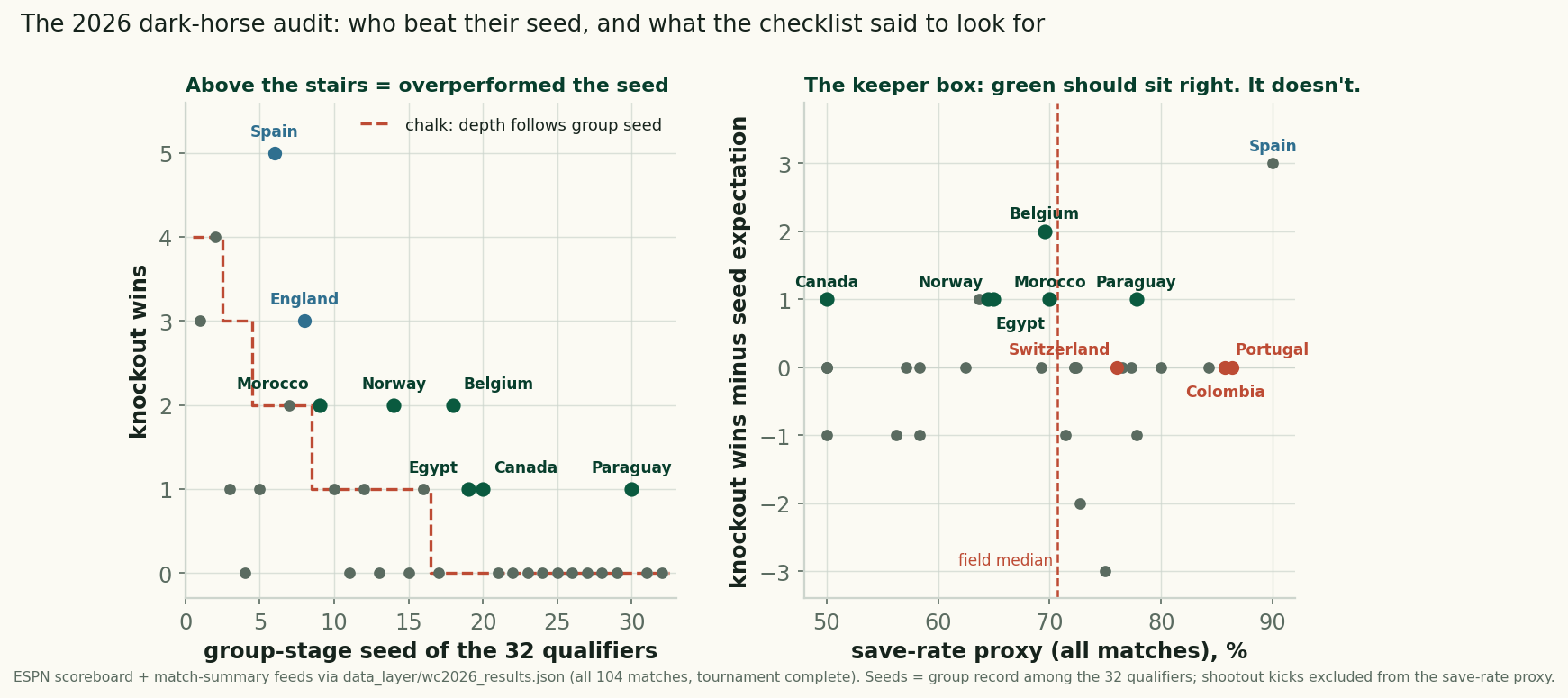
The 2026 Dark-Horse Audit: Grading Our June Checklist
Six teams beat their group seed at the 2026 World Cup, scored against our pre-tournament checklist: the keeper box failed, the kind draw barely helped.
The Shootouts: Rarer, Earlier, and a Reprieve That Never Lasted
Retro #4 closes the series: the shootout rate fell to 12.5% of knockout games from 2022's 31%, all four came early, and survivors went 1-3 next time out.
The Groups Told the Truth: How June Predicted July at the 2026 World Cup
Group-stage points strongly predicted knockout survival: 9-point teams went 3-for-3, 4-point teams 2-for-11, and the last four all ranked top-8.