The Long Throw-In: A Set Piece Hiding in Plain Sight
The unglamorous restart that behaves like a free corner.
It is hard to see why the long throw gets treated as a kind of footballing bad manners — a sign that a team has run out of better ideas. Strip away the snobbery and you find one of the few genuinely free sources of danger in the game: a delivery into the six-yard box, from a dead situation, that an opponent cannot legislate against the way they can a corner. Yet most teams that win a throw in the attacking third just play it short and start again, handing back something they were under no obligation to surrender. That waste is the subject here.
Our argument is simple. A long throw flung into the box is, in every way that matters to a goalkeeper or a centre-half, a corner taken from the touchline — and it obeys the same expected-goals logic. Once you see it that way, the question stops being "is the long throw a bit ugly?" and becomes "why aren't more sides squeezing free deliveries out of throws they're going to win anyway?"
Why a long throw functions like a corner
Strip a corner down to its essentials and it is simply a delivery of the ball, from a dead or near-dead situation, into a crowded penalty area for attackers to attack and defenders to defend. A long throw delivered into the box is the same thing. The ball arrives in the danger zone, contested in the air, met first time by a moving player among a thicket of bodies. The crowd-and-chaos dynamics that make corners so hard to model — flick-ons, knockdowns, second balls, scrambles — all reappear at a long throw. From the defending team's point of view, it is a corner to be defended, just launched from the touchline instead of the corner flag.
There are real differences, of course, and they cut both ways. A throw cannot be given offside — you cannot be offside directly from a throw-in — which lets attackers position themselves more aggressively than they could from a corner. The trajectory is different too: a hurled ball tends to arrive flat and fast, a flick-on weapon rather than a floated cross, which is why long-throw teams so often aim for a near-post glance rather than a clean header at goal. And the throw is taken with the hands, so the delivery point is the touchline, not the by-line, changing the angle of attack. But the strategic essence is identical: it is a free, repeatable opportunity to put the ball into the mixer, and a team with a genuine long-throw specialist effectively earns a corner every time it wins a throw in the attacking third.
The delivery zones
Like a corner, a long throw lives or dies on where it is aimed, and the target zones mirror corner theory closely.
The classic target is the near post. A flat, fast throw flicked on at the near post by a tall attacker is the signature long-throw move, because the flick redirects the ball into the most dangerous area — the centre of the six-yard box — while wrong-footing defenders and the goalkeeper, who must react to a sudden change of direction at close range. The near-post flick-on is to the long throw what the in-swinging corner is to set-piece routines: the highest-percentage way to manufacture chaos in front of goal. Watch a well-drilled side do it and the target man barely seems to head the ball at all — just a touch, a deflection, enough to send it skidding across bodies that are all moving the wrong way.
Behind the flick sits the central six-yard zone, where the runners arrive to attack a knockdown or a missed header. And then there is the second-ball zone at the top of the box, where clearances and half-cleared knockdowns drop to lurking midfielders. As with corners, a large share of the genuine danger comes from this second phase rather than the first contact, which is why well-drilled long-throw teams station players specifically to attack the drop.
The xG case for and against
The case for the long throw is straightforward and rests on the same arithmetic that justifies corners. Any single delivery into the box is a low-probability event — the average is worth only a few hundredths of a goal, as we lay out in set-piece xG explained. But a team that can turn a routine throw into a box delivery manufactures a large number of these low-value chances over a season, for essentially zero cost, from situations the opponent would otherwise treat as harmless. Hundredths of a goal, repeated dozens of times, add up to real goals. The long throw is a way of buying extra set-piece volume out of thin air, and volume of low-value chances is exactly how the dead ball pays off. It is also a great leveller: it requires one specialist thrower and some rehearsed movement, not expensive technical talent, which is why it has so often been a weapon of underdog and lower-division sides.
The case against has three parts. First, the per-throw value is genuinely low, and the flat, contested delivery is even harder to convert cleanly than a floated corner — first contact is usually a flick or a knockdown, not a shot, so the chance that does emerge is messy and off-balance. Second, committing to the long throw means committing bodies forward into the box, which leaves a team exposed if the delivery is cleared and the opponent breaks; the lost throw becomes a transition the way a lost corner does. Third, there is an opportunity cost: a long throw surrenders possession in a controlled situation in exchange for a low-percentage aerial lottery, which sits badly with possession-based philosophies that would rather keep the ball and build. Whether the trade is worth it depends on a team's strengths — its aerial personnel, its thrower, and how much it values control versus chaos.
Famous practitioners
The long throw has a real, documented history as a deliberate weapon, and a handful of names are inseparable from it. In the English game, Stoke City under Tony Pulis in the late 2000s and early 2010s became the defining modern example: Rory Delap's flat, javelin-like throws were a genuine tactical identity, feared across the Premier League and explicitly built into how Stoke attacked and how opponents prepared to defend them. Delap's deliveries were so flat and fast that they functioned exactly like an extra in-swinging corner from the touchline, and the routine drew enough copycats and counter-measures to be treated as a tactic in its own right rather than a quirk.
Going further back, Wimbledon's "Crazy Gang" of the late 1980s used the long throw, among other direct and physical methods, as part of a deliberately disruptive, set-piece-heavy style that helped a club rise rapidly through the divisions. The throw fit a broader philosophy: if you cannot out-pass better-resourced opponents, you can out-organise them at dead balls and second balls, where talent matters less and rehearsal matters more.
What connects these sides is not nostalgia but logic. Each understood, long before the analytics vocabulary existed, what expected goals later made explicit: set pieces are a large, repeatable, low-cost share of a season's chances, and a team that squeezes extra deliveries out of throw-ins is buying goals at the margin. The long throw drifts in and out of fashion — it is periodically declared dead and then revived by a coach who notices the free value lying on the touchline — but its underlying case never really changes.
How to read a long-throw team
If you want to judge whether a side's long throw is a real weapon or just a habit, watch the same things you would at a corner. Is there a designated specialist with the range to reach the six-yard box flat and fast? Is there a near-post target whose job is to flick, and runners timed to attack the knockdown? Is the second-ball zone at the top of the box occupied? And crucially, is the team protected against the counter if the throw is cleared — or does it pour everyone forward and leave itself open? A long throw defended and attacked with the same care as a corner deserves to be judged as one. Treated casually, it is just a way of giving the ball back in a dangerous area. The restart is the same either way; the coaching is what turns it into a weapon.
Sources, notes & further reading
- StatsBomb — research on set-piece value and the dynamics of box deliveries and second-phase chances.
- StatsBomb open data — event-level data, including set-piece and throw-in play patterns.
- FBref — set-piece and shot data (via Opta) across a wide range of competitions.
- Understat — season-level xG tables for separating set-piece contributions.
More from Stat Explainers
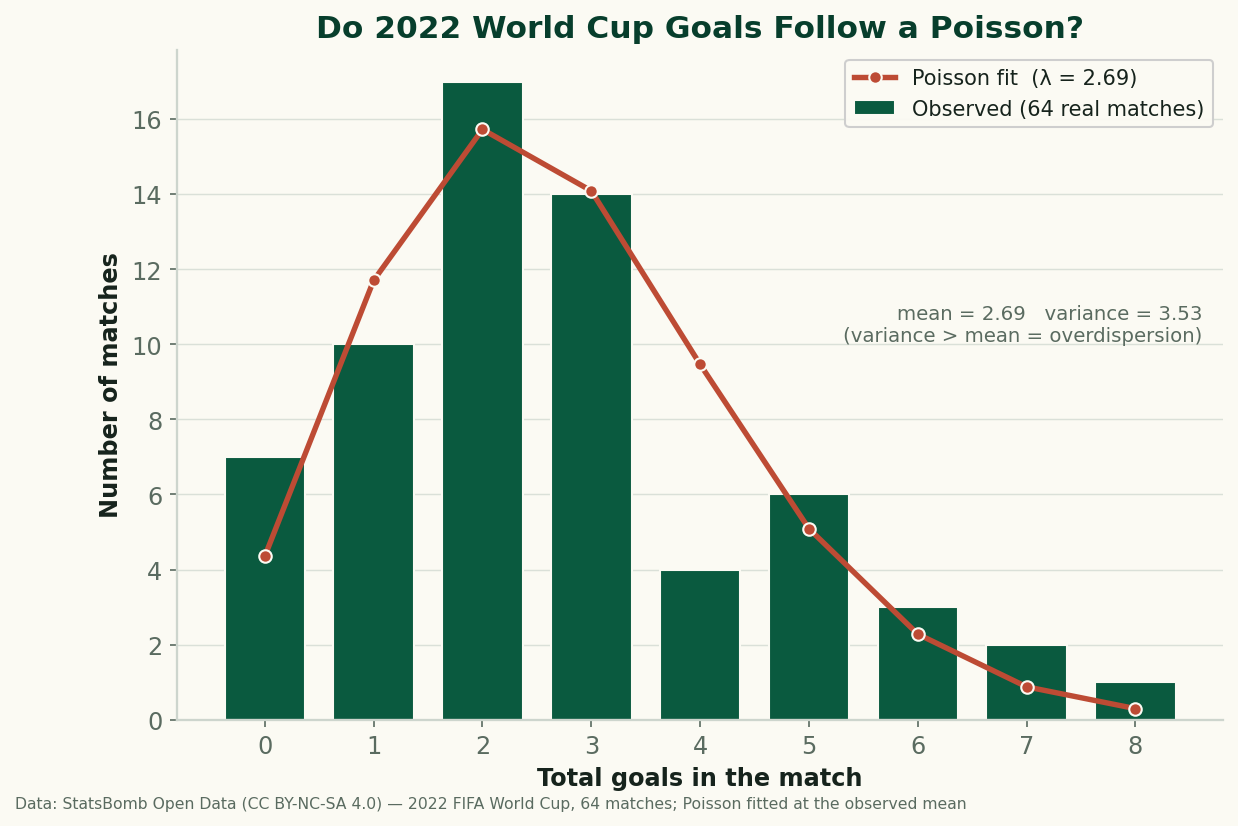
Do Football Goals Follow a Poisson? Testing the Standard Model on All 64 Games of 2022
Every scoreline prediction in football rests on the Poisson. We fit it to all 64 games of 2022 — it gets the shape right, but real goals are overdispersed.
Aerial Duels and Heading Data: Reading Win Rate Without Getting Fooled by Volume
Aerial-duel win percentage, why raw counts mislead, and where aerial dominance actually matters — set pieces, target men, and defending crosses.
Expected Points (xPts): Turning Shot-Level xG Into a Fairer Table
Expected points (xPts) simulates a match from its shot-level xG to get win, draw and loss odds — points that reward chances created, not goals that went in.