Set-Piece xG Explained: Why Corners Feel Deadly and Mostly Aren’t
The gap between how dangerous a corner feels and what it is worth.
The corner is the most overrated moment in football, even though every crowd still leans forward when one is won. Our instincts and the evidence point in opposite directions here. The stadium senses danger; the data records a clearance and play restarting forty yards away. That gap — between how lethal a corner feels and what it is actually worth — is the single best reason to look at set pieces through expected goals rather than through the pit of your stomach. So here is the dead ball taken apart, situation by situation, to show where the menace is real and where it is theatre.
What a set piece is actually worth
Expected goals attaches a probability to a shot: the chance that a shot from that position, in that situation, becomes a goal. Run dead-ball situations through that lens and the headline finding is, frankly, humbling. The average corner is worth only a few hundredths of a goal, and the overwhelming majority of corners produce no shot at all — the ball is cleared, recycled, or won straight back by the defending side. The feeling of menace is real; the conversion is not.
The reason is geometry, the same thing that drives xG everywhere else. A corner is a delivery into a crowd, usually met first time, often with the head, by a player who is moving, marked, and facing away from the most of the goal. Every one of those factors pushes the probability of a goal down. A clean header from the penalty spot is a decent chance; a flick-on in a six-man scrum, contested in the air, is not. The chance the average corner generates — if it generates one at all — is a low-value one.
None of this means corners are worthless. A team wins a great many of them over a season, and a few hundredths of a goal repeated dozens of times adds up to real goals. The point is the rate, not the total: any single corner is far more likely to end in nothing than in a shot, and the shot it does produce is usually a poor one. If you have ever shouted at a team to “just win a corner” while chasing a game, the data gently suggests you were asking for very little.
Direct free kicks: distance, the wall, and a low ceiling
The direct free kick feels like the glamour set piece — the dead ball struck cleanly at goal, the wall, the wait. Its expected-goals profile is sobering for a different reason than the corner’s. Here the shot does happen, every time, but it is taken from distance, against a set defence, into a goal that has been deliberately made smaller.
Two things suppress the value. The first is distance, the strongest predictor in any xG model: conversion falls steeply as the ball is placed further from goal, and most direct free kicks are struck from ranges where open-play shots are already long shots. The second is the wall and the set goalkeeper. A direct free kick is one of the few shots in football where the defence is allowed to build a partial obstruction and the keeper has a moment to set his feet and read the angle. The shooter must beat both, usually by bending the ball over or around the wall and inside a post, which is precisely why the spectacular free-kick goal is celebrated as a piece of skill rather than expected as a matter of course.
So the honest framing is that even from promising central positions, a direct free kick is a low-probability event. It is worth taking — the alternative is conceding the shot entirely — and a genuine specialist tilts the odds in his favour over a career. But it sits much closer to the hopeful long-range effort than to the gilt-edged chance the crowd reaction implies.
The penalty: the high-value exception
Against that backdrop the penalty is the great outlier. It is the one dead-ball situation that is reliably, overwhelmingly a good chance. A penalty is worth roughly 0.76 to 0.79 xG — a near-constant in every model precisely because it is the same shot every time: a fixed spot, a fixed distance, an unobstructed strike with no defender between the ball and the goal except the keeper, who is not allowed to move off his line until the ball is struck.
That value — roughly three goals in every four — dwarfs anything a corner or a typical free kick offers. It is the reason a foul in the box is a catastrophe and a foul just outside it is merely a setback, and it is why winning a penalty is one of the most valuable single events in a match. If you want the full anatomy of why the number sits where it does, we devote a whole piece to it in the penalty conversion rate. For everything else on this page, just hold onto the contrast: penalties are the exception that proves how unthreatening the average set piece really is.
Why set-piece xG is genuinely hard to model
There is a deeper reason to treat set-piece xG with extra caution, and it is one more match-day graphics should acknowledge: it is genuinely harder to model than open play, and the usual freeze-frame features do less of the work. A standard xG model is trained on shot location, angle, body part, and the positions of defenders and the keeper at the moment of the shot. That works beautifully for an open-play chance, where the shot tends to be the clean end of a sequence. Set pieces break the assumptions.
The trouble is that a corner or an indirect free kick is a controlled act of chaos. The first contact is often a flick-on or a knockdown, not a shot. The dangerous shot — if one comes — frequently arrives from the second ball: a header that drops to a lurking midfielder, a clearance that falls to the edge of the box, a scramble after the keeper parries. Those second-phase shots are messy to attribute and noisy to value. Crowding makes it worse: a dozen players are packed into a tiny space, so “how many defenders are near the shooter” stops discriminating between chances the way it does in open play, where it is a powerful signal.
The practical consequences are real. Set-piece xG is noisier per shot than open-play xG, second-phase chances are easy to mis-credit, and the small samples any one team generates in a season mean a couple of flukey conversions can badly distort a set-piece “rating” over a short window. The metric is still useful in aggregate — it is the right tool for asking whether a team’s routines manufacture good chances — but it deserves more humility, and a larger sample, than the open-play number. Post-shot models, which value what happens after the ball leaves the foot or head, help with the keeper’s side of the ledger; we cover them in post-shot xG and goalkeeper metrics.
How smart teams attack the low base rate
If the average corner is nearly worthless, the interesting question is not whether to bother but how to do meaningfully better than average. Over the last decade a quiet specialism has grown up around exactly that, and it has changed how good teams treat the dead ball.
The first response is to stop playing the percentages everyone else plays. The short corner — declining the contested delivery in favour of keeping the ball, drawing a defender out, and attacking from a better angle or simply retaining possession — is a rational answer to a delivery that usually fails. So are designed routines: blocks and screens to free a runner, decoy movement to drag markers out of the danger zone, deliveries aimed at a specific pre-rehearsed spot rather than hopefully into the mixer. The aim is the same in every case — to manufacture the one thing the average corner lacks, a clean contact for a free attacker.
The second response is organisational, and it is the clearest sign the analytics took hold: the rise of the dedicated set-piece coach. A role that barely existed a decade ago is now common at the top of the game, and the logic is pure expected goals. Set pieces are a large, repeatable share of a season’s chances; the base rate is low; marginal gains compound. A coach who can lift a team from a poor set-piece process to a good one is buying extra goals at the margin, on both sides of the ball, for a fraction of the cost of a transfer. That is what it looks like when a sport reads its own data: not abandoning the corner, but refusing to accept the average return on it.
The data behind this piece
- StatsBomb — research on set-piece value, second-phase chances, and how freeze-frame features feed an xG model.
- StatsBomb open data — shot- and event-level data, including set-piece play patterns, for analysts who want to compute this themselves.
- Understat — season-level xG tables that let you separate set-piece and open-play contributions.
- FBref — set-piece and shot data (via Opta) across a wide range of competitions.
Zonal, man or hybrid: how teams defend set pieces
This section was first published on 13 June 2026 as a separate article.
Watch any match on television and the moment a side concedes a header from a corner, you can almost set a timer: within seconds someone has blamed "zonal marking" as if naming the system were the same as diagnosing the goal. It almost never is. The choice between marking zones, marking men, or blending the two is one of the oldest arguments in football, and also one of the most lazily refereed — because the same commentator who hangs a goal on zonal marking will quietly let an identical man-marking error pass without comment.
So set the system question aside for a moment and ask a more useful one. What does each scheme actually buy you, what does it cost, and how would you tell a well-coached version from a badly coached one if nobody told you the label? Answer those, and the "zonal or man?" debate mostly dissolves.
The three systems
Defending a corner comes down to a single question: do your defenders mark space or do they mark opponents? The three answers to that question are zonal marking, man-marking, and the hybrid that almost every elite side actually uses.
Zonal marking assigns each defender a patch of the box to protect rather than a specific attacker to follow. You stand in your zone, and you attack any ball that comes into it, whoever happens to arrive there. The logic is that the ball, not the man, is what scores, so you defend the dangerous spaces — the near post, the centre of the six-yard box, the penalty spot — and trust that an attacker can only score from a zone you are already occupying. Its great virtue is that defenders face the ball, are set, and can attack the flight of the cross with momentum rather than chasing a runner from behind.
Man-marking does the opposite: each defender is given an attacker and told to go wherever that attacker goes. The logic is accountability — every dangerous opponent has a shadow, and if a man scores, you know exactly who lost him. Its great virtue is that it denies attackers a free run-up, because someone is physically attached to them. Its weakness is that it hands the initiative to the attacking side, who can use movement, blocks, and decoy runs to drag markers out of position and manufacture the one thing zonal marking guards jealously: a free header in a dangerous zone.
Hybrid marking — the system most top teams run — mixes the two. A few defenders hold key zones (typically the near post, the front of the six-yard box, and the area around the keeper), while others man-mark the most dangerous aerial threats. One or two more might be posted on the posts themselves, and a player or two left high up the pitch as an outlet for the counter. The aim is to get the best of both: the set, ball-facing solidity of zones in the highest-value space, plus the accountability of man-marking on the opponents most likely to score.
The trade-offs, honestly
Here is the thing worth holding onto: each system fails in a characteristic way, and knowing the failure mode is far more useful than knowing the name on the tin. Pure zonal marking fails when an attacker times a run into the seam between two zones, arriving with momentum at a ball that neither zone-defender quite owns; it can look passive, and a poorly drilled zonal scheme concedes "free" headers that enrage supporters precisely because nobody appears to be marking anyone. Pure man-marking fails to blocks and screens: attacking sides design routines specifically to obstruct markers, pick them off, and spring a runner free, and once a marker is beaten there is often no covering defender because everyone else is occupied with their own man. It is also vulnerable to simple physical mismatches — put your best aerial attacker on their weakest header and you have a contest you expect to win.
This is why the zonal-versus-man debate is so often miscast. When a team concedes from a corner, pundits frequently blame "zonal marking" as if the system itself were the culprit. But a man-marking side concedes too, just for different reasons, and the broadcast rarely frames those goals as an indictment of man-marking. The system does not concede goals; poorly executed defending concedes goals, under every system. What actually distinguishes good set-piece defending from bad is not the label on the scheme but the quality of the coaching: clear responsibilities, well-chosen zones, the right men on the right threats, and defenders who attack the ball rather than waiting for it.
What the data says about conceding from corners
Two findings from the analytics era reframe the whole argument. The first is the one we cover at length in set-piece xG explained: the average corner is worth very little. The overwhelming majority produce no shot at all, and the shots they do produce are low-value, contested, off-balance efforts. Whatever system you defend with, the base rate you are defending against is low, which means the difference between a "good" and a "bad" corner defence, measured per corner, is small and noisy — and easily swamped by a couple of flukey concessions over a short run of games.
The second finding is the one that should have ended the debate years ago: large studies of conceding rates have found no clear, robust advantage for either pure system once you control for confounders. Teams that mark zonally do not concede from corners at meaningfully different rates than teams that mark man-to-man, on average. What varies is execution. A well-coached zonal side and a well-coached man-marking side both defend corners well; a badly organised version of either defends them badly. The system is a vehicle; the coaching is the engine.
How to evaluate a defensive set-piece system
If the label does not tell you whether a defence is good, what does? Watch and measure the process, not the outcome of any single corner. A few questions cut to the heart of it.
Are the dangerous zones occupied and the dangerous men tracked? Freeze the frame at the moment the corner is taken. Is there a defender set at the near post and one guarding the centre of the six-yard box? Is the opponent's best header picked up by a credible aerial match-up, not left in space? A scheme that leaves a high-value zone empty or a top threat unmarked has a structural hole regardless of its name.
Do defenders face the ball and attack its flight? The single biggest predictor of winning a defensive header is being set, facing the cross, and meeting it with momentum, rather than chasing a runner and jumping from a standstill. Good zonal and hybrid schemes are built to maximise the number of defenders in that ball-facing posture.
Is the team protected against the second ball? As we note in the set-piece xG piece, a large share of set-piece goals come not from the first contact but from the second phase — a knockdown, a clearance that falls to the edge of the box, a scramble. A defence that wins the first header but has nobody screening the top of the box has only half-solved the problem. Look for who is posted on the edge of the area to mop up.
Is there an outlet, and is the keeper's domain protected? Leaving a forward high commits a body away from the box but offers a counter-attacking release if you win the ball — a real trade-off against defensive numbers. And in the six-yard box, is the goalkeeper given a clean working zone, or is he being screened and bodied by his own markers as much as the opponents'?
Judge over a large sample, with xG, not a single goal. Because corners are low base-rate and noisy, the only fair way to rate a set-piece defence is over many corners and ideally in expected-goals terms — the quality of chances conceded, not whether one fluke went in. A defence can do everything right and still concede a worldie header off a poor delivery; that goal is not evidence the system is broken. Reading the process over a season, the way we argue you should read every box-score number in context, is the only honest verdict.
So the answer to "zonal or man-marking?" is, unsatisfyingly but truthfully, "whichever one the team coaches well." The systems encode different bets about where danger comes from — space or men — and the hybrid hedges both. But the variable that actually moves the conceding rate is not the label. It is whether the dangerous zones are occupied, the dangerous men are tracked, the defenders attack the ball, and the second phase is covered. Get those right and the name of your scheme barely matters.
Where these numbers come from
- StatsBomb — research on set-piece value, defensive structures, and second-phase chances.
- StatsBomb open data — event-level data, including set-piece play patterns, for analysts who want to study this directly.
- FBref — set-piece and shot data (via Opta) across many competitions.
- Understat — season-level xG tables that help separate set-piece from open-play concessions.
More from Stat Explainers
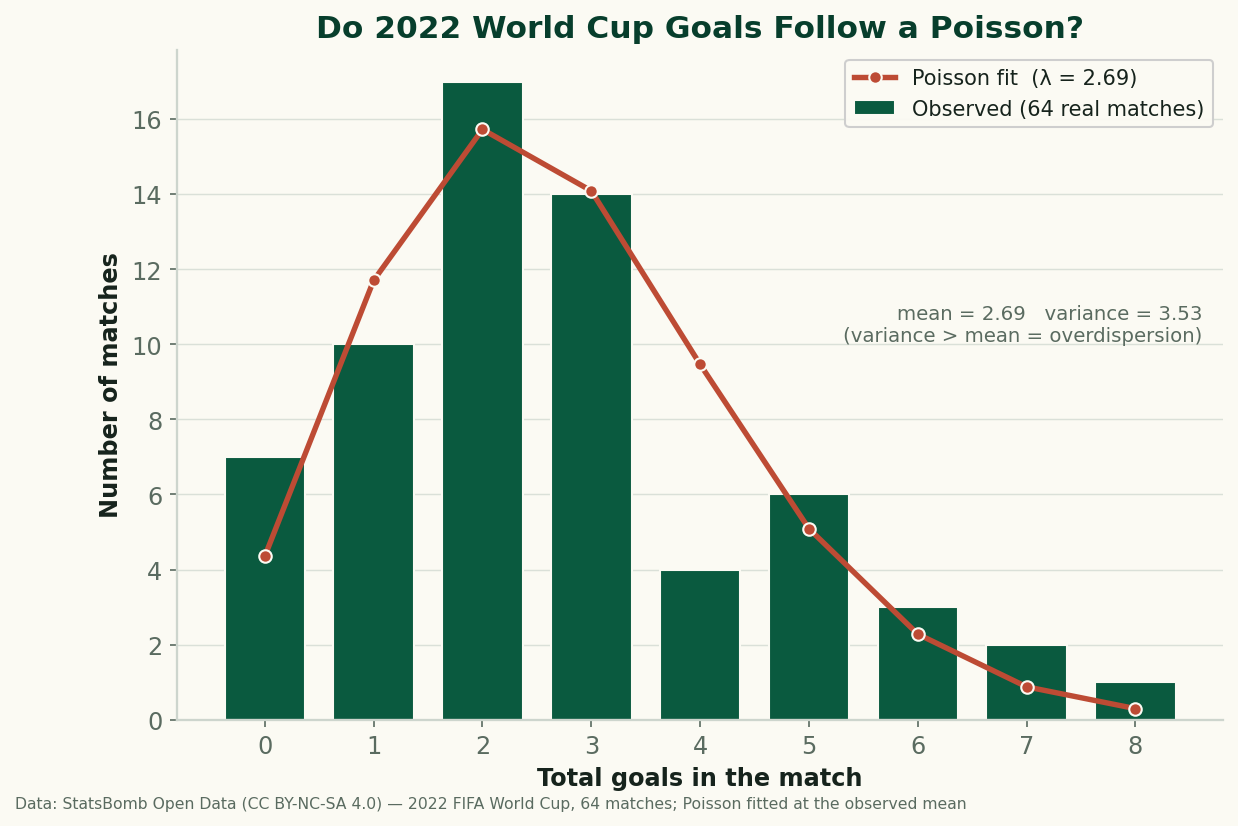
Do Football Goals Follow a Poisson? Testing the Standard Model on All 64 Games of 2022
Every scoreline prediction in football rests on the Poisson. We fit it to all 64 games of 2022 — it gets the shape right, but real goals are overdispersed.
Aerial Duels and Heading Data: Reading Win Rate Without Getting Fooled by Volume
Aerial-duel win percentage, why raw counts mislead, and where aerial dominance actually matters — set pieces, target men, and defending crosses.
Expected Points (xPts): Turning Shot-Level xG Into a Fairer Table
Expected points (xPts) simulates a match from its shot-level xG to get win, draw and loss odds — points that reward chances created, not goals that went in.