Zonal, Man, or Hybrid: How Teams Defend Set Pieces and How to Judge Them
Why the system a team picks matters less than how well it is coached.
Watch any match on television and the moment a side concedes a header from a corner, you can almost set a timer: within seconds someone has blamed "zonal marking" as if naming the system were the same as diagnosing the goal. It almost never is. The choice between marking zones, marking men, or blending the two is one of the oldest arguments in football, and also one of the most lazily refereed — because the same commentator who hangs a goal on zonal marking will quietly let an identical man-marking error pass without comment.
So I want to set the system question aside for a moment and ask a more useful one. What does each scheme actually buy you, what does it cost, and how would you tell a well-coached version from a badly coached one if nobody told you the label? Answer those, and the "zonal or man?" debate mostly dissolves.
The three systems
Defending a corner comes down to a single question: do your defenders mark space or do they mark opponents? The three answers to that question are zonal marking, man-marking, and the hybrid that almost every elite side actually uses.
Zonal marking assigns each defender a patch of the box to protect rather than a specific attacker to follow. You stand in your zone, and you attack any ball that comes into it, whoever happens to arrive there. The logic is that the ball, not the man, is what scores, so you defend the dangerous spaces — the near post, the centre of the six-yard box, the penalty spot — and trust that an attacker can only score from a zone you are already occupying. Its great virtue is that defenders face the ball, are set, and can attack the flight of the cross with momentum rather than chasing a runner from behind.
Man-marking does the opposite: each defender is given an attacker and told to go wherever that attacker goes. The logic is accountability — every dangerous opponent has a shadow, and if a man scores, you know exactly who lost him. Its great virtue is that it denies attackers a free run-up, because someone is physically attached to them. Its weakness is that it hands the initiative to the attacking side, who can use movement, blocks, and decoy runs to drag markers out of position and manufacture the one thing zonal marking guards jealously: a free header in a dangerous zone.
Hybrid marking — the system most top teams run — mixes the two. A few defenders hold key zones (typically the near post, the front of the six-yard box, and the area around the keeper), while others man-mark the most dangerous aerial threats. One or two more might be posted on the posts themselves, and a player or two left high up the pitch as an outlet for the counter. The aim is to get the best of both: the set, ball-facing solidity of zones in the highest-value space, plus the accountability of man-marking on the opponents most likely to score.
The trade-offs, honestly
Here is the thing worth holding onto: each system fails in a characteristic way, and knowing the failure mode is far more useful than knowing the name on the tin. Pure zonal marking fails when an attacker times a run into the seam between two zones, arriving with momentum at a ball that neither zone-defender quite owns; it can look passive, and a poorly drilled zonal scheme concedes "free" headers that enrage supporters precisely because nobody appears to be marking anyone. Pure man-marking fails to blocks and screens: attacking sides design routines specifically to obstruct markers, pick them off, and spring a runner free, and once a marker is beaten there is often no covering defender because everyone else is occupied with their own man. It is also vulnerable to simple physical mismatches — put your best aerial attacker on their weakest header and you have a contest you expect to win.
This is why the zonal-versus-man debate is so often miscast. When a team concedes from a corner, pundits frequently blame "zonal marking" as if the system itself were the culprit. But a man-marking side concedes too, just for different reasons, and the broadcast rarely frames those goals as an indictment of man-marking. The system does not concede goals; poorly executed defending concedes goals, under every system. What actually distinguishes good set-piece defending from bad is not the label on the scheme but the quality of the coaching: clear responsibilities, well-chosen zones, the right men on the right threats, and defenders who attack the ball rather than waiting for it.
What the data says about conceding from corners
Two findings from the analytics era reframe the whole argument. The first is the one we cover at length in set-piece xG explained: the average corner is worth very little. The overwhelming majority produce no shot at all, and the shots they do produce are low-value, contested, off-balance efforts. Whatever system you defend with, the base rate you are defending against is low, which means the difference between a "good" and a "bad" corner defence, measured per corner, is small and noisy — and easily swamped by a couple of flukey concessions over a short run of games.
The second finding is the one that, for me, should have ended the debate years ago: large studies of conceding rates have found no clear, robust advantage for either pure system once you control for confounders. Teams that mark zonally do not concede from corners at meaningfully different rates than teams that mark man-to-man, on average. What varies is execution. A well-coached zonal side and a well-coached man-marking side both defend corners well; a badly organised version of either defends them badly. The system is a vehicle; the coaching is the engine.
How to evaluate a defensive set-piece system
If the label does not tell you whether a defence is good, what does? Watch and measure the process, not the outcome of any single corner. A few questions cut to the heart of it.
Are the dangerous zones occupied and the dangerous men tracked? Freeze the frame at the moment the corner is taken. Is there a defender set at the near post and one guarding the centre of the six-yard box? Is the opponent's best header picked up by a credible aerial match-up, not left in space? A scheme that leaves a high-value zone empty or a top threat unmarked has a structural hole regardless of its name.
Do defenders face the ball and attack its flight? The single biggest predictor of winning a defensive header is being set, facing the cross, and meeting it with momentum, rather than chasing a runner and jumping from a standstill. Good zonal and hybrid schemes are built to maximise the number of defenders in that ball-facing posture.
Is the team protected against the second ball? As we note in the set-piece xG piece, a large share of set-piece goals come not from the first contact but from the second phase — a knockdown, a clearance that falls to the edge of the box, a scramble. A defence that wins the first header but has nobody screening the top of the box has only half-solved the problem. Look for who is posted on the edge of the area to mop up.
Is there an outlet, and is the keeper's domain protected? Leaving a forward high commits a body away from the box but offers a counter-attacking release if you win the ball — a real trade-off against defensive numbers. And in the six-yard box, is the goalkeeper given a clean working zone, or is he being screened and bodied by his own markers as much as the opponents'?
Judge over a large sample, with xG, not a single goal. Because corners are low base-rate and noisy, the only fair way to rate a set-piece defence is over many corners and ideally in expected-goals terms — the quality of chances conceded, not whether one fluke went in. A defence can do everything right and still concede a worldie header off a poor delivery; that goal is not evidence the system is broken. Reading the process over a season, the way we argue you should read every box-score number in context, is the only honest verdict.
So the answer to "zonal or man-marking?" is, unsatisfyingly but truthfully, "whichever one the team coaches well." The systems encode different bets about where danger comes from — space or men — and the hybrid hedges both. But the variable that actually moves the conceding rate is not the label. It is whether the dangerous zones are occupied, the dangerous men are tracked, the defenders attack the ball, and the second phase is covered. Get those right and the name of your scheme barely matters.
Where these numbers come from
- StatsBomb — research on set-piece value, defensive structures, and second-phase chances.
- StatsBomb open data — event-level data, including set-piece play patterns, for analysts who want to study this directly.
- FBref — set-piece and shot data (via Opta) across many competitions.
- Understat — season-level xG tables that help separate set-piece from open-play concessions.
More from Stat Explainers
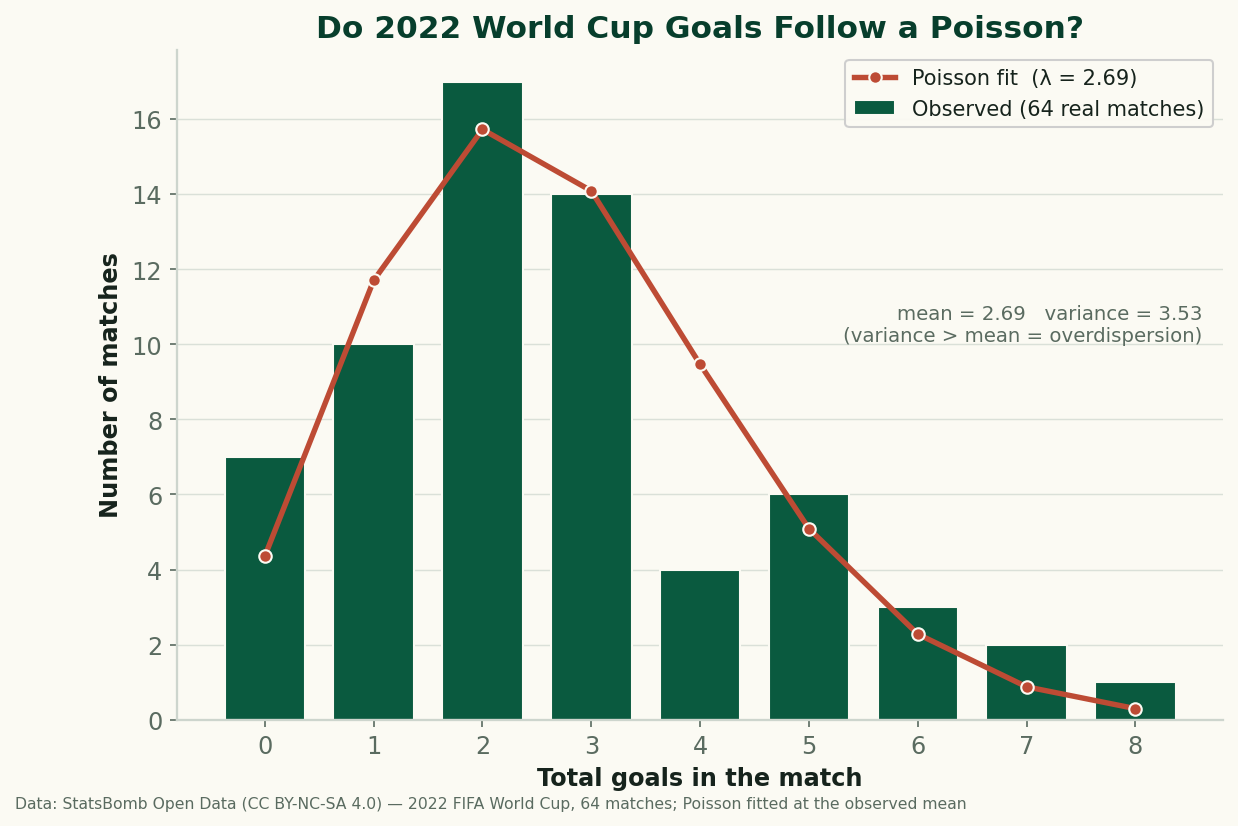
Do Football Goals Follow a Poisson? Testing the Standard Model on All 64 Games of 2022
Every scoreline prediction in football rests on the Poisson. I fit it to all 64 games of 2022 — it gets the shape right, but real goals are overdispersed.
Aerial Duels and Heading Data: Reading Win Rate Without Getting Fooled by Volume
Aerial-duel win percentage, why raw counts mislead, and where aerial dominance actually matters — set pieces, target men, and defending crosses.
Expected Points (xPts): Turning Shot-Level xG Into a Fairer Table
Expected points (xPts) simulates a match from its shot-level xG to get win, draw and loss odds — points that reward chances created, not goals that went in.