Field Tilt as Territorial Dominance: Measuring Who Owns the Final Third
The measurement decisions behind a territory percentage, and what the number is worth once you have made them.
Possession is the most quoted number in football and, fairly often, the most misleading. A side can finish with 65% of the ball and have been pinned in its own half for most of the afternoon. Field tilt is the metric we reach for to settle that argument: it ignores where the ball mostly sits and measures only the share of the game each team plays in the final third. Field tilt and territory explained makes the case for the idea and shows what it looks like next to expected goals. This piece is the other half — the measurement. How you actually compute the number from event data, which undocumented choices change the answer, what it earns the right to predict, and where it quietly stops working.
The measurement choices nobody documents
"Each team's share of final-third action" sounds like one definition. It is at least four, and the differences are large enough that two published field-tilt figures for the same match can disagree by several points without either being wrong.
Touches or passes? The two most common denominators. Touch-based tilt counts every event where a player made contact with the ball in the zone; pass-based tilt counts only passes. Pass-based figures run a little lower for direct teams, because a long ball into the channel produces one final-third touch and no final-third pass. Neither is more correct; they answer slightly different questions, and mixing them across sources is the most common way people end up comparing nothing.
Where does the final third start? On StatsBomb's 120-by-80 pitch the attacking third begins at x = 80. On a normalised 100-long pitch it is x = 66.7. Providers who use their own coordinate systems round differently, and a few use a tighter zone than a strict third. A boundary shifted by five yards moves a match's tilt figure noticeably, because the density of touches near the halfway line is high.
Which events count? Does a goal kick that lands in the opponent's final third count as a touch there? Does a defensive clearance from inside your own box, taken by the team that is defending, belong in the other team's tilt? Most implementations count only the attacking team's own touches in the zone it is attacking, and drop pure defensive events, but this is a convention rather than a rule, and it is rarely stated on the dashboard showing you the number.
Whose thirds? Field tilt compares each team's touches in its own attacking third, which means the two zones are at opposite ends of the pitch. Getting this backwards — comparing both teams' touches in one fixed third — produces a number that looks plausible and means nothing.
The practical rule that follows: fix one recipe, write it down next to the figure, and compare only within it. A field-tilt percentage without its definition attached is a number you cannot audit, and this site's whole argument is that unauditable numbers are not worth publishing.
Computing it from public event data
With event data in hand, the calculation is a filter and a division. The recipe below is the touch-share version on a 120-long pitch, which is what StatsBomb's open data gives you.
- Take every on-ball event with a location — passes, carries, dribbles, shots, receipts — and drop events without coordinates.
- Orient the pitch. StatsBomb records every event as if the acting team is attacking to the right, which means x ≥ 80 is already "this team's attacking third" for whichever team the event belongs to. Providers who record absolute pitch coordinates instead need a flip applied per team per half, and forgetting it is the single most common bug in a first attempt.
- Filter to x ≥ 80 and count events per team. Call these A and B.
- Divide: field tilt for the first team is A ÷ (A + B). The two shares sum to 100%.
- Decide about dead balls before you look at the answer, not after. Corners and attacking free kicks generate clusters of final-third touches; whether you keep them is a defensible choice either way, but choosing once you have seen how it moves the number is not.
If all you have is a public match log rather than event data, several providers publish final-third or attacking-third touch counts per team directly, and the same division applies. What you cannot do is derive field tilt from a shot file: shots tell you about the end of a sequence, not about where the game was played. That is why the 2022 World Cup shot dataset this site serves at data_layer/wc2022_shots.json supports the shot-map and finishing work but cannot produce a tilt figure — the touches simply are not in it. It is also why there is no field-tilt table on this site for 2026: the public tournament feed behind that coverage carries match totals, not touch locations, so the honest thing is to say so rather than to estimate.
What it earns the right to predict
A derived metric justifies itself by predicting something the simpler number does not, and field tilt's claim is specific: territory tracks chance creation more faithfully than possession does.
The mechanism is not mysterious. Chances come from the final third. A measure built only from final-third action has already discarded the back-four passing that inflates possession without producing threat, so it should line up with shot and expected-goal dominance more tightly than a measure counting every harmless touch anywhere on the pitch — and that is broadly what analysts find. Field tilt is answering "who spent the match in position to create" rather than "who finished what they created", which makes it a description of control rather than of outcome.
Two properties make it practical as well as sound. It is bounded and symmetric: two shares that sum to 100%, so one team's dominance is exactly the other's suppression, and no normalisation is needed to compare matches of different lengths or tempos. And it is cheap: computable from public event data in a few lines, hard to fudge, and legible to a reader who has never heard of a possession-value model. A blunt number you can verify beats a clever one you have to take on faith, which is a large part of why tilt has become a dashboard staple while more sophisticated territorial models have not.
Three ways it fails
The scoreline bends it, hard. A team protecting a lead concedes territory deliberately, so a side that scores early can post a low full-match tilt and still have been comfortably the better team. Field tilt is a volume share, which is exactly the class of metric score effects distort most. A while-level split is far more honest than the full-time figure, and if you cannot split it, note the goal times next to the number.
Territory is not threat. A side can pin its opponent in and take every touch in harmless wide areas in front of a packed block. The tilt is real; the danger is not. This is the failure mode danger-weighted approaches such as expected threat exist to catch, by valuing where the ball is rather than merely counting touches there. Field tilt tells you whose game it was territorially and stops.
One match is not a sample. A single spell of sustained pressure — a late siege, a five-corner sequence — can move a match's tilt several points. The metric stabilises over a season the way most style measures do, but a single-match figure is a prompt to go and watch, not evidence to argue from.
There is a fourth, subtler caution worth naming: opponent quality is baked in. A team's raw seasonal tilt partly measures who it played, and a mid-table side's respectable average may be built entirely against the bottom half. Opponent-adjusting tilt is the same exercise as opponent-adjusting anything else, and the same trap as leaving it unadjusted.
Using it across a season
The single-match number is the least interesting thing field tilt produces. Aggregated, it becomes a description of how a team habitually plays and a tripwire for when that changes.
Track it per match across a campaign and the mean tells you whether a side habitually pushes the game into the opponent's half; the variance tells you whether it can do so against anyone or only against weaker opposition. A sustained shift — a team drifting down five or six points of tilt over a run of games — is worth investigating: a formation change, a personnel loss, fatigue, or a side that has started defending leads it did not used to have.
Pair it, always. Read tilt next to possession and the gap between them is the insight: when they agree the possession headline is trustworthy, and when they diverge tilt is almost always the more honest read of who controlled the dangerous areas. Read tilt next to expected goals and you learn whether the territory was converted into anything. Read tilt next to a pressing measure such as PPDA and you learn whether a high press is actually buying field position or merely burning legs. Used that way — defined explicitly, split by game state, aggregated over enough matches, and never quoted alone — field tilt is the cleanest available antidote to the oldest false friend on the box score.
The data behind this piece
- Field tilt and territory explained — the companion piece: what the metric is, the wider family of territory measures, and reading tilt alongside xG.
- StatsBomb — documentation of event definitions, pitch coordinates and territorial metrics.
- StatsBomb open data — event-level data with locations on the 120×80 pitch, which is what the recipe above assumes.
- FBref — possession, touch-location and final-third statistics across competitions, useful when full event data is not available.
- Understat — season-level xG data for checking how territory lines up with chance creation.
More from Stat Explainers
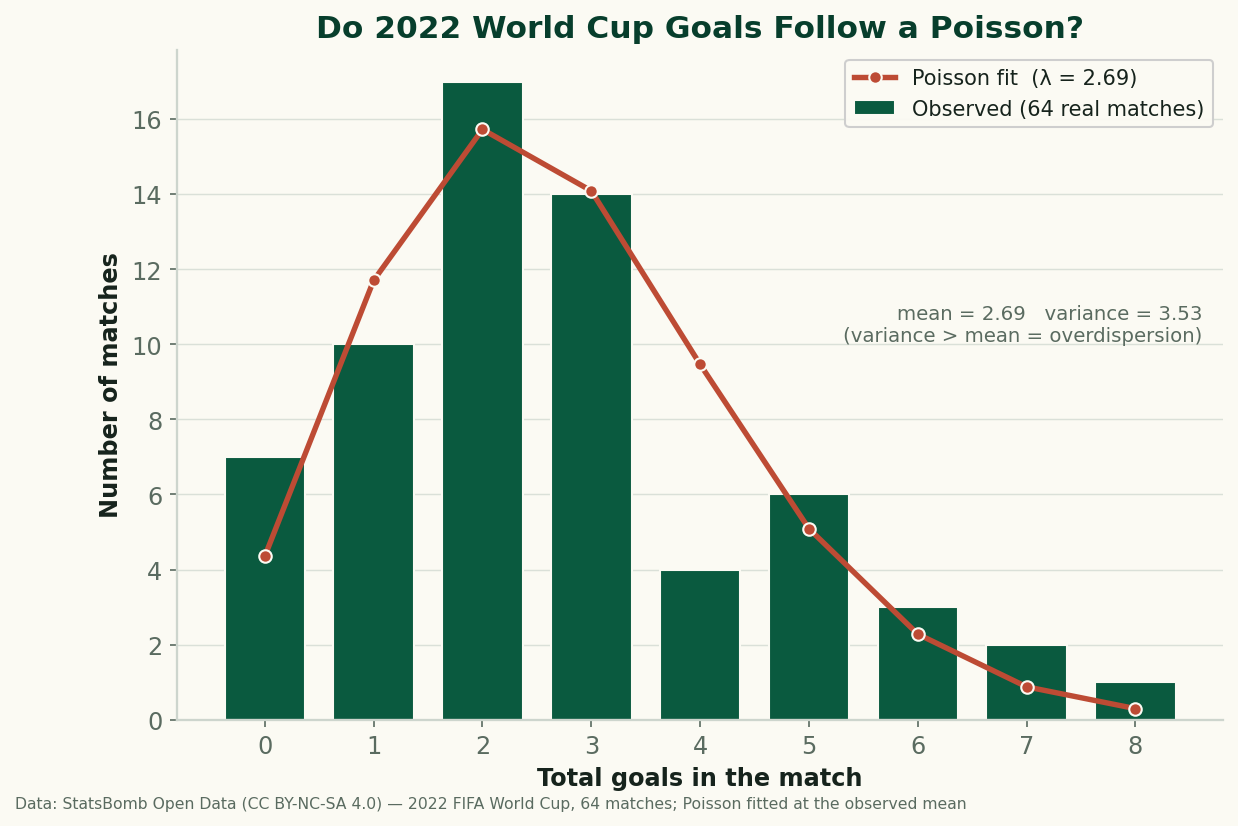
Do Football Goals Follow a Poisson? Testing the Standard Model on All 64 Games of 2022
Every scoreline prediction in football rests on the Poisson. We fit it to all 64 games of 2022 — it gets the shape right, but real goals are overdispersed.
Aerial Duels and Heading Data: Reading Win Rate Without Getting Fooled by Volume
Aerial-duel win percentage, why raw counts mislead, and where aerial dominance actually matters — set pieces, target men, and defending crosses.
Expected Points (xPts): Turning Shot-Level xG Into a Fairer Table
Expected points (xPts) simulates a match from its shot-level xG to get win, draw and loss odds — points that reward chances created, not goals that went in.