PPDA and Pressing Intensity: Reading the Number That Measures How Hard a Team Presses
How to read a pressing number somebody hands you — and what it cannot tell you.
Pressing is the loudest tactical idea in modern football, and for most of the sport's history it was also one of the least measurable. You could see a team swarming the ball, but you could not put a number on how hard they pressed or compare one side's intensity to another's. PPDA — passes per defensive action — is the metric that fixed that. It is also, as metrics go, unusually easy to misread: the scale runs backwards, the sensible range is narrower than people assume, and the number describes an intention rather than a result.
This piece is the reader's guide. It assumes a PPDA figure has already landed in front of you, on a broadcast graphic or a stats site, and asks what you can honestly do with it. If you want the construction instead — the spatial restriction, which events count as defensive actions, and a full walkthrough against real event data from the 2022 World Cup — that is the job of PPDA explained, and it is worth reading first if you have never built one yourself. The one-line version: PPDA is the opponent's passes in their own build-up zone divided by your defensive actions in that same zone.
The scale runs backwards
Everybody gets this wrong the first time, so it is worth stating as flatly as possible: lower PPDA means a more intense press. The quantity is "passes the opponent gets to make before you stop them," so a smaller number means you intervened sooner, which means you pressed harder. A team with a PPDA of 7 is hunting; a team with a PPDA of 14 is standing off.
The reason this trips people is that almost every other defensive metric points the other way — more tackles, more interceptions, more recoveries all read as more activity. PPDA is a ratio with the opponent's activity on top, so it inverts. If you find yourself saying "their pressing was up at 12," stop: their pressing was down.
A reading scale, and why there is no threshold
Roughly, a PPDA around 6 to 8 describes an aggressive, high-pressing side: the opponent strings together only six to eight passes in their own territory before a tackle, an interception or a foul arrives. Up around 11 to 15 you are looking at a team content to let the opposition build slowly and to defend in a mid- or low-block. In between it shades gradually from one approach to the other.
What there is not is a threshold. Nobody has established a value above which a team "does not press", and the ranges above drift with competition, era and provider: leagues differ in how much possession the average team concedes, and event providers differ in what they log as a challenge or a foul. Two sites can hand you PPDA figures for the same match that disagree by a full unit without either being wrong, because they counted the denominator differently. So the useful comparisons are within one dataset — this team against that team, in the same competition, from the same feed — and the useless one is a bare number quoted against a remembered benchmark from somewhere else.
One consequence worth internalising: because it is a ratio and not a raw count, PPDA does not simply reward whichever side had less of the ball. A possession-dominant team can post a low PPDA in the windows when it does not have possession, because the metric only ever looks at the opponent's build-up phases. That is precisely what lets you put a possession side and a counter-attacking side on the same scale.
It describes intent, not quality
The single biggest misreading is treating a low PPDA as praise. It is not. It is a description of what a team tried to do, and it is silent on whether the attempt worked.
A low PPDA tells you a side intervenes early. It says nothing about whether those interventions win the ball in dangerous areas or just concede fouls in harmless ones, nothing about whether the press is coordinated or frantic, and nothing about what happens when it is broken. Two teams with identical PPDA can be a slick ball-winning machine and a chaotic one that gets played through every third sequence. To judge whether a press works, you need something PPDA does not contain: where turnovers happen, how many shots follow them, how much expected-goal value each recovery is worth — and, on the other side of the ledger, the chances conceded on the counters a high line invites.
The mirror-image error is treating a high PPDA as criticism. A side that deliberately invites the opponent forward, stays compact and defends superbly in its own half will record a high PPDA because it is not trying to win the ball in the build-up zone at all. The number reflects a choice. PPDA genuinely cannot distinguish a team that cannot press from a team that has decided not to, and no amount of staring at the figure will tell you which one you are looking at.
Four questions to ask before you quote a PPDA
What was the score, and for how long? A team chasing a goal presses desperately; a team protecting a lead drops off. A full-match PPDA averages those phases into one figure that describes neither. If a side led from the tenth minute, its PPDA is largely a measurement of how comfortable it was, not of how it likes to defend. This is the general problem covered in how game state distorts the stats, and PPDA is one of its worst-affected victims.
How many matches is this? A one-match PPDA is a noisy thing: it can hinge on a single spell of sustained opponent possession. Pressing profiles stabilise over a season the way most style metrics do; single-match values are best used as a prompt to watch the match again, not as evidence.
Was any of it a trap? A team can stand off on purpose, let the opponent play into a prepared shape, and then spring. Throughout the invitation, PPDA registers a passive value even though the whole sequence is a sophisticated pressing scheme. The metric sees passes allowed; it cannot see the reason they were allowed.
Whose definition is this? Build-up zone conventions vary (the defending team's own 60% of the pitch is the common one but not the only one), and so does the list of events counted as defensive actions. Before comparing two numbers, check they came from the same recipe.
Read it in pairs
PPDA earns its keep when it is one axis of a two-dimensional picture, and it stops being ambiguous the moment you pair it with something.
Your PPDA against theirs. The most immediately informative pairing in the metric. Both low is a frantic, end-to-end contest in which neither side is allowed to settle. Both high is a cagey, respectful stand-off. One low and one high is a clear statement about who was doing the hunting and who was doing the building — and it usually maps onto the match you remember watching.
PPDA against territory. A low PPDA says the opponent was interrupted early; a field tilt figure says whose final third the game was played in. Intense pressing that also produces territorial dominance is a functioning high press. Intense pressing with no territory is a side working extremely hard to stay where it is.
PPDA against turnover location and what follows. This is the pairing that converts intent into effectiveness. Recoveries high up the pitch that turn into shots are the point of pressing; recoveries high up the pitch that turn into nothing are exercise. PPDA can tell you a side is trying; only the follow-through tells you it is working.
Use it as a tripwire
The best everyday use of PPDA is not ranking teams at all — it is monitoring one. Aggregate PPDA is stable enough across a season that a sustained move is a real signal rather than noise. A side drifting from 7 up to 11 over a handful of matches is telling you something has changed: legs going in a congested fixture run, a formation switch, a key presser injured, a new manager with different instructions, or a team that has started protecting leads it did not used to have.
Treated that way — as a characterisation and a tripwire rather than a scoreboard — a single easily-misread ratio does honest work. Treated as a league table of effort, it will mislead you in both directions at once.
A note on what is not here: PPDA needs event data, every pass and every defensive action with a pitch location, which the public tournament feed behind this site's 2026 coverage does not carry. So there is no 2026 PPDA table on this site, and there will not be one until the underlying data exists. The 2022 World Cup figures in PPDA explained are computed from StatsBomb's open event data, which does. For everything the completed 2026 matches do support, see the full World Cup coverage.
Sources & further reading
- PPDA explained — the companion piece: the construction, the event definitions and a worked 2022 World Cup table.
- StatsBomb — documentation of event definitions and pressing metrics, including PPDA construction.
- StatsBomb open data — event-level match data you can use to compute PPDA yourself.
- FBref — pressing and defensive-action statistics across major competitions.
- Understat — season-level data for the major European leagues.
More from Stat Explainers
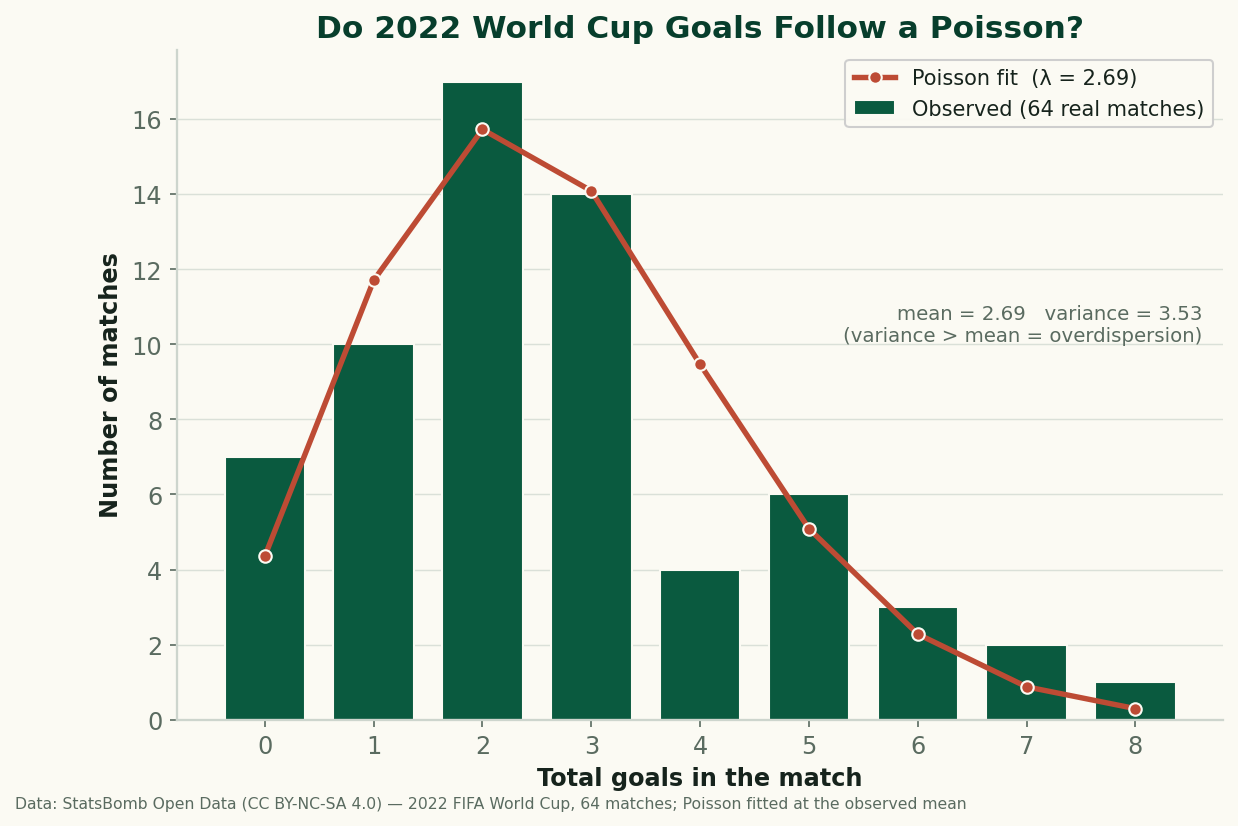
Do Football Goals Follow a Poisson? Testing the Standard Model on All 64 Games of 2022
Every scoreline prediction in football rests on the Poisson. We fit it to all 64 games of 2022 — it gets the shape right, but real goals are overdispersed.
Aerial Duels and Heading Data: Reading Win Rate Without Getting Fooled by Volume
Aerial-duel win percentage, why raw counts mislead, and where aerial dominance actually matters — set pieces, target men, and defending crosses.
Expected Points (xPts): Turning Shot-Level xG Into a Fairer Table
Expected points (xPts) simulates a match from its shot-level xG to get win, draw and loss odds — points that reward chances created, not goals that went in.