The Golden Boot: A World Cup Goalscoring History
From thirteen in one tournament to six — how goalscoring records shrank.
In 1958, a French forward scored thirteen goals at a single World Cup. No one has come within touching distance since, and almost certainly no one ever will. The story of the Golden Boot — the award for a tournament’s top scorer — is really the story of how World Cup goalscoring concentrated, then democratised, until the modern race is routinely won with a number that would have finished mid-table in 1958. It is one of the clearest illustrations in football of how the game itself has changed.
Fontaine’s thirteen: the untouchable record
Just Fontaine’s thirteen goals at the 1958 World Cup in Sweden is the single most secure record in the sport. To grasp how far out of reach it is, consider that it has stood for the better part of seventy years through every subsequent tournament, including editions with more matches and more games per team than 1958 offered. Fontaine did it in six matches. A modern forward, even one who plays every match of a deep run, would need to average better than two goals a game across the entire tournament to match it.
The record endures not because modern strikers are worse — they plainly are not — but because the conditions that produced it have vanished. Defences in 1958 were less organised, the tactical emphasis on preventing chances was far weaker, and the very best forwards could feast in a way the modern game’s defensive sophistication simply does not permit. Fontaine’s thirteen is a relic of a more open era, preserved precisely because the game closed up around it.
Klose’s sixteen: the marathon record
If Fontaine owns the sprint, Miroslav Klose owns the marathon. The German forward scored sixteen goals across four World Cups, a career aggregate that overtook the previous mark and now stands as the all-time tournament total. It is a fundamentally different kind of record — not an explosion in one summer but a sustained, decade-spanning consistency, a handful of goals per tournament accumulated over four editions and sixteen years of international football.
Klose’s record speaks to longevity as much as to finishing: to be your nation’s focal point across four World Cups requires staying fit, staying in form, and staying selected over an exceptional span. Where Fontaine’s thirteen is about peak, Klose’s sixteen is about durability, and the two records bracket the two ways a player can write their name into World Cup goalscoring history. Both are difficult; both have survived strong challengers; both look likely to stand for some time yet.
The modern Golden Boot: won with six
Here is the statistic that captures how much the game changed: in recent World Cups, the Golden Boot has frequently been won with around six goals, and rarely more than eight. A number that would have left Fontaine fully seven goals clear of the field now wins the award outright. The modern top scorer is not scoring less because the talent has thinned; they are scoring less because chances are scarcer, defences are drilled, and the route to goal is contested in a way the 1950s could not imagine.
The mechanics behind this are exactly the ones our expected goals explainer formalises. Modern defences are organised to suppress not just goals but the quality of chances — to force shots from worse positions, with more bodies in the way. Fewer high-value chances per match means fewer goals to go round, and that compresses the top of the scoring chart. The Golden Boot is no longer won by a forward who monopolises goals; it is won by whoever edges a tight, low-scoring race, often decided by a single strike or by penalties earned and converted.
How scoring concentration changed
The deeper shift is in distribution. In the early World Cups, goals concentrated heavily in a few prolific forwards who could dominate weaker, less structured defences. As the game professionalised and defending grew sophisticated, that concentration dispersed. Goals spread across more scorers, the gap between the top scorer and the chasing pack narrowed, and the very idea of one player running away with the scoring chart became a period curiosity.
This dispersion tracks the broader tactical history of the tournament. The same defensive evolution that suppressed top-scorer totals — deeper blocks, organised pressing, the systematic denial of space — is the story told in our piece on how World Cup tactics evolved. As defences got better at preventing high-quality chances, the spoils of attack got shared out more evenly, and the Golden Boot became a closely contested prize rather than a procession. A modern forward who scores six to win it is operating in a fundamentally harder scoring environment than Fontaine ever faced.
What to watch in 2026
The expanded 48-team format introduces a genuine wrinkle to the Golden Boot race. More group-stage mismatches against the weakest field ever assembled could hand a forward a glut of early goals against overmatched defences — the kind of run that pads a tally without proving much about elite finishing. At the same time, the extra knockout round means a deep run now spans more matches than ever, giving a tournament’s standout scorer more games in which to accumulate.
Whether those two effects push the winning total back above the recent norm is an open question this article will not pretend to answer, because the 2026 tournament has not been played. What can be said is that the structural realities still favour a low winning number: knockout defences remain organised, the decisive matches remain tight, and goals in the games that matter remain scarce. Fontaine’s thirteen is not under threat, and almost certainly never will be again. The modern Golden Boot is a different, smaller, harder-won prize — and the gap between six and thirteen is the whole history of how scoring at the World Cup changed.
Sources & data
- FIFA — official Golden Boot records and top-scorer lists for every World Cup.
- RSSSF — complete historical goalscoring records, including goal-by-goal detail for past tournaments.
- FBref — scoring data and, for recent editions, expected-goals context for leading scorers.
- StatsBomb — shot-level data for recent World Cups, useful for separating finishing from chance volume.
More from World Cup 2026
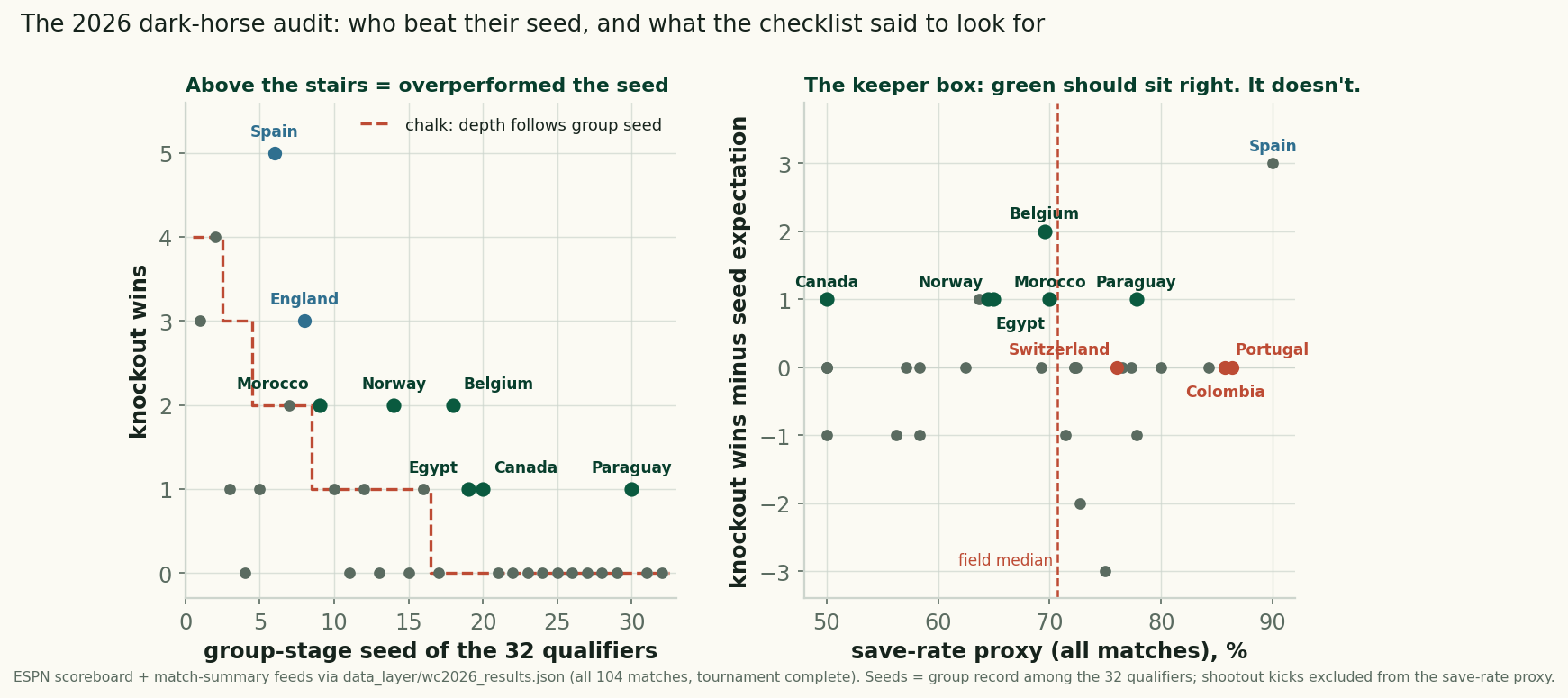
The 2026 Dark-Horse Audit: Grading Our June Checklist
Six teams beat their group seed at the 2026 World Cup, scored against our pre-tournament checklist: the keeper box failed, the kind draw barely helped.
The Shootouts: Rarer, Earlier, and a Reprieve That Never Lasted
Retro #4 closes the series: the shootout rate fell to 12.5% of knockout games from 2022's 31%, all four came early, and survivors went 1-3 next time out.
The Groups Told the Truth: How June Predicted July at the 2026 World Cup
Group-stage points strongly predicted knockout survival: 9-point teams went 3-for-3, 4-point teams 2-for-11, and the last four all ranked top-8.