How World Cup Tactics Evolved
The tournament where the game's big ideas went to be tested.
Line up a photo of the 1930 final next to one from 2018 and you are looking at two different sports wearing the same name. Players who barely crossed the halfway line; players who all defend and all attack. Almost every shift in between — the marking systems, the sweepers, the total interchange of position, the suffocating possession, the relentless press — got its loudest hearing at a World Cup, because that is where a new idea had to survive against the rest of the planet rather than the rest of the league. Trace the tactics across the tournaments and you have, more or less, traced the whole history of how the game is played.
The WM and the early structures
The earliest World Cups were contested with formations that look almost unrecognisable now. The dominant structure of the 1930s was the WM — a 3–2–2–3 shape that arranged players into the rough letters W and M and represented the first systematic attempt to balance attack and defence after a change to the offside law in 1925. It was a genuine tactical framework rather than a free-for-all, and it governed the first decades of international football.
What the WM era lacked was any notion of pressing, compactness, or the fluid movement that would later define the game. Players largely held their stations; the contest was more positional and less dynamic than anything a modern viewer expects. It was the baseline from which everything else departed — the museum exhibit against which every subsequent revolution can be measured.
Hungary 1954 and Brazil 1970: the attacking peaks
The first great tactical jolt came from Hungary. The “Mighty Magyars” of the early 1950s pulled their centre-forward deep, confusing the rigid marking schemes of the day and creating a numerical and positional puzzle defences could not solve. They arrived at the 1954 World Cup as overwhelming favourites and revolutionaries, and although they lost a famous final, their influence on how forwards could move and combine was profound and lasting.
If Hungary opened the door, Brazil walked through it in spectacular fashion. The Brazil side of 1970 is widely regarded as the finest attacking team the tournament has produced — a collection of technicians who attacked with a fluency and creativity that the more cautious European game had not matched. It was the high-water mark of a certain kind of expressive, front-foot football, and it set a standard for attacking ambition that later, more systematic teams would have to reckon with.
Total Football and catenaccio: the great argument
The 1970s crystallised football’s central tactical debate into two opposing philosophies. On one side stood catenaccio, the Italian system built around a sweeper and rigorous man-marking, designed to lock matches down and win them by the narrowest of margins. It was control taken to its logical extreme: deny space, absorb pressure, strike on the break. For a period it was extraordinarily effective, and it embedded defensive organisation as a respectable, even glamorous, way to win.
On the other side stood the Dutch. The Netherlands of 1974 played Total Football — a system in which any outfield player could occupy any position, the team pressing and rotating as a single organism, attackers defending and defenders attacking in a constant, disorienting flux. They did not win the final, but they changed the sport’s sense of what was possible. What the modern metrics would have made of that side — the relentless interchange, the high defensive line, the collective pressing — is the subject of our piece on Total Football, quantified. The short version: almost everything elite teams now do can be traced to that team, decades before the data existed to measure it.
Tiki-taka and Spain 2010
The Dutch idea, filtered through Johan Cruyff’s years at Barcelona, re-emerged a generation later as tiki-taka. Spain’s triumph at the 2010 World Cup was its coronation on the international stage: a team that controlled matches through relentless short passing and positional discipline, starving opponents of the ball and, with it, of any opportunity to attack. Possession itself became the defensive weapon — you cannot score if you cannot get the ball.
It was a polarising way to win. Spain’s knockout matches in 2010 were famously low-scoring, several decided by a single goal, and critics complained the football was sterile. But it was ruthlessly effective, and it represented the fullest expression at a World Cup of the possession-control philosophy that Cruyff had carried out of the Total Football era. For a few years it was the orthodoxy every serious side measured itself against.
The high press and the modern game
The reaction to possession dominance was, inevitably, a way to disrupt it: the high press. If a team is going to keep the ball and pass you to death, you go and take it back high up the pitch, in the moments of transition when the opponent is least organised. The pressing systems that came to define club football in the 2010s — and that increasingly shape the international game — turned the defensive phase into an attacking weapon, hunting the ball in the opponent’s half rather than waiting for it.
This is where tactics and data converged most visibly. The metrics built to measure pressing, possession value and chance quality emerged alongside the tactics they described, each making the other legible — the story told in full in our history of how Pep, Klopp and the data era rewired tactics. By the most recent World Cups, the analytical lens of expected goals, pressing intensity and possession value had become the standard way to understand what teams were doing, and the tactical sophistication on display reflected a game that now measures itself constantly.
What 2026 inherits
The 2026 World Cup arrives as the heir to all of this. The teams that contend will, almost without exception, play some synthesis of the ideas this history records: possession structures descended from Cruyff and Spain, pressing schemes descended from the modern club game, defensive organisation descended from the Italian tradition. The tactical baseline is now extraordinarily high, and what once would have been a revolution — a high line, a coordinated press, total positional fluidity — is simply the price of entry.
Whatever genuinely new idea emerges in 2026, if any does, the tournament’s history suggests it will be measured almost immediately, because the analytical apparatus to track it is now mature. The World Cup has always been tactics’ biggest stage; it is now also its most thoroughly observed. The next great idea will be quantified before the final whistle — which is itself the clearest sign of how far the game has travelled from the W and the M.
The data behind this piece
- FIFA — official tournament histories and match archives across every World Cup.
- RSSSF — historical line-ups, formations and results useful for tracing tactical change.
- StatsBomb — research on pressing, possession value and the metrics that describe modern tactics.
- FBref — advanced tactical and possession data for recent international football.
More from World Cup 2026
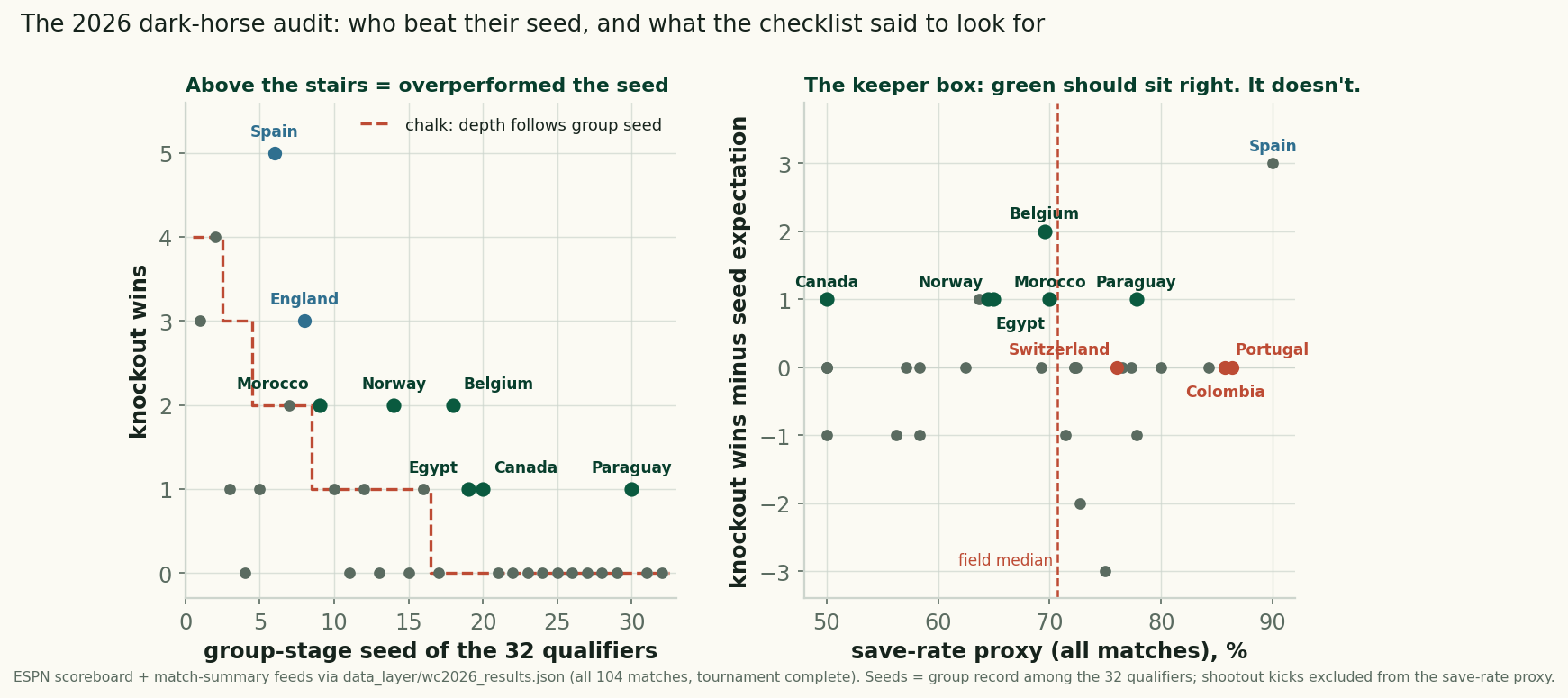
The 2026 Dark-Horse Audit: Grading Our June Checklist
Six teams beat their group seed at the 2026 World Cup, scored against our pre-tournament checklist: the keeper box failed, the kind draw barely helped.
The Shootouts: Rarer, Earlier, and a Reprieve That Never Lasted
Retro #4 closes the series: the shootout rate fell to 12.5% of knockout games from 2022's 31%, all four came early, and survivors went 1-3 next time out.
The Groups Told the Truth: How June Predicted July at the 2026 World Cup
Group-stage points strongly predicted knockout survival: 9-point teams went 3-for-3, 4-point teams 2-for-11, and the last four all ranked top-8.