Extra Time and Late Goals: The Data Behind World Cup Drama
When the goals arrive, and how often the knockouts go the distance.
The moments that define a World Cup are rarely the ones that arrive on schedule. They come in the ninetieth minute and beyond, in the strange hinterland of extra time, in the unbearable lottery of a shoot-out. The tournament’s grip on the world has a lot to do with this: knockout football is engineered to push decisions later and later, and the later a goal arrives, the more it tends to mean. Here is the data behind the drama — when World Cup goals actually come, and how often the decisive games refuse to end on time.
The shape of when goals arrive
Goals are not spread evenly across a match. Across football broadly, scoring tends to rise as a game wears on: the second half produces more goals than the first, and the final stretch more than the opening exchanges. Fatigue opens gaps, chasing teams commit more bodies forward, defensive concentration frays, and the closing minutes become disproportionately productive. The late goal is not a fluke of perception — it reflects a real tilt in the rate at which goals are scored as the clock runs down.
At a World Cup, this ordinary tendency is amplified by the stakes. A team a goal down in a knockout has no next week to fix it, so the final ten minutes become a controlled emergency: everything pushed forward, the defensive structure abandoned in search of the equaliser. That gamble is precisely what produces stoppage-time goals — and stoppage-time goals at a World Cup, because of what hangs on them, lodge in the collective memory in a way a third-minute opener never does.
How often knockouts go the distance
The defining structural fact of the knockout stage is that a meaningful share of its matches do not end in ninety minutes. Knockout games, played between well-matched survivors with everything to lose, are tight by nature, and tight games are the ones that run into extra time. A substantial proportion of World Cup knockout matches over the years have needed the extra thirty minutes, and a notable share of those have gone all the way to penalties.
The cumulative effect is that the deeper a tournament goes, the likelier any given match is to require more than regulation time to settle. This is not an accident of any single edition but a recurring property of single-elimination football between strong teams. The exact frequencies vary tournament to tournament — and this article will not invent a precise percentage where the historical record is mixed — but the direction is unambiguous and well established: knockout football pushes decisions late, and a real fraction of the time it pushes them past ninety minutes entirely.
The golden-goal era: 1998 to 2002
For two World Cups, the drama of extra time carried an extra twist. The golden goal — sudden death, where the first goal in extra time ended the match instantly — was used at the 1998 and 2002 tournaments, and it produced some of the most charged moments the format has seen. A single strike in extra time did not just put a team ahead; it ended the contest on the spot, with the losing side having no chance to respond.
The golden goal was eventually abandoned, partly because it often made extra time more cautious rather than more open: teams, terrified of conceding the instant, decisive goal, frequently played not to lose rather than to win, which was the opposite of the intended effect. It remains a fascinating historical experiment — a deliberate attempt to engineer sudden, sharp drama that ran into the same conservative instincts that make knockout football tense in the first place. Modern extra time has reverted to the full thirty minutes, with all the late, exhausted drama that entails.
The shoot-out: drama’s final form
When even extra time cannot separate two teams, the World Cup reaches for its most excruciating instrument: the penalty shoot-out. It is the purest distillation of tournament drama — a sequence of individual duels, each one potentially decisive, played out under a pressure that has broken some of the greatest names in the sport. A shoot-out can end a nation’s four-year cycle in the time it takes to strike a ball, and the moments it produces are among the most replayed in football history — very often with a goalkeeper at the centre of them, as our piece on World Cup shot-stopping explores.
The shoot-out is its own deep subject, with its own patterns around who tends to win, how often the favourite prevails, and why it is so psychologically brutal — all of which our history of World Cup penalty shoot-outs takes up in detail. For the drama math, the point is that the shoot-out sits at the end of a deliberately escalating sequence: ninety minutes that often will not settle it, thirty more that frequently will not either, and finally a lottery designed to guarantee a result no matter how evenly matched the teams. Each stage ratchets the tension higher than the last.
What 2026 changes — and what it does not
The expanded tournament — 48 teams, 104 matches, the structural shape laid out in our 2026 by the numbers primer — adds a whole extra knockout round, the round of 32, which means more single-elimination matches than any World Cup has staged — and therefore, in pure expectation, more opportunities for extra time, more stoppage-time winners, and more shoot-outs. A longer knockout bracket is, mechanically, more chances for the format’s signature drama to occur. The more games that can go the distance, the more of them will.
What the expansion does not change is the underlying logic that produces the drama. Tight games between well-matched survivors will still push decisions late; chasing teams will still throw everything forward in the closing minutes; the best-matched ties will still find their way to extra time and penalties. The 2026 World Cup, by adding games, simply adds stages on which all of this can happen. If history is any guide — and on this it is a reliable guide — the goals that decide the tournament will, more often than not, arrive late, and some of the biggest matches will refuse to end until the very last, nerve-shredding kick.
Where these numbers come from
- FIFA — official match records, including goal times, extra time and shoot-out results.
- RSSSF — detailed historical results with goal-by-goal timing across every World Cup.
- FBref — match data and, for recent editions, shot-level detail useful for timing analysis.
- StatsBomb — open shot-level data for recent World Cups, including knockout matches.
More from World Cup 2026
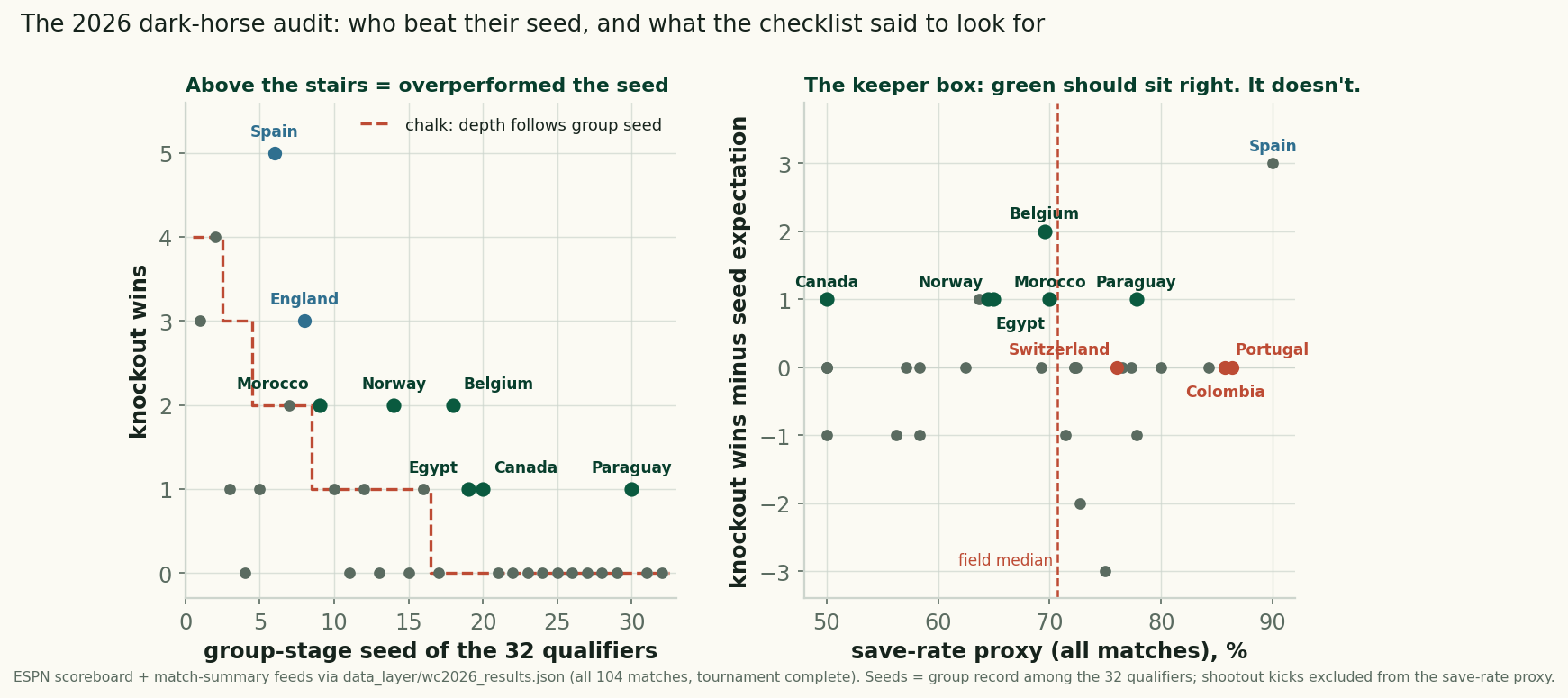
The 2026 Dark-Horse Audit: Grading Our June Checklist
Six teams beat their group seed at the 2026 World Cup, scored against our pre-tournament checklist: the keeper box failed, the kind draw barely helped.
The Shootouts: Rarer, Earlier, and a Reprieve That Never Lasted
Retro #4 closes the series: the shootout rate fell to 12.5% of knockout games from 2022's 31%, all four came early, and survivors went 1-3 next time out.
The Groups Told the Truth: How June Predicted July at the 2026 World Cup
Group-stage points strongly predicted knockout survival: 9-point teams went 3-for-3, 4-point teams 2-for-11, and the last four all ranked top-8.