The 2026 World Cup Is Cooling Off — and Still the Highest-Scoring in Generations
It opened at a goal-a-game pace not seen in decades, peaked at 3.26, and has settled to 2.98. Still sky-high — just no longer record-shattering.
When the goals were flying early, it looked like 2026 might be the most prolific World Cup of the modern era. It still might be — but the frenzy is calming down. Through 54 completed matches, the tournament is averaging 2.98 goals a game, down from a peak running average of 3.26 after the first month of action. That cooling is exactly what you'd expect as a small, hot sample regresses — and yet 2.98 is still a remarkable number: comfortably above 2022 (2.69) and 2018 (2.64), and the highest scoring rate at a World Cup since 1970.
Sourcing. Every figure is from the 54 completed matches only, pulled fresh from ESPN's public match feed and parsed in code (not from memory) on June 25, 2026. A dated snapshot, taken while the tournament was still being played; completed games only, nothing invented for fixtures still to come. The closing update above carries the final figures.
The exhibit: the running average, settling
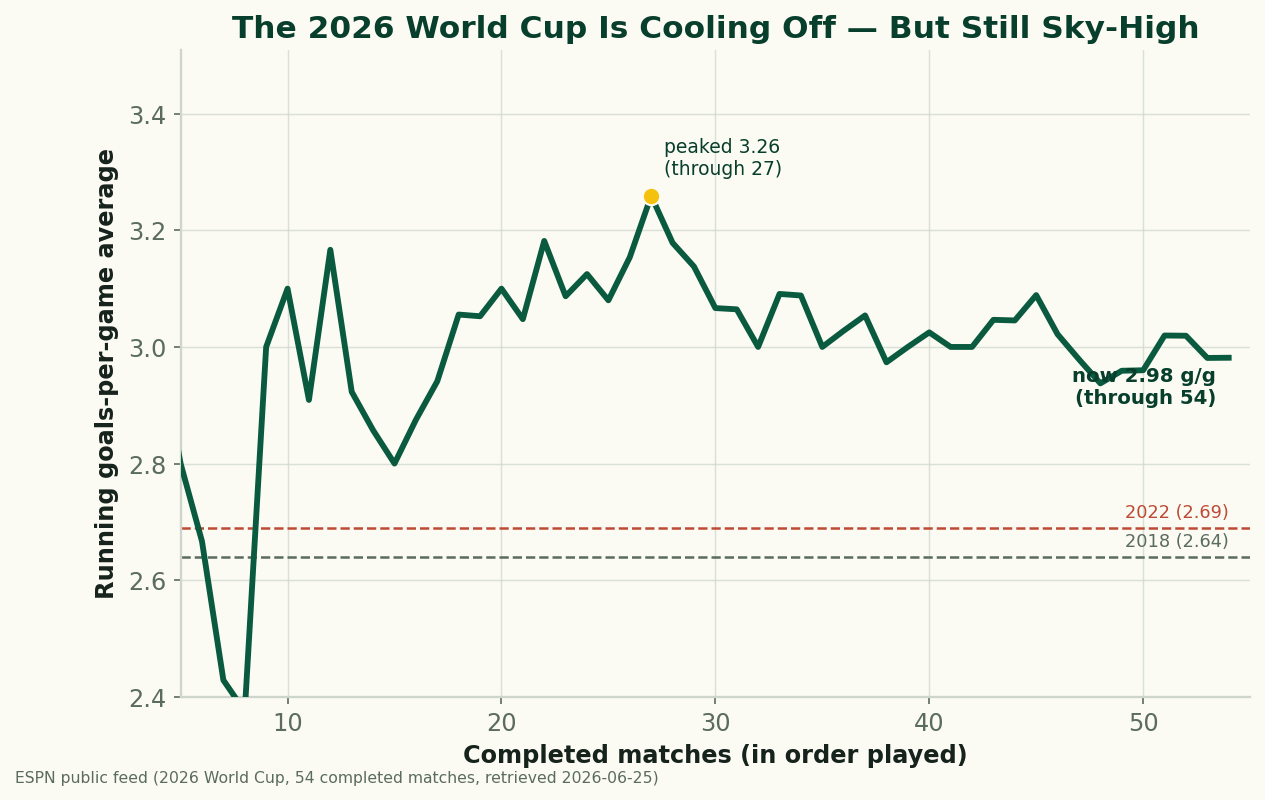
Read the curve left to right. The first handful of matches swing wildly — that's the small-sample noise any running average shows when one 5-goal game can move the line half a goal. By the 20-match mark it stabilizes in the low 3.0s, peaks at 3.26 around match 27, then grinds down toward 2.98. Crucially, even at its lowest the 2026 line never threatens the 2022 and 2018 baselines below it. This isn't a collapse in scoring; it's a record-hot start regressing toward a still-excellent number.
Why it cooled
Two ordinary forces explain the drift, and neither is “the goals dried up.” First, regression: early World Cup matches over-delivered on finishing, and finishing — as we found when we looked at xG overperformance — doesn't stay hot. A sample that opens above its true rate tends to fall back toward it. Second, tightening stakes: as the group stage progresses, more matches carry knockout implications, and teams that need only a draw to advance play more conservatively. The blowouts of matchday one give way to cagier must-not-lose affairs. Both pull the average down without anything dramatic happening.
Putting 2.98 in historical context
A shade under three goals a game sounds unremarkable until you line it up against history. The modern World Cup has lived in the 2.5–2.7 range for decades: 2.69 in 2022, 2.64 in 2018, 2.67 in 2014. You have to go back to 1970 (2.97) to find a tournament scoring at the rate 2026 is managing right now, and past that to the famously open tournaments of the 1950s for anything clearly higher. So even after cooling, 2026 is an outlier — the question is no longer “is this the highest-scoring ever?” (it isn't) but “why is it the highest in over half a century?” The expanded 48-team field, which brings in more lopsided matchups, is the leading suspect, a theme we explored in why 2026 is more polarized than 2022.
The honest caveats
- This is a moving snapshot. The figure is current as of 54 matches and will keep changing; the knockout rounds, which tend to be tighter and lower-scoring, are likely to pull the final number down further.
- Early volatility is real. The wild first few readings on the chart are small-sample artifacts, not a meaningful trend; only once a few dozen matches are in does the average mean much.
- Format inflates the rate. More teams means more mismatches in the group stage, which lifts scoring; comparing 2026's 48-team group stage to older 32-team tournaments isn't perfectly apples-to-apples.
- One source, completed games only. Counts come from a single public feed and exclude everything still unplayed.
The takeaway
The story of 2026's goals has shifted from “record-breaking” to “historically high and settling.” At 2.98 a game through 54 matches, this is still the most prolific World Cup since 1970, even as the early fireworks regress toward a more sustainable pace. Watch the line keep drifting once the knockouts begin — tighter, win-or-go-home football usually trims a tenth or two off the average. But the headline holds: by the standards of the last fifty years, 2026 has been a feast. For the fuller picture, see the World Cup hub and our early-tournament snapshot, the 2026 World Cup so far, by the numbers.
Reproduce it
Order the completed matches in data_layer/wc2026_results.json by date, accumulate total goals, and divide by the match count at each step to get the running average. Refresh the dataset with data_layer/build_wc2026_results.py (ESPN public feed, parsed in code). The chart is drawn by charts/chart_wc2026_scoring_pace.py. No network at build time, nothing hand-entered.
Sources & data
- 2026 results: bundled
data_layer/wc2026_results.json— ESPN public feed, 54 completed matches, retrieved 2026-06-25 viabuild_wc2026_results.py. Charted bycharts/chart_wc2026_scoring_pace.py. - Companion: the 2026 World Cup so far, by the numbers (the early snapshot) and why 2026 is more polarized.
- History: a century of World Cup scoring · the World Cup analysis & prediction hub.
A century of World Cup scoring
This section was first published on 3 June 2026 as a separate article.
If you could watch one World Cup match from 1954 and one from 1990 back to back, you would think you were watching two different sports. The first would likely be a goal-soaked, end-to-end affair; the second a tense, low-scoring chess match. The numbers bear that out. World Cup scoring has not been constant — it has a clear, well-documented arc, peaking in the 1950s, bottoming out around 1990, and settling since into a steadier band. The shape of that curve, and the rule changes and tactical shifts that bent it, is one of the cleaner long-run stories in football data.
The shape of the curve
The broad trajectory is not in serious dispute, even if any single decimal place deserves a little caution. World Cup goals per game started high in the early tournaments, climbed to its peak at the 1954 tournament in Switzerland — comfortably above five goals per game, the highest of any edition — then declined steadily across the following decades. The low point came at Italia 1990, with an average down around 2.2 goals per game, the most defensive World Cup on record. Since then the figure has recovered modestly and stabilised, with recent tournaments clustering in the high-2.6 to 2.7 range.
So the century-long story is an inverted curve: a high-scoring youth, a long defensive maturation bottoming out in 1990, and a modern plateau noticeably below the 1950s but comfortably above the 1990 trough. It is one of the few football trends with enough data behind it — every tournament, scored the same way — to state with real confidence.
| Era / edition | Goals per game (approx.) | Character |
|---|---|---|
| 1954 (Switzerland) | ~5.4 | The all-time high — the most open World Cup |
| 1950s–1960s, broadly | ~3.5–4 | High-scoring era, attacking norms |
| 1970s–1980s, broadly | ~2.7–3 | Gradual tightening as organisation improved |
| 1990 (Italy) | ~2.2 | The low point — the most defensive edition on record |
| Recent editions (2018, 2022) | ~2.6–2.7 | Modern plateau, stable across tournaments |
A word on honesty about these numbers: the exact goals-per-game for any one tournament is a matter of record and easy to verify, but the era bands above are deliberately rounded ranges meant to show the trend, not precise claims for every year within them. The endpoints — the 1954 high, the 1990 low, the modern plateau — are the well-established anchors; treat the middle rows as illustrative shape rather than exact figures.
Why the 1950s scored so freely
The early high-scoring era reflects a game that was, tactically, far less organised defensively than today’s. Defensive structures were looser, pressing as a coordinated system did not exist, and the gap in resources and preparation between strong and weak entrants was often vast — producing lopsided scorelines that lifted the average. Fitness levels and tactical discipline were nowhere near modern standards. Goals came more easily because preventing them was simply less of a science.
The long defensive maturation and the 1990 floor
From the 1960s onward, defensive organisation became a discipline in its own right. Italian football’s influence in particular spread the idea that a well-drilled defensive structure could neutralise superior attacking talent. By Italia 1990 this had reached its logical conclusion: a tournament so cautious, so focused on not conceding, that it averaged barely over two goals a game and prompted genuine concern that the spectacle was suffering. The 1990 floor was not an accident — it was the endpoint of three decades of defences getting better faster than attacks could respond.
The rule changes that pushed scoring back up
The recovery from the 1990 low was, in part, engineered. Two changes around that time are the most cited drivers, and the chronology fits the data well.
The back-pass ban (1992). Before 1992, a defender could pass the ball back to the goalkeeper to pick up with his hands — a simple, time-killing way to shut a game down. The rule change outlawing the goalkeeper handling a deliberate back-pass removed that release valve, forcing teams to play out under pressure and keeping the ball in live, contestable situations. It is widely credited with making the game more open.
Three points for a win. The shift from two points to three for a victory — adopted in various competitions through the early-to-mid 1990s — increased the reward for winning relative to drawing, nudging teams toward more positive approaches, particularly in group play where a draw became comparatively less valuable.
Alongside the rules, the broader professionalisation of fitness and sports science raised the tempo and intensity of matches, which over time supported more chances and more goals than the grinding caution of 1990 allowed. The combined effect was to lift scoring off the floor — not back to 1950s levels, but into the stable modern band.
Why it settled rather than soared
The interesting feature of the modern era is its stability. Recent World Cups land within a narrow range of one another, which suggests the game has found a kind of equilibrium between attacking and defensive forces. Attacks have the benefit of higher fitness, sophisticated build-up, and the analytics revolution — expected goals and the optimisation of possession and positional play — while defences have pressing systems, video analysis, and their own data tools. The two arms races roughly cancel, holding the goals-per-game figure steady where neither side runs away from the other.
That steadiness is itself a useful baseline. Because recent tournaments cluster so tightly, a representative modern World Cup rate — somewhere in the high-2.6 range — is a reasonable anchor for what tournament-level scoring looks like now, a point our numbers-led tournament primer leans on. The century-long curve tells you how far the game has travelled from the open contests of the 1950s; the flat modern segment tells you the journey, for the moment, has reached a plateau.
Sources, notes & further reading
- FIFA — official tournament records, goal tallies and match counts for every World Cup edition.
- RSSSF — comprehensive historical results from which goals-per-game figures can be reconstructed edition by edition.
- StatsBomb — methodology and data on scoring and chance quality for recent tournaments.
- FBref — match and competition data, including goal totals for recent World Cups.
More draws and more blowouts than 2022
This section was first published on 20 June 2026 as a separate article.
A bigger World Cup was always going to mean a wider range of teams — and the early data shows exactly that, in a shape worth naming. Through 32 completed matches, the 2026 World Cup isn’t simply higher- or lower-scoring than 2022. It’s more polarized: more draws and more blowouts, with the comfortable-but-competitive middle squeezed from both sides. The expanded 48-team field is producing more stalemates between similar teams and more routs of the mismatches, and fewer of the ordinary one- and two-goal wins that used to be the tournament’s bread and butter.
Sourcing. All 2026 figures are from the 32 completed matches only, pulled from ESPN’s public results feed and retrieved June 20, 2026; the 2022 comparison uses the bundled StatsBomb results for all 64 games. Completed matches only, no projections, nothing invented.
Three kinds of result
Sort every match into one of three buckets by its goal margin: a draw, a close win (decided by one or two goals), or a blowout (three or more). Then compare how the 2026 games so far split against the full 2022 tournament.
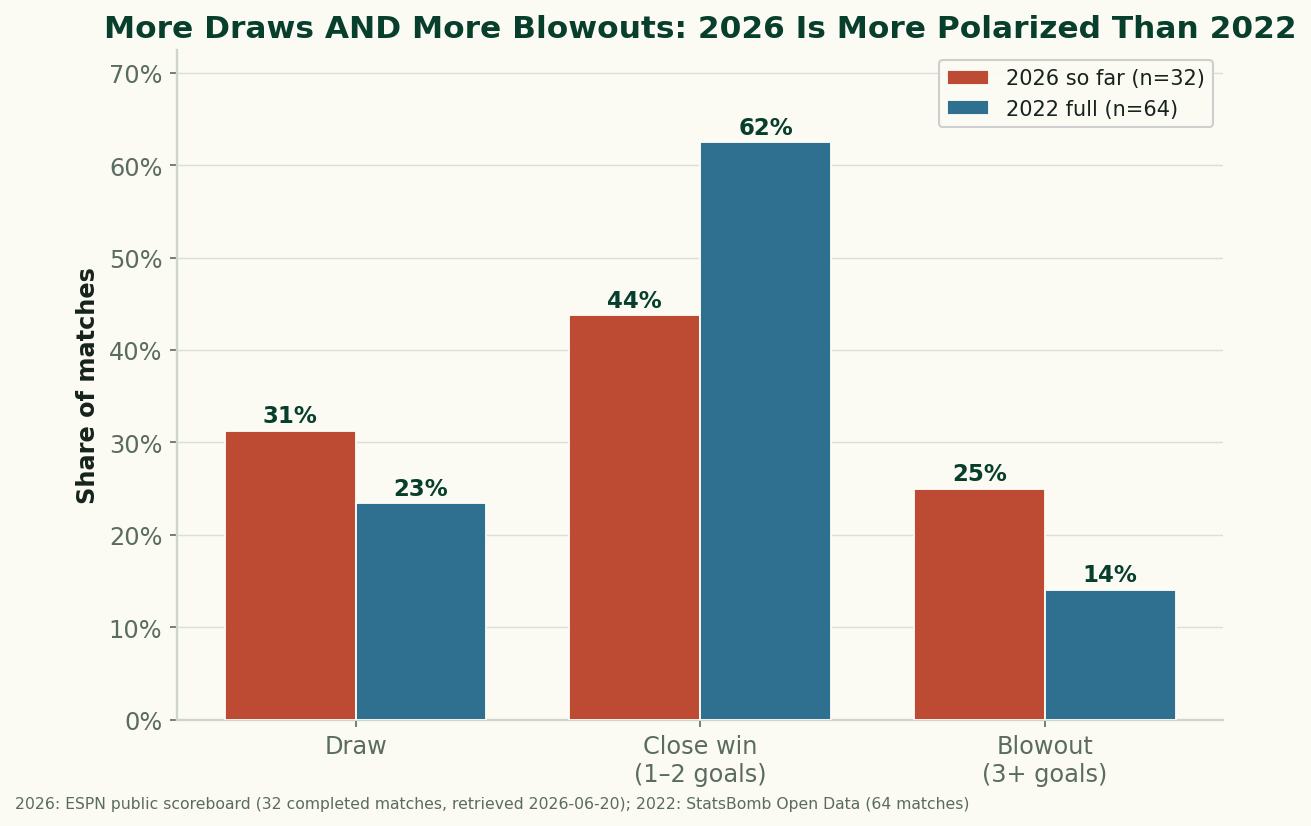
The numbers are clean. Draws: 31% in 2026 against 23% in 2022. Blowouts: 25% against 14% — nearly double the rate of three-plus-goal margins. And the close-win middle collapsed from 62% of 2022’s games to just 44% so far. Both tails of the distribution grew at the expense of the center. That’s the statistical signature of polarization: not a shift in the average, but a spreading-out.
Why a bigger field pulls the results apart
This is the expanded format doing exactly what you’d expect. A 48-team World Cup admits a wider range of quality than a 32-team one — more debutants and lower-ranked sides alongside the traditional powers. That wider range shows up at both ends:
- The mismatches produce blowouts. When a heavyweight draws a debutant, the expected margin is large, and the early group games are where those lopsided pairings concentrate. The result is the crop of three-, four-, and six-goal wins inflating the blowout share.
- The well-matched games produce draws. Among teams of similar level — and there are now more of them clustered in the middle tier — group-stage caution and fine margins push a lot of games to a level finish. Nine of the ten draws so far had goals (mostly 1–1); these aren’t dead games, they’re tight ones.
The squeezed middle is the flip side: fewer games feature a clear-but-not-overwhelming favorite grinding out a one- or two-goal win, because the field has fewer of those evenly-but-not-equally matched pairings and more of the extremes.
It reconciles the earlier “higher scoring” story
This also sharpens what we wrote when the tournament had played 29 games: that 2026 was outscoring 2022. With 32 games in, the goals-per-match average has eased to about 3.0 (from 3.14), drifting toward 2022’s 2.69 as predicted — but the polarization is the more durable finding. The higher early scoring was never about every game being open; it was largely those blowouts. A distribution with fat tails on both ends can have a higher mean (the routs pull it up) while also having more draws (which pull it down). Polarization, not a uniform goal surge, is what the 48-team field actually changed.
Why it’s still early — and what to watch
- Small, group-stage-only sample. Thirty-two games is under a third of the tournament, and these are disproportionately first-round games, where mismatches are most common. As weak teams are eliminated, the blowout share should fall — the surviving games are between better-matched sides.
- Draws may fall too, for the opposite reason. The knockouts can’t end level in 90 minutes; extra time and penalties force a result. So both tails should compress as the tournament advances — the polarization is itself partly a group-stage phenomenon.
- One source, scores only. Result type is about as verifiable as data gets, but it’s a blunt lens: a 1–1 thriller and a goalless bore are both “draws,” and margin says nothing about chance quality (the expected-goals story is separate).
- 2022 is one benchmark. Comparing to a single prior tournament is suggestive, not definitive; a multi-tournament baseline would firm up whether 31% draws and 25% blowouts are genuinely high.
The takeaway
The headline number to watch at this World Cup isn’t the goals-per-game average — it’s the spread. Through 32 games, 2026 is delivering more draws and more blowouts than 2022 and fewer normal close wins, the polarization a wider 48-team field naturally creates. Expect both tails to shrink as the minnows go home and the knockouts force results, but for now the defining feature of the 2026 group stage is that its matches are landing at the extremes. The closing update at the top of this page records where both tails finished once all 104 matches were played.
Reproduce it
Classify each match in data_layer/wc2026_results.json (ESPN, completed games only) and wc2022_matches.json by goal margin into draw / close (1–2) / blowout (3+), and compare the shares. The chart is drawn by charts/chart_wc2026_result_types.py. No network at build time, nothing hand-entered.
Sources & further reading
- 2026 results: bundled
data_layer/wc2026_results.json— ESPN public scoreboard feed, 32 completed matches, retrieved 2026-06-20. Charted bycharts/chart_wc2026_result_types.py. - 2022 comparison: bundled
data_layer/wc2022_matches.json— StatsBomb Open Data (free public dataset; attribution required), all 64 matches. - Companion: The 2026 World Cup so far, by the numbers and what actually wins games.
- Context: Why the World Cup expanded to 48 and will 48 teams mean more upsets?
Did 48 teams dilute the World Cup?
This section was first published on 27 July 2026 as a separate article.
The case against expanding the World Cup was always the same sentence: more teams means worse teams, worse teams mean blowouts, and blowouts kill the thing people watch for. Now both tournaments are complete datasets, so the sentence can be tested. The answer splits cleanly in two. The group stage: yes — 2026’s groups produced three-goal-plus margins at two and a half times 2022’s rate. The knockouts: the opposite — 2026’s elimination rounds were tighter than 2022’s, with more one-goal games, fewer routs, and not a single four-goal margin in thirty-two matches. The expansion didn’t dilute the World Cup. It sorted it.
Sourcing. Both tournaments are bundled in full: 2026 from our final 104-match ESPN dataset, 2022 from StatsBomb’s open data (all 64 matches; free public dataset, attribution required). Knockout scores in both are post-extra-time with shootout games recorded as draws, so every margin comparison below is like-for-like. Chart script: charts/chart_wc_expansion_margins.py.
The two tournaments, side by side
| 2022 (32 teams) | 2026 (48 teams) | |
|---|---|---|
| Matches / goals | 64 / 172 | 104 / 308 |
| Goals per game | 2.69 | 2.96 |
| Group stage, goals per game | 2.50 | 2.99 |
| Knockouts, goals per game | 3.25 | 2.91 |
| Group games decided by 3+ | 10% | 25% |
| Knockout games decided by 1 (of all knockout games) | 25% | 53% |
| Knockout margins of 4+ | 1 (6%) | 0 (0%) |
The group stage: the critics were right, and it barely mattered
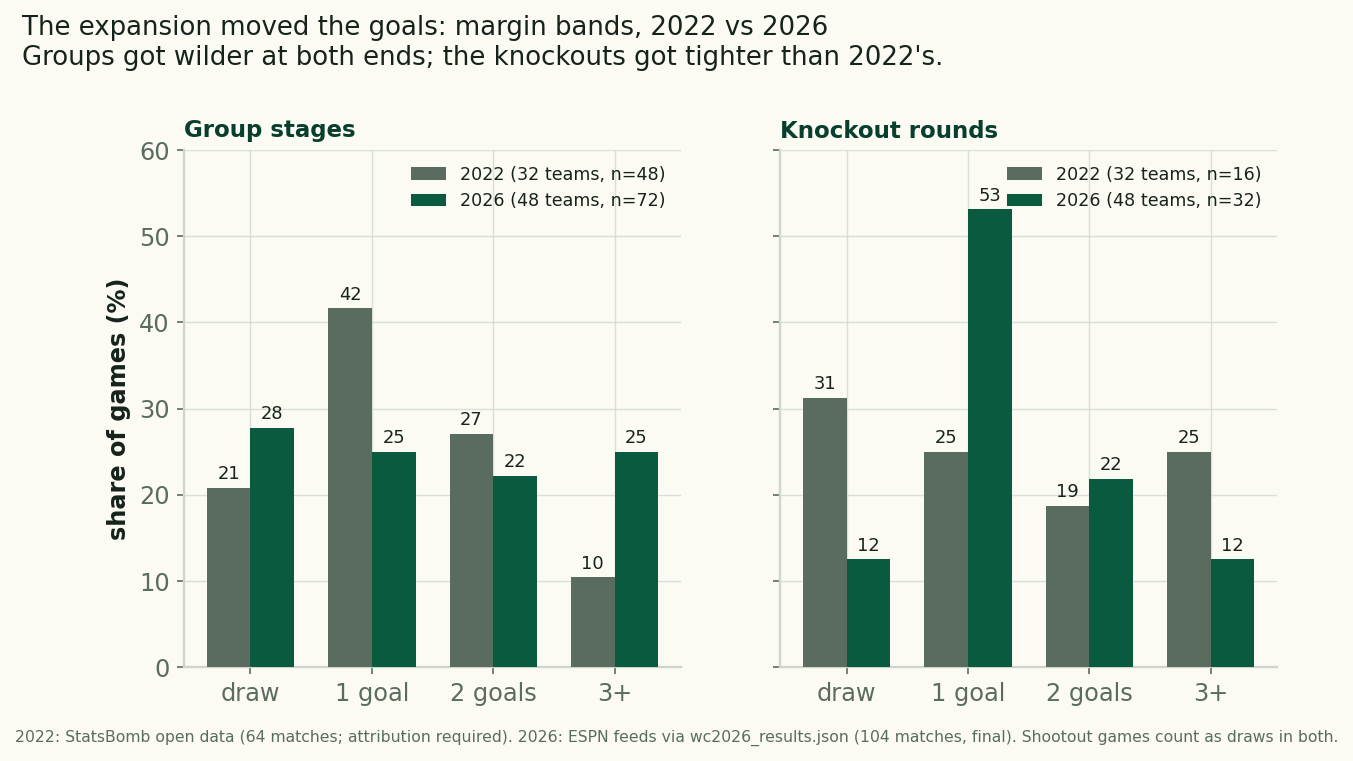
Concede the point honestly, with its full size: 2026’s 72 group games produced 18 margins of three or more (25%) against 2022’s 5 in 48 (10%); margins of four-plus ran 12% against 4%; and the roll call of group-stage teams who conceded seven or more across their three games ran to eleven of the 48 (Tunisia and Iraq with 12 each, Uzbekistan 11, Qatar 10, New Zealand 10…) where 2022 had six of 32. Germany 7–1 Curaçao and Canada 6–0 Qatar are exactly the fixtures the skeptics predicted. The sixteen extra teams were, on average, what everyone said they’d be.
But look at what else happened in those groups: draws rose too — 28% against 2022’s 21% — and one-goal games collapsed from 42% to 25%. The group stage didn’t uniformly decay; it polarized. Mismatches got settled emphatically, while the games between comparable sides got cagier — plausibly because with a round of 32 waiting, second place (and even a good third) kept teams alive, and nobody chased risk they didn’t need. Wilder at both ends, hollow in the middle: that’s not dilution, that’s sorting.
The knockouts: the prediction inverted
Here is the finding that should reframe the expansion debate. Once the sorting finished, the tournament’s business end was tighter than 2022’s on every measure we can compute. Knockout games finishing one goal apart: 53% in 2026 versus 25% in 2022. Routs of three-plus: 12% versus 25%. Margins of four or more: 2022’s knockouts had one (Portugal 6–1 Switzerland in the round of 16); 2026’s had none — zero in thirty-two elimination games. Even the goals-per-game gap (3.25 vs 2.91) reads differently in this light: 2022’s knockout scoring average was inflated by its own lopsided semis, while 2026’s knockouts packed their goals into coin-flip games — the France–England bronze final’s ten goals arrived at a one-goal-game cadence, 4–6.
The mechanism is mundane once you see it: a round of 32 inserts one extra sorting pass between the groups and the quarter-finals. By the time 2026 reached the rounds people actually schedule their lives around, the field had been sieved twice, and the teams that survived the sieve were the ones whose identity travelled. The 16-team knockout of 2022 admitted more passengers — and passengers get routed.
The worked example: same fixture class, different eras
Take the widest games in each dataset. 2022’s was Spain 7–0 Costa Rica — a group game between two teams who had both qualified through continental gauntlets, in the smaller, allegedly purer format. 2026’s was Germany 7–1 Curaçao — a group game the expansion critics can fairly claim. But follow both tournaments forward: 2022’s knockouts still produced a 3–0 semi-final; 2026’s produced nothing wider than England 1–2 Argentina and a final decided by one goal on twenty shots to two. The embarrassments moved to June, where group games have always been allowed to be lopsided, and vacated July, where the tournament lives.
Caveats, at full volume
This is one tournament per format — n=1 against n=1 — and 2022 was itself an outlier (the lowest-scoring World Cup since 1954 through its group stage, played mid-season in November). Formats weren’t the only difference: hosts, continents, calendars, and squads all moved between editions, and none of that separates cleanly. The 2026 knockout tightness could partly be a one-off — 24 of 28 decided games going to the shots-on-target leader suggests a tournament where the better team kept winning by enough, and a bouncier edition would smear these numbers. The claim this piece can actually defend is narrow: in the one head-to-head we have, expansion made the early rounds more lopsided and the late rounds less so — and every argument about the format should now have to carry both halves.
Next in the retrospective series: did the group stage actually tell us who would survive the bracket — or was the round of 32 a reset button? The hub collects the whole line.
Sources
- 2026: ESPN public scoreboard + match-summary APIs, parsed to
data_layer/wc2026_results.json(all 104 matches, final); served at /data/wc2026_results.json. - 2022: StatsBomb open data, all 64 match results (
data_layer/wc2022_matches.json) — free public dataset; attribution required. Knockout scores post-extra-time in both datasets; shootout games recorded as draws. - Every table figure computed by
charts/chart_wc_expansion_margins.pyand its companion audit run; the historical note on 2022’s low-scoring group stage is public record. - Related: what predicted the knockouts, the final, by the numbers, and the group-stage-era running ledger.
More from World Cup 2026
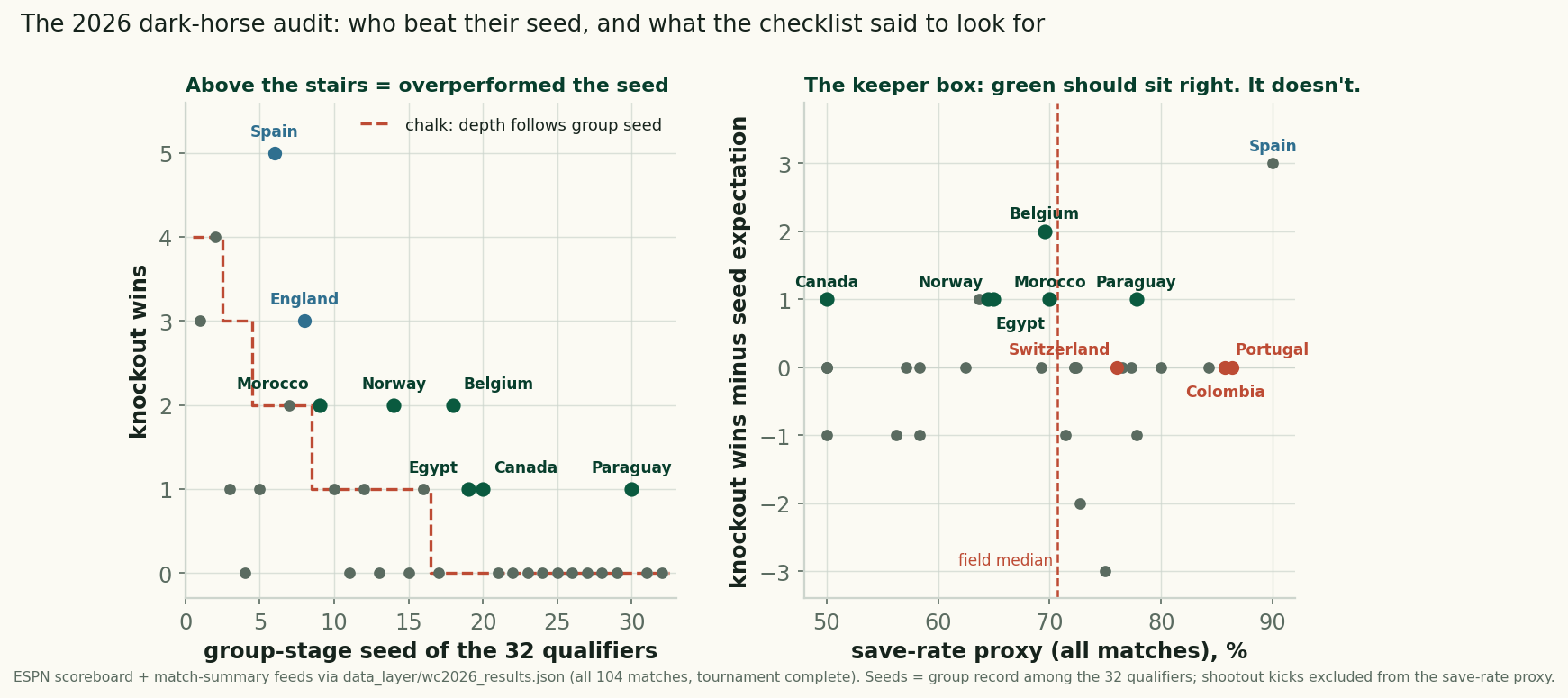
The 2026 Dark-Horse Audit: Grading Our June Checklist
Six teams beat their group seed at the 2026 World Cup, scored against our pre-tournament checklist: the keeper box failed, the kind draw barely helped.
The Shootouts: Rarer, Earlier, and a Reprieve That Never Lasted
Retro #4 closes the series: the shootout rate fell to 12.5% of knockout games from 2022's 31%, all four came early, and survivors went 1-3 next time out.
The Groups Told the Truth: How June Predicted July at the 2026 World Cup
Group-stage points strongly predicted knockout survival: 9-point teams went 3-for-3, 4-point teams 2-for-11, and the last four all ranked top-8.