Goalkeeper Distribution and Playing Out From the Back: Reading the Numbers Behind Buildup
The modern goalkeeper is the first passer in the buildup, and the stats now treat him like one.
Watch a goal-kick now and watch one from twenty years ago and you are looking at two different sports. The old version was simple: catch it, boot it, let the outfield players fight over whatever came down. Somewhere in the last decade or so that changed completely. The keeper stopped being the man who ended possession and became the man who starts it — the first passer in the buildup, the extra body who lets a team beat the press by playing through it instead of hammering it over. The numbers followed the tactics, and a goalkeeper's distribution profile now tells you almost as much about his team's plan as about him.
The two questions distribution data answers
Goalkeeper passing splits into two questions that are easy to run together and should be kept apart: what does the keeper choose to do, and how well does he do it. The first is style; the second is skill. Confuse them and a keeper in a long-ball team looks bad at something he is simply not asked to do.
A high launch % describes a direct keeper; a low one describes a keeper who builds short. On its own it is a measure of choice, not quality.
Short versus long: a stylistic spectrum, not a ranking
The first thing distribution data reveals is where a team sits on the short-to-long spectrum, and that is a tactical decision made above the goalkeeper's head.
Building short. A keeper with a low launch % is rolling or passing to centre-backs and full-backs who have dropped to receive. The team is inviting the press, trying to draw opponents forward and then play through the gaps that pressing leaves behind. It is higher-risk near one's own goal and higher-reward in territory gained with control — the approach that reshaped how the best sides build.
Going long. A keeper with a high launch % is bypassing the press entirely, aiming for a target man, a flick-on, or the second ball in midfield. It concedes the cleanest form of buildup but removes the risk of being dispossessed in front of one's own goal, and it can be a deliberate weapon against a high-pressing opponent — or a tactical surrender of possession to win territory and contest the knockdown.
Neither is inherently better. Launch % tells you which game a team is playing, and you cannot grade a keeper's distribution without first knowing which game he was asked to play. A 70% launch rate is a failure in a possession side and exactly the plan in a direct one — same number, opposite verdict, and the only way to tell them apart is to know the brief.
The number that does measure skill: completion under pressure
If launch % is mostly choice, pass completion is where skill shows — but only when read against the difficulty of the pass. A keeper who plays everything short and safe will post a glittering completion percentage that proves nothing; a keeper trusted to thread passes through an onrushing press and still finds his man is doing something genuinely hard.
The honest version of the metric therefore conditions on pressure and distance. Completion on passes made while being closed down, completion on passes into tight areas, completion on the long launches a direct team depends on — these separate keepers who can actually play from keepers whose numbers are flattered by never attempting anything difficult. The parallel is exact to the one we draw for possession-adjusted defensive stats: a raw rate has to be adjusted for the situations that produced it before it means anything.
How distribution choices shape buildup
The reason any of this matters is that the goalkeeper's first pass sets the terms of everything that follows. A keeper who can reliably play short under pressure gives his team a permanent extra man at the back — eleven-against-ten in the buildup phase, because the press now has one more player to account for than it has pressers. That spare man is what lets a side beat the first line of pressure and progress the ball with control rather than gambling it forward.
The choice also shapes where the game is fought. A short-building keeper drags the opponent's press up the pitch, which opens space behind it; a launching keeper concedes that pressing game and contests the ball in midfield instead. So a keeper's distribution profile is, in effect, a statement about where his team wants the decisive duels to happen — in the opponent's pressing structure, or in the air over the halfway line. And because the choice carries real risk near one's own goal, the value of a keeper who can build short is not just the possession kept but the chances not conceded by avoiding the turnover in a fatal area — the flip side that a giveaway in buildup hands the opponent an expected-goals gift.
Reading the data well
Start by establishing style before grading skill: look at launch % to learn what the keeper is asked to do, then judge completion against that. Always read completion conditioned on difficulty — under pressure, into tight zones, on the long balls — rather than the headline rate, which rewards safety. Compare keepers within similar systems, because a possession team's keeper and a direct team's keeper are being measured on different jobs. Watch for the scoreline distorting the picture exactly as it distorts every aggregate: a team protecting a lead launches more to kill the game, so a full-match launch % can overstate how direct a keeper naturally is, the same game-state effect that warps possession and pressing numbers.
Finally, remember what the distribution stats leave out. They count the pass and its completion, not the decision quality — the right moment to go long, the bravery to keep it short when the press arrives, the disguise that buys a team-mate a second. Those are visible to the eye long before they show up in any spreadsheet, which is why we treat goalkeeper distribution data as the frame around the film rather than the verdict on its own.
The bottom line
Goalkeeper distribution data only makes sense in two layers. The first, launch %, tells you the style the team chose — short and through the press, or long and over it — and grades nothing. The second, completion read against difficulty, tells you how well the keeper executes the hard version of whatever was asked. Separate the two and the modern goalkeeper comes into focus as what the possession era made him: the first decision in the buildup, the spare man who turns ten-against-ten into eleven, and the player whose passing choices quietly decide where the whole match will be contested.
The data behind this piece
- FBref — goalkeeper passing, launch %, goal-kick length and pass completion (via Opta).
- StatsBomb — event definitions for goalkeeper distribution and pressure.
- StatsBomb open data — event-level data for computing distribution profiles yourself.
- How Pep, Klopp and data rewired tactics — the tactical shift that made playing out from the back standard.
More from Stat Explainers
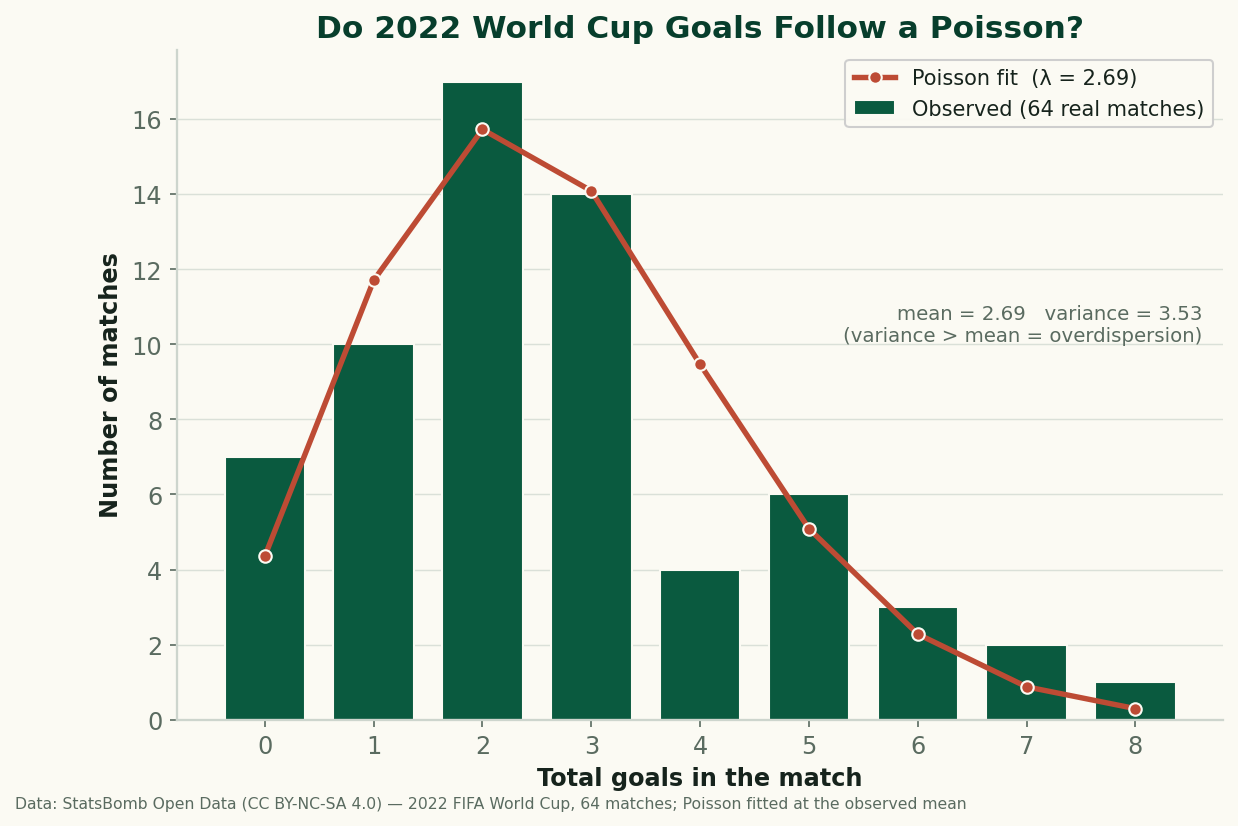
Do Football Goals Follow a Poisson? Testing the Standard Model on All 64 Games of 2022
Every scoreline prediction in football rests on the Poisson. We fit it to all 64 games of 2022 — it gets the shape right, but real goals are overdispersed.
Aerial Duels and Heading Data: Reading Win Rate Without Getting Fooled by Volume
Aerial-duel win percentage, why raw counts mislead, and where aerial dominance actually matters — set pieces, target men, and defending crosses.
Expected Points (xPts): Turning Shot-Level xG Into a Fairer Table
Expected points (xPts) simulates a match from its shot-level xG to get win, draw and loss odds — points that reward chances created, not goals that went in.