The Biggest World Cup Upsets, by the Numbers
The matches where the gap between expectation and result was widest.
The most memorable shocks are the ones nobody had any business expecting: a team of American part-timers beating England, Saudi Arabia knocking over the eventual champions in their opening game. What makes those moments land is not the result on its own but the distance between it and how sure everyone was beforehand. And once you start measuring that distance, the World Cup’s great upsets stop looking random — they keep sharing the same handful of features, which makes the next one a little less astonishing, if never any less fun.
What "upset" means in numbers
Before listing them, it is worth being honest about measurement. The cleanest proxy for a pre-match expectation gap is bookmaker odds, and reliable odds only exist for the modern era; for matches from the 1950s the "favourite" is a judgement from reputation and form, not a quoted price. So we treat the older entries qualitatively — everyone agreed who was supposed to win — and the recent ones with a bit more numerical confidence. In every case the underlying idea is the same: how far the result sat from what a neutral, informed observer would have forecast. That is the same lens behind expected goals at the match level — what should have happened, set against what did.
USA 1–0 England, 1950
The benchmark by which all later upsets are measured. England, playing in their first World Cup, were among the most respected football nations on earth; the United States were part-timers assembled from disparate backgrounds. The result — a single goal by Joe Gaetjens settling it — was so far outside expectation that the story (probably apocryphal) goes that some newspapers assumed the scoreline was a transmission error and printed England winning. There are no odds to quote. There does not need to be. By reputation gap alone, this is still the widest in World Cup history.
Cameroon 1–0 Argentina, 1990
The opening match of Italia ’90 pitted the defending champions, with Diego Maradona at the height of his fame, against a Cameroon side most observers expected to be tournament filler. Cameroon won 1–0 — and did it down to nine men, having had two players sent off. The expectation gap was enormous and the manner of it larger still: the holders, beaten by a team playing the last quarter of the match a man and then two men short. Cameroon went on to reach the quarter-finals, the first African side to do so, which suggests the result was less of a fluke than it looked in the moment.
Senegal 1–0 France, 2002
Another opening match, another reigning champion humbled. France arrived in 2002 as both World Cup holders and reigning European champions, one of the strongest squads of the era. Senegal were tournament debutants. Senegal won 1–0 through Papa Bouba Diop, and it set the tone for a French campaign that ended without a single goal scored and a group-stage exit. Like Cameroon, Senegal then backed it up, reaching the quarter-finals themselves — a recurring feature of the great upsets, which we return to below.
The teams that beat Germany: South Korea 2018, Mexico 2018
Germany’s defence of its title in 2018 ended in the group stage, sealed by a 2–0 defeat to South Korea — a result almost no model gave meaningful weight to beforehand, with the defending champions eliminated at the first hurdle for the first time in modern memory. Mexico had already beaten Germany 1–0 in the same group’s opening round. Two separate upsets, compounding into one of the great tournament collapses. The expectation gap on each individual match was wide; the gap on "Germany fails to escape the group" was wider than either.
Saudi Arabia 2–1 Argentina, 2022
The most recent entry, and one of the few where we have firm odds to anchor the gap. Argentina entered 2022 among the clear favourites and were on a long unbeaten run; Saudi Arabia were rank outsiders for the match by any market you cared to check. Argentina led at half-time and were the better side on the underlying numbers, then conceded twice in the second half and lost 2–1. The instructive footnote: Argentina went on to win the whole tournament. The single-match upset was real and enormous; it told you almost nothing about where the trophy would end up — a clean illustration of how one result can be a genuine shock and still be poor evidence about overall quality.
| Result | Tournament | Why it was an upset |
|---|---|---|
| USA 1–0 England | 1950 | Part-timers beat one of the world’s great football nations on debut |
| Cameroon 1–0 Argentina | 1990 | Defending champions beaten by a side reduced to nine men |
| Senegal 1–0 France | 2002 | Debutants beat the reigning world and European champions |
| South Korea 2–0 Germany | 2018 | Holders eliminated in the group stage |
| Saudi Arabia 2–1 Argentina | 2022 | Rank outsiders beat an eventual champion and pre-tournament favourite |
What the great upsets have in common
Pull the cases together and a few features recur with striking regularity.
They cluster in opening matches. Cameroon–Argentina, Senegal–France, Saudi Arabia–Argentina — all first games. A favourite’s opener is fertile ground for an upset: rust, the weight of expectation, an opponent with nothing to lose and everything sharpened for one performance. The underdog can pour its whole tournament into ninety minutes the favourite is still settling into.
They are usually 1–0 or one-goal margins. Football is low-scoring, and that is precisely why upsets are possible at all. In a sport that averages under three goals a game, a single moment — one set piece, one counter, one goalkeeping error — can outweigh ninety minutes of territorial superiority. The favourite often has the better of the underlying numbers and still loses, because chances created and goals scored diverge most violently in exactly these small-sample, one-event matches.
The good ones were not flukes. Cameroon and Senegal both reached the quarter-finals; South Korea’s win was part of a wider story; Saudi Arabia beat a side that would go on to win it all. The biggest upsets tend to be produced by teams genuinely better than their billing on the day, not merely lucky — which is part of why a few of them seed the most improbable tournament runs rather than fading the next week.
None of this makes the next shock predictable. It makes it legible. The structural ingredients — a low-scoring game, a favourite carrying expectation, a focused underdog, an opening match — are present at every World Cup, which is the deeper reason the tournament keeps producing results nobody saw coming. It is built to.
The data behind this piece
- FIFA — official match records and tournament archives for every World Cup result cited above.
- RSSSF — detailed historical results, line-ups and context for matches across the competition’s history.
- StatsBomb — methodology for the underlying-quality metrics used to separate genuine upsets from variance.
- FBref — match data and competition records for recent World Cups.
Will 48 teams mean more upsets?
This section was first published on 6 June 2026 as a separate article.
The expanded World Cup invites an obvious prediction: more teams, more matches, more weaker sides in the mix — surely more upsets. It is a reasonable intuition, and it might be right. But the structure of the new tournament also contains forces pushing the other way, and the honest answer is that the format does not unambiguously favour chaos. This is the competitive-balance case argued from both sides, because the interesting question is not "will there be upsets" — there always are — but whether 2026's design makes them more or less frequent than before.
First, what counts as an upset
An upset is a result that defies the pre-match expectation — the weaker side, by the ratings, beating the stronger. That framing matters because it ties "upset frequency" directly to two things: how often mismatched teams play each other, and how much randomness a single match carries. The expanded format changes both, and not always in the same direction. Keep in mind throughout that football is already a high-variance sport in which the better team loses a meaningful share of matches; we are asking whether 2026 nudges that baseline up or down, not whether upsets are possible.
The case for more upsets
Three arguments push toward more chaos. The first is simple volume: 104 matches instead of 64 is far more opportunities for a surprise, so even at a constant per-match upset rate the tournament will contain more upset events. That is almost trivially true and worth stating, even if it is really about counting rather than competitive balance.
The second is the wider field. A 48-team tournament admits the least-ranked sides ever to qualify, which means more genuinely mismatched fixtures, especially in the group stage. More mismatches is more chances for the underdog to catch the favourite on a bad day. The flip side — that many of these games will simply be won comfortably by the stronger team — is real, but the additional spread of quality does create more of the lopsided ties from which upsets are sampled.
The third, and most structural, is the knockout round that begins at 32. Single-game knockouts are the purest upset machine football has, because they remove the averaging that a two-legged tie or a league provides — one match, one result, maximum variance. By starting the bracket at 32 rather than 16, the expanded format adds a full extra round of these high-variance, win-or-go-home games, and does so at a stage where some of the qualifiers are weaker sides who scraped through. More single-elimination matches involving more vulnerable favourites is, on its face, a recipe for shocks.
The case against
The counter-arguments are less intuitive but real. The first is seeding. The tournament is not drawn at random; the strongest teams are seeded to be kept apart in the group stage and, by the structure of the bracket, are steered away from each other early. Seeding is explicitly designed to protect the favourites from premature collisions, which suppresses the highest-profile upsets — the giant-versus-giant shocks — and tends to feed the strongest sides a softer early path. A format can add games and still funnel the elite safely through the opening rounds.
The second is that more games can let class show. Variance is the underdog's friend over one match, but it averages out over several. A team that must navigate a group of three and then a longer knockout run has more total matches in which its true quality can reassert itself; a fluke result in one game is more likely to be corrected by the next. Over a longer tournament, the cream has more opportunities to rise, which works against the underdog who needs everything to go right at once.
The third is subtler: an extra round can help the strong as much as the weak. The new round of 32 does add a high-variance game — but it also hands elite teams an additional fixture against, often, a clearly weaker opponent, which is an extra expected win, not an extra coin flip, for the favourites. Whether the round-of-32 expansion is net pro-upset depends on which effect dominates, and that is genuinely unclear in advance.
Why this is hard to call
The deep reason the answer is uncertain is that upset frequency is the product of competing levers, and the format pulls several at once in opposite directions. More matches and a wider field raise the raw count of upset opportunities; seeding and additional games for the elite work to contain the damage to the favourites. How a forecaster nets these out depends on assumptions a model has to make — particularly how much match-level variance to assume and how large a seeding-and-path advantage to grant the top teams — which is exactly the kind of choice that makes two careful simulations disagree, as set out in how a World Cup simulation works and, for league forecasts, why league projection models disagree. There is no clean theoretical answer; there is a balance of forces and a set of modelling choices.
What to actually watch for
The honest position is agnostic with a structure. Expect the number of upsets to rise simply because there are far more matches — that much is near-certain and not very interesting. Whether the rate of upsets per match rises, and whether the marquee favourites are more likely to fall, is the open question, and it hinges on how the new round of 32 and the seeding interact. The thing to track is not the early group-stage mismatches, which will mostly go to form, but the round-of-32 ties between a seeded contender and a weaker qualifier: that fixture, repeated across the bracket, is where the format's pro-chaos and pro-class forces meet head-on. The related question of whether anyone outside the traditional powers can actually break through — a different cut of the same balance — is taken up in confederations at the World Cup. And the search for the specific teams positioned to spring those shocks is the subject of how to spot a dark horse.
The data behind this piece
- FIFA — the official format, seeding principles and bracket structure for the expanded tournament.
- FBref — international results and ratings inputs for assessing pre-match expectation and therefore upsets.
- ClubElo — a rating system that frames what "the favourite" and "the underdog" mean in any given match.
- StatsBomb — event data and research on match variance and competitive balance.
More from World Cup 2026
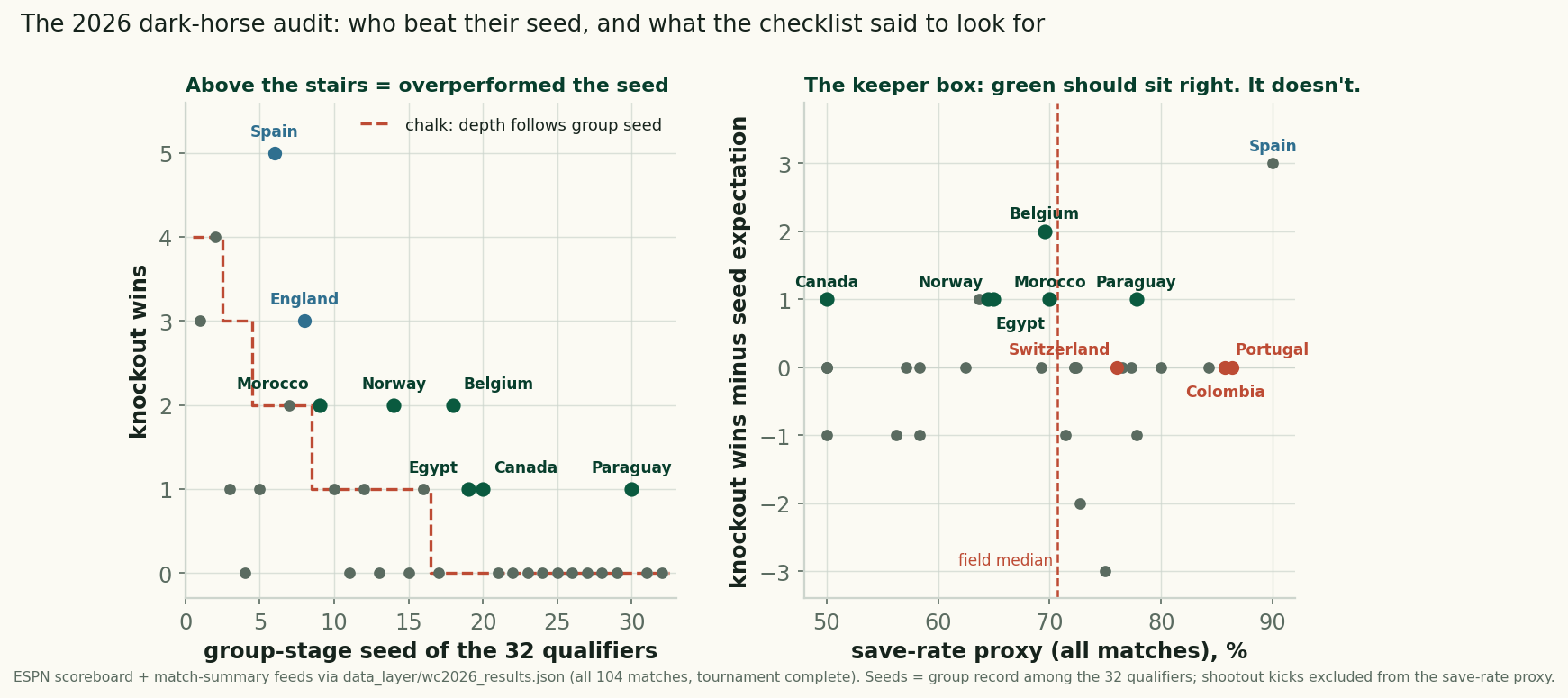
The 2026 Dark-Horse Audit: Grading Our June Checklist
Six teams beat their group seed at the 2026 World Cup, scored against our pre-tournament checklist: the keeper box failed, the kind draw barely helped.
The Shootouts: Rarer, Earlier, and a Reprieve That Never Lasted
Retro #4 closes the series: the shootout rate fell to 12.5% of knockout games from 2022's 31%, all four came early, and survivors went 1-3 next time out.
The Groups Told the Truth: How June Predicted July at the 2026 World Cup
Group-stage points strongly predicted knockout survival: 9-point teams went 3-for-3, 4-point teams 2-for-11, and the last four all ranked top-8.