Host-Nation Advantage at the World Cup: The Record of the Home Team
Six hosts have won it at home — and almost none go out early.
There is a number that sounds like a coincidence until you sit with it: six different countries have won a World Cup on home soil, in a competition that has been staged a little over twenty times. No other variable — not reigning champion status, not bookmaker favouritism, not continental pedigree — predicts a winner half as reliably as simply being the host. The home team does not always lift the trophy. But it almost never embarrasses itself, and far more often than chance would allow, it goes all the way.
The six who won at home
The roll-call is worth stating plainly, because the pattern is in the names. Uruguay won the inaugural tournament they hosted in 1930. Italy won in 1934 on home ground. England’s only world title came at Wembley in 1966. West Germany won in 1974. Argentina won in 1978. And France won in 1998, the last host to do it — for now.
Six home winners across the history of the event is a strike rate far above what you would expect if hosting were neutral. With roughly two dozen tournaments and a field that has ranged from thirteen to thirty-two teams, a randomly drawn host would lift the trophy a small handful of times by pure chance. The hosts have comfortably beaten that baseline. The honest caveat is that early hosts were often also among the strongest footballing nations of their day — Italy and Uruguay were genuine powers, not plucky underdogs — so part of the effect is selection rather than advantage. But not all of it. Something about playing at home moves the needle.
Winning is rare; surviving is the rule
The more robust finding is not at the very top of the bracket but lower down. Host nations almost never crash out early. For most of the tournament’s history, the host reached at least the knockout rounds as a matter of course, and reaching a semi-final as host has been more common than not in many eras. A first-round exit by the host is genuinely unusual — rare enough that the handful of cases (South Africa in 2010 the most-cited modern example) are remembered precisely because they break the pattern.
This matters more than the trophy count, because it is a larger sample. Any one tournament win can be variance — a kind shoot-out here, a deflection there. A century-long tendency for the host to outlast its seeding is harder to wave away. The home team tends to perform a tier or two above where a neutral assessment of its squad would place it, and it tends to do so consistently. That is the signature of a real effect rather than a run of luck.
Where the advantage actually comes from
The mechanisms behind home advantage are not mysterious, and they have been studied carefully in domestic football, where the sample is enormous. (We have put numbers on the domestic home edge elsewhere; the tournament version is the same forces, concentrated.) Three drivers do most of the work.
The crowd. A partisan stadium changes the emotional texture of a match, and — this is the better-evidenced part — it appears to influence officials. Research on domestic leagues has repeatedly found a referee component to home advantage: marginally more added time when the home side is behind, marginally more favourable marginal calls. At a World Cup, where an entire nation is in the stands and watching, that pressure is amplified rather than diluted.
Travel and fatigue. Visiting teams cross time zones, sleep in unfamiliar beds, and adjust to climate and altitude. The host does none of that. In a tournament where matches come every few days and recovery is everything, the absence of travel load is a quiet, cumulative edge.
Familiarity. The host plays on pitches its players know, in conditions its staff have prepared for, in front of a public whose support requires no adaptation. Familiarity reduces the number of small unknowns, and in a low-scoring sport, small unknowns decide matches.
Why a short tournament both helps and hurts the host
Home advantage is real, but a World Cup is a brutal format to convert it in. A knockout tournament is high-variance by construction — one bad afternoon and you are out, regardless of how much the crowd is willing you on. The same short format that produces improbable underdog runs can swallow a favoured host in a single quarter-final shoot-out. Home advantage shifts the probabilities; it does not suspend them.
So the right way to read the host’s record is as a thumb on the scale, not a guarantee. Being the home team is worth something like a meaningful upgrade in win probability — enough to turn a good side into a contender and a contender into a favourite — but it sits inside a tournament structure that punishes the best team often enough that the pre-tournament favourite wins less than half the time. A host that is already strong is dangerous. A host relying on the crowd alone is hoping variance breaks the right way.
2026: three hosts, and a setup with no precedent
Here is where the historical record runs out of direct guidance. The 2026 World Cup — the first 48-team edition, 12 groups, 104 matches, staged across the United States, Canada and Mexico from June into July — has three host nations, all of whom qualify automatically. There has never been a three-host World Cup before. (The 2002 tournament in South Korea and Japan was co-hosted by two, and both reached the knockout rounds, with South Korea’s run becoming one of the great host stories.)
What that means for the home-advantage effect is genuinely uncertain, and worth flagging rather than guessing at. The advantage may be diluted: with three hosts spread across a continent the size of an entire confederation, matches will involve long internal travel, varied climates and altitudes, and crowds that are partisan only some of the time. A "home" match in one corner of North America is a near-away fixture in another. Alternatively, each host enjoys its concentrated edge in its own venues while the rest of the field absorbs the travel costs that the hosts collectively avoid against overseas opponents. We will not know which way it cuts until the tournament is played — and consistent with this site’s house rule, this is a history piece: it makes no prediction about how any 2026 host will fare.
The cleaner statement is the historical one. Across nearly a century, the country hosting a World Cup has outperformed its seeding far more often than not, six of those countries have lifted the trophy at home, and the mechanisms behind that — crowd, travel, familiarity — are well understood. Whether a continent-sized, three-nation host can capture the same edge is a question the record cannot answer, only frame.
Sources & data
- FIFA — official tournament archives, host nation records, and historical results for every World Cup.
- RSSSF — exhaustive match-by-match records and final standings for host nations across the competition’s history.
- FBref — match and competition data for international football, including World Cup results and squads.
More from World Cup 2026
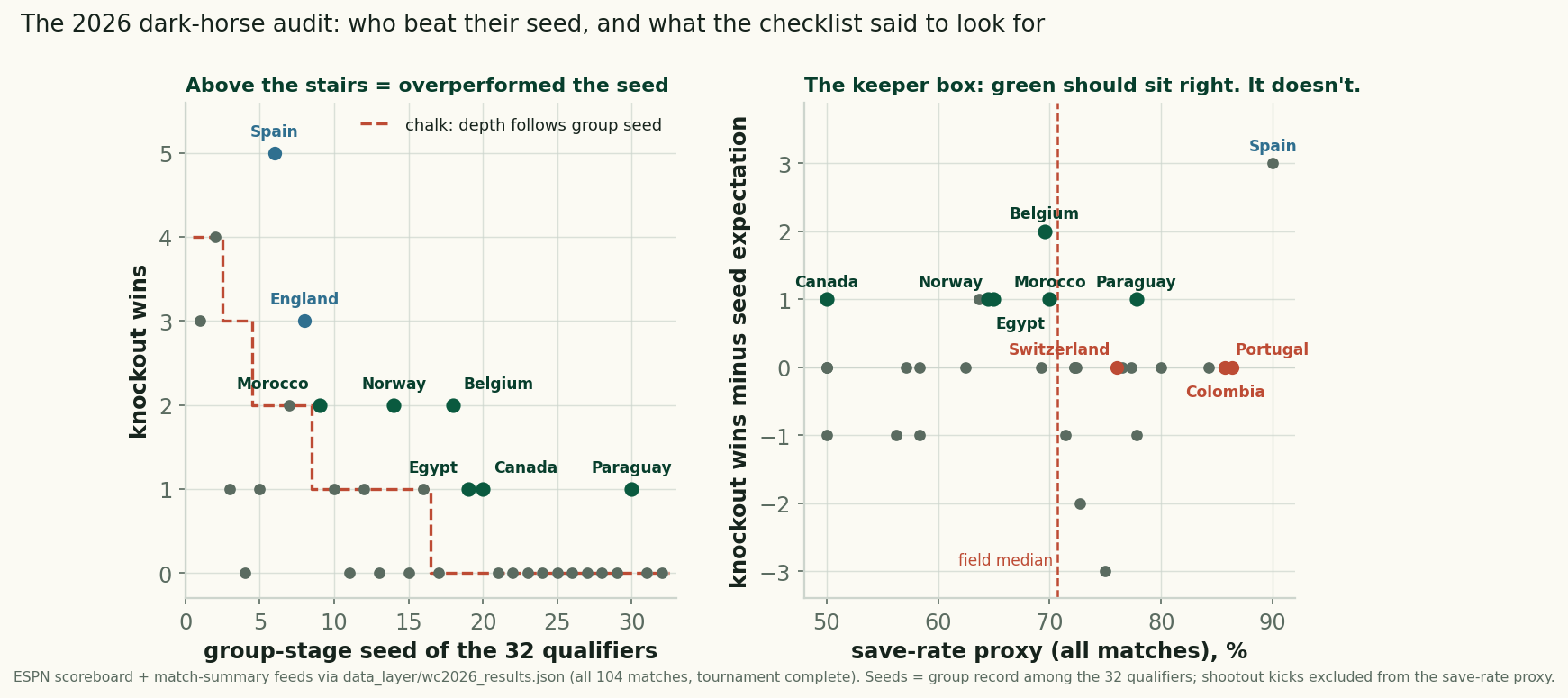
The 2026 Dark-Horse Audit: Grading Our June Checklist
Six teams beat their group seed at the 2026 World Cup, scored against our pre-tournament checklist: the keeper box failed, the kind draw barely helped.
The Shootouts: Rarer, Earlier, and a Reprieve That Never Lasted
Retro #4 closes the series: the shootout rate fell to 12.5% of knockout games from 2022's 31%, all four came early, and survivors went 1-3 next time out.
The Groups Told the Truth: How June Predicted July at the 2026 World Cup
Group-stage points strongly predicted knockout survival: 9-point teams went 3-for-3, 4-point teams 2-for-11, and the last four all ranked top-8.