The Most Improbable World Cup Runs, by the Numbers
How a short tournament keeps producing Cinderella runs — and why.
A league season is a long, grinding sieve: play thirty-eight matches and you end up roughly where your quality says you should. A World Cup is the opposite — seven matches, single elimination, almost no margin for a bad afternoon. That structure is unkind to favourites and generous to outsiders, and it is the reason the tournament keeps producing runs that, on paper, simply should not happen. Here are the most improbable of them, and the statistical reason short tournaments manufacture Cinderella stories the way long seasons cannot.
What makes a run improbable
The same logic that governs the most improbable league seasons runs in reverse here. A season-long outlier requires a team to sustain overperformance across dozens of games — hard, because variance averages out over a long sample. A tournament outlier requires the opposite: a team only has to ride variance for a handful of matches before it averages out. That is far easier. A side that is, say, a one-in-three underdog in each of four knockout ties has a real, non-trivial chance of winning all four by chance alone. Stack a low-scoring sport — where one set piece can outweigh ninety minutes of pressure — on top of a seven-match format, and improbable runs stop being miracles and start being a structural feature.
Croatia: two finals and a semi from a country of four million
No nation embodies the phenomenon like Croatia. A country of roughly four million people reached the World Cup semi-finals in 1998, on its tournament debut as an independent state, finishing third. Twenty years later it went one better, reaching the 2018 final — and did so the hard way, winning three consecutive knockout ties that went to extra time, two of them to penalties. In 2022 Croatia reached the semi-finals again. Three deep runs in a quarter-century from a population smaller than many host cities is, by any base-rate reasoning about talent pools, deeply improbable.
The 2018 run is the analytically interesting one, because of how it was assembled: surviving repeated coin-flip situations. A team that wins multiple shoot-outs and extra-time matches in a single tournament is, in part, the beneficiary of variance breaking its way — which takes nothing away from the achievement, but explains why such runs are rare. You have to be good enough to reach the coin flips and fortunate enough to keep winning them.
South Korea 2002: a co-host’s run to the last four
South Korea reached the semi-finals as co-hosts in 2002, eliminating more fancied European sides along the way. It is partly a host-nation story — we cover how much hosting is worth separately — and partly a study in how a fit, ferociously organised team can ride the knockout format past opponents with more individual talent. The run remains one of the deepest by an Asian side, and a reminder that home advantage and short-tournament variance compound: the host gets a thumb on the scale, and the format does the rest.
Morocco 2022: the first African and Arab semi-finalist
Morocco’s run to the 2022 semi-finals was a genuine landmark — the first time an African or Arab nation reached the last four of a World Cup. And, importantly, it was not smoke and mirrors. Morocco’s underlying performance held up across the tournament; the side defended with real structural discipline over six matches rather than surviving on goalkeeping heroics and luck alone. That distinction matters because it separates a sustainable run from a fragile one. Defensive quality is a lower-variance skill than attacking output — goals prevented is harder to fake across six games than goals scored — which is precisely why a defensively excellent outsider is the archetype of a run that goes deep.
The mid-90s outsiders: Bulgaria and Sweden, 1994
USA 1994 produced two of the era’s great surprise semi-finalists. Bulgaria, who had famously never won a World Cup match before that tournament, reached the last four, beating Germany on the way. Sweden also reached the semi-finals and finished third. Neither was a pre-tournament heavyweight; both rode a combination of form, organisation and a kind draw into the final stages. They are textbook examples of the format’s generosity: get hot for a fortnight, avoid the strongest possible path, and the semi-final is reachable for a team no model would have placed there.
Turkey 2002: third on a near-debut
Turkey reached the semi-finals at the 2002 World Cup — the same tournament as South Korea’s run — finishing third, on what was a return to the tournament after a very long absence. Like Bulgaria and Sweden before them, Turkey were not among the favourites and assembled a deep run from organisation, momentum and a navigable bracket. That two such runs (Turkey and South Korea) happened in the same edition is itself instructive: when a tournament throws up an open half of the draw, the improbable becomes likely somewhere — you just cannot say in advance which outsider it will favour.
Why short tournaments produce them — and why 2026 may produce more
The unifying explanation is variance over a small sample. The fewer the games, the less a team’s true quality has time to assert itself, and the more a run of favourable single-goal results can carry an outsider past better sides. This is the same force that keeps the pre-tournament favourite from winning more often than it does: a short knockout punishes the best team and rewards the lucky-and-organised one. Add the recurring ingredients of the great runs — defensive solidity, a fit and cohesive squad, and a draw that avoids the strongest opponents — and you have the recipe.
The 2026 World Cup, the first 48-team edition with 12 groups and 104 matches, adds a structural wrinkle worth noting in a history piece without predicting any outcome. The expanded format means more teams from outside the traditional elite reach the knockout rounds, and it introduces a longer bracket — a round of 32 — with more single-elimination ties in which variance can express itself. More knockout matches mean more coin flips, and more coin flips mean more opportunities for some outsider to string together the improbable. The format is wider and the bracket is longer; both push, structurally, toward more Cinderella stories rather than fewer. Which nation, if any, writes the next one is precisely the thing the numbers cannot tell you in advance — and exactly why the tournament is worth watching.
Sources, notes & further reading
- FIFA — official tournament archives and results for every World Cup run discussed.
- RSSSF — match-by-match records and final placings for underdog runs across the competition’s history.
- StatsBomb — underlying-performance methodology used to distinguish sustainable runs from variance.
- FBref — match and competition data for recent World Cups, including underlying numbers.
More from World Cup 2026
The 2026 Dark-Horse Audit: Grading Our June Checklist
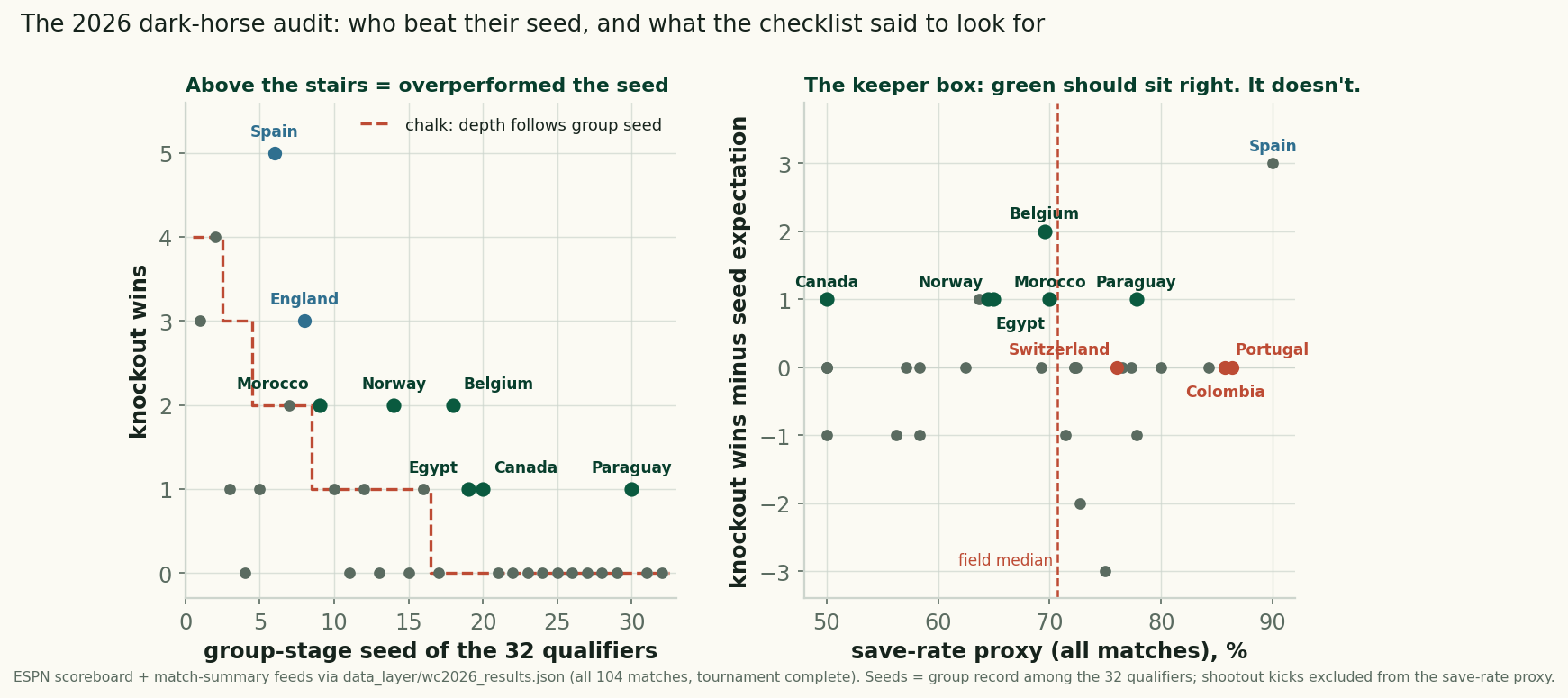
Six teams beat their group seed at the 2026 World Cup, scored against our pre-tournament checklist: the keeper box failed, the kind draw barely helped.
The Shootouts: Rarer, Earlier, and a Reprieve That Never Lasted
Retro #4 closes the series: the shootout rate fell to 12.5% of knockout games from 2022's 31%, all four came early, and survivors went 1-3 next time out.
The Groups Told the Truth: How June Predicted July at the 2026 World Cup
Group-stage points strongly predicted knockout survival: 9-point teams went 3-for-3, 4-point teams 2-for-11, and the last four all ranked top-8.