Confederations at the World Cup: Can 2026 Break the Duopoly?
A European and South American monopoly, and whether more slots can crack it.
In the entire history of the men's World Cup, the trophy has been lifted only by nations from two of football's six confederations: Europe and South America. No team from Africa, Asia, North and Central America, or Oceania has ever won it, and only a handful have even reached the final four. The 2026 tournament expands the field to 48 and redistributes places more generously across the confederations than ever before. Does that finally threaten the duopoly — or just add more first-round fixtures while the same names contest the latter stages? Here is the history, and the honest answer.
The monopoly, stated plainly
Every World Cup champion has been European or South American. That is not a quirk of one era; it has held across the whole history of the competition, through every format the tournament has used. The same two confederations have supplied almost all of the finalists and the overwhelming majority of semi-finalists. When forecasters list the perennial contenders — Brazil, Argentina from South America; France, Germany, Spain, England, Italy and others from Europe — they are describing this pattern, and a power rating encodes it because these nations have, over long samples, beaten strong opposition repeatedly. The duopoly is the single most durable fact in international football.
Best of the rest
Outside those two confederations, the ceiling has been the semi-final, reached on rare and celebrated occasions. The most prominent breakthroughs are remembered precisely because they were exceptional: a co-host from Asia reaching the last four in 2002, and an African side reaching the semi-finals in 2022 — the latter, as our own numbers showed, on the back of genuinely strong underlying performance rather than luck alone, a point made in World Cup 2026 by the numbers. North and Central America has produced quarter-finalists; Asia and Africa have produced quarter-finalists and the occasional semi-finalist; Oceania has had the smallest footprint of all. These runs matter — they prove the ceiling is not a hard wall — but their rarity is the point. The best of the rest have knocked on the door; none has gone through it to win.
What expansion changes
The move to 48 teams redistributes qualifying places, and the confederations outside the duopoly gain the most additional slots in relative terms. More teams from Africa, Asia, and North and Central America will be present than at any previous tournament. The obvious question is whether more entrants translates into a higher ceiling. The structural answer is that expansion guarantees more participation from these confederations, and therefore more matches and more chances for a breakout run — but participation and winning are different things. The extra slots largely go to nations in the middle and lower tiers of each confederation's pecking order, which improves representation far more than it improves the odds of a champion.
There is a second-order effect worth naming. More matches against high-quality opposition is, over time, developmental — exposure that can raise a footballing nation's level across cycles. But that is a long-run argument about the future, not a claim that the 2026 field is suddenly poised to crown a first-time confederation. The expanded slots change who is in the room; they do not, by themselves, change who is favoured once the knockout rounds begin.
The duopoly question, weighed
So can 2026 break it? The case that it might rests on the ingredients of any upset run, applied at confederation scale: a wider field and a longer single-elimination bracket create more high-variance knockout games, and a strong side from outside the duopoly that catches a kind draw could ride that variance further than its rating suggests — the mechanics are in will 48 teams mean more upsets and the team-level profile in how to spot a dark horse. A semi-final, even a final, from a non-traditional confederation is well within the range of what variance can produce, and arguably more reachable in a longer bracket.
The case that it probably will not rests on where elite depth actually lives. Winning a World Cup requires beating several strong teams in succession, and the squad quality to do that has, for the whole history of the tournament, been concentrated in Europe and South America. Seeding tends to protect those nations early, and more total matches give class more opportunities to reassert itself over variance. The honest forecast is therefore asymmetric: a breakout run to the latter stages from outside the duopoly is plausible and would not be a fluke, but a first-time champion from a third confederation remains a genuine long shot — not impossible, but the kind of outcome a model assigns a small probability, not a coin flip.
Reading it without picking a winner
The disciplined position is to treat the duopoly as a strong prior, not a law. It is strong because it has never once been broken and because the underlying reason — concentrated squad depth — has not disappeared. It is a prior rather than a law because nothing forbids a sufficiently good team from anywhere reaching the top, and the expanded, longer 2026 format very slightly widens the door. None of this names which confederation, let alone which team, might make the next leap — that would be exactly the false precision this site argues against, and the forecasting pipeline that produces such judgements is laid out in how models rate the field before a World Cup is played. Watch the knockout ties involving the best sides from Africa, Asia and the host confederation: that is where the prior gets tested, one high-variance match at a time.
Where these numbers come from
- FIFA — confederation slot allocations, qualifying structure and the historical tournament record.
- ClubElo — and the World Football Elo project it complements, for cross-confederation strength comparisons.
- FBref — international results and xG across confederations, useful for gauging the gap to the duopoly.
- StatsBomb — event data and research behind underlying-quality assessments of breakout teams.
More from World Cup 2026
The 2026 Dark-Horse Audit: Grading Our June Checklist
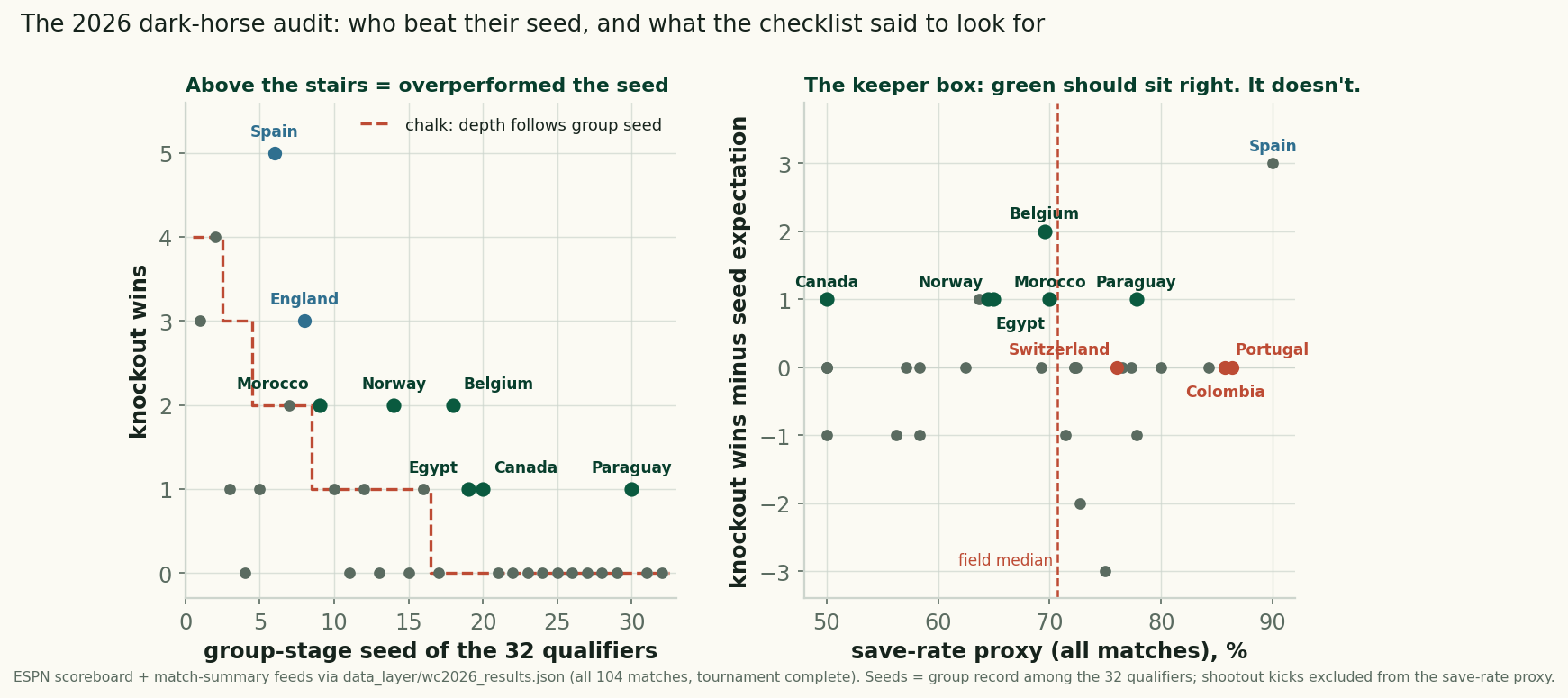
Six teams beat their group seed at the 2026 World Cup, scored against our pre-tournament checklist: the keeper box failed, the kind draw barely helped.
The Shootouts: Rarer, Earlier, and a Reprieve That Never Lasted
Retro #4 closes the series: the shootout rate fell to 12.5% of knockout games from 2022's 31%, all four came early, and survivors went 1-3 next time out.
The Groups Told the Truth: How June Predicted July at the 2026 World Cup
Group-stage points strongly predicted knockout survival: 9-point teams went 3-for-3, 4-point teams 2-for-11, and the last four all ranked top-8.