How to Spot a World Cup Dark Horse
The repeatable profile of a team that goes further than expected.
Every World Cup anoints an unexpected team — a side that was not on the shortlist of favourites and yet finds itself in a quarter-final or beyond, dragging the bracket into shapes nobody drew. Calling these runs "fairy tales" is fun and almost entirely unhelpful, because the teams that overperform tend to share a recognisable profile. None of it lets you name the next one with confidence — that would defeat the point of the word "dark" — but it does let you build a sensible watchlist instead of waiting to be surprised.
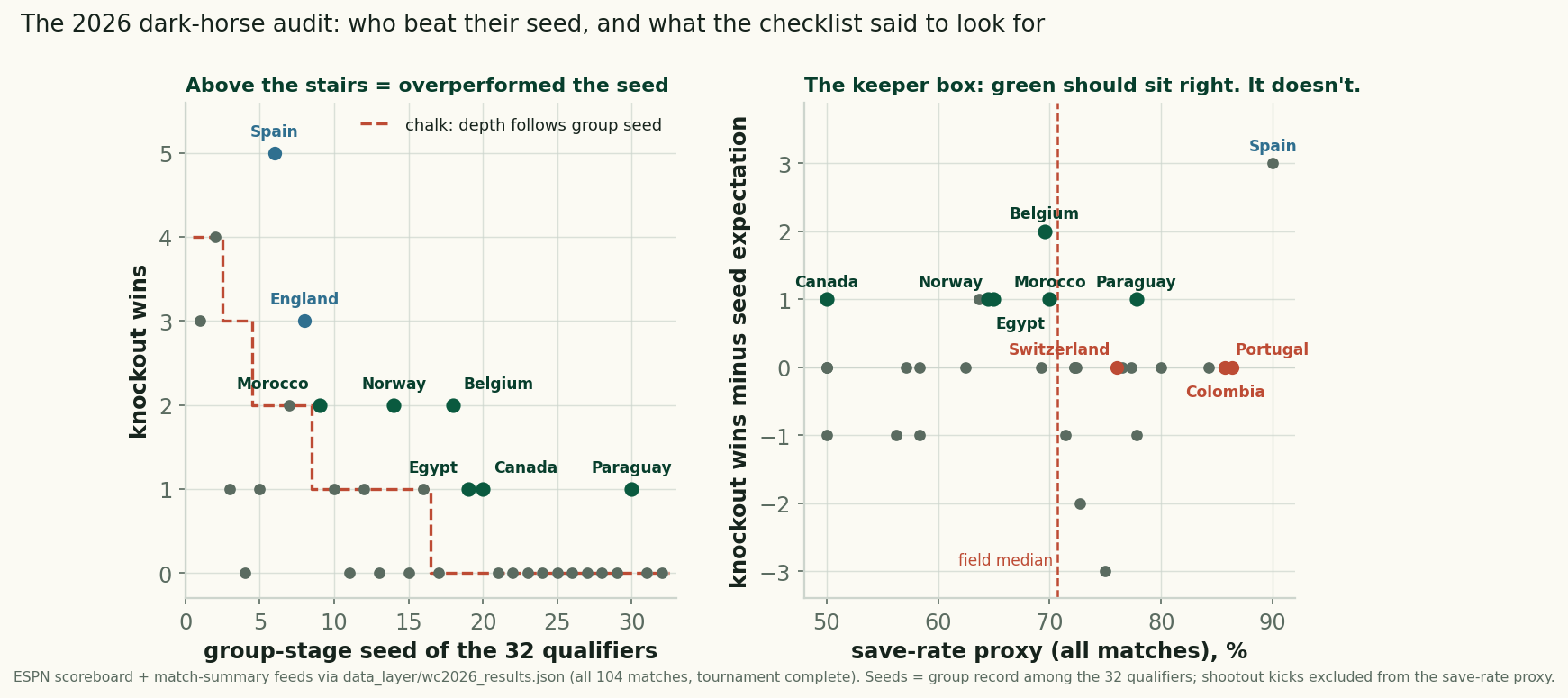
Update, August 17: the tournament has now graded this checklist. Who actually beat their seed in 2026, and which of the boxes below marked them — the keeper and kind-draw boxes did not — is in the 2026 dark-horse audit.
First, define the term properly
A dark horse is not a bad team that gets lucky. It is a team the consensus has under-rated — one whose true quality is higher than its public billing or even its power rating suggests, which then performs closer to its real level and looks like a shock. The distinction matters because it tells you where to look: not for a weak side riding pure variance (those exist, but they are unpredictable by definition), but for a mispricing — a gap between how good a team actually is and how good everyone thinks it is. That reframes dark-horse hunting as the same exercise as the rest of forecasting, built on the predictors in what predicts a deep World Cup run.
The profile of an overperformer
Across past tournaments, the sides that exceeded expectations tended to combine several of the following. Treat this as a checklist, not a formula.
Underlying quality the rating hasn't caught. The most valuable signal is a team whose performance numbers — chance creation and prevention, by xG and xGA — are better than its results or reputation. A side that has been losing close games it deserved to draw, or winning ugly while creating well, may be stronger than its record. This is the same "results lie, performance leaks the truth" logic that underpins xG-aware ratings in soccer power ratings; a dark horse is often a team the results-only systems have priced too low.
A goalkeeper capable of stealing ties. Knockout football is low-scoring and variance-heavy, so a keeper a level above expectation can carry a team further than its outfield quality alone would. Many memorable runs featured exactly this. It is part skill, part hot streak — but a side that already has an elite shot-stopper has a built-in mechanism for overperformance, especially once matches reach shoot-outs, where preparation compounds the edge (preparing for penalties).
A set-piece edge. Dead-ball situations are the most repeatable source of goals in tournament football, and they neutralise some of the gap to stronger opponents. A team that is genuinely excellent at attacking corners and free-kicks — or at defending them — manufactures and denies high-value chances without having to out-play a better side in open play. Because set-piece quality is more stable than open-play finishing, it is one of the more trustworthy ingredients of a deep run.
A kind draw. The same quality goes much further from a soft bracket than a brutal one. A dark horse often turns out, in hindsight, to be a decent team that avoided the other contenders until late. Since the draw is measurable variance, the path is part of the profile, not an excuse — the reason forecasters simulate the specific bracket rather than reason in the abstract (how a World Cup simulation works).
Depth and the conditions multiplier
An overperforming run is, by definition, longer than expected, which means more matches in heat and on short rest than a team's planners may have bargained for. Depth turns a promising side into one that can survive a suspension or a third game in nine days without falling apart — the argument developed in squad depth and the five-sub era. In 2026 the conditions are themselves a wildcard: a team well-built for heat or comfortable at altitude could find an edge over a "better" side that wilts, a factor discussed from past evidence in altitude and heat at the 2026 venues. Conditions do not create quality, but they can widen the door a quality-but-underrated team is already trying to walk through.
An illustrative profile (not a pick)
To make the checklist concrete without pretending to forecast: imagine a side rated, hypothetically, in the fifteenth-to-twentieth range of the field — comfortably outside the favourites — but whose underlying numbers over the last cycle looked more like a top-ten team, with a goalkeeper among the best at the tournament and a clearly drilled set-piece routine. Hand that side a group it should escape and a first knockout match against another non-contender, and a run to the last eight stops looking like a fairy tale and starts looking like the base case. Every detail there is invented to show the shape of the argument; none of it describes any actual 2026 team, and the point is precisely that the profile is identifiable in advance even when the specific team is not.
Why you still cannot name it
The honest limit: even a team that ticks every box is more likely than not to go out early, because a short tournament punishes everyone with variance. The checklist raises a side's probability of overperforming from small to less-small; it does not make the run likely in any single case. What it does well is keep you from being surprised in the wrong direction — from dismissing a team that had the profile all along, or from anointing a side on momentum alone with none of the durable edges. The discipline is the same one that runs through all of this site's tournament coverage: weight the repeatable signals, distrust the narrative, and own the range. The favourites' side of that ledger is in how models rate the field.
Sources, notes & further reading
- StatsBomb — event data and research on set-piece value, goalkeeping (post-shot xG) and chance quality.
- FBref — international xG and xGA, the basis for spotting teams whose performance outruns their results.
- ClubElo — a results-based rating useful as the baseline a dark horse is under-priced relative to.
- FIFA — tournament format and the bracket structure that determines the draw's kindness.
More from World Cup 2026
The 2026 Dark-Horse Audit: Grading Our June Checklist
Six teams beat their group seed at the 2026 World Cup, scored against our pre-tournament checklist: the keeper box failed, the kind draw barely helped.
The Shootouts: Rarer, Earlier, and a Reprieve That Never Lasted
Retro #4 closes the series: the shootout rate fell to 12.5% of knockout games from 2022's 31%, all four came early, and survivors went 1-3 next time out.
The Groups Told the Truth: How June Predicted July at the 2026 World Cup
Group-stage points strongly predicted knockout survival: 9-point teams went 3-for-3, 4-point teams 2-for-11, and the last four all ranked top-8.