Altitude and Heat at the 2026 World Cup Venues
Thin air and high temperatures as tactical variables, from the evidence.
Most World Cup analysis treats the pitch as a neutral surface and the air as nothing at all. For 2026, that will not do. The tournament is spread across a continent that includes one of the highest-altitude major football cities on earth and several venues capable of brutal summer heat. Thin air and high temperatures are not background colour; they are physical variables that have measurably changed how football is played in the past. What follows is what the documented evidence says about those effects — and a careful refusal to pretend to know a schedule that has not been set.
Why altitude changes the game
Altitude does two distinct things, and it helps to keep them separate. The first is aerodynamic. At elevation the air is thinner, so it exerts less drag on a moving ball. The well-documented consequence is that the ball travels faster and further for the same strike, dipping and swerving less predictably; long passes carry, shots arrive quicker, and goalkeepers and defenders have fractionally less time to react. Players who have spent careers calibrating their touch and their distances at sea level describe needing to recalibrate at altitude, and the effect on dead-ball flight is real enough to be felt by free-kick and goal-kick specialists.
The second effect is physiological, and larger. Thinner air means less oxygen per breath, which reduces aerobic capacity for anyone not acclimatised. The practical signature is faster fatigue — the high-intensity sprints that define modern pressing become harder to repeat, and the final stages of a match at altitude can look slower and more stretched as legs go. Acclimatisation helps but takes time, which is why teams based at elevation, or those who prepare for it, have historically held an edge over visitors arriving from sea level.
The evidence, hedged honestly
The strongest real-world demonstration comes from high-altitude venues in international football. Matches at major elevation — the classic examples are played well above 2,000 metres — have long been associated with home sides springing results against nominally stronger visitors, and with visiting teams visibly struggling to sustain their usual intensity. Researchers studying South American World Cup qualifying, where altitude varies enormously between host cities, have found a measurable relationship between the altitude gap separating two teams' home cities and the match outcome: the larger the elevation a visitor must climb to, the worse they tend to fare. That literature is the firmest ground here, and it is the basis for taking altitude seriously as a competitive variable rather than a curiosity.
The necessary caution: that evidence comes from specific past competitions and venues, and translating it into a precise edge for any 2026 match would be false precision. Elite teams and their sports-science staff now plan for these conditions deliberately — altitude camps, hydration and pacing strategies, careful use of the bench — which can blunt the effect. The honest claim is directional: altitude has mattered, plausibly will matter, and is worth watching, without a number attached to any particular fixture.
Heat: the other variable
A summer tournament across this region also raises the prospect of matches played in serious heat and humidity, particularly for any fixtures scheduled in the middle of the day. The effects are well established from past hot-weather football. High temperatures raise the physiological cost of the same running, push players toward dehydration, and tend to slow the overall tempo — possession is held more conservatively, pressing is rationed, and the game's intensity dips, especially late. The most visible adaptation is the cooling break: when conditions cross a heat threshold, officials can pause each half to let players rehydrate, a now-routine feature of hot-weather matches that itself subtly changes a game by handing both coaches an extra moment to instruct.
Heat interacts directly with two themes elsewhere in this coverage. It magnifies the value of squad depth and rotation, because fresh legs matter more when every player is fatiguing faster — the argument in squad depth and the five-sub era — and it raises the leverage of the five-substitute rule, traced in the five-substitutions era. A bench that can refresh a third of the outfield is worth more in a furnace than in mild conditions.
How this folds into a forecast
Conditions are one of the genuine sources of disagreement between tournament models, because they sit right next to the home-advantage term that every model has to set. The size of a host or familiarity edge, and whether to add anything for altitude acclimatisation or heat tolerance, is a real modelling choice rather than a settled fact — which is part of why two good simulations can diverge, as laid out in how a World Cup simulation works. The general magnitude of playing-environment effects, and how empty-stadium football revealed their components, is quantified in home advantage, quantified.
The practical, honest framing for 2026: altitude and heat are real variables with documented past effects, they plausibly favour teams that prepare specifically for them and have the depth to absorb the extra physical cost, and they are worth factoring into expectations as tendencies. What they are not is a basis for asserting that a particular team will play a particular match in particular conditions — the schedule, the venues for each tie, and the weather on the day are not knowable in advance, and any analysis that pretends otherwise has stopped being analysis. For the wider structural picture of the expanded tournament these conditions sit inside, see World Cup 2026 by the numbers.
Sources, notes & further reading
- FIFA — the governing body's guidance on heat and cooling-break protocols and on tournament conditions.
- StatsBomb — event data that lets analysts measure tempo, pressing intensity and how they shift with conditions.
- FBref — match and team data useful for comparing performance across venues and environments.
- ClubElo — a rating system illustrating how a home and venue edge is incorporated into match expectations.
More from World Cup 2026
The 2026 Dark-Horse Audit: Grading Our June Checklist
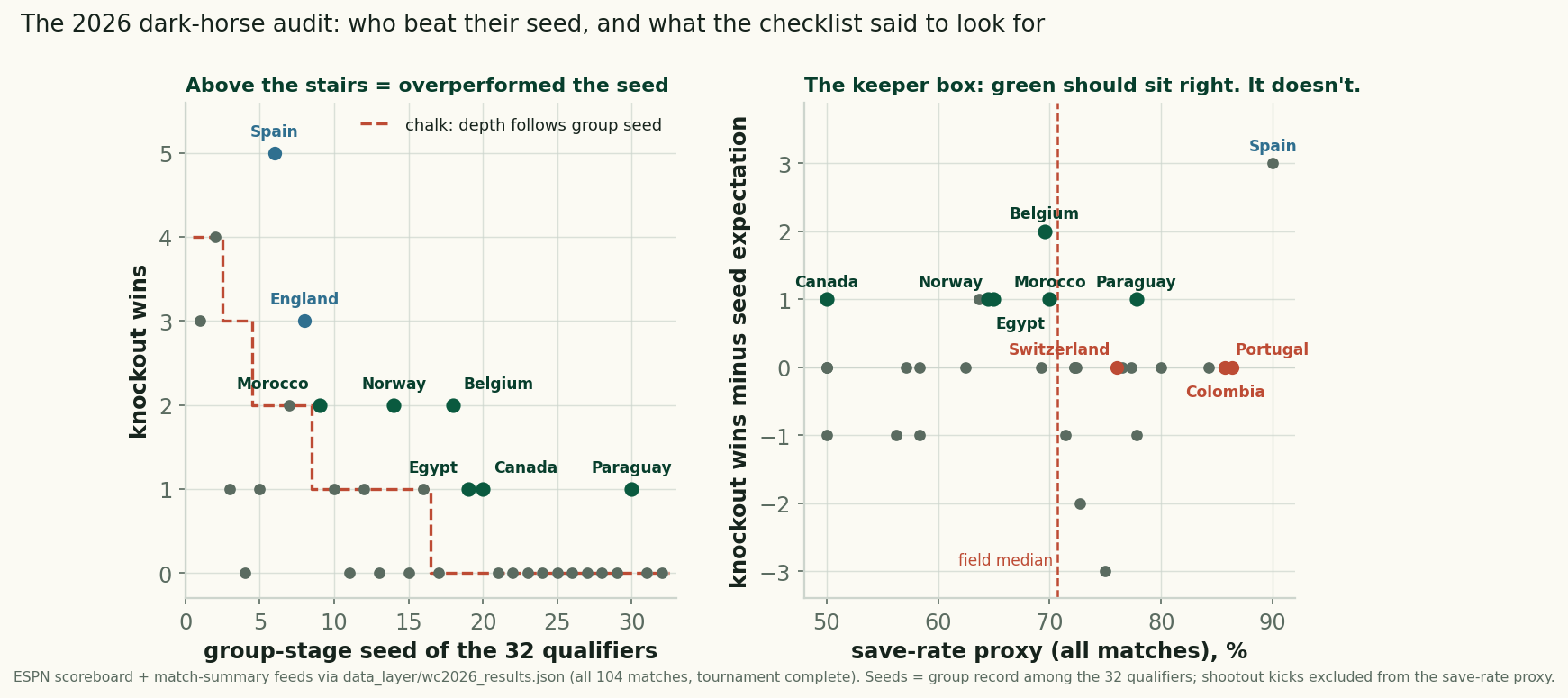
Six teams beat their group seed at the 2026 World Cup, scored against our pre-tournament checklist: the keeper box failed, the kind draw barely helped.
The Shootouts: Rarer, Earlier, and a Reprieve That Never Lasted
Retro #4 closes the series: the shootout rate fell to 12.5% of knockout games from 2022's 31%, all four came early, and survivors went 1-3 next time out.
The Groups Told the Truth: How June Predicted July at the 2026 World Cup
Group-stage points strongly predicted knockout survival: 9-point teams went 3-for-3, 4-point teams 2-for-11, and the last four all ranked top-8.