Data Sources to Follow World Cup 2026: Where the Real Numbers Live
Where to get real numbers during the tournament — for free.
Following a World Cup through data is a different job from following a league. The matches come in a flood — 104 of them across a single month — and the teams are international sides you may have little prior data on. The good news is that the free and public sources that cover club football also cover the World Cup, and one of them carries the full event-level history of past tournaments at no cost. Here is where the real numbers live during 2026, what is free, what is paid, and what to actually expect from each.
The two things you'll want during the tournament
Before listing sources, it helps to separate the two kinds of data you'll reach for, because no single source does both equally well.
The first is live and recent match data — xG totals, shot maps, and per-team stats for matches as they finish. This is what you use to ask whether a 1–0 was deserved, who is creating the better chances, and how a contender's underlying numbers are trending across the group stage. Speed and coverage matter here: you want every match, updated within hours.
The second is historical context — the event-level record of past World Cups, so you can compare what you're seeing now against what previous tournaments actually looked like. This is what grounds a take ("is this xG total high for a World Cup match?") in something other than vibes. Depth and granularity matter here more than freshness, since the past doesn't change.
The sources below cover one, the other, or both. The broader landscape of free football data — beyond just the World Cup — is mapped in full in every free public soccer data source, ranked, which is the companion to this piece.
FBref — the breadth play for live numbers
For following matches as the tournament unfolds, FBref is the most practical free option. It publishes advanced stats across hundreds of competitions, the World Cup among them, and the numbers are powered by Opta — the same underlying data many broadcasters use. Expect per-match and per-team xG and xGA, shot data, progressive passing, and squad and player breakdowns, updated after matches finish.
The catch is real and worth stating plainly. FBref is a web-scraping target, not an API, and Sports Reference rate-limits aggressively — the standard guidance is one request every three seconds, with everything cached locally, and they will block scrapers that ignore it. The data is Opta-licensed, which means you can publish a chart or a model output derived from it but you cannot redistribute the raw numbers. For following along, reading the site directly is free and unrestricted; the constraints bite only when you automate.
StatsBomb — and the open data for past World Cups
StatsBomb is a commercial provider whose full, live World Cup data sits behind their paid product. But the part that matters most for a public audience is free: StatsBomb's open data release includes complete event-level data for past World Cups — every pass, shot, and carry, with pre-computed xG values and freeze-frame snapshots of player positions at the moment of each shot.
That open archive is the single best free resource for historical World Cup context. It is the dataset behind most of the "what did the 2022 tournament actually look like" analysis you'll read, and it is granular enough to rebuild shot maps and run your own aggregations. It will not give you 2026 matches in real time — the open release is curated and historical, not a live feed — but it lets you benchmark whatever you're watching against a properly measured past. If you want to actually load it and build something, the tutorial on getting started with StatsBomb open data takes you from pip install to a working leaderboard in about fifty lines of Python.
Free versus paid, honestly
It is worth being clear about where the line falls, because "free" covers more than people expect and "paid" guards less that a public follower actually needs.
Free gets you a long way. Reading xG, shot data, and team stats on FBref as matches finish is free. The complete event-level history of past World Cups via StatsBomb open data is free. Match results, scores, and historical odds from results archives are free. For someone following the tournament analytically — reading deserved results, tracking contenders' underlying numbers, comparing against history — the free tier is genuinely sufficient.
Paid buys speed, completeness, and rights. What money unlocks is real-time event streams during the tournament, the complete current-event dataset rather than a curated historical slice, and the licence to build commercial products on top. Professional analysts and clubs pay for those things because their job demands them. A fan, a writer, or a hobbyist analyst building charts for a blog generally does not need any of it.
The honest summary: you can follow World Cup 2026 with real, well-sourced numbers without spending anything. The paid products are better and faster, but the gap matters most for commercial and professional use, not for understanding the football.
What to expect for a major tournament
A few realistic expectations will save you frustration once the matches start.
Live data lags by hours, not seconds, on the free tier. Free sources update after matches, and sometimes with a delay during a packed matchday when many games finish close together. If you want the score the instant it happens, that is what the broadcast is for; the data is for the morning-after analysis, and it is excellent at that.
Coverage of a World Cup is strong. Unlike obscure club competitions, a major tournament is covered comprehensively by every provider — there is no patchy-coverage problem here. Every match will have xG, shot data, and team stats available somewhere on the free tier.
Models differ, so cross-check. Different providers run different xG models, so a match's xG total can vary depending on whose number you read. This is normal and not a sign anyone is wrong — it reflects different training data and feature choices. When a figure matters, note which source it came from and don't treat two providers' numbers as interchangeable to the decimal.
FIFA is the source of record for the facts. For fixtures, results, squads, and the official format — 48 teams, 12 groups, 104 matches, hosts across the United States, Canada, and Mexico — FIFA's own channels are the authoritative reference. They are not an analytics source, but they are the place to confirm what is actually true before you build a number on top of it.
Put together, the free landscape is more than enough to follow 2026 properly: FBref for live-ish match numbers, StatsBomb open data for historical depth, and FIFA for the facts of record. For how to actually use these numbers once you have them, the guide to watching with xG and the shot-map reading guide turn raw data into something you can read at a glance.
Where these numbers come from
- Every Free Public Soccer Data Source, Ranked — the full landscape of free football data, with the catch for each.
- Getting Started with StatsBomb Open Data — load the past-World-Cup event data and build your first leaderboard.
- How to Watch the World Cup with xG — what to do with the numbers once you have them.
- FBref — Opta-powered advanced stats across the World Cup and hundreds of other competitions.
- StatsBomb open data — free event-level data for past World Cups, including shot-by-shot xG.
- StatsBomb — methodology documentation for the data spec and xG model.
- FIFA — the official source of record for fixtures, results, squads, and tournament format.
More from World Cup 2026
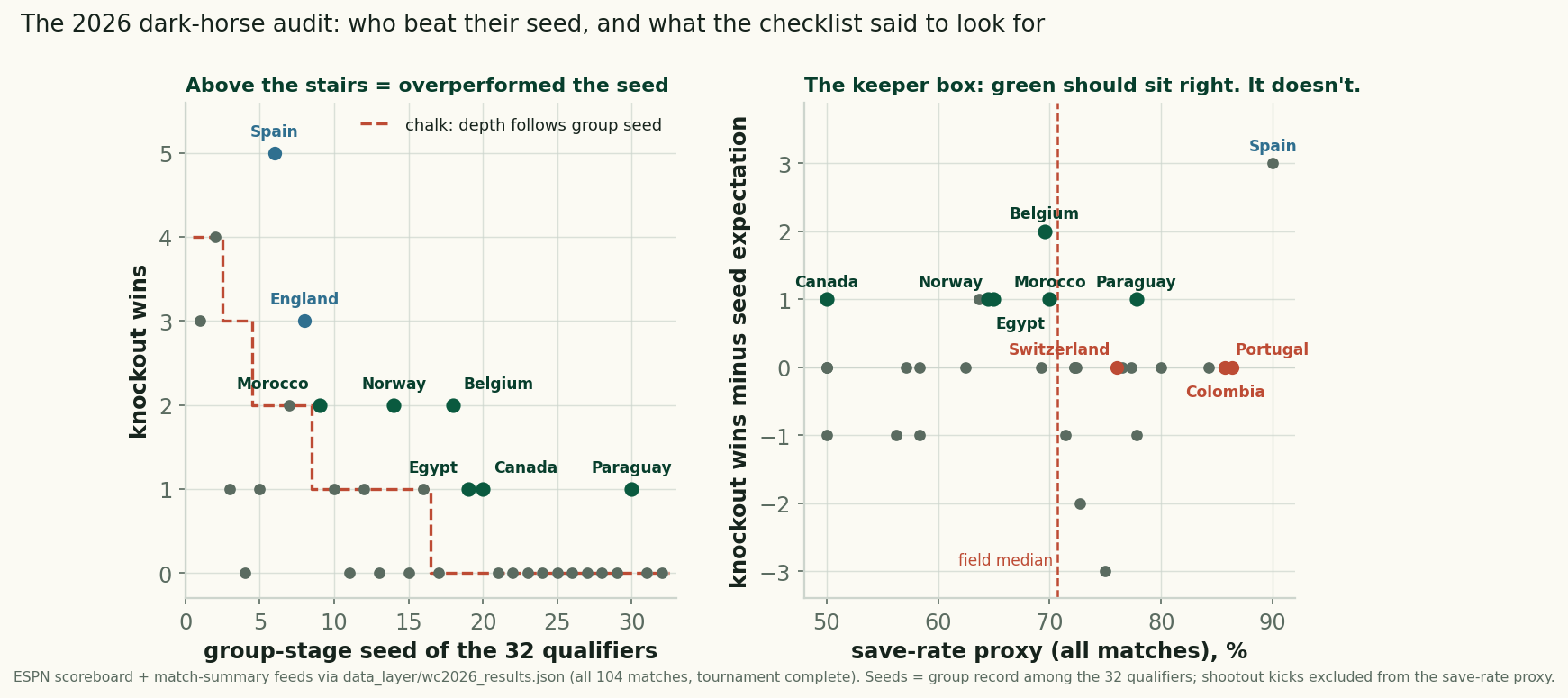
The 2026 Dark-Horse Audit: Grading Our June Checklist
Six teams beat their group seed at the 2026 World Cup, scored against our pre-tournament checklist: the keeper box failed, the kind draw barely helped.
The Shootouts: Rarer, Earlier, and a Reprieve That Never Lasted
Retro #4 closes the series: the shootout rate fell to 12.5% of knockout games from 2022's 31%, all four came early, and survivors went 1-3 next time out.
The Groups Told the Truth: How June Predicted July at the 2026 World Cup
Group-stage points strongly predicted knockout survival: 9-point teams went 3-for-3, 4-point teams 2-for-11, and the last four all ranked top-8.