Does Europe Cost English Clubs at the Weekend? Three Seasons Can't Find It
October packs 18 European-to-league turnarounds into two weekends for nine English clubs. Three complete seasons of results say the fatigue everyone expects is too small to find.
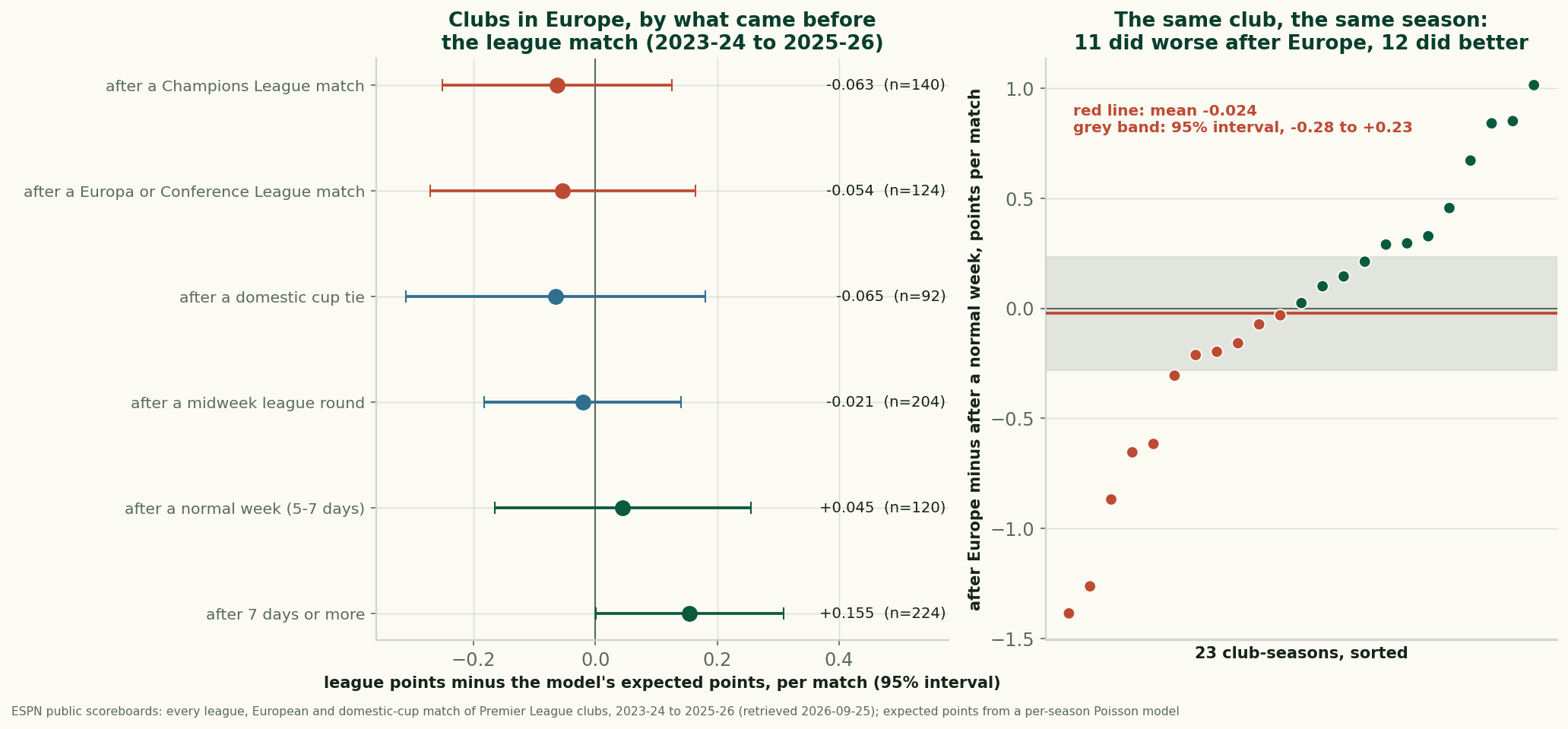
The Premier League comes back from a three-week break on 10 October, and three days later the European nights start landing between league weekends. By 25 October nine English clubs will have played 18 league matches within five days of a European one. The standing assumption is that those matches cost points: tired legs, rotated line-ups, the Thursday-to-Sunday turnaround of the Europa League. We measured it across three complete seasons. After a European match, English clubs took 1.56 league points a game against 1.62 expected, a shortfall of -0.059 a match. Compared with the same club in the same season after a normal week, the gap is -0.024, with a standard error of 0.132. Eleven of 23 club-seasons did worse after Europe and twelve did better. Whatever the cost is, it is too small to see.
Sourcing. Every competitive fixture of every Premier League club from 2023-24 to 2025-26, taken from ESPN's public scoreboards for six competitions: the league, the Champions League, the Europa League, the Conference League, the FA Cup and the League Cup. English clubs played 72, 88 and 113 European matches in those three seasons. The same pull carries 2026-27 to date and the fixtures scheduled through 25 October. It is built by data_layer/build_club_schedules.py, and every figure below is recomputed by charts/chart_epl_europe_weekend.py, which exits non-zero if any of them stops reproducing.
How to judge a result after a European night
Raw points will not do. A club coming off a European night is usually one of the best in the league, and a good club wins a lot of league matches whatever it did on Wednesday. So each league match gets an expected-points figure from a simple goals model: an attack and a defence rating for every club, plus home advantage, fitted separately to each season's 380 matches. The measure is points won minus points expected. Positive means the club did better than the fixture suggested.
Rest is counted in hours, kickoff to kickoff, from the club's previous competitive match. Anything under 120 hours counts as a midweek turnaround. The model has one known flaw, and it matters only for the absolute numbers. It expects 252.4 draws across the three seasons where there were 279, so its expected points run slightly high for everyone; the average league match comes out at -0.012. Every comparison below is between groups, and the flaw affects each group equally.
What came before the league match
The 264 league matches English clubs played within five days of a European match came out at -0.059 a match against expectation. That is small, and it sits beside every other kind of short week:
| What came before the league match | Matches | Points vs expected | Standard error |
|---|---|---|---|
| A Champions League match (under 5 days) | 140 | -0.063 | 0.096 |
| A Europa or Conference League match (under 5 days) | 124 | -0.054 | 0.111 |
| A domestic cup tie (under 5 days) | 92 | -0.065 | 0.126 |
| A midweek league round (under 5 days) | 204 | -0.021 | 0.082 |
| A normal week (5 to 7 days) | 120 | +0.045 | 0.107 |
| 7 days or more | 224 | +0.155 | 0.078 |
Three things stand out. First, the Thursday turnaround is not worse. Europa and Conference League clubs had 69 hours on average before their league match, against 89 hours after a Champions League night, and came out at -0.054 against -0.063. Twenty extra hours bought nothing visible. Second, a domestic cup tie in midweek produces the same dip as a European one, -0.065, so if there is a cost it belongs to the short week, not to Europe. Third, the headline comparison is small and noisy. After Europe minus after a normal week is -0.104 a match with a standard error of 0.129, well inside the noise.
The one group that stands out, +0.155 after seven days or more, mixes two different things: 118 matches after a gap of seven to eleven days, and 106 after twelve days or longer, which covers the international breaks and 16 season openers. That is not a clean rest comparison, and clubs not in Europe come out at -0.082 after the same long gaps.
The rest gap is real even if its effect is hard to find. After a European night the club had 80 hours on average and its league opponent had 149. By season, the post-Europe figure was -0.072, -0.090 and -0.025 on 68, 86 and 110 matches. The sign is steady, but the size stays small every season.
The same club, the same season
The fairest test holds the club and the season fixed. For each club-season with both kinds of week, take its league result after Europe and subtract its result after a normal week. Twenty-four club-seasons had a European campaign; 23 have both kinds of week, because Crystal Palace in 2025-26 never played a league match after a normal five-to-seven-day week.
Eleven of the 23 were worse after Europe and twelve better. The spread is wide, from Manchester City and West Ham in 2023-24, more than a point a match worse, to Liverpool in 2024-25, a point better. At a count of 23, that spread is what noise looks like. The honest summary is a range. Against expectation, the 95% interval for the after-Europe figure runs from -0.20 to +0.08 a match. That rules out a cost of more than a fifth of a point a match, but not a modest one. The average club-season had 11 league matches straight after a European night, so even the raw -0.059 adds up to about two-thirds of a point over a season.
Rest against the opponent
If short rest hurt, the clearest place to see it would be a rest mismatch, whoever the clubs are. Across all 2,280 league team-matches of the three seasons, teams with 48 or more hours more rest than their opponent came out at -0.028 a match against expectation. Teams with 48 or more hours less came out at +0.004. There were 387 matches on each side, and the gap runs the wrong way for the theory. Whatever decides Premier League matches, a two-day rest edge is not visibly part of it.
The first turnarounds of 2026-27
The eight English clubs who have played European matches this season all won on matchday one. Their next league matches produced 8 points from 8 games. That tells us nothing on its own: eight matches cannot carry a finding, and one of them was a derby between two of the clubs.
| Club | European match | Next league match | Hours between | League points |
|---|---|---|---|---|
| Manchester City | FC Porto 0-2 Manchester City (8 Sep) | Manchester United 0-1 Manchester City | 116 | 3 |
| Aston Villa | Club Brugge 2-3 Aston Villa (8 Sep) | Aston Villa 1-2 Nottingham Forest | 93 | 0 |
| Arsenal | Napoli 0-1 Arsenal (9 Sep) | Sunderland 0-2 Arsenal | 72 | 3 |
| Liverpool | Liverpool 2-1 Atlético Madrid (9 Sep) | Liverpool 0-0 Fulham | 67 | 1 |
| Manchester United | Manchester United 4-0 Sabah FK (10 Sep) | Manchester United 0-1 Manchester City | 68 | 0 |
| Sunderland | Sunderland 1-0 AZ Alkmaar (16 Sep) | Manchester City 5-3 Sunderland | 90 | 0 |
| Crystal Palace | Crystal Palace 4-0 Lech Poznan (17 Sep) | Leeds United 0-0 Crystal Palace | 66 | 1 |
| AFC Bournemouth | Real Sociedad 1-2 AFC Bournemouth (17 Sep) | AFC Bournemouth 0-1 Liverpool | 66 | 0 |
October is where the schedule tightens. The Champions League returns on 13 and 14 October, the Europa and Conference Leagues on 15 October, and Brighton join the list in the Conference League. Across the weekends of 17-18 and 24-25 October the schedule has 18 turnarounds for nine clubs, 12 of them under 72 hours. In five league fixtures both sides come off a European night: Brighton against Crystal Palace and Bournemouth against Sunderland on 18 October, Aston Villa against Manchester City on 24 October, and Manchester United against Bournemouth and Liverpool against Brighton on 25 October. In those five neither side gets a rest edge. In the other eight, one side comes off a European night and its opponent does not, and three seasons of evidence say that gap is unlikely to decide them.
What this does and does not say
It measures results, not legs. A manager who rotates after a European night and still gets the expected result has paid the cost in selection, not in points. This article says the points do not show it; it cannot say the players felt nothing. It looks one match back. The cumulative load of a long European run, which might tell by March, is not the same question as the turnaround, and three seasons of clubs is too few to split by month. The baseline is fitted in-season, so it knows how good each club turned out to be. That is the right yardstick for a fixture-by-fixture comparison, and the within-club test does not depend on it much, since both of its halves share the same club ratings.
The home-advantage question ran into the same wall: a real effect can be small enough that a season of results cannot separate it from noise. Here even three seasons cannot.
Sources & Further Reading
- ESPN public soccer feeds (scoreboards for eng.1, uefa.champions, uefa.europa, uefa.europa.conf, eng.fa and eng.league_cup, walked one month at a time): every competitive fixture of Premier League clubs, 2023-24 to 2025-26, and 2026-27 to date with the fixtures scheduled through 25 October, retrieved 2026-09-25. Built by
data_layer/build_club_schedules.py; verified bycharts/chart_epl_europe_weekend.py. - Home Advantage Didn't Die. The Results Column Can't See It: the same limit on what a season of results can detect.
- Manchester United Lead the League in Shots and Sit Twelfth: what a five-game sample of this season is worth.
- The Premier League 2026-27, by the numbers: the living snapshot of the season so far.
More from Data Deep-Dives
Manchester United Lead the League in Shots and Sit Twelfth
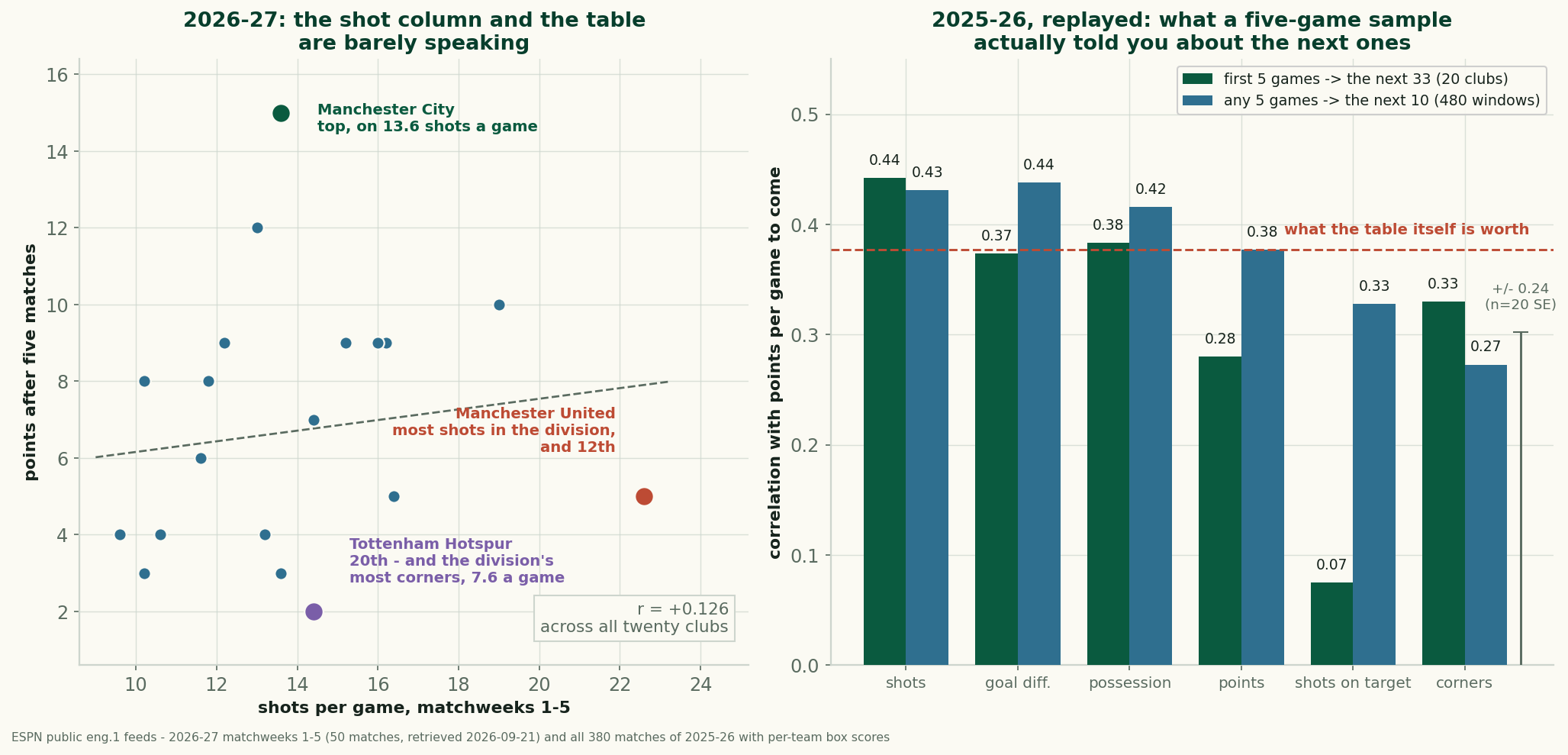
United take 22.6 shots a game and have 5 points. Across 2025-26, a club's five-game shot count predicted its next results better than its points did.
Home Advantage Didn't Die. The Results Column Can't See It
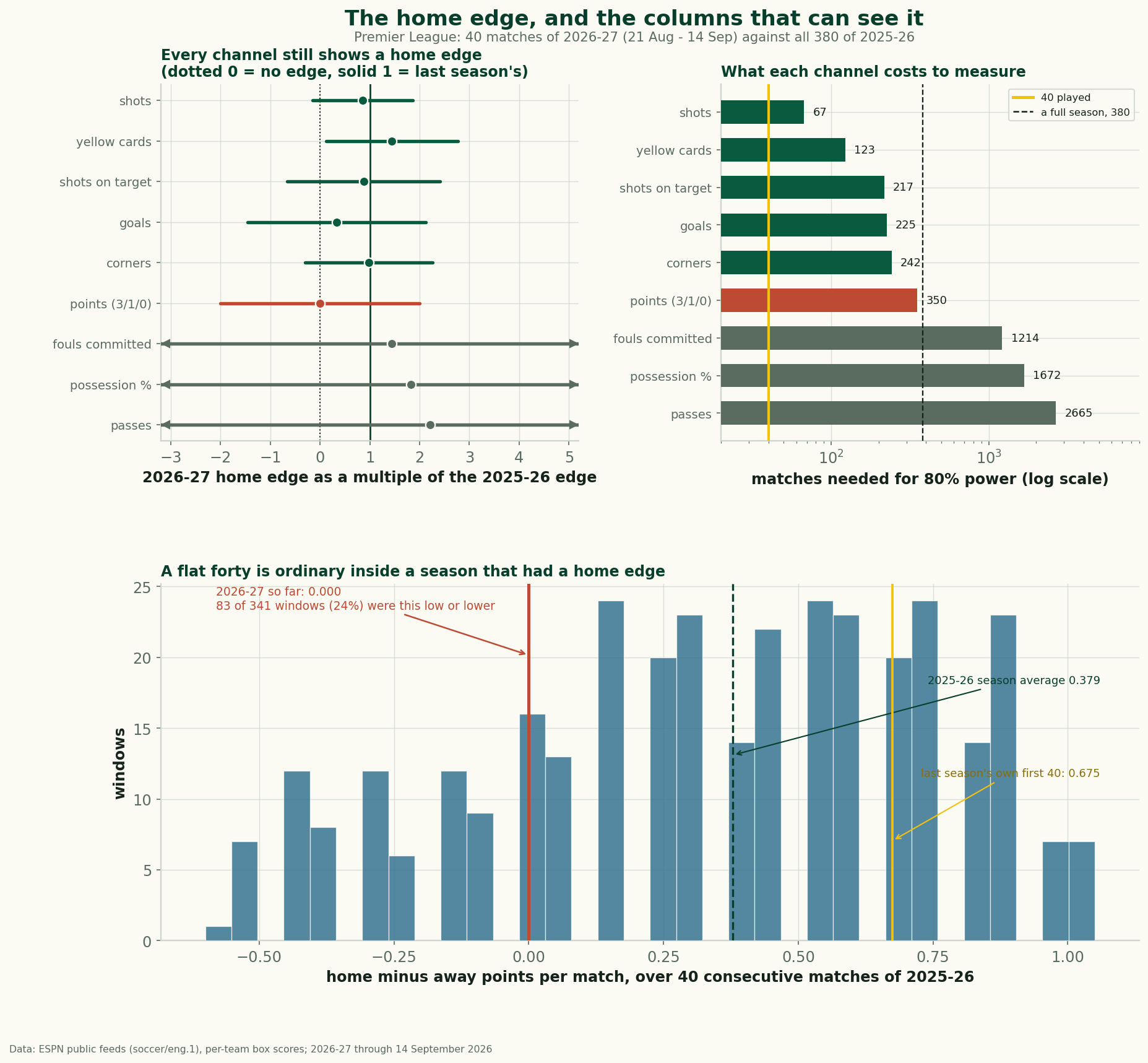
Home and away split the first 40 matches of 2026-27 evenly, yet the shot, corner and card columns keep the home edge. Plus a decade of home-advantage data.
Finishing and Saving Rates Have No Memory
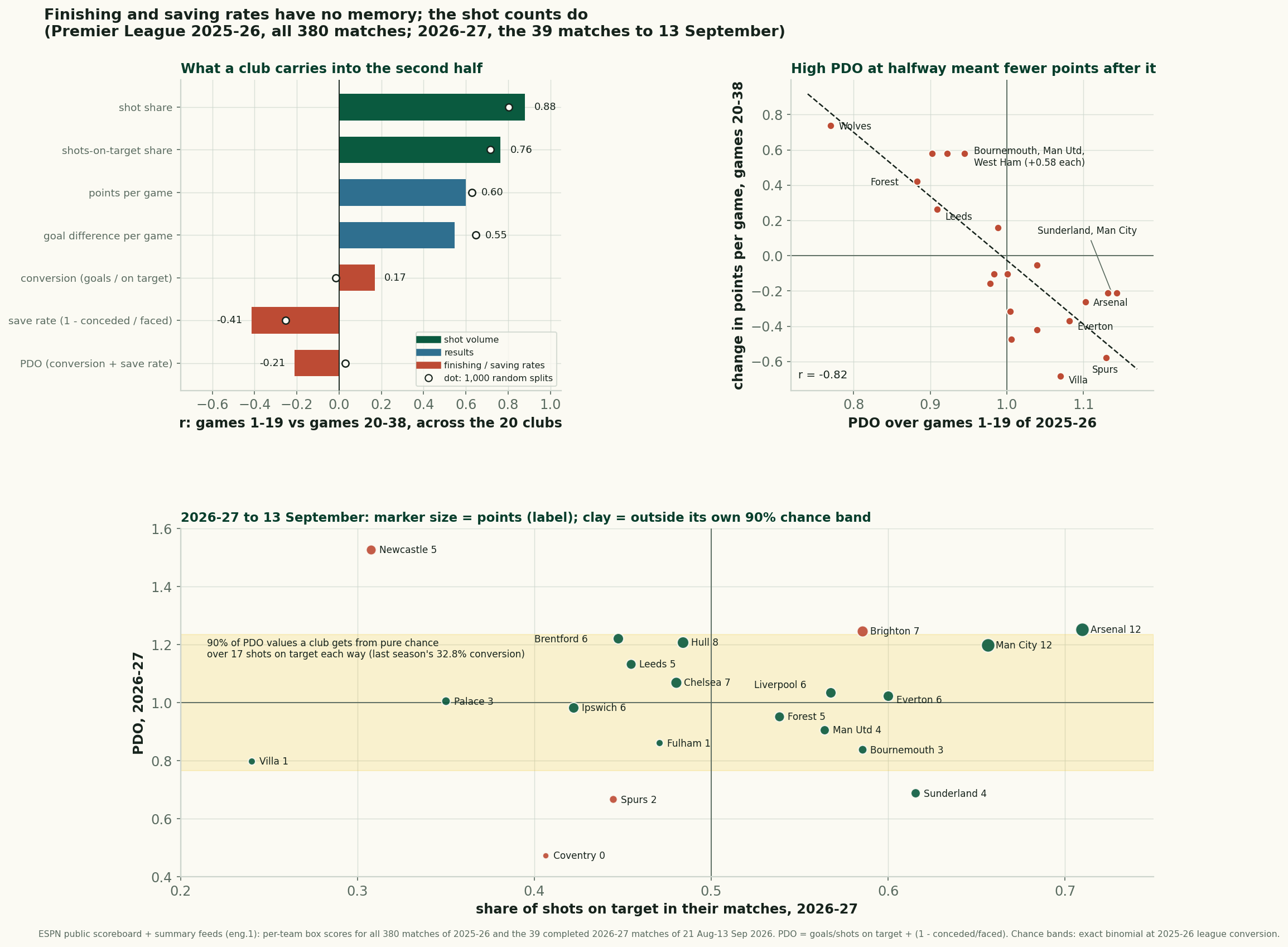
Last season a club's finishing and saving rates at halfway said nothing about its second half. Four rounds into 2026-27, those rates explain most of the table.