Group-Stage Survival: The Points Math of Getting Out
How many points really gets you out of a World Cup group.
Every four years the same anxious arithmetic plays out in living rooms around the world: a team draws its opener, wins its second match, and someone asks whether four points will be enough. For decades the answer was a reassuring rule of thumb — four points almost always advances, three sometimes does. The 2026 World Cup keeps the four-team group but changes what happens to the team that finishes third, and that single rule change quietly rewrites the survival math for a third of the field.
The four-team group and its three games
The building block has been stable for decades: four teams, each playing the other three once, three points for a win and one for a draw. That structure produces a small, well-understood set of possible points totals. A team plays three matches, so its final tally lives somewhere between zero and nine, and the realistic outcomes cluster tightly. Win two and lose one and you have six points. Win one and draw two and you have five. One win, one draw, one loss is four. Three draws is three.
Because only six matches are played in a group, the points tend to distribute in recognisable patterns. A group with a clear hierarchy often produces a 9–6–3–0 or 7–5–3–1 spread; a tight, competitive group can leave several teams bunched on four. That bunching is where the drama lives, and where the question of exactly how many points you need stops being academic.
The historical thresholds
Under the old 32-team format, eight groups of four sent their top two through, and the empirical pattern across tournaments was consistent enough to state plainly. Four points almost always advanced. A team with four points finished in the top two of its group the overwhelming majority of the time; the cases where four points were not enough were genuine rarities, requiring an unusually strong group in which three sides all won twice. Five points was, in practice, a near-guarantee. Six points was essentially never eliminated.
Three points was the genuine coin flip. A single win and two defeats, or three draws, sometimes squeaked a team through and sometimes sent them home, depending entirely on how the other results fell and on goal difference. And historically, anything below three points meant elimination — a team that managed one draw and two losses, or worse, was going home. These are robust, well-documented patterns rather than precise guarantees, which is the honest way to state them: tendencies with rare exceptions, not laws.
| Points | Typical record | Old format (top 2) |
|---|---|---|
| 9 | 3 wins | Always through |
| 7 | 2 wins, 1 draw | Always through |
| 6 | 2 wins, 1 loss | Almost always through |
| 5 | 1 win, 2 draws | Very likely through |
| 4 | 1 win, 1 draw, 1 loss | Usually through |
| 3 | 1 win, 2 losses / 3 draws | Coin flip |
| ≤2 | 1 draw or fewer | Eliminated |
What the eight-best-thirds rule changes
The 2026 format keeps groups of four but expands the field to forty-eight teams in twelve groups, and crucially it advances more than just the top two. The top two from each of the twelve groups go through automatically — twenty-four teams — and they are joined by the eight best third-placed teams across all twelve groups, filling out a round of 32. That third-place lifeline is the structural novelty, and it is what moves the survival bar.
The effect on the points math is direct: third place is no longer automatic elimination. A team that finishes third in its group now has a real, often good, chance of advancing as one of the eight best thirds. In practice this means three points — once a coin flip for second place — becomes a frequently sufficient total for a third-place berth, and even a single well-timed win can be enough. The bar for survival, for a third of the qualifiers, drops from “finish top two” to “be among the better third-placed sides,” and those are very different thresholds. The precise cut-off varies edition to edition because it depends on how points and goal difference fall across all twelve groups; the detailed mechanics of that comparison are worked through in our piece on the best-third-place qualification math.
Why three points now travels further
There is a precedent worth invoking. The expanded format borrows its best-thirds mechanism from the 24-team World Cups of 1986, 1990 and 1994, and from recent 24-team European Championships, all of which advanced four of six third-placed teams. The lesson from those tournaments was consistent: a modest points total that would have been eliminated in a strict top-two format instead survived, sometimes with as little as a single win or even three points from draws. Teams learned to play the percentages, knowing third place was not the end.
The same dynamic will shape 2026, with an important wrinkle: because the bottom of the 48-team field is the weakest ever assembled, the third-placed teams that advance may have padded their goal difference against overmatched opposition. Goal difference, always the first tiebreaker, becomes even more decisive when comparing third-placed teams across groups of differing strength. A team eyeing a best-third spot cannot simply avoid defeat; it may need to win by enough, which subtly changes in-game incentives late in group matches.
The practical takeaway for 2026
If you are tracking a team through the group stage in 2026, recalibrate the old rule of thumb. Four points still all but guarantees advancement — now comfortably, often as a group winner or runner-up. Three points, historically a nervous coin flip for second, is now frequently enough to sneak through in third. Even a team with a single win and two losses is no longer automatically eliminated, which is a genuine and deliberate softening of the old jeopardy. What has not changed is that goal difference decides the close calls, so margins in supposedly dead rubbers matter more than ever.
The deeper point is that the expansion did not just add teams; it added a second, lower survival threshold, and that lowers the cost of a slow start. A side that loses its opener — once close to fatal — can now realistically recover into a best-third place with one win and a respectable goal difference. The math of getting out of a World Cup group has, for the first time in the modern era, become genuinely forgiving. How those survivors then fare in the longer knockout bracket is a separate question, and one our tournament primer takes up.
Where these numbers come from
- FIFA — official 2026 format rules, including the third-place qualification mechanism and tiebreaker order.
- RSSSF — complete historical group-stage tables and points totals for every World Cup, including the 24-team editions.
- FBref — group-stage results and standings for recent World Cups and continental tournaments.
More from World Cup 2026
The 2026 Dark-Horse Audit: Grading Our June Checklist
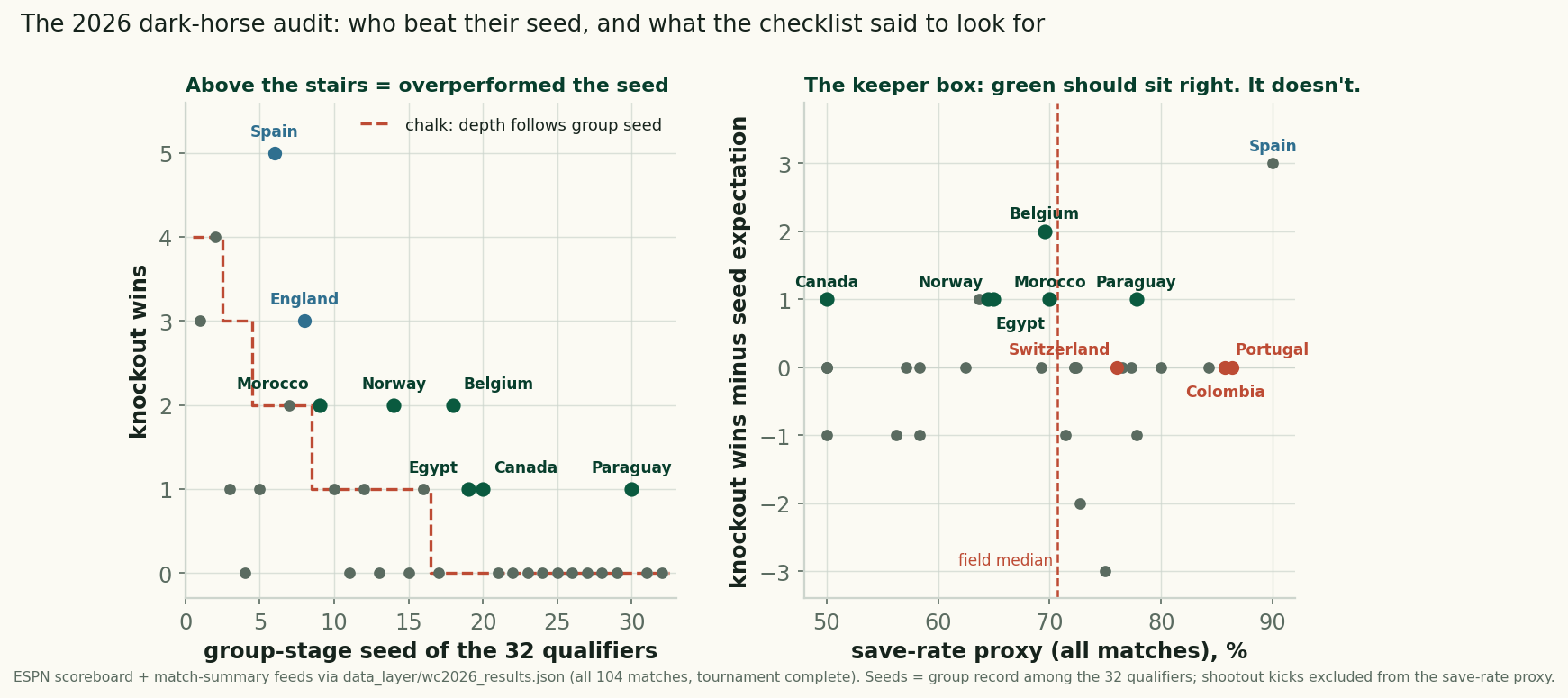
Six teams beat their group seed at the 2026 World Cup, scored against our pre-tournament checklist: the keeper box failed, the kind draw barely helped.
The Shootouts: Rarer, Earlier, and a Reprieve That Never Lasted
Retro #4 closes the series: the shootout rate fell to 12.5% of knockout games from 2022's 31%, all four came early, and survivors went 1-3 next time out.
The Groups Told the Truth: How June Predicted July at the 2026 World Cup
Group-stage points strongly predicted knockout survival: 9-point teams went 3-for-3, 4-point teams 2-for-11, and the last four all ranked top-8.