How Debutants Fare at the World Cup
What history says happens to a nation's first World Cup.
For a nation reaching the World Cup for the first time, simply being there is the achievement of a generation. What happens next is usually short and chastening: most debutants are eliminated in the group stage, outmatched by opponents with deeper tournament experience and stronger squads. But “usually” is not “always,” and the history of World Cup newcomers contains just enough glorious exceptions to keep every first-timer dreaming. With 48 teams in 2026, there will be more debutants than ever — and the question of how they tend to fare has rarely mattered more.
The base rate: most go home early
The honest starting point is sobering. Across World Cup history, the typical debutant exits at the group stage. There are structural reasons for this that have nothing to do with effort or organisation. A first-time qualifier is, almost by definition, a nation that has historically been below the threshold of the world’s best, and one tournament rarely closes that gap. Debutants often lack the squad depth to survive a month of high-intensity football, the big-match experience to manage tight knockout games, and the institutional memory of how a World Cup actually feels.
This is not a criticism — it is simply what the base rate looks like. Reaching a World Cup for the first time means clearing an enormous bar; thriving once there means clearing a higher one still. The realistic expectation for a debutant is three competitive matches and an early flight home, with the occasional famous result against a bigger side as the keepsake of the campaign. Setting that expectation honestly is the kindest thing analysis can do, because it frames any deeper run as the extraordinary feat it genuinely is.
The exceptions that light up tournaments
And yet the exceptions are some of the most beloved stories the tournament has produced. The clearest modern example is Senegal in 2002, debutants who opened the tournament by beating the reigning champions and went on to reach the quarter-finals — a run that announced a footballing nation to the world and became one of the defining narratives of that World Cup. It is the template for what a debutant dream looks like: an early statement result, then a knockout run that nobody saw coming.
Senegal were not entirely alone in the modern era. The 2018 World Cup featured several nations either making their debut or returning after long absences, and the tournament was widely noted for the competitiveness of its newer and less-established sides against traditional powers. The broader history holds a handful of other deep debutant runs, scattered across the decades, each remembered precisely because it defied the base rate. These runs are rare enough that they do not change the overall expectation — but common enough that ruling them out entirely would be its own kind of error.
Why the favourites still usually win
The flip side of debutant struggles is the durability of the established order. The deep stages of the World Cup are overwhelmingly populated by experienced footballing nations, and the eventual champion is almost always one of a small group of traditional powers. A debutant is, structurally, the longest of long shots to win the tournament — the kind of outcome that pre-tournament models assign a probability indistinguishable from zero, and rightly so given the history.
This is the same dynamic our piece on how often the favourite wins quantifies from the other direction: the World Cup is a competition where, despite all its upsets and drama, the strongest teams convert their advantage at the business end with remarkable reliability. A debutant reaching the latter stages is the rare crack in that pattern, and a debutant winning has never happened in the modern era of the tournament. The newcomer’s realistic ambition is a memorable run, not a trophy — and a memorable run is more than enough to justify the journey.
What 48 teams means for newcomers
The 2026 expansion to 48 teams reshapes the debutant question in two opposing ways. First, and most obviously, there will simply be more debutants: a wider field draws in nations that have never qualified before, and the tournament will feature a larger contingent of first-timers than any previous edition. The expanded slots across the confederations — explored in our look at how the confederations have fared — deliberately open the door to newcomers from regions long underrepresented at the finals.
Second, the new format gives those debutants a slightly softer landing. The eight-best-thirds rule means a first-timer no longer has to finish in the top two of its group to survive; a third-place finish with a respectable record can now be enough to reach the round of 32. That lowers the bar for a debutant to claim the milestone of a knockout appearance, even if it does nothing to improve their odds once the single-elimination football begins. A newcomer that grabs a single win and a draw now has a real path out of the group — a path that simply did not exist under the old top-two format.
Setting expectations for 2026
The grounded forecast for 2026’s debutants blends the two histories. Expect most first-timers to be eliminated in the group stage, as they almost always have been — the structural disadvantages of inexperience and squad depth do not vanish because the field grew. But expect, too, that the larger number of debutants and the more forgiving qualification math will let at least some reach the knockout rounds, and do not entirely rule out one of them producing a Senegal-style run that becomes the story of the tournament.
The beauty of the debutant narrative is that the base rate and the dream coexist honestly. The data says go home early; the history says someone, occasionally, does not. For the nations stepping onto this stage for the first time in June 2026, that gap between the expected and the possible is precisely where the magic of a first World Cup lives.
Sources & data
- FIFA — official records of every nation’s World Cup debut and tournament results.
- RSSSF — complete historical results, useful for tracing debutant performances across every edition.
- FBref — match and tournament data for recent World Cups, including newcomer sides.
- StatsBomb — open shot-level data for recent World Cups, useful for assessing underlying performance.
More from World Cup 2026
The 2026 Dark-Horse Audit: Grading Our June Checklist
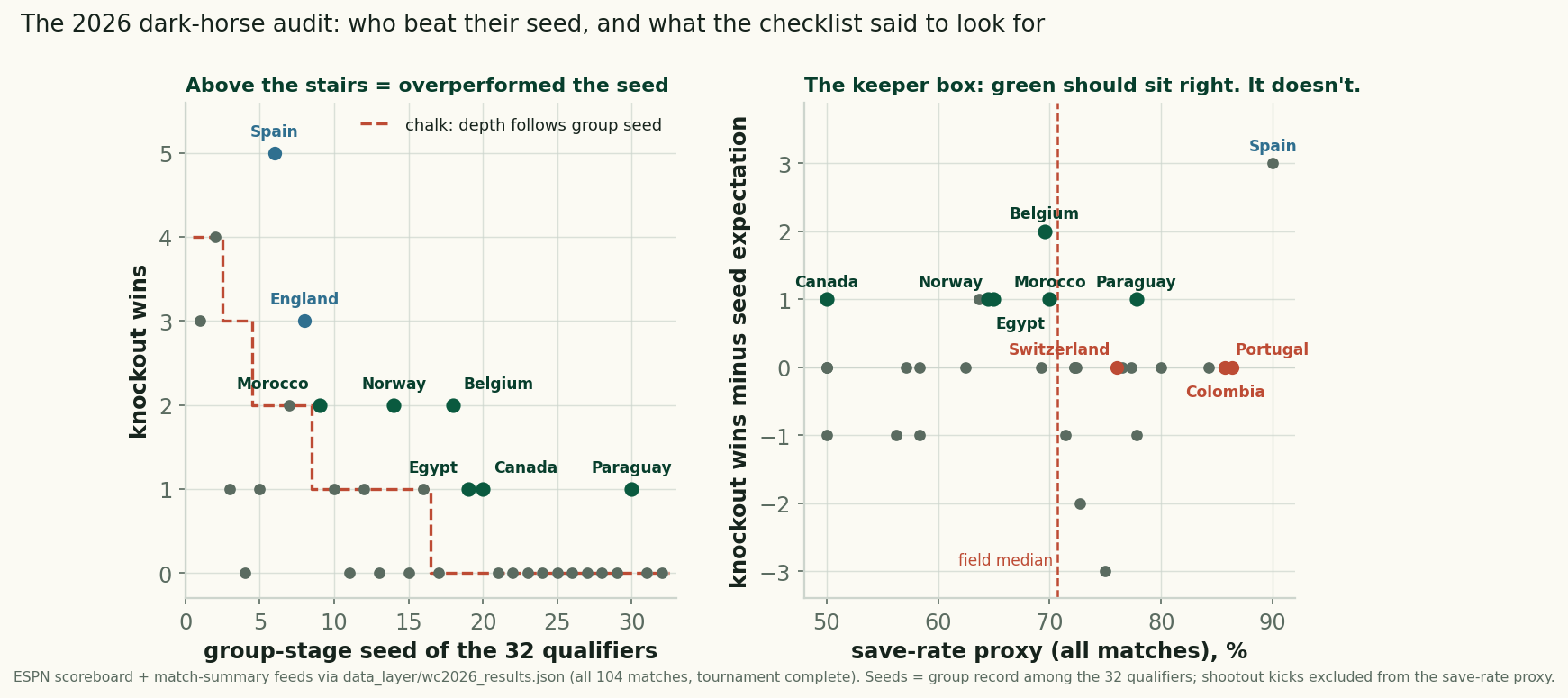
Six teams beat their group seed at the 2026 World Cup, scored against our pre-tournament checklist: the keeper box failed, the kind draw barely helped.
The Shootouts: Rarer, Earlier, and a Reprieve That Never Lasted
Retro #4 closes the series: the shootout rate fell to 12.5% of knockout games from 2022's 31%, all four came early, and survivors went 1-3 next time out.
The Groups Told the Truth: How June Predicted July at the 2026 World Cup
Group-stage points strongly predicted knockout survival: 9-point teams went 3-for-3, 4-point teams 2-for-11, and the last four all ranked top-8.