A Data History of the World Cup Final
The one match that is never quite like the others.
Here is a theory about World Cup finals: a billion people tune in expecting the best match of the tournament, and most years they get the most cautious one instead. The history backs it up. Finals skew tight, low-scoring, often still level deep into the second half, and increasingly settled by extra time or penalties rather than in open play. Then 2022 came along and ignored every one of those tendencies at once — which is exactly why it mattered so much.
The defining trait: finals are tight
If you knew nothing about a given World Cup final except that it was a final, the safest prediction would be a low score. The occasion compresses the game. Both teams have survived a month of attrition to get there; both have something historic to lose; managers who pressed and gambled all tournament tend to grow conservative when the trophy is on the table. The result is that finals, as a class, produce fewer goals than the tournaments that contain them.
The extreme cases make the point. Several World Cup finals have finished goalless after ninety minutes, decided only in extra time or on penalties. Others have been settled by a single goal. A final that produces a comfortable multi-goal winning margin is the exception, not the rule, and when it happens it tends to be remembered as a statement performance precisely because it broke the pattern of caution.
When ninety minutes is not enough
The corollary of tightness is that finals increasingly fail to resolve in normal time. Extra time at a World Cup final is common rather than exotic, and the penalty shoot-out — once unthinkable as a way to crown a world champion — has now decided multiple finals. The first World Cup final settled on penalties came in 1994, when the showpiece in Pasadena finished scoreless and was decided from twelve yards. It was a watershed: the biggest match in the sport handed to its most nerve-shredding tiebreaker.
Shoot-outs have decided finals since, and the prospect now hangs over every tied final as the clock runs down. The broader history of those duels — who has won them, how often the favourite prevails, and why the format is so cruel — is the subject of our World Cup penalty shoot-out history. For the purposes of the final specifically, the key fact is that the trend has run toward later and later resolution: more extra time, more shoot-outs, fewer matters settled cleanly inside ninety minutes.
Favourites, underdogs, and who actually wins
For all the talk of magic and momentum, the World Cup final is not where giant-killing usually happens. The teams that reach the final have, by definition, already beaten the bracket, and the eventual champions are overwhelmingly drawn from a small set of traditional powers. The roll call of winners is dominated by a handful of nations from Europe and South America, a concentration explored in our look at how the confederations have fared. A true underdog lifting the trophy — a first-time winner emerging from outside the established elite — is rare, and the final is the stage where the favourites most reliably reassert themselves.
That does not make finals predictable in the moment. A tight, single-goal match is, almost by construction, a high-variance event: the better team over ninety minutes may not be the team that scores the decisive goal, and a final balanced on a knife edge can turn on one set piece, one error, or one shoot-out kick. The pattern is that favourites win the tournament; the caveat is that the final itself is often a coin flip dressed up as a coronation. How reliably the pre-tournament favourite goes all the way is quantified in our piece on how often the favourite wins.
2022: the final that broke the mould
And then there was Lusail. The 2022 final finished three goals each after extra time before being decided on penalties — a scoreline that violated nearly every historical tendency of the fixture at once. Where finals are cautious, this one was wide open. Where finals are low-scoring, this one produced six goals in normal and extra time. Where finals often peter toward a tense, goalless shoot-out, this one surged back and forth, with the trailing side hauling itself level not once but twice, the second time in the dying moments of extra time.
It was, by the standards of the data, a genuine outlier — the kind of match that, had it not actually happened, a model would have assigned a vanishingly small probability. That is precisely why it is now the reference point for what a final can be when both teams refuse to manage the occasion. It does not overturn the historical pattern; one extraordinary match does not move a century of base rates. But it is a vivid reminder that base rates describe tendencies, not certainties, and that the single most cautious fixture in football is still capable of producing its most chaotic ninety — or hundred and twenty — minutes.
What to expect from the 2026 final
The expanded tournament changes the road to the final but not the nature of the match at the end of it. The two teams that reach Sunday, July 19 in 2026 will have played more matches than any finalists before them, navigating an extra knockout round on the way. Fatigue may sharpen the historical tilt toward caution and late resolution; a deeper, longer tournament is not obviously a recipe for an open final.
The honest forecast, grounded in the history rather than in hope, is a tight match: more likely a one-goal margin or a draw forced into extra time than a blowout, with a real chance of penalties, and a strong likelihood that the winner comes from the traditional elite. The 2022 final is the standing proof that the showpiece can defy all of that. But if you are setting expectations, set them low-scoring and tense — and let the occasion surprise you, as it occasionally, gloriously does.
The data behind this piece
- FIFA — official records of every World Cup final, including scorelines, extra time and shoot-out results.
- RSSSF — detailed historical match data for all World Cup finals, including line-ups and goal times.
- FBref — match data and, for recent finals, shot-level and expected-goals detail.
- StatsBomb — open shot-level data for recent World Cups, including the 2022 final.
More from World Cup 2026
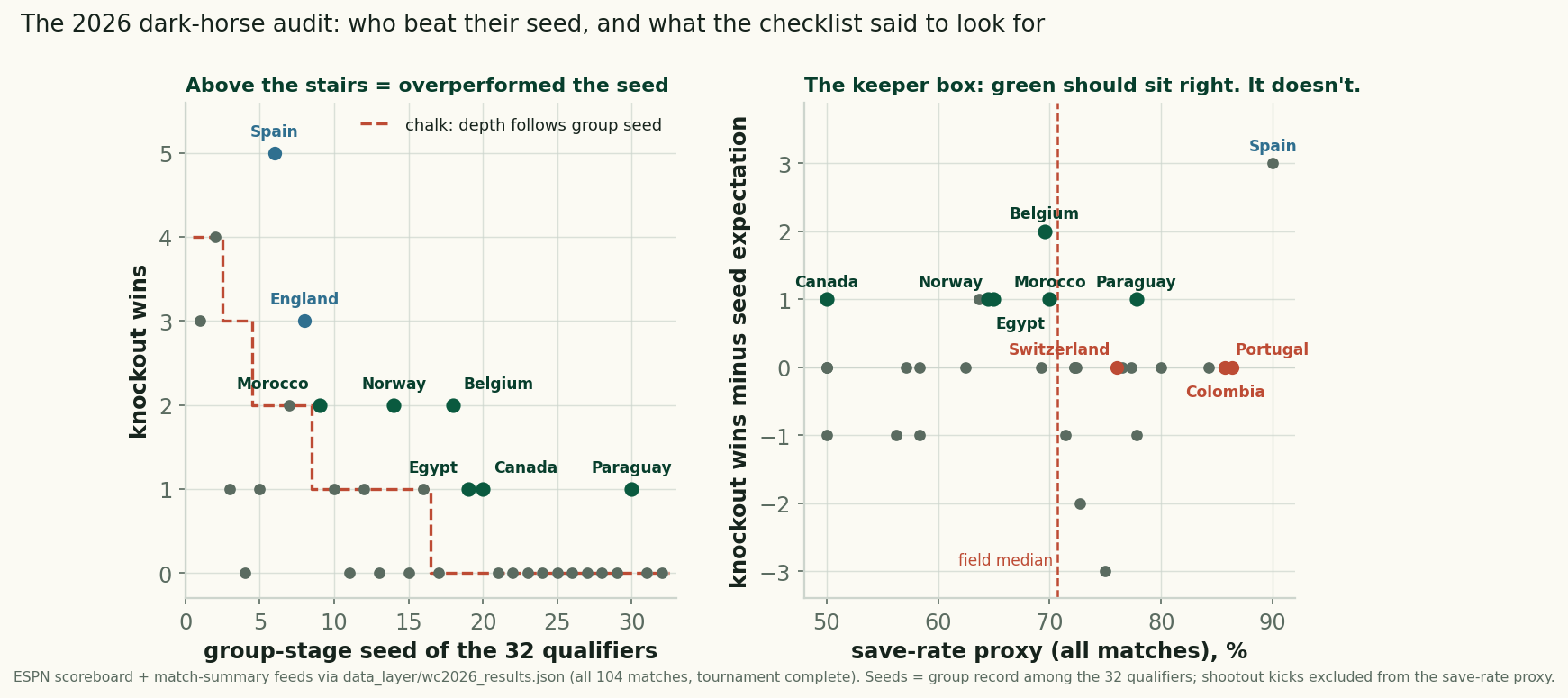
The 2026 Dark-Horse Audit: Grading Our June Checklist
Six teams beat their group seed at the 2026 World Cup, scored against our pre-tournament checklist: the keeper box failed, the kind draw barely helped.
The Shootouts: Rarer, Earlier, and a Reprieve That Never Lasted
Retro #4 closes the series: the shootout rate fell to 12.5% of knockout games from 2022's 31%, all four came early, and survivors went 1-3 next time out.
The Groups Told the Truth: How June Predicted July at the 2026 World Cup
Group-stage points strongly predicted knockout survival: 9-point teams went 3-for-3, 4-point teams 2-for-11, and the last four all ranked top-8.