Set Pieces at the World Cup: The Margins That Decide Tournaments
Why dead balls carry more weight in knockout football — and decide more of it.
In a 4–3 league game on a Saturday, a goal from a corner is a footnote. In a tense World Cup quarter-final that finishes 1–0, the same corner is the entire match. That is the core reason set pieces loom larger at a World Cup than almost anywhere else: tournament football is tighter and lower-event than league football, and when goals are scarce, every dead ball is worth proportionally more. The teams that have understood this have turned the corner, the free-kick and the long throw from afterthoughts into one of the tournament’s sharpest weapons.
Why dead balls are worth more when games are tight
The logic is one of proportion. A set piece — a corner, a direct or indirect free-kick, a penalty — converts to a goal at some roughly stable rate. What changes between contexts is how much a single goal is worth. In an open, high-scoring match, one goal is a small fraction of the total and rarely decisive. In a cagey knockout tie where both sides are organised, cautious and creating little from open play, one goal frequently is the result. So the same set-piece goal swings the outcome far more often in tournament football than in a free-flowing league fixture.
This is the same small-sample, low-event logic that makes the penalty — the ultimate set piece — so decisive, and that lets a single moment outweigh ninety minutes of territorial control. When open play is throttled, the dead ball becomes the most reliable route to the goal that matters, and its relative value rises accordingly.
The elevated set-piece share in tournament football
There is a well-established tendency for set pieces to account for a larger share of goals in tournament and knockout football than in open league play. The drivers are intuitive. Knockout matches are more conservative; teams prioritise not conceding, which suppresses open-play chances and raises the relative contribution of dead balls. Defences are well-drilled and unfamiliar with one another, making them harder to break down in open play but no less vulnerable to a well-rehearsed routine. And fatigue across a congested tournament schedule degrades the concentration needed to defend a crowded six-yard box.
Put together, these forces push the set-piece share of goals up precisely when matches matter most. The deeper a tournament goes — the tighter and more cautious the football becomes — the more the dead ball tends to decide things. The exact share varies tournament to tournament and depends on how you classify goals, so the honest claim is directional rather than a fixed percentage: set pieces reliably matter more in knockout football, even if any single figure should be treated as an estimate.
2018: the set-piece World Cup
The 2018 World Cup in Russia became the standard reference point for set-piece football, widely described at the time as "the set-piece World Cup." An unusually high proportion of its goals came from dead-ball situations — corners, free-kicks and penalties — and several teams visibly built their tournament around them. England in particular leaned heavily on rehearsed corner routines, treating the set piece as a primary attacking plan rather than a bonus, and rode that plan deep into the tournament.
What made 2018 notable was not that set pieces existed — they always have — but that the best-prepared teams treated them as a designed, coached phase of play on a par with their open-play approach. The tournament demonstrated, at the highest level and on the biggest stage, that systematic set-piece work was a route to outperforming your open-play quality. That lesson did not go unlearned.
The rise of the rehearsed routine
The modern set piece is increasingly an engineered product. Where a corner was once a hopeful delivery into a crowd, leading sides now design routines: blocking and screening movements to free a target, choreographed runs to attack specific zones, near-post flicks and far-post overloads, short variations to manufacture a better angle. Some clubs and federations have hired dedicated set-piece coaches whose entire remit is to extract goals from dead-ball situations — and to defend them.
This is, at heart, an analytics story. The same data revolution that gave us expected goals made it possible to value set pieces precisely — to model which delivery types, positions and routines generate the most set-piece xG, and to identify the marginal gains available to a team willing to invest in them. Once you can measure the expected goals a corner routine produces, you can optimise it, and once a few teams optimise it, the rest must follow or fall behind. The corner stopped being luck and became a process.
What this frames for 2026
The 2026 World Cup — the first 48-team edition, 12 groups and 104 matches across North America — will be played under the same structural pressures that elevate set pieces, and this history-and-structure piece makes no prediction about results, only about forces. Two features point toward dead balls mattering at least as much as ever. First, the new round of 32 lengthens the knockout phase, adding single-elimination ties — exactly the tight, cautious, low-event matches in which a set-piece goal is most likely to be decisive. Second, set-piece coaching has only become more sophisticated and more widespread since 2018, so the best-prepared sides arrive with sharper routines than any previous tournament.
None of that says which teams will profit, or how many goals will come from corners — the tournament has not been played, and any specific figure would be invention. What the history supports is the general shape: in a long, tense knockout competition, the margins are thin, the games are tight, and the dead ball is where a disproportionate number of the decisive goals come from. The teams that treat the set piece as a designed weapon rather than a hopeful punt have, for years now, been the ones quietly tilting those margins in their favour.
Sources & further reading
- FIFA — official tournament records and match data, including goal breakdowns by edition.
- StatsBomb — set-piece data and methodology, including how dead-ball chances are valued.
- FBref — match-level data including set-piece and penalty information for international football.
- RSSSF — historical results and match records for World Cup matches across the competition’s history.
More from World Cup 2026
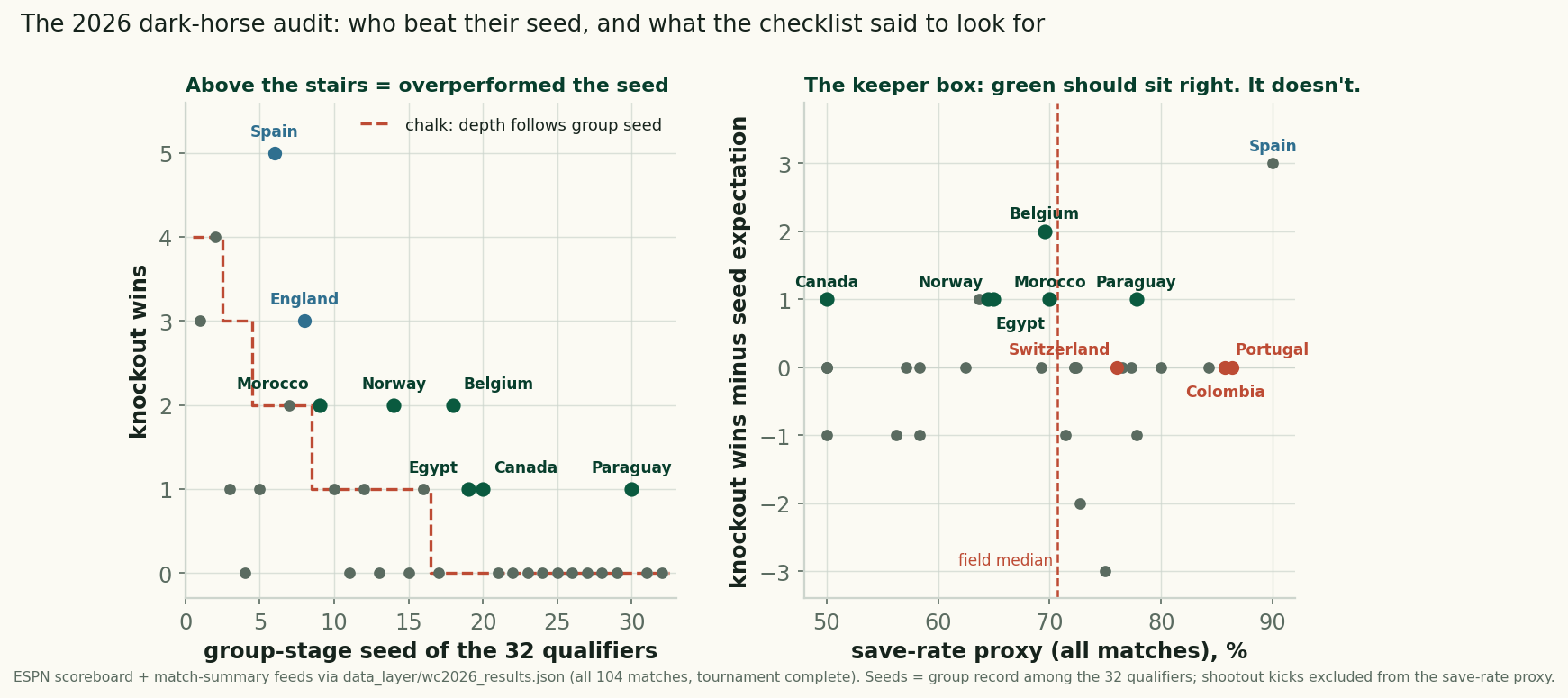
The 2026 Dark-Horse Audit: Grading Our June Checklist
Six teams beat their group seed at the 2026 World Cup, scored against our pre-tournament checklist: the keeper box failed, the kind draw barely helped.
The Shootouts: Rarer, Earlier, and a Reprieve That Never Lasted
Retro #4 closes the series: the shootout rate fell to 12.5% of knockout games from 2022's 31%, all four came early, and survivors went 1-3 next time out.
The Groups Told the Truth: How June Predicted July at the 2026 World Cup
Group-stage points strongly predicted knockout survival: 9-point teams went 3-for-3, 4-point teams 2-for-11, and the last four all ranked top-8.