Preparing for Penalties: What the Data Says About Shootout Prep
Not a lottery — the trainable parts of a penalty shootout.
"It's a lottery." It is the most repeated line in football, trotted out every time a knockout tie reaches a shootout, and it is mostly wrong. A penalty shootout is high-variance, certainly — but high variance is not the same as unpredictable, and a great deal about it is trainable. Teams that treat the shootout as a coachable phase rather than a coin flip give themselves a real, if modest, edge. With knockout football guaranteeing that some 2026 ties will be settled this way, here is what the evidence actually supports — and what remains genuinely a toss-up.
Start from the base rate
The single most useful fact is how favourable a penalty is to begin with. It is the most studied shot in football precisely because it is nearly identical every time — same spot, same distance, same lone obstacle — and it converts at a strikingly stable rate, scored something like three times in every four across large samples; the geometry and the reasons it ever misses are dissected in the penalty conversion rate. That base rate frames everything: the taker is heavily favoured, the keeper is fighting uphill, and the whole exercise is a sequence of high-probability chances where small edges and small mistakes accumulate. A shootout is not random; it is a string of favourable shots under extreme pressure, and pressure is the variable preparation targets.
Order: not random, even if the difference is small
Who takes which penalty, and when, is a genuine decision rather than a formality. The conventional logic is to lead with reliable, mentally robust takers to build a cushion and put early pressure on the opponent, and to ensure your best penalty-takers are scheduled within the first five rather than held back for a sudden-death slot that may never arrive — or may arrive at the most pressurised moment of all. There is debate about exactly how much sequencing matters, and the honest reading is that the effect is real but not enormous; still, leaving it to chance when you could plan it is a small edge surrendered for no reason. The deeper point is psychological: a taker who knows in advance that he is the designated first-up, and has rehearsed that exact responsibility, carries a different mental load than one handed the ball by surprise.
Keeper homework: the clearest edge
If there is one area where preparation demonstrably pays, it is goalkeeper intelligence. Penalty-takers, even elite ones, have tendencies — a preferred side, a favoured height, patterns that show up under pressure — and those tendencies can be studied from video and data ahead of a knockout tie. A keeper who has done the homework can weight his dive toward a taker's documented preference, and the analytics-minded goalkeeping setups now treat this as standard practice: dossiers on likely takers, side preferences, what a player tends to do when he changes his run-up. It does not turn a 75%-or-so conversion rate into a coin flip, but shifting even a handful of percentage points across five-plus penalties is the difference between winning and losing a shootout. The keeper cannot save what he cannot anticipate; homework is how anticipation is manufactured.
Where to aim
For the taker, the geometry points to a clear principle: the corners, and particularly the upper corners, are the hardest region for a keeper to reach. Placement away from the goalkeeper's reach beats power, and the highest-value targets are the areas a diving keeper simply cannot cover even with a correct guess. The trade-off is risk — aiming higher and tighter to the post raises the chance of missing the target entirely — so the practical coaching emphasis is on a repeatable, well-rehearsed technique that places the ball into a difficult region reliably, rather than chasing the unsaveable corner at the cost of accuracy. The taker who has grooved one dependable, hard-to-reach placement under fatigue is in a stronger position than one improvising in the moment.
The going-first debate, honestly
One topic deserves caution because it is genuinely unsettled: whether the team taking first in each round enjoys an advantage. The intuition is that going first applies scoreboard pressure — the second taker is more often kicking to stay alive, which feels harder. Some studies reported a measurable edge to the team shooting first; subsequent and larger analyses have challenged how big that effect really is, or whether it robustly exists at all once you account for sample size and confounds. The fair summary is that the going-first advantage is plausible, modest at most, and not as settled as it is sometimes presented. It is one reason the coin toss for order is not purely ceremonial — and one reason an honest analyst will not assign it a confident number. Treat it as a possible small edge, not an established law.
Why this matters for a forecast
Shootouts sit right inside the tournament-simulation question. Most models, lacking better information, treat a shootout as close to a coin flip between any two teams — a simplifying assumption, not a measured truth, and one of the input choices that makes two simulations disagree, as set out in how a World Cup simulation works. The evidence here suggests a refinement: a side with demonstrably better preparation, a strong shot-stopping keeper, and a settled cohort of reliable takers should be given a small edge over the coin flip, not parity. That a goalkeeper a level above expectation can swing knockout ties is also why keeper quality is a genuine predictor of deep runs, a thread in what predicts a deep World Cup run. For the longer record of how shootouts have actually played out at the tournament, see the World Cup penalty shootout history.
The honest bottom line
A shootout is not a lottery, and it is not fully controllable either. It is a high-variance phase with a trainable core: order can be planned, keepers can be briefed, placement can be rehearsed, and the base rate already favours the taker. What preparation buys is a shift of a few percentage points and a measure of composure under the worst pressure in the sport — small in any single kick, decisive across a full shootout. The going-first edge remains an open question, and anyone quoting a precise advantage for it is overstating the evidence. The defensible claim is the modest one: teams that prepare win shootouts a little more often than teams that shrug and call it a lottery — and "a little more often", compounded over a knockout tournament, is exactly the kind of edge worth having.
The data behind this piece
- StatsBomb — event data on penalties and research on shot placement and goalkeeping tendencies.
- FBref — penalty conversion data and goalkeeper save records across competitions.
- FIFA — the Laws of the Game (via IFAB) on shootout procedure and order of kicks.
- ClubElo — a rating baseline for the strength comparison a shootout assumption sits on top of.
More from World Cup 2026
The 2026 Dark-Horse Audit: Grading Our June Checklist
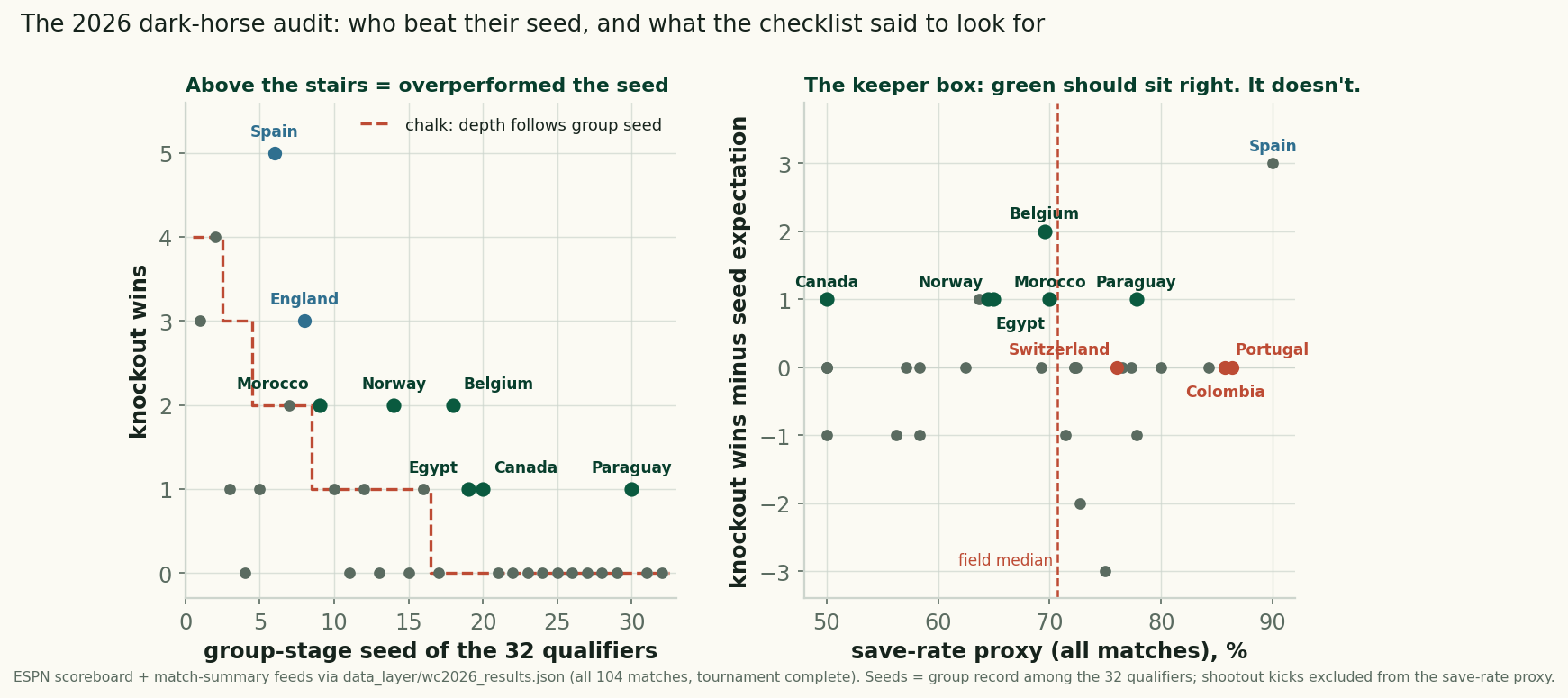
Six teams beat their group seed at the 2026 World Cup, scored against our pre-tournament checklist: the keeper box failed, the kind draw barely helped.
The Shootouts: Rarer, Earlier, and a Reprieve That Never Lasted
Retro #4 closes the series: the shootout rate fell to 12.5% of knockout games from 2022's 31%, all four came early, and survivors went 1-3 next time out.
The Groups Told the Truth: How June Predicted July at the 2026 World Cup
Group-stage points strongly predicted knockout survival: 9-point teams went 3-for-3, 4-point teams 2-for-11, and the last four all ranked top-8.