xGChain and xGBuildup Explained: Crediting the Whole Possession
Two metrics that pay the players a goal forgets.
Goals and assists reward the last two touches of a move and ignore everything that made those touches possible. The centre-back who broke the press, the holding midfielder who turned and switched the play, the winger who dragged a full-back out of position — none of them appear on the scoresheet, and most of them never will. xGChain and xGBuildup were built to fix that, by paying everyone who was part of a possession instead of only the two players at the end of it.
The problem with goals and assists
Think about how a good goal is actually built. A possession might run through six or seven players: a recovery deep in your own half, a couple of progressive passes through midfield, a switch out wide, a cross, a finish. Conventional credit goes to two of those players — the scorer and the assister — and the other four or five get nothing. Worse, the credit is binary and rare. A move worth a great chance that the striker skies is worth zero goals and zero assists to everyone involved, even though the build-up was excellent.
That is a measurement problem, not just a fairness problem. If you only ever reward the final two actions, you systematically undervalue the players whose job is everything before that — deep-lying playmakers, ball-progressing defenders, midfielders who set the tempo. Their contribution is real and repeatable, but it is invisible in the box score. xGChain and xGBuildup make it visible by spreading the value of a possession across the players who built it.
What xGChain measures
The definition is simple once you accept the premise. Take a possession that ends in a shot. That shot has an expected-goals value. xGChain credits every player who touched the ball during that possession with the full xG of the shot it produced. If you were involved in a move that ended in a 0.30 xG chance, you get +0.30 xGChain — whether you scored it, assisted it, or simply made the second pass of the move forty yards from goal.
The logic is that a possession is a collective act. If the move had not happened, the chance would not have existed, and every player who kept it alive contributed to it existing. Over a season, a player’s xGChain is the total xG of all the shot-ending possessions they were part of. It surfaces players who are reliably involved in dangerous moves even when they are nowhere near the finish.
The metric was popularised through the public-analytics ecosystem — StatsBomb’s research and the freely browsable tables on Understat put both numbers in front of a wide audience — which is why you now see xGChain quoted in scouting threads and recruitment notes rather than only in academic work.
A worked possession (hypothetical)
Numbers make this concrete, so here is a deliberately simple, made-up move — round figures, chosen to illustrate the mechanics, not drawn from any real match.
Imagine a four-pass possession. A centre-back wins the ball and plays it to a deep-lying midfielder. The midfielder turns and passes to a number eight. The eight slides it wide to a winger. The winger crosses, and a striker meets it for a chance worth 0.30 xG. Five players touched the ball: the centre-back, the deep midfielder, the eight, the winger, and the striker.
The possession ended in a 0.30 xG shot, so each of the five players involved gets +0.30 xGChain.
The shot was the striker’s; the assist was the winger’s cross. Remove those two, and the remaining three — centre-back, deep midfielder, eight — each get +0.30 xGBuildup.
That is the entire idea in one move. xGChain pays all five the value of the chance. xGBuildup pays only the three who did the build-up work, because it strips out the two players the box score already rewards.
What xGBuildup measures — and why it is the sharper tool
xGBuildup is xGChain with one deliberate subtraction: it excludes the shooter and the player who made the assisting pass. Everyone else who touched the ball in a shot-ending possession still gets the full xG; the final two contributors get nothing for that move.
That single exclusion is what makes the metric interesting. Goals, assists, and xG already capture the end of moves perfectly well. What no traditional stat captures is the player who is involved in a huge volume of dangerous possessions but is never the one to finish or assist them — the regista who starts attacks, the ball-playing centre-back, the midfielder who is always the third-to-last touch. xGBuildup is built precisely to surface those players. A defender or deep midfielder with a high xGBuildup is telling you something a clean sheet and a pass-completion number never will: that the team’s dangerous moves keep running through them.
Used together, the two numbers triangulate a player’s role. High xGChain with high xGBuildup points to a deep creator. High xGChain but low xGBuildup points to a player who lives at the sharp end — a forward or an advanced creator whose value is mostly in the final two actions, which is exactly what you would expect. Neither number replaces watching the player; both stop you overlooking him.
The caveats, and how to use them honestly
These metrics come with a structural bias that you must control for, and it is easy to state: they reward being on a good, high-volume team. A player whose side has the ball constantly and takes a lot of shots will accumulate xGChain and xGBuildup almost mechanically, because the metric pays you for being on the pitch during dangerous possessions and his team has more of them. The same player in a low-possession side that rarely strings moves together would post far smaller totals while doing similar work.
There are two standard corrections, and you should apply both. The first is to use the numbers per 90 minutes rather than as raw season totals, so a regular starter is not flattered simply by playing more. The second is to think in possession-adjusted terms: a deep playmaker at a ball-dominant club is involved in far more possessions than one at a low-block side, and comparing their raw xGBuildup is comparing different opportunity levels. The fix is the same one we apply to defensive counts — normalise for how much of the ball the team had — and it is worth reading possession-adjusted stats before you rank players across very different systems.
Two further notes. xGChain and xGBuildup say nothing about where in a move a player contributed — a meaningless backpass and a line-breaking pass into the box can earn the same credit if they are in the same shot-ending possession — so they reward involvement, not quality of involvement. And they are blind to off-ball running: a striker who pins two defenders to create the space the move exploits never touches the ball and gets nothing. For the creation side of the picture, pair these with the expected-assist family of metrics in xA and expected threat, and keep expected goals itself in mind as the quantity all of this is ultimately spreading around. Used with those guardrails, xGChain and xGBuildup do something genuinely valuable: they pay the players a goal forgets.
Sources & data
- Understat — publishes xGChain and xGBuildup per player for the major European leagues, the easiest place to see the metrics in the wild.
- StatsBomb — research and methodology on possession-value and build-up metrics.
- StatsBomb open data — event-level data with possession identifiers, for computing chain metrics yourself.
- FBref — complementary buildup, progression, and shot-creation data via Opta.
More from Stat Explainers
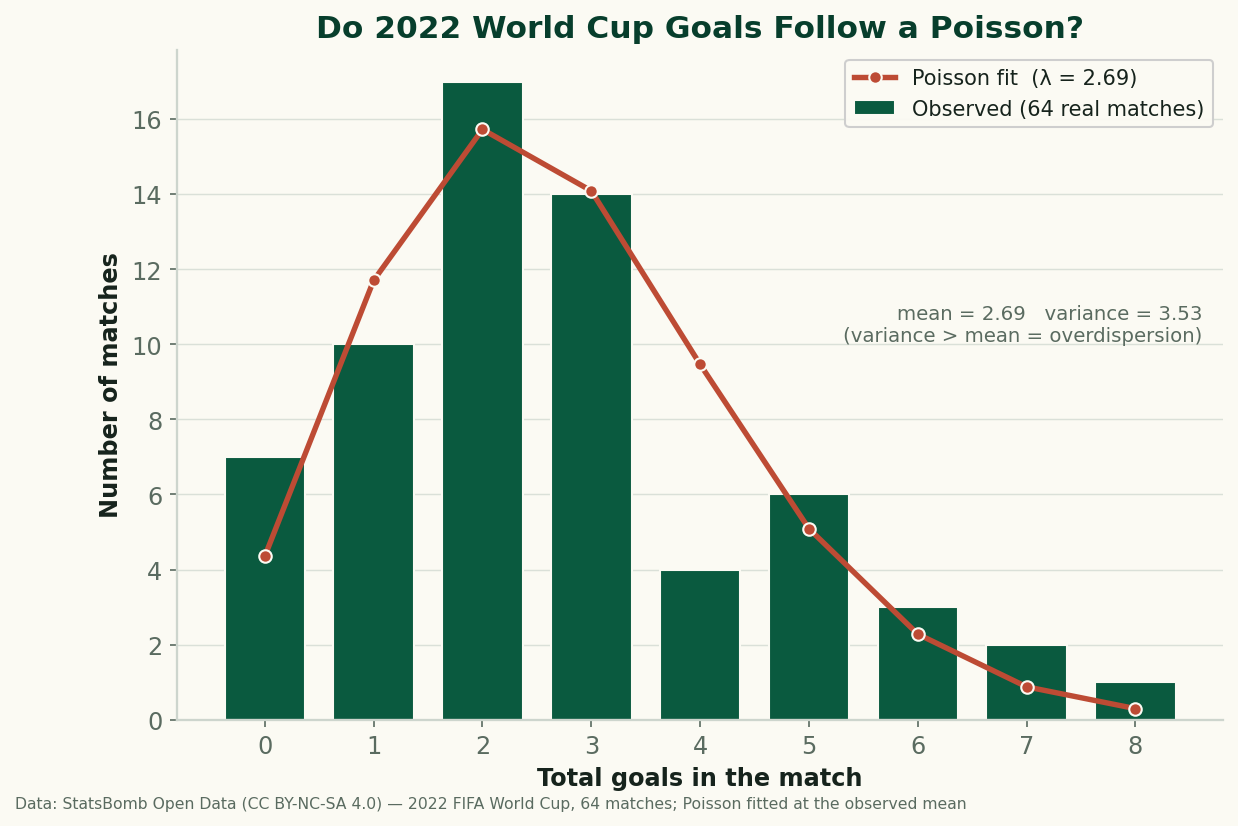
Do Football Goals Follow a Poisson? Testing the Standard Model on All 64 Games of 2022
Every scoreline prediction in football rests on the Poisson. We fit it to all 64 games of 2022 — it gets the shape right, but real goals are overdispersed.
Aerial Duels and Heading Data: Reading Win Rate Without Getting Fooled by Volume
Aerial-duel win percentage, why raw counts mislead, and where aerial dominance actually matters — set pieces, target men, and defending crosses.
Expected Points (xPts): Turning Shot-Level xG Into a Fairer Table
Expected points (xPts) simulates a match from its shot-level xG to get win, draw and loss odds — points that reward chances created, not goals that went in.